Epitalon vs DSIP: How They Differ
Epitalon is a four-amino-acid peptide studied for ageing, telomeres and the pineal gland’s melatonin rhythm, while DSIP (delta sleep-inducing peptide) is a nine-amino-acid neuropeptide studied for sleep itself. They meet in two places: both touch the night-time side of physiology, and the same research group tested each one in an almost identical lifelong mouse study. Here is how they compare, what the research found, and which research questions each one fits.
Findings
- Epitalon is the tetrapeptide Ala-Glu-Asp-Gly, a synthetic analogue of epithalamin, a peptide preparation from the pineal gland.
- In old rhesus monkeys, Epitalon raised night-time melatonin and lowered basal glucose and insulin, with no effect in young animals (2005).
- DSIP is the nonapeptide Trp-Ala-Gly-Gly-Asp-Ala-Ser-Gly-Glu. In a placebo-controlled, double-blind study of 14 adults with severe chronic insomnia, seven nights of DSIP brought night-time sleep efficiency up to the level of normal controls (1987).
- In matching lifelong studies in female mice, Epitalon raised maximum life span by 12.3% and a DSIP preparation by 24.1% against controls (both 2003).
What is Epitalon?
Epitalon, also spelled Epithalon, is a short synthetic peptide of four amino acids, Ala-Glu-Asp-Gly, sometimes written AEDG (Khavinson et al., Molecules, 2020). It was designed as a synthetic analogue of epithalamin, a peptide extract of the pineal gland (Goncharova et al., Exp Gerontol, 2005). The pineal gland makes melatonin, which is why so much of the Epitalon research measures melatonin and daily hormone rhythms. The full background is in Epitalon: what the research actually shows.
The melatonin and hormone research
Old rhesus monkeys (20 to 27 years) had lower night-time melatonin and higher basal glucose and insulin than young ones (6 to 8 years). Epitalon raised the old animals’ night melatonin, lowered their basal glucose and insulin and normalised their insulin response to a glucose load, without changing hormone or metabolic values in the young animals (Goncharova et al., Exp Gerontol, 2005). A later report from the same researchers described the pineal peptides restoring night-time melatonin release and the daily melatonin rhythm in old monkeys, and raising night melatonin in elderly people with reduced pineal function (Korkushko et al., Adv Gerontol, 2007).
The telomere research
Added to human fetal fibroblasts that do not normally express telomerase, Epitalon induced the enzyme’s catalytic subunit, telomerase activity and telomere lengthening (Khavinson et al., Bull Exp Biol Med, 2003). A group at Brunel University London reported in 2025 that Epitalon extended telomeres in a dose-dependent way in normal human epithelial cells and fibroblasts through higher hTERT expression and telomerase activity (Al-Dulaimi et al., Biogerontology, 2025).
What is DSIP?
DSIP is a nonapeptide, Trp-Ala-Gly-Gly-Asp-Ala-Ser-Gly-Glu, named for the deep delta-wave sleep it produced in the first experiments (Graf and Kastin, Neurosci Biobehav Rev, 1984). As of a 2006 review, no DSIP gene or dedicated receptor had been isolated, so the peptide is defined by its effects on sleep, hormones and daily rhythm rather than by a single target (Kovalzon and Strekalova, J Neurochem, 2006). Its structure and forms are covered in Buy DSIP in Canada.
The human sleep studies
The strongest result is a 1987 placebo-controlled, double-blind study of 14 middle-aged adults with severe chronic insomnia. Seven nights of DSIP improved night sleep from the first administration, sleep efficiency reached the level of normal controls, and daytime alertness and performance rose significantly (Schneider-Helmert, Eur Neurol, 1987). A 1986 study of 18 chronic insomniacs aged 29 to 83 found middle-aged participants reached normal sleep values within the week, and older participants normalised by the end of follow-up (Schneider-Helmert, Eur Neurol, 1986); two later double-blind studies from other groups reported smaller effects (Monti et al., 1987; Bes et al., 1992). DSIP was also studied in 107 inpatients in alcohol or opiate withdrawal (Dick et al., Eur Neurol, 1984).
The two mouse life-span studies
The clearest point of comparison is a pair of studies from one research group (both list Anisimov and Zabezhinski as authors) using the same design: female Swiss-derived SHR mice, 54 per group, given the peptide or saline under the skin on five consecutive days every month from three months of age until natural death.
- Epitalon slowed the age-related loss of oestrous function, cut chromosome aberrations in bone marrow cells by 17.1%, lengthened the life span of the last 10% of survivors by 13.3% and raised maximum life span by 12.3%. It did not change total tumour incidence but inhibited leukaemia 6-fold (Anisimov et al., Biogerontology, 2003).
- DSIP, as the preparation Deltaran, also slowed the loss of oestrous function, cut chromosome aberrations by 22.6%, lengthened the life span of the last 10% of survivors by 17.1% and raised maximum life span by 24.1%. It lowered total spontaneous tumour incidence 2.6-fold, mainly mammary carcinomas and leukaemias (Popovich et al., Mech Ageing Dev, 2003).
Neither peptide changed mean life span in these studies. Because the designs match, the pair is a rare like-for-like comparison of two peptides in the ageing literature.
How do Epitalon and DSIP compare side by side?
| Question | Epitalon | DSIP |
|---|---|---|
| What is it? | Synthetic analogue of a pineal peptide preparation | Neuropeptide named for delta sleep |
| Size | 4 amino acids (Ala-Glu-Asp-Gly) | 9 amino acids |
| Main research area | Ageing, telomeres, melatonin rhythm | Sleep, hormone levels, withdrawal |
| Mechanism focus | Telomerase induction, pineal and endocrine regulation | Defined by its effects; no receptor isolated |
| Human evidence | Small studies of melatonin in elderly people | Placebo-controlled insomnia studies, 1980s |
| Animal life-span data | Maximum life span up 12.3% in mice | Maximum life span up 24.1% in mice |
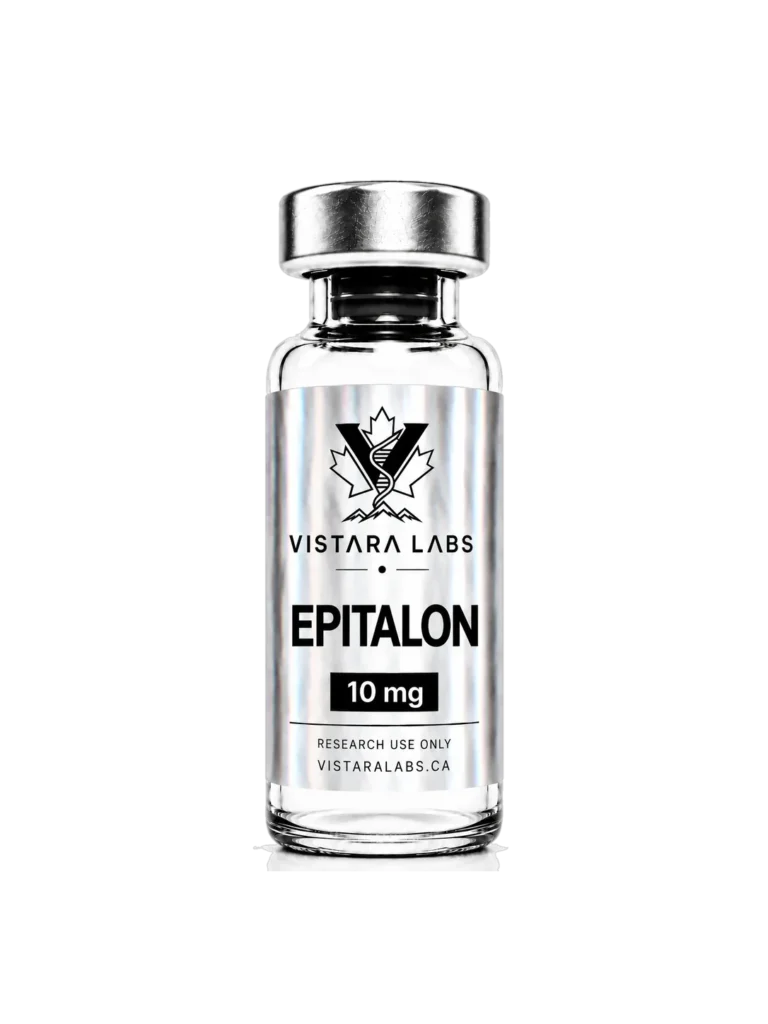
| Forms we supply | 10 mg vial | 5 mg vial and nasal spray |
Which one fits which research question?
- Sleep architecture, sleep efficiency and daytime function after sleep: DSIP, which has the laboratory-recorded human sleep studies.
- Melatonin output and daily hormone rhythm in older subjects: Epitalon, whose primate work measured night melatonin, glucose and insulin.
- Telomeres and cellular ageing: Epitalon, which has the telomerase studies in human cells.
- Life span and tumour incidence in animals: either, and the matched mouse studies make them directly comparable.
Can Epitalon and DSIP be studied together?
No published study has tested them as a pair. Their literatures sit close together, since one acts on the pineal melatonin rhythm and the other on sleep itself, so a combined design would need separate arms to show which peptide produced which change. For a related comparison, see DSIP vs melatonin; for DSIP alongside Selank, see DSIP vs Selank.
How are Epitalon and DSIP supplied?
Epitalon comes as a 10 mg lyophilised vial, and DSIP as a 5 mg lyophilised vial and a ready-mixed DSIP Nasal Spray (0.175 mL per press), which is also part of the Sleep & Calm Spray Stack. Vials are reconstituted with bacteriostatic water: see the Epitalon reconstitution guide and the DSIP reconstitution guide. Certificates of analysis are on the lab reports page, and every order ships from within Canada by Canada Post Xpresspost.
Epitalon and DSIP are supplied for laboratory research use only. The human studies above were clinical research using pharmaceutical preparations.
Frequently asked questions
What is the difference between Epitalon and DSIP?
Epitalon is a four-amino-acid synthetic analogue of a pineal peptide preparation, studied for ageing, telomeres and the melatonin rhythm. DSIP is a nine-amino-acid neuropeptide studied for sleep, with placebo-controlled insomnia studies from the 1980s.
Is Epitalon or DSIP better for sleep research?
DSIP is the one with direct human sleep studies, which recorded sleep in the laboratory. Epitalon’s link to sleep runs through melatonin: it raised night-time melatonin in old monkeys and in elderly people with reduced pineal function.
Do Epitalon and DSIP extend life span?
In matching lifelong studies in female mice, Epitalon raised maximum life span by 12.3% and a DSIP preparation by 24.1% against controls. Neither changed mean life span, and there are no comparable human data.
Can Epitalon and DSIP be studied together?
No published study has tested them as a pair. Because both relate to night-time physiology, a combined design would need separate arms to attribute each change.
Where can I buy Epitalon and DSIP in Canada?
Vistara Labs supplies Epitalon as a 10 mg vial and DSIP as a 5 mg vial and a ready-mixed nasal spray, shipped from within Canada by Canada Post Xpresspost with certificates of analysis on the lab reports page.
Product details from vistaralabs.ca, October 2026. Sources: Khavinson V et al. AEDG peptide (Epitalon) stimulates gene expression and protein synthesis during neurogenesis: possible epigenetic mechanism. Molecules. 2020. PMID 32019204. Goncharova ND et al. Pineal peptides restore the age-related disturbances in hormonal functions of the pineal gland and the pancreas. Exp Gerontol. 2005. PMID 15664732. Korkushko OV et al. Normalizing effect of the pineal gland peptides on the daily melatonin rhythm in old monkeys and elderly people. Adv Gerontol. 2007. PMID 17969590. Khavinson VKh, Bondarev IE, Butyugov AA. Epithalon peptide induces telomerase activity and telomere elongation in human somatic cells. Bull Exp Biol Med. 2003. PMID 12937682. Al-Dulaimi S et al. Epitalon increases telomere length in human cell lines through telomerase upregulation or ALT activity. Biogerontology. 2025. PMID 40908429. Anisimov VN et al. Effect of Epitalon on biomarkers of aging, life span and spontaneous tumor incidence in female Swiss-derived SHR mice. Biogerontology. 2003. PMID 14501183. Popovich IG et al. Effect of delta-sleep inducing peptide-containing preparation Deltaran on biomarkers of aging, life span and spontaneous tumor incidence in female SHR mice. Mech Ageing Dev. 2003. PMID 12782416. Graf MV, Kastin AJ. Delta-sleep-inducing peptide (DSIP): a review. Neurosci Biobehav Rev. 1984. PMID 6145137. Kovalzon VM, Strekalova TV. Delta sleep-inducing peptide (DSIP): a still unresolved riddle. J Neurochem. 2006. PMID 16539679. Schneider-Helmert D. Effects of delta-sleep-inducing peptide on 24-hour sleep-wake behaviour in severe chronic insomnia. Eur Neurol. 1987. PMID 3622582. Schneider-Helmert D. Efficacy of DSIP to normalize sleep in middle-aged and elderly chronic insomniacs. Eur Neurol. 1986. PMID 3792404. Monti JM et al. Study of delta sleep-inducing peptide efficacy in improving sleep on short-term administration to chronic insomniacs. Int J Clin Pharmacol Res. 1987. PMID 3583493. Bes F et al. Effects of delta sleep-inducing peptide on sleep of chronic insomniac patients. A double-blind study. Neuropsychobiology. 1992. PMID 1299794. Dick P et al. DSIP in the treatment of withdrawal syndromes from alcohol and opiates. Eur Neurol. 1984. PMID 6548969.
More on this: Peptides for Sleep: What the Research Shows.
All products supplied by Vistara Labs are intended for laboratory research use only. They are not drugs, are not approved for human or veterinary use, and are not intended to diagnose, treat, cure or prevent any condition. Nothing on this page constitutes medical advice or guidance for use in humans.