


HCG: The Peptide Hormone With Decades of Clinical Use
Recherche sur les hormones, l'hormone de croissance et la composition corporelle
HCG is the rare item in a research catalogue that needs no introduction to medicine: it has been an approved, prescribed hormone therapy for decades, with a clinical record most compounds never approach.
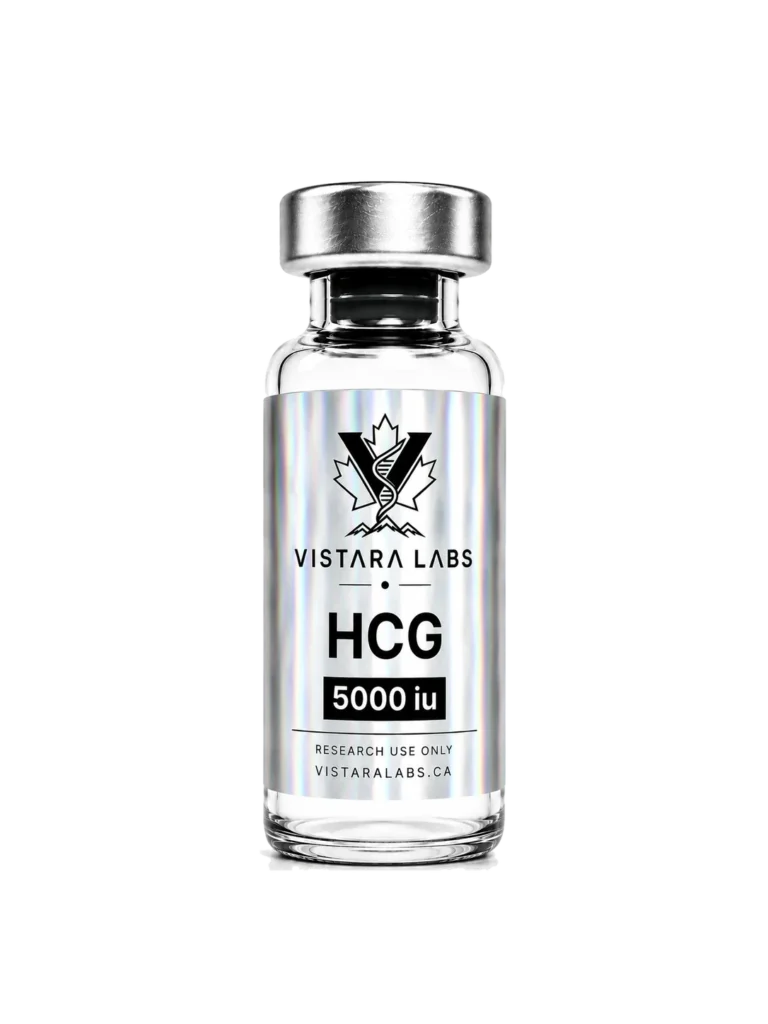 View product →
Findings
- HCG is an approved medication with decades of clinical use in fertility medicine and hormone therapy.
- It signals the body the same way luteinising hormone does, stimulating natural testosterone production in men and ovulation in women.
- Unlike testosterone replacement, clinical reviews note HCG maintains the body’s own hormone production and fertility rather than shutting it down.
- A 2021 clinical review called it a prime candidate for secondary hypogonadism for exactly that reason.
What HCG is
Human chorionic gonadotropin is a natural glycoprotein hormone. Structurally it is a close mimic of luteinising hormone (LH), the pituitary signal that tells the testes to make testosterone and the ovaries to release an egg. That mimicry is the entire clinical story: give HCG, and the body’s own hormonal machinery responds.
The clinical record
HCG has been used clinically since the mid-twentieth century: in fertility medicine to trigger ovulation, and in men to stimulate natural testosterone and sperm production. A 2021 review in Expert Review of Endocrinology & Metabolism summarised the comparison with testosterone replacement therapy directly: testosterone replacement suppresses the body’s own production and impairs fertility, while HCG stimulates both. That is why the authors describe it as a prime candidate for secondary hypogonadism.
Why it sits in a peptide catalogue
HCG is a peptide-class molecule — a glycoprotein built from amino-acid chains — and it is studied alongside the hormonal axis compounds in this catalogue: the same research territory as tesamorelin and the growth-hormone secretagogues, one axis over.
Frequently asked questions
Is HCG an approved drug?
Yes. HCG has been an approved medication for decades, used clinically in fertility treatment and hormone therapy.
How does HCG differ from testosterone therapy?
Clinical reviews note that testosterone replacement suppresses natural production and fertility, while HCG stimulates the body’s own testosterone and sperm production.
Sources: Ide V et al., Expert Rev Endocrinol Metab 2021 (PMID 33345656); Nat Rev Urol 2025 (PMID 40346275).
References
hCG has an extensive controlled human research literature; it is a glycoprotein hormone rather than a short research peptide.
- Low-dose human chorionic gonadotropin maintains intratesticular testosterone in normal men with testosterone-induced gonadotropin suppressionRandomised trial; 29 normal men on testosterone enanthate randomised to placebo or varying hCG doses.
- A double-blind, placebo-controlled, randomized clinical trial of recombinant human chorionic gonadotropin on muscle strength and physical function and activity in older men with partial age-related androgen deficiencyDouble-blind, placebo-controlled randomised trial in older men with partial age-related androgen deficiency.
Links open the study record on PubMed so the source can be checked directly. Listing a study is not a claim that its findings apply to any other use, product or route of administration. Research use only.