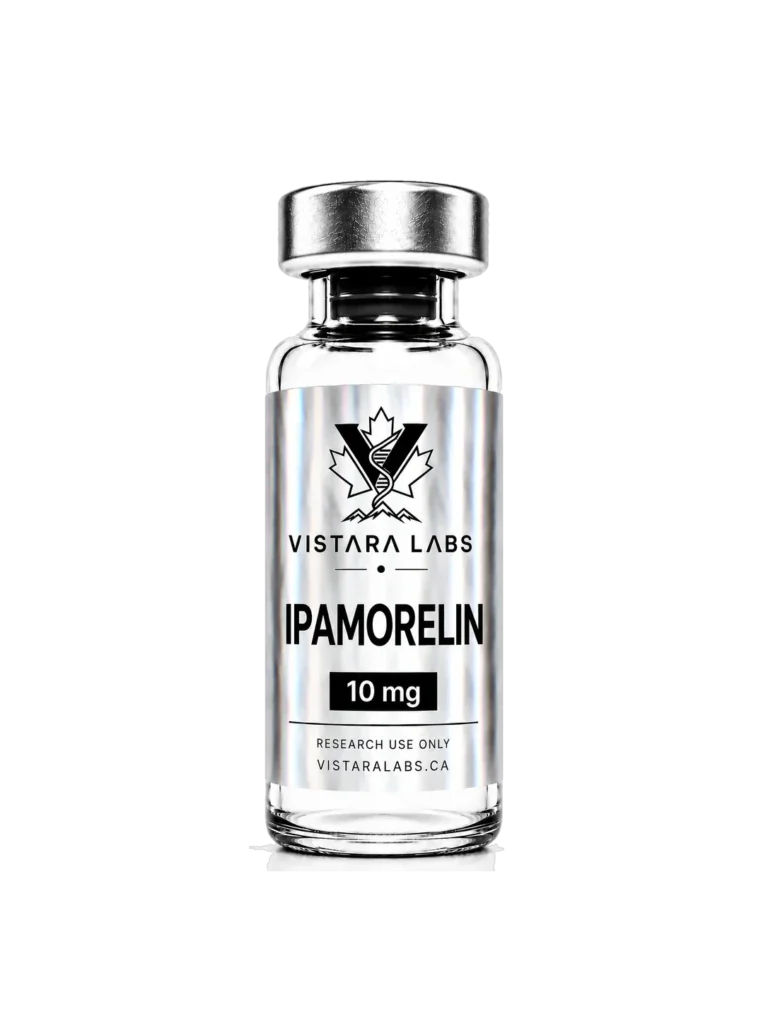


Combien d'eau bactériostatique pour un flacon de CJC-1295 + ipamoréline de 10 mg
Add 2 mL of bacteriostatic water to a 10 mg CJC-1295 + Ipamorelin vial and the result is a 5 mg/mL solution, so every 0.1 mL (10 units on a U-100 insulin syringe) contains 0.5 mg of the blend. Adding 1, 3 or 5 mL instead gives 10, 3.33 or 2 mg/mL, and the tables below set the four volumes side by side.
The vial in question is the CJC-1295 + Ipamorelin (No DAC) blend. As the product page states, it holds 5 mg of CJC-1295 without DAC and 5 mg of Ipamorelin, lyophilised together and sold as a single 10 mg vial. The material is supplied for laboratory research use.
How much bacteriostatic water for a 10 mg blend vial
There is no single correct volume. The water you add sets the concentration, and the concentration sets how much liquid you draw to measure a given quantity of peptide. Adding more water does not put more peptide in the vial. The 10 mg is fixed by the label; the water only spreads it across a larger volume.
The table below gives the concentration for the volumes that fit comfortably in a standard vial.
| Bacteriostatic water added | Concentration | Blend per 0.1 mL (10 units) |
|---|---|---|
| 1 mL | 10 mg/mL | 1 mg |
| 2 mL | 5 mg/mL | 0.5 mg |
| 3 mL | 3.33 mg/mL | 0.33 mg |
| 5 mL | 2 mg/mL | 0.2 mg |
Two millilitres is a practical middle ground. It dissolves the powder without difficulty, it leaves headspace in the vial, and the resulting 5 mg/mL concentration produces round numbers on a syringe: 0.5 mg sits at 10 units, 1 mg at 20 units. One millilitre gives a stronger 10 mg/mL solution in which small quantities land on very few units, which makes measurement less forgiving. Three and five millilitres give weaker solutions in which each quantity occupies more of the syringe barrel and is easier to read, at the cost of a fuller vial.
The general formula, for any volume: concentration (mg/mL) = 10 mg divided by the millilitres of water added. The volume that contains a given quantity is that quantity divided by the concentration.
Reading the volume on a U-100 syringe
A U-100 insulin syringe is graduated in units, and 1 mL equals 100 units. That makes the conversion simple: units = mL x 100. A 1 mL syringe holds 100 units, a 0.5 mL syringe holds 50, and a 0.3 mL syringe holds 30. The unit marks mean the same thing on all three; the smaller barrels simply spread them further apart so fine graduations are easier to read.
At the 2 mL dilution (5 mg/mL), the volume that contains a given quantity of blend is that quantity divided by 5. The table shows four arbitrary amounts to illustrate the arithmetic. They are worked examples, not recommendations.
| Quantity of blend (illustrative) | Volume at 5 mg/mL | U-100 units |
|---|---|---|
| 0.25 mg | 0.05 mL | 5 units |
| 0.5 mg | 0.1 mL | 10 units |
| 1 mg | 0.2 mL | 20 units |
| 2 mg | 0.4 mL | 40 units |
Because the blend is 1:1, each of those quantities is half CJC-1295 and half Ipamorelin by mass. The 0.2 mL that contains 1 mg of blend holds 0.5 mg of each peptide. If you reconstitute with 1 mL instead, halve every volume in the table; with 5 mL, multiply each volume by 2.5.
Rounding: 3 mL gives 3.33 mg/mL, so the per-0.1 mL figure in the first table is rounded, and the 0.25 mg example lands on a half unit (0.075 mL, 7.5 units). The other three examples come out whole at 3 mL: 15, 30 and 60 units. The 0.25 mg example also falls on a half unit at 1 mL (2.5 units) and at 5 mL (12.5 units); of the four volumes, only 2 mL puts all four examples on whole unit marks. The calculateur de peptides handles the awkward numbers for you either way.
Why the blend comes as one vial
CJC-1295 (No DAC) and Ipamorelin are both water-soluble peptides that lyophilise cleanly, so they can be freeze-dried together in a single vial rather than supplied as two. The ratio is fixed by the vial itself: 5 mg of each, 10 mg in total. Whatever volume of water you add, every draw from that vial contains the two peptides in the same 1:1 proportion. There is nothing to balance between two separate solutions and only one reconstitution to do.
For the background on the No DAC form and how it differs from the DAC version, see our CJC-1295 Ipamorelin No DAC article.
Reconstitution technique
The mixing itself is straightforward. The aim is to dissolve the powder completely without foaming it.
- Let the vial reach room temperature. Unopened lyophilised vials are kept cold and dark. Remove one from storage and leave it on the bench until it is no longer cold to the touch before you open it.
- Swab both stoppers. Wipe the rubber stopper of the peptide vial and of the bacteriostatic water vial with an alcohol swab and let them dry.
- Draw the water. Draw 2 mL of bacteriostatic water, or whichever volume you have chosen from the table, into a syringe. For 2 mL you will need a syringe larger than an insulin syringe, or two fills of a 1 mL syringe.
- Add it slowly, down the glass. Pass the needle through the stopper and aim the stream at the inside wall of the vial, not straight onto the powder. Let the water run down the glass and pool around the cake.
- Swirl, never shake. Tilt and roll the vial gently until the powder has dissolved. Shaking foams the solution and gains nothing; a slow swirl is enough.
- Check that it is clear. The finished solution should be clear and colourless with no visible particles. If it is cloudy or has gelled, read why peptides gel or go cloudy first.
- Refrigerate. Store the reconstituted vial at 2 to 8 °C, protected from light.
Bacteriostatic water versus sterile water
Bacteriostatic water is sterile water with 0.9% benzyl alcohol added as a preservative. The preservative is what makes it suitable for a vial that will be accessed more than once. Plain sterile water has no preservative, so it is intended for single access: open, use, discard. Our eau bactériostatique comes in 10 mL vials, enough to reconstitute several 10 mg vials at 2 mL each. The longer explanation is in bacteriostatic water explained.
Checking what is in the vial
The arithmetic on this page assumes the vial contains 10 mg of blend, the quantity stated on the label. A certificate of analysis for this product is published on our Lab Results page.
Questions fréquentes
How much bacteriostatic water do I add to a 10 mg vial of CJC-1295 + Ipamorelin?
There is no single correct volume. Adding 2 mL of bacteriostatic water to the 10 mg blend vial gives a 5 mg/mL solution; 1, 3 or 5 mL gives 10, 3.33 or 2 mg/mL. Adding more water does not change the quantity in the vial, it spreads it through a larger volume, so write the concentration you chose on the vial.
How many units on a U-100 syringe contain 0.5 mg of the blend at 5 mg/mL?
10 units, which is 0.1 mL: at 5 mg/mL every 0.1 mL contains 0.5 mg of the blend. Units are millilitres multiplied by 100. The amounts on this page illustrate the arithmetic only.
Can I use sterile water instead of bacteriostatic water?
Only for a vial that will be accessed once. Bacteriostatic water is sterile water with 0.9% benzyl alcohol added as a preservative. The preservative is what makes it suitable for a vial that will be accessed more than once. Plain sterile water has no preservative, so it is intended for single access: open, use, discard. Our bacteriostatic water comes in 10 mL vials, enough to reconstitute several 10 mg vials at 2 mL each. Details in bacteriostatic water explained.
How should a reconstituted CJC-1295 + Ipamorelin vial be stored?
Refrigerated at 2 to 8 °C, protected from light and labelled with the date and the concentration. Unopened lyophilised vials are kept cold and dark until they are needed. The full storage guide is how to store research peptides.
Work it out for a different vial or concentration
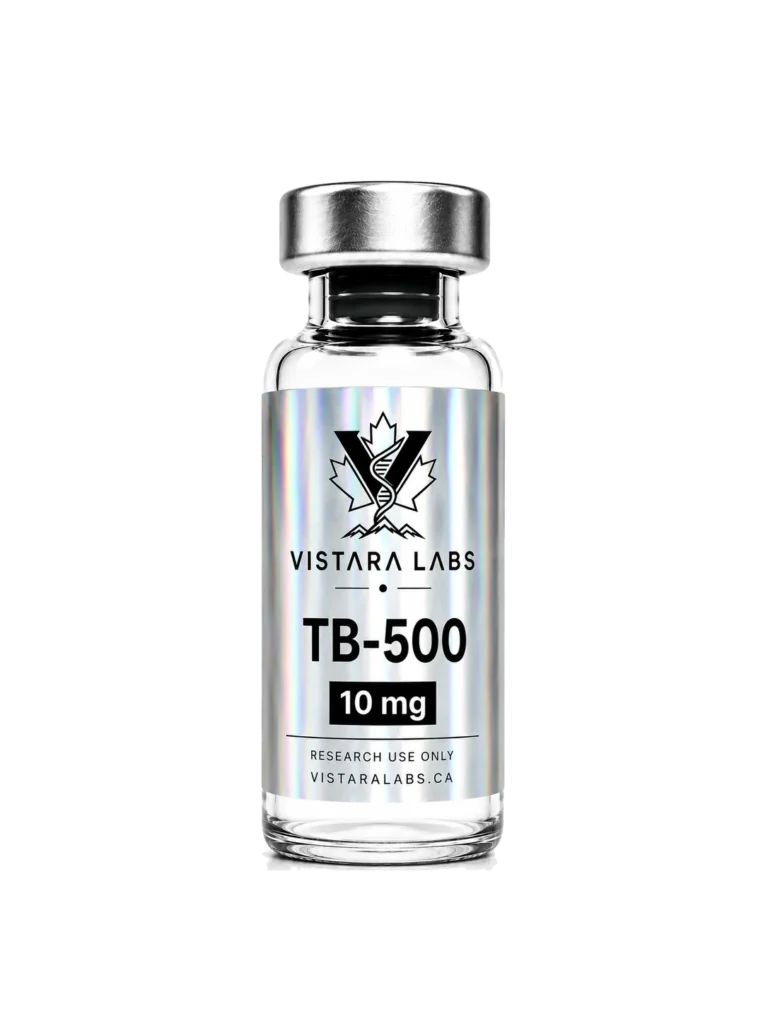
L' calculateur de peptides opens pre-loaded with this example: a 10 mg vial, 2 mL of water, 1 mg on a 1 mL U-100 syringe. Change the vial size, the water volume or the quantity and it redraws the syringe diagram with the new unit mark. The same arithmetic applies to any 10 mg vial, including BPC-157 10 mg et TB-500 10 mg.
Product pages: CJC-1295 + Ipamorelin 10 mg et bacteriostatic water 10 mL. If you are comparing Canadian suppliers first, our buying guide covers what to look for.