What Is Cerebrolysin? The Neurotrophic Peptide Explained
Cognitive & Nootropic Research
Cerebrolysin is a peptide preparation derived from pig brain, made of low-molecular-weight neuropeptides and free amino acids, that acts on the nervous system much like the brain’s own neurotrophic factors, the proteins that keep neurons alive and help them grow and connect. Unlike most compounds in this field it has a large clinical trial record: randomised, placebo-controlled studies in stroke, traumatic brain injury and Alzheimer’s disease have reported better motor recovery, language recovery and global outcomes. Vistara Labs supplies it as a Cerebrolysin 60 mg lyophilised vial.
Findings
- Cerebrolysin is a neuropeptide preparation of porcine origin, a mixture of small peptides and free amino acids rather than a single molecule.
- In the CARS trial of 208 stroke patients, it showed a large advantage over placebo in arm and hand function at day 90, with a Mann-Whitney effect size of 0.71 (2016).
- In 123 stroke patients with aphasia, it added 14.8 points more improvement on the Western Aphasia Battery than speech therapy with placebo (2025).
- A meta-analysis of the CAPTAIN trials in 185 patients with moderate to severe brain injury found a significant benefit at days 30 and 90 (2021).
- Across six randomised trials in mild-to-moderate Alzheimer’s disease, it improved global clinical change at 4 weeks and 6 months (2015).
 View product →
What is Cerebrolysin?
Cerebrolysin is not one compound but a standardised preparation. The CARS investigators describe it as a neuropeptide preparation of porcine origin, made of low-molecular-weight neuropeptides and free amino acids (Muresanu et al., Stroke, 2016). A review in Drugs & Aging describes it as a porcine brain-derived peptide preparation with pharmacodynamic properties similar to those of endogenous neurotrophic factors, given clinically by injection or infusion (Plosker and Gauthier, Drugs Aging, 2009).
That makes it different from the single, defined peptides that make up most research catalogues. Semax, for example, is a seven-amino-acid chain built on a fragment of ACTH, and Dihexa is a small engineered molecule from angiotensin IV. Cerebrolysin is closer to a concentrated mixture of the brain’s own signalling fragments. The differences are set out in Semax vs Cerebrolysin and Dihexa vs Cerebrolysin.
What neurotrophic factors are
Neurotrophic factors are proteins such as nerve growth factor (NGF), brain-derived neurotrophic factor (BDNF) and insulin-like growth factor 1 (IGF-1). They support neuron survival, the growth of new connections (neuroplasticity), the birth of new neurons (neurogenesis) and the growth of new blood vessels. A 2023 review in Medicinal Research Reviews describes Cerebrolysin as resembling the activities of these factors and modulating how much of them the brain itself produces (Rejdak et al., Med Res Rev, 2023).
How Cerebrolysin works
Most of the mechanism work comes from cell and animal studies, summarised in a 2012 pharmacology review (Masliah and Diez-Tejedor, Drugs Today, 2012):
- Protection. In stroke models, Cerebrolysin stabilised the structure of cells by inhibiting calpain, a protein-cutting enzyme activated by injury, and reduced the number of cells dying by apoptosis (programmed cell death). It also reduced infarct volume and swelling.
- Repair. It promoted new neurons in the brain’s two main neurogenic zones, the dentate gyrus of the hippocampus and the subventricular zone after stroke, and supported functional recovery.
- Dementia pathology. In dementia models it reduced beta-amyloid deposits and tau phosphorylation by regulating the enzymes GSK-3 beta and CDK5, increased synaptic density and restored the normal architecture of neurons.
- Spinal cord. After experimental spinal cord injury it prevented the death of injured motor neurons and promoted recovery.
The CARS investigators summarised the clinical picture the same way: neuroprotective effects, including reduced excitotoxicity, free radical formation and microglial activation, alongside neurotrophic effects such as neuronal sprouting and neurogenesis (Muresanu et al., 2016).
What the research has shown
Cerebrolysin is one of the few compounds in our catalogue with multiple randomised, double-blind, placebo-controlled human trials. The full trial-by-trial account is on Cerebrolysin: Stroke and Brain-Injury Research; the headline results are below.
Motor recovery after stroke
The CARS trial randomised 208 patients, 104 to each arm, starting 24 to 72 hours after stroke. All took part in a standardised 21-day rehabilitation programme. On the Action Research Arm Test, which scores grasping, gripping, pinching and gross arm movement, Cerebrolysin showed a large superiority over placebo at day 90 (Mann-Whitney effect size 0.71). Across 12 outcome scales of global status, the advantage was small to medium. Fewer than 4% of patients stopped early, and safety was comparable with placebo (Muresanu et al., 2016).
Language recovery after stroke
The ESCAS trial, run at two Romanian stroke centres, enrolled 132 patients with nonfluent aphasia (difficulty producing speech) after left-hemisphere stroke, with 123 in the main analysis. Every patient received speech and language therapy, plus Cerebrolysin or placebo. By day 90, Western Aphasia Battery scores had risen by about 35.6 points with Cerebrolysin and about 20.8 points with placebo, a difference of 14.8 points. The Cerebrolysin group also improved more in neurological deficit and in independence in daily activities, and the safety analysis raised no concerns (Homberg et al., Stroke, 2025).
Traumatic brain injury
The CAPTAIN trial series tested Cerebrolysin as an add-on to usual care in moderate to severe traumatic brain injury. A prospective meta-analysis of the two randomised trials, 185 patients in all, found a small-to-medium effect in favour of Cerebrolysin on a combined set of functional and neuropsychological outcomes, statistically significant at day 30 and day 90 (odds ratio 1.77 at day 90), with comparable safety in both groups (Vester et al., Neurol Sci, 2021).
Alzheimer’s disease
A meta-analysis pooled six randomised, double-blind, placebo-controlled trials in mild-to-moderate Alzheimer’s disease. Cerebrolysin improved cognitive function at 4 weeks and global clinical change at both 4 weeks (odds ratio 3.32) and 6 months (odds ratio 4.98), and its combined global benefit was significant at both time points. Safety was comparable with placebo (Gauthier et al., Dement Geriatr Cogn Disord, 2015). An earlier review noted that dizziness or vertigo was the most frequently reported adverse event in the dementia trials (Plosker and Gauthier, 2009).
Cerebrolysin at a glance
| Question | Answer |
|---|---|
| Type | Porcine brain-derived peptide preparation |
| Contents | Small neuropeptides and free amino acids |
| Action | Neurotrophic-factor-like protection and repair |
| Human trials | Stroke, aphasia, brain injury, Alzheimer’s |
Forms Vistara Labs stocks
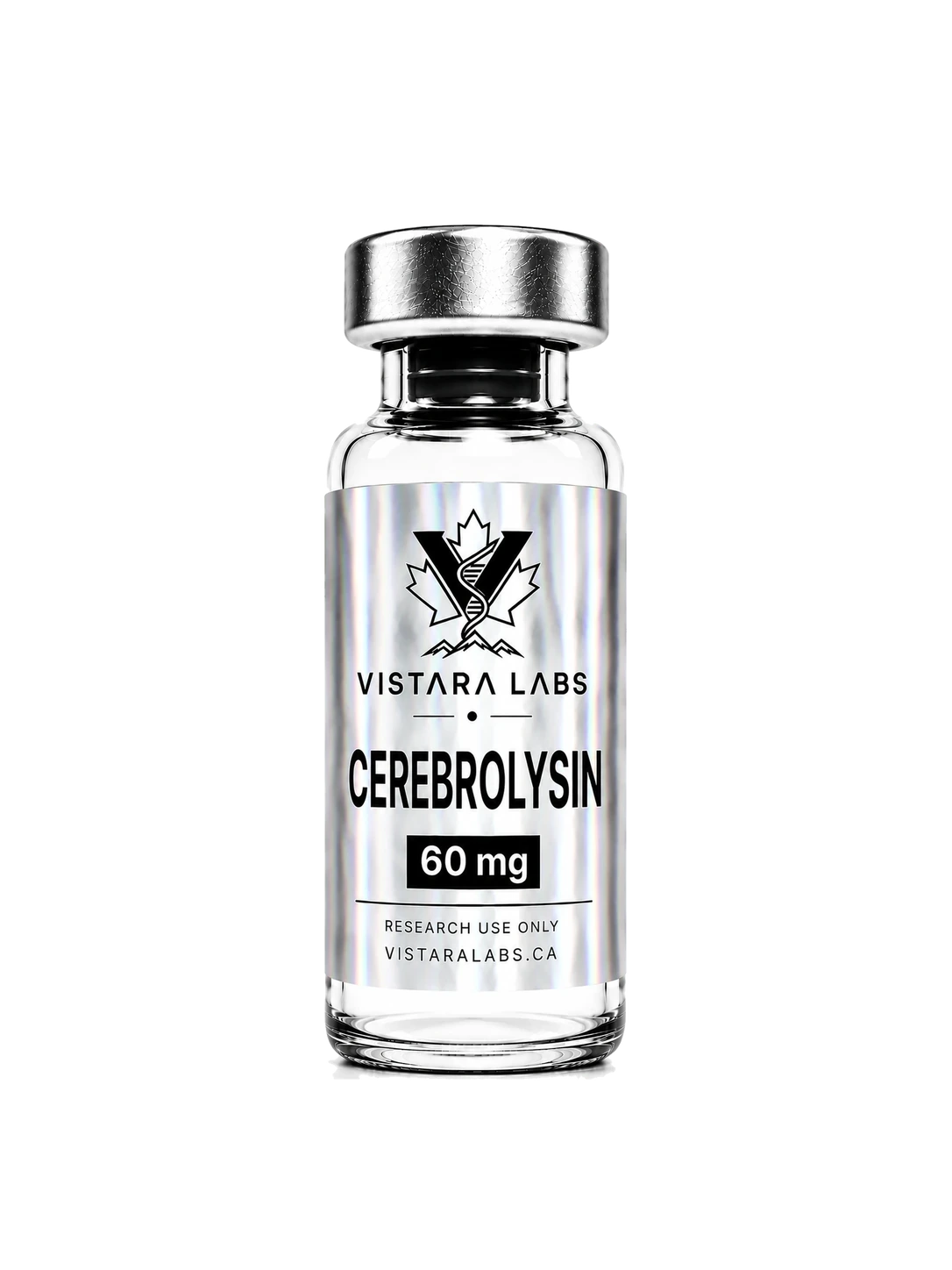
Cerebrolysin comes as a 60 mg lyophilised vial, a freeze-dried format that keeps the peptides stable until reconstitution. The concentration arithmetic is in Cerebrolysin Reconstitution: How Much Bacteriostatic Water. Certificates of analysis are on the lab reports page, and ordering details are in Buy Cerebrolysin in Canada.
Cerebrolysin is supplied by Vistara Labs for laboratory research use only. The clinical trials above are described as published facts, not as guidance.
Frequently asked questions
What is Cerebrolysin?
Cerebrolysin is a neuropeptide preparation derived from pig brain, made of low-molecular-weight neuropeptides and free amino acids. It acts much like the brain’s own neurotrophic factors, which support neuron survival, growth and connection.
What has Cerebrolysin research shown?
Randomised placebo-controlled trials found a large advantage in arm and hand function after stroke (2016), 14.8 points more language recovery in post-stroke aphasia (2025), a significant benefit after moderate to severe brain injury (2021) and improved global clinical change in Alzheimer’s disease (2015).
How does Cerebrolysin work?
Laboratory studies show it protects neurons by inhibiting the injury enzyme calpain and reducing cell death, promotes new neurons in the hippocampus and after stroke, and in dementia models reduces beta-amyloid deposits and tau phosphorylation while increasing synaptic density.
Is Cerebrolysin a single peptide?
No. It is a standardised mixture of small peptides and free amino acids from porcine brain, which sets it apart from single defined peptides such as Semax or Dihexa.
What did the CARS stroke trial find?
In 208 patients who also received standardised rehabilitation, Cerebrolysin showed a large superiority over placebo on the Action Research Arm Test at day 90, a small-to-medium advantage in global status, and safety comparable with placebo.
Product details from vistaralabs.ca, October 2026. Sources: Muresanu DF et al. Cerebrolysin and Recovery After Stroke (CARS): a randomized, placebo-controlled, double-blind, multicenter trial. Stroke. 2016. PMID 26564102. Homberg V et al. Speech therapy combined with Cerebrolysin in enhancing nonfluent aphasia recovery after acute ischemic stroke: ESCAS randomized pilot study. Stroke. 2025. PMID 39957612. Vester JC et al. Cerebrolysin after moderate to severe traumatic brain injury: prospective meta-analysis of the CAPTAIN trial series. Neurol Sci. 2021. PMID 33620612. Gauthier S et al. Cerebrolysin in mild-to-moderate Alzheimer’s disease: a meta-analysis of randomized controlled clinical trials. Dement Geriatr Cogn Disord. 2015. PMID 25832905. Plosker GL, Gauthier S. Cerebrolysin: a review of its use in dementia. Drugs Aging. 2009. PMID 19848437. Masliah E, Diez-Tejedor E. The pharmacology of neurotrophic treatment with Cerebrolysin. Drugs Today. 2012. PMID 22514792. Rejdak K et al. Modulation of neurotrophic factors in the treatment of dementia, stroke and TBI: effects of Cerebrolysin. Med Res Rev. 2023. PMID 37052231.
More on this: Cognitive & Nootropic Research.
All products supplied by Vistara Labs are intended for laboratory research use only. They are not drugs, are not approved for human or veterinary use, and are not intended to diagnose, treat, cure or prevent any condition. Nothing on this page constitutes medical advice or guidance for use in humans.
References
Cerebrolysin has substantial human neurological research, with results that vary by condition, outcome measure and study design.
- Cerebrolysin in vascular dementia: improvement of clinical outcome in a randomized, double-blind, placebo-controlled multicenter trialRandomised, double-blind, placebo-controlled multicentre trial; 242 patients with vascular dementia, 24 weeks.
- Cerebrolysin in Alzheimer's disease: a randomized, double-blind, placebo-controlled trial with a neurotrophic agentRandomised, double-blind, placebo-controlled trial; 192 patients with Alzheimer's disease.
- Cerebrolysin enhances cognitive recovery of mild traumatic brain injury patients: double-blind, placebo-controlled, randomized studyRandomised, double-blind, placebo-controlled pilot; 32 patients with mild traumatic brain injury.
- Efficacy and Safety of Cerebrolysin for Acute Ischemic Stroke: A Meta-Analysis of Randomized Controlled TrialsMeta-analysis of 7 randomised trials, 1,779 acute ischaemic stroke patients; no significant superiority on major functional outcomes.
Links open the study record on PubMed so the source can be checked directly. Listing a study is not a claim that its findings apply to any other use, product or route of administration. Research use only.