What Is Epitalon? The Pineal Tetrapeptide Explained
Cellular Energy & Mitochondrial Research
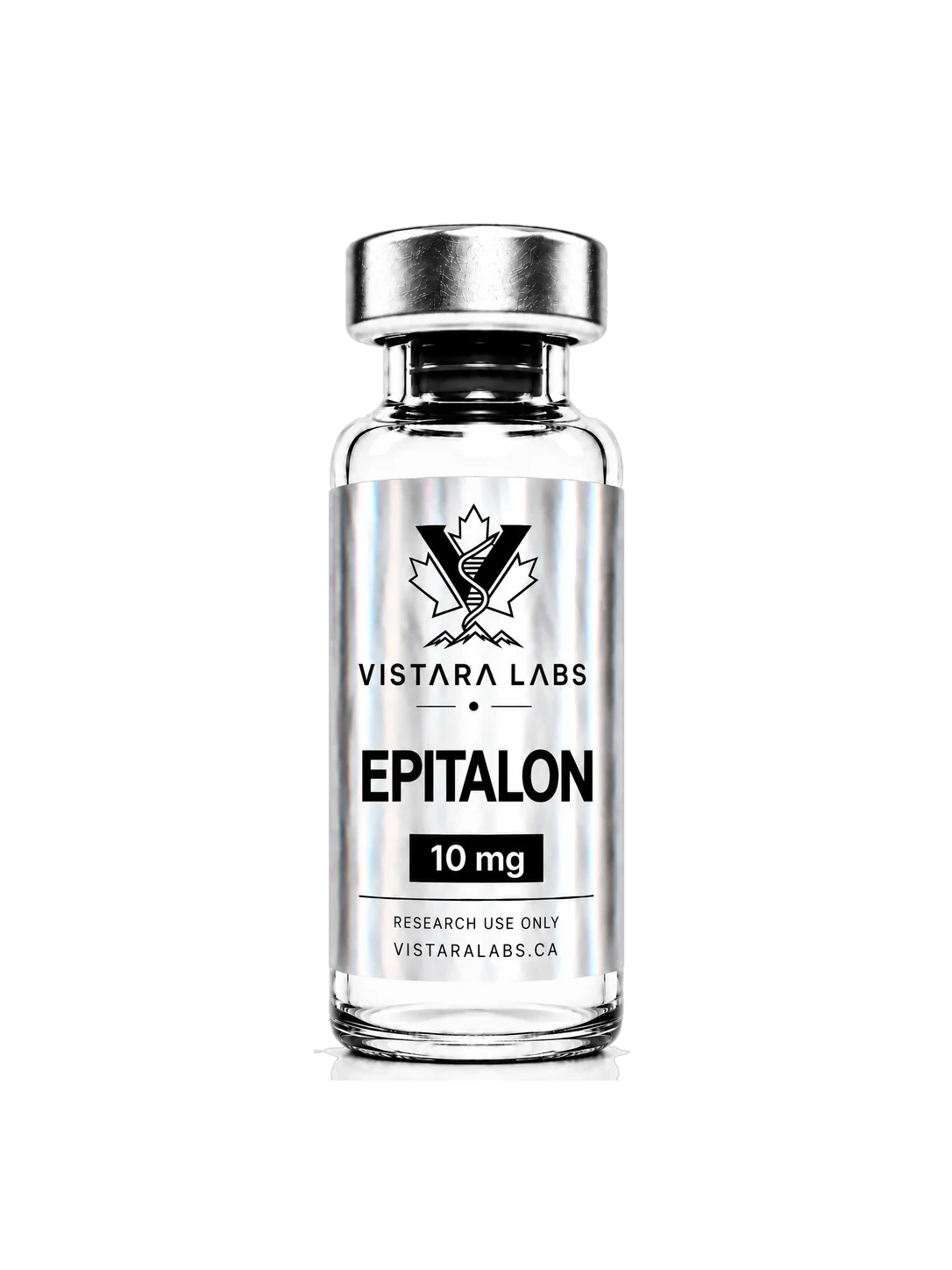
Epitalon (also spelled Epithalon, and known as AEDG peptide) is a synthetic four-amino-acid peptide, Ala-Glu-Asp-Gly, modelled on epithalamin, an extract of the pineal gland, and studied for its effects on telomeres, melatonin rhythms and the biology of ageing. It was developed by Vladimir Khavinson’s group at the St Petersburg Institute of Bioregulation and Gerontology, and in human fibroblasts it switched on telomerase, the enzyme that rebuilds the protective caps on chromosomes. Vistara Labs supplies it as an Epitalon 10 mg lyophilised vial.
Findings
- Epitalon is Ala-Glu-Asp-Gly, synthesised from the amino acid composition of epithalamin, a bovine pineal gland extract (Araj et al., 2025).
- In elderly people with low pineal function, pineal peptides including Epitalon restored night-time melatonin release and normalised its daily rhythm (2007).
- In human fetal fibroblasts, it activated telomerase and lengthened telomeres (2003), a result extended in normal human cells in 2025.
- In old rhesus monkeys, it lowered fasting glucose and insulin and raised night-time melatonin, with no effect in young animals (2005).
- In human stem cells, it raised four markers of new neuron formation by 1.6-1.8 times (2020).
 View product →
What is Epitalon?
Epitalon is a tetrapeptide: a chain of just four amino acids, alanine, glutamic acid, aspartic acid and glycine, which is why it is often written AEDG using one-letter amino acid codes. That makes it far smaller than the hormones and pineal extracts it is studied alongside.
From pineal extract to a defined peptide
The story starts with epithalamin, a polypeptide preparation extracted from the pineal glands of cattle. The pineal gland is a pea-sized structure in the brain that produces melatonin, the hormone that sets the body’s day-night rhythm. Researchers at the St Petersburg Institute of Bioregulation and Gerontology studied epithalamin for decades, then synthesised Epitalon based on the extract’s amino acid composition, giving them a single defined molecule to work with in place of a mixture (Araj et al., Int J Mol Sci, 2025). A 2026 review describes Epitalon and epithalamin as chemically distinct, so results for one do not automatically transfer to the other (Jain et al., Int J Mol Sci, 2026).
The parent extract’s human record
Much of the interest in Epitalon comes from long-term studies of its parent extract. In a study of 266 elderly people followed for 6 to 8 years, those given epithalamin had 1.6 to 1.8 times lower mortality than controls (Khavinson and Morozov, Neuro Endocrinol Lett, 2003). In a randomised comparison of 39 elderly coronary patients with 40 controls, epithalamin slowed markers of cardiovascular ageing, improved physical endurance and normalised the melatonin rhythm (Korkushko et al., Bull Exp Biol Med, 2011). These studies used the extract, not Epitalon itself.
How Epitalon works
Telomeres and telomerase
Telomeres are repeated stretches of DNA that cap the ends of chromosomes, like the plastic tips on shoelaces. They shorten each time a cell divides, and short telomeres are one of the hallmarks of cellular ageing. Telomerase is the enzyme that can rebuild them, but most adult body cells keep it switched off. In 2003, Khavinson’s group added Epitalon to cultures of human fetal fibroblasts (connective-tissue cells) that had no telomerase activity. It increased expression of telomerase’s catalytic subunit, raised telomerase activity and lengthened telomeres, which the authors interpreted as reactivation of the telomerase gene (Khavinson et al., Bull Exp Biol Med, 2003).
An independent group confirmed and extended this in 2025. In normal human epithelial cells and fibroblasts, Epitalon lengthened telomeres in a dose-dependent way by raising hTERT (telomerase) gene expression and telomerase activity (Al-Dulaimi et al., Biogerontology, 2025).
Melatonin and the pineal gland
Night-time melatonin output falls with age. Epitalon’s link to the pineal gland is its other main research thread, covered below in both primates and people.
Gene regulation
Khavinson’s group proposes that short peptides such as Epitalon act as gene regulators. In human gingival mesenchymal stem cells, Epitalon raised production of four neuron-development markers (Nestin, GAP43, beta-tubulin III and doublecortin) 1.6 to 1.8 times, and computer modelling suggested it binds histone proteins that package DNA, a possible epigenetic route to switching genes on (Khavinson et al., Molecules, 2020).
What the research has shown
Melatonin in elderly people and old primates
In a study run in parallel in old monkeys and elderly people, ageing lowered night-time and average daily melatonin and flattened its daily rhythm. Pineal peptides, epithalamin and Epitalon, restored night-time melatonin release and normalised the rhythm, raising night-time melatonin in elderly people with low pineal function, and the authors reported no side effects (Korkushko et al., Adv Gerontol, 2007). In old rhesus monkeys aged 20 to 27, Epitalon also lowered fasting glucose and insulin, improved glucose clearance and normalised the insulin response, while leaving young monkeys unchanged (Goncharova et al., Exp Gerontol, 2005).
Retinal health
In a study of retinitis pigmentosa, an inherited disease that slowly destroys the retina, Epitalon preserved retinal structure and improved retinal electrical activity in a rat model, and 90% of patients with degenerative retinal lesions showed a positive clinical effect (Khavinson et al., Neuro Endocrinol Lett, 2002).
Telomeres in human blood cells
In blood lymphocytes taken from 11 healthy men and grown in the laboratory, Epitalon lengthened telomeres significantly in five people, by 18% to 156%. The authors described a normalising tendency: cells with shorter-than-average telomeres tended to gain length (Khavinson et al., Bull Exp Biol Med, 2019).
Lifespan in laboratory animals
Khavinson’s 2002 review reports that Epitalon increased lifespan in mice and fruit flies and restored melatonin and cortisol rhythms in old monkeys, the basis of what he called a peptide theory of ageing (Khavinson, Neuro Endocrinol Lett, 2002).
The human studies of Epitalon itself are small, and most of the published work to date is laboratory research. A fuller review is on Epitalon (Epithalon): What the Research Actually Shows.
Epitalon at a glance
| Question | Answer |
|---|---|
| Other names | Epithalon, AEDG peptide |
| Sequence | Ala-Glu-Asp-Gly |
| Parent | Epithalamin, a bovine pineal extract |
| Main research threads | Telomerase, melatonin, gene regulation |
| Developed at | St Petersburg Institute of Bioregulation and Gerontology |
How Epitalon compares with related compounds
Epitalon and DSIP are both studied around sleep and rhythms, but DSIP is a nine-amino-acid peptide researched for deep sleep (Epitalon vs DSIP; What Is DSIP?). SS-31 is the other ageing tetrapeptide, aimed at mitochondria rather than telomeres (SS-31 vs Epitalon), and NAD+ is a coenzyme rather than a peptide (Epitalon vs NAD+).
Forms we stock
Epitalon comes as a 10 mg lyophilised vial (freeze-dried powder for laboratory reconstitution). Concentration arithmetic is in How Much Bacteriostatic Water for an Epitalon 10 mg Vial?, and storage guidance in How to Store Research Peptides. Certificates of analysis are on the lab reports page, and orders ship from within Canada by Canada Post Xpresspost (see Buy Epitalon (Epithalon) in Canada).
Epitalon is supplied by Vistara Labs for laboratory research use only. The studies above are described as published research findings.
Frequently asked questions
What is Epitalon?
Epitalon, also spelled Epithalon, is a synthetic four-amino-acid peptide, Ala-Glu-Asp-Gly, made from the amino acid composition of epithalamin, a bovine pineal gland extract. It was developed in St Petersburg and is studied for telomeres, melatonin rhythms and ageing.
Is Epitalon the same as Epithalon?
Yes. Epitalon and Epithalon are two spellings of the same tetrapeptide, which is also called AEDG peptide. Epithalamin is different: it is the pineal extract that Epitalon was modelled on.
What has Epitalon research shown?
It activated telomerase and lengthened telomeres in human fibroblasts (2003, extended in 2025), restored night-time melatonin release in elderly people and old monkeys (2007), and lowered fasting glucose and insulin in old monkeys (2005).
How does Epitalon affect telomeres?
In laboratory studies it raised expression and activity of telomerase, the enzyme that rebuilds the DNA caps on the ends of chromosomes, and lengthened telomeres in normal human cells in a dose-dependent way.
What did research show about Epitalon and melatonin?
A 2007 study in old monkeys and elderly people found that pineal peptides, including Epitalon, restored night-time melatonin release and normalised its daily rhythm, with no side effects reported.
Product details from vistaralabs.ca, October 2026. Sources: Khavinson VKh. Peptides and ageing. Neuro Endocrinol Lett. 2002. PMID 12374906. Khavinson V et al. Pineal-regulating tetrapeptide epitalon improves eye retina condition in retinitis pigmentosa. Neuro Endocrinol Lett. 2002. PMID 12195242. Khavinson VKh et al. Epithalon peptide induces telomerase activity and telomere elongation in human somatic cells. Bull Exp Biol Med. 2003. PMID 12937682. Khavinson VKh, Morozov VG. Peptides of pineal gland and thymus prolong human life. Neuro Endocrinol Lett. 2003. PMID 14523363. Goncharova ND et al. Pineal peptides restore the age-related disturbances in hormonal functions of the pineal gland and the pancreas. Exp Gerontol. 2005. PMID 15664732. Korkushko OV et al. Normalizing effect of the pineal gland peptides on the daily melatonin rhythm in old monkeys and elderly people. Adv Gerontol. 2007. PMID 17969590. Korkushko OV et al. Peptide geroprotector from the pituitary gland inhibits rapid aging of elderly people: results of 15-year follow-up. Bull Exp Biol Med. 2011. PMID 22451889. Khavinson VK et al. Effect of peptide AEDG on telomere length and mitotic index of PHA-stimulated human blood lymphocytes. Bull Exp Biol Med. 2019. PMID 31761987. Khavinson V et al. AEDG peptide (Epitalon) stimulates gene expression and protein synthesis during neurogenesis: possible epigenetic mechanism. Molecules. 2020. PMID 32019204. Araj SK et al. Overview of Epitalon: highly bioactive pineal tetrapeptide with promising properties. Int J Mol Sci. 2025. PMID 40141333. Al-Dulaimi S et al. Epitalon increases telomere length in human cell lines through telomerase upregulation or ALT activity. Biogerontology. 2025. PMID 40908429. Jain A et al. Epitalon and epithalamin: a narrative review of mechanistic, preclinical, and clinical evidence. Int J Mol Sci. 2026. PMID 42884164.
More on this: Peptides for Sleep: What the Research Shows.
All products supplied by Vistara Labs are intended for laboratory research use only. They are not drugs, are not approved for human or veterinary use, and are not intended to diagnose, treat, cure or prevent any condition. Nothing on this page constitutes medical advice or guidance for use in humans.