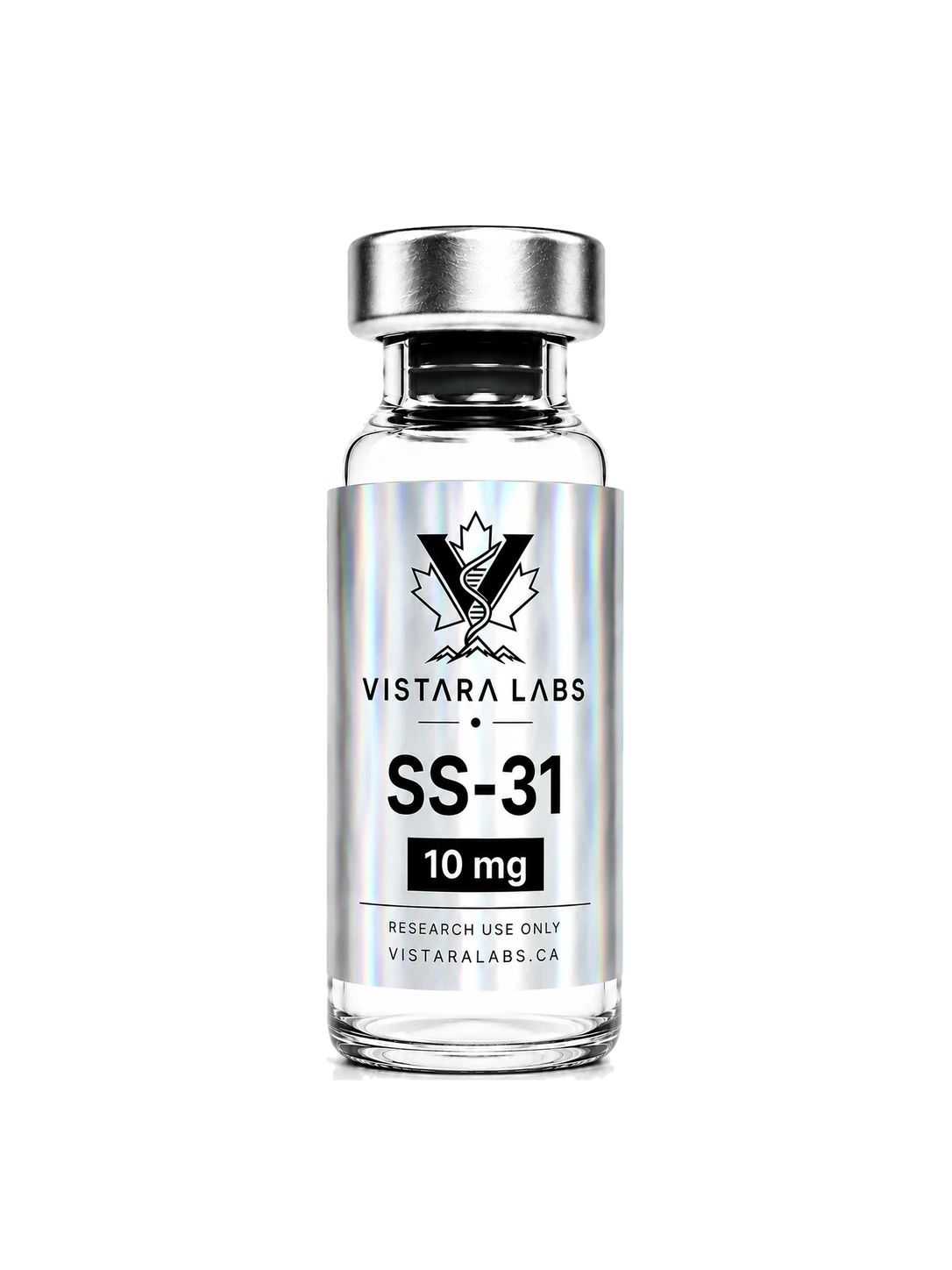
What Is SS-31? The Cardiolipin-Targeting Peptide
Cellular Energy & Mitochondrial Research
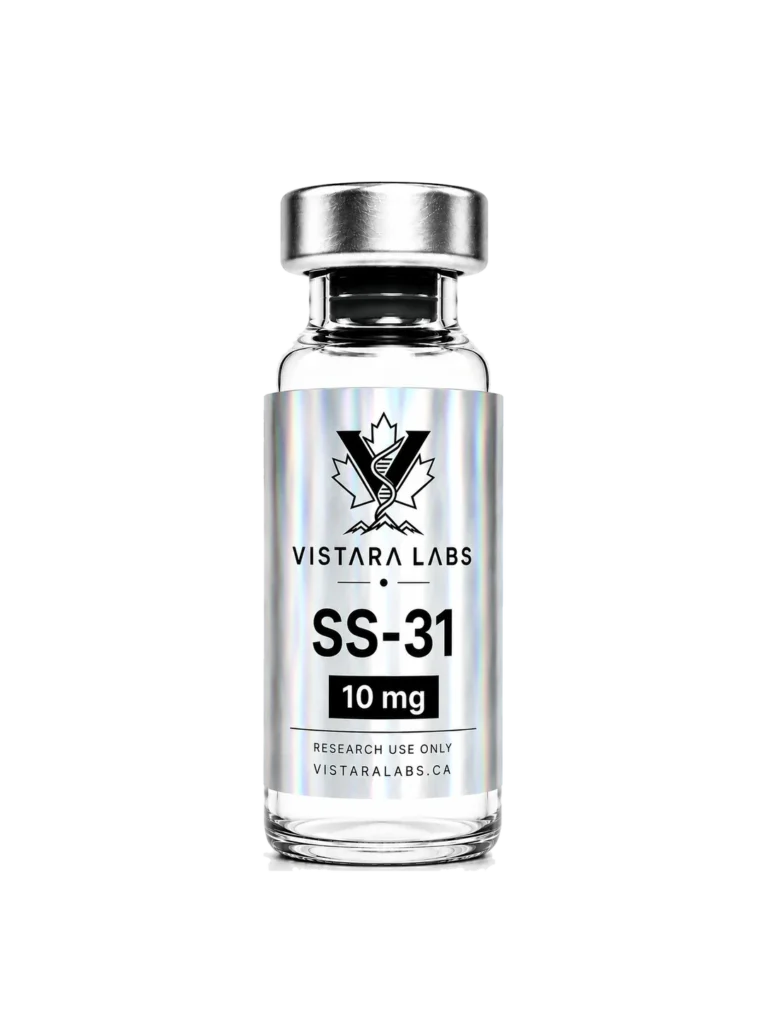
SS-31 (elamipretide) is a synthetic four-amino-acid peptide, D-Arg-Dmt-Lys-Phe-NH2, that travels to the inner membrane of mitochondria and binds cardiolipin, the fat molecule that holds the cell’s energy-making machinery in shape. It was co-designed by Peter Schiller at the IRCM in Montreal and Hazel Szeto at Cornell, and on 19 September 2025 it became the first FDA-approved treatment for Barth syndrome, a rare inherited mitochondrial disease. Vistara Labs supplies it as an SS-31 10 mg lyophilised vial.
Findings
- SS-31 binds cardiolipin on the inner mitochondrial membrane, protecting the structure that produces ATP (Szeto, 2014).
- The FDA granted it accelerated approval for Barth syndrome in September 2025, based on improved knee-extensor muscle strength in the TAZPOWER trial.
- In the TAZPOWER extension, Barth syndrome patients walked 96.1 m further on the six-minute walk test after 168 weeks (2024).
- In 36 adults with primary mitochondrial myopathy, the highest dose group gained 64.5 m on the six-minute walk after 5 days, with a dose-dependent effect (2018).
- A single infusion raised maximum ATP production in the hand muscle of 39 healthy older adults (2021).
 View product →
What is SS-31?
SS-31 is a tetrapeptide, a chain of four amino acids, with an unusual design. Its sequence is D-arginine, 2′,6′-dimethyltyrosine (Dmt, a modified tyrosine), lysine and phenylalanine, with an amide cap at the end. Using the “D” (mirror-image) form of arginine and capping the end greatly enhanced its stability against the enzymes that break down ordinary peptides. Its alternating pattern of aromatic (ring-shaped) and positively charged amino acids makes it remarkably cell permeable for such a water-soluble molecule, and inside cells it concentrates on the inner mitochondrial membrane (Szeto, Br J Pharmacol, 2014).
Where it came from
The name comes from its inventors. Szeto-Schiller (SS) peptides were co-designed by Peter W. Schiller, a peptide chemist at the Institut de recherches cliniques de Montréal (IRCM) known for pioneering work on opioid peptides, and Hazel H. Szeto at Cornell’s medical college in New York. IRCM and the Cornell Research Foundation hold joint patents on the compounds, and Stealth BioTherapeutics took them into clinical development (IRCM). Szeto has described their discovery of mitochondria-targeting activity as serendipitous (Szeto and Birk, Clin Pharmacol Ther, 2014). In clinical trials and on its drug label, SS-31 is called elamipretide.
A Canadian-designed peptide with an FDA approval
On 19 September 2025, the U.S. Food and Drug Administration granted accelerated approval to elamipretide as the first treatment for Barth syndrome, which the agency describes as a rare, serious and life-threatening disease of the mitochondria. The approval rests on improved strength of the muscle that straightens the leg at the knee, and the FDA has asked for a confirmatory randomised trial (FDA, 2025). Few research peptides have reached that stage.
How SS-31 works: cardiolipin
Mitochondria are the cell’s power plants. Their inner membrane is folded into ridges called cristae, packed with the protein complexes of the electron transport chain that turn food energy into ATP. Cardiolipin is a phospholipid (a type of fat molecule) found exclusively in this inner membrane (Szeto, 2014), and it acts as the scaffold that keeps those complexes together and the cristae in shape.
When a cell is under stress, cardiolipin can bind cytochrome c, a protein in the electron transport chain, and turn it into a peroxidase, an enzyme that generates damaging oxidants. SS-31 binds cardiolipin with high affinity, which stops this switch and supports normal energy production (Szeto, 2014). In a kidney ischaemia model, SS-31 protected the cristae, reduced mitochondrial swelling and sped up ATP recovery after blood flow returned, which cut cell death and kidney damage (Birk et al., J Am Soc Nephrol, 2013). Barth syndrome, the disease it is approved for, is itself a disorder of cardiolipin, which is why patients’ cardiolipin profiles were tracked in its trials.
What the research has shown
SS-31 has more human data than almost any other research peptide.
Barth syndrome
TAZPOWER began as a 28-week randomised, double-blind, placebo-controlled trial. Ten patients entered the open-label extension and eight reached week 168. Six-minute walk distance improved at every extension time point, reaching a cumulative gain of 96.1 m at week 168. Fatigue scores improved at all time points, a marker of cardiolipin processing improved, heart volumes trended toward improvement, and injection-site reactions were the most common adverse events (Thompson et al., Genet Med, 2024). A separate comparison with 19 untreated patients from natural history records found the treated group walked 79.7 m further at week 64 and 91.0 m further at week 76, with greater muscle strength (Hornby et al., Orphanet J Rare Dis, 2022). The full trial record is on SS-31 (Elamipretide) Benefits: From Research to FDA Approval.
Primary mitochondrial myopathy
Primary mitochondrial myopathy is a group of inherited diseases in which faulty mitochondria leave muscles weak and easily tired. In a randomised, dose-escalation trial of 36 adults, the highest dose group increased its six-minute walk distance by 64.5 m after 5 days, against 20.4 m with placebo, and the walk-test gain rose with dose, with no added safety concerns (Karaa et al., Neurology, 2018).
Ageing muscle
At the University of Washington, 39 healthy adults aged 60 to 85 received a single infusion of SS-31 or placebo. Magnetic resonance spectroscopy, which measures energy chemistry inside living muscle, showed that maximum mitochondrial ATP production in a hand muscle rose immediately after SS-31 compared with placebo (Roshanravan et al., PLoS One, 2021). It was one of the first direct demonstrations of the peptide raising energy capacity in ageing human tissue.
SS-31 at a glance
| Question | Answer |
|---|---|
| Other name | Elamipretide |
| Sequence | D-Arg-Dmt-Lys-Phe-NH2 |
| Target | Cardiolipin, inner mitochondrial membrane |
| Designed by | Schiller (IRCM, Montreal) and Szeto (Cornell) |
| Regulatory status | FDA accelerated approval, Barth syndrome, 2025 |
How SS-31 compares with other mitochondrial compounds
SS-31 protects the structure of mitochondria from the inside, while MOTS-c is a signalling peptide encoded in mitochondrial DNA that acts on metabolism (MOTS-c vs SS-31: Two Mitochondrial Peptides Compared; What Is MOTS-c?). NAD+ is the coenzyme that carries electrons into the same machinery (What Is NAD+?), and Epitalon is another ageing tetrapeptide, studied for telomeres and melatonin (SS-31 vs Epitalon).
Forms we stock
SS-31 comes as a 10 mg lyophilised vial (freeze-dried powder for laboratory reconstitution). It is also part of the Mitochondrial Energy stack with MOTS-c (see Buy the Mitochondrial Energy Stack). Concentration arithmetic is in How Much Bacteriostatic Water for an SS-31 10 mg Vial?, and general storage guidance is in How to Store Research Peptides. Certificates of analysis are on the lab reports page, and orders ship from within Canada by Canada Post Xpresspost (see Buy SS-31 in Canada).
SS-31 is supplied by Vistara Labs for laboratory research use only. The approved drug and the clinical studies above are described as published research findings.
Frequently asked questions
What is SS-31?
SS-31, also called elamipretide, is a synthetic four-amino-acid peptide, D-Arg-Dmt-Lys-Phe-NH2, that concentrates in mitochondria and binds cardiolipin on their inner membrane. It was co-designed by Peter Schiller at the IRCM in Montreal and Hazel Szeto at Cornell.
Is SS-31 the same as elamipretide?
Yes. SS-31 is the original research code, from Szeto-Schiller peptide 31, and elamipretide is its international drug name. In September 2025 the FDA granted elamipretide accelerated approval for Barth syndrome.
What has SS-31 research shown?
In Barth syndrome, patients in the TAZPOWER extension walked 96.1 m further after 168 weeks. In 36 adults with primary mitochondrial myopathy, the highest dose group gained 64.5 m on the six-minute walk after 5 days, and a single infusion raised maximum ATP production in the muscle of older adults.
How does SS-31 work?
It binds cardiolipin, the fat molecule that holds the energy-producing complexes of the inner mitochondrial membrane together. This stops cytochrome c from turning into a damaging peroxidase, protects the folded cristae and supports ATP production.
Why is SS-31 called a Canadian-designed peptide?
One of its two inventors, peptide chemist Peter W. Schiller, worked at the Institut de recherches cliniques de Montréal, which holds joint patents on the Szeto-Schiller peptides with the Cornell Research Foundation.
Product details from vistaralabs.ca, October 2026. Sources: Birk AV et al. The mitochondrial-targeted compound SS-31 re-energizes ischemic mitochondria by interacting with cardiolipin. J Am Soc Nephrol. 2013. PMID 23813215. Szeto HH. First-in-class cardiolipin-protective compound as a therapeutic agent to restore mitochondrial bioenergetics. Br J Pharmacol. 2014. PMID 24117165. Szeto HH, Birk AV. Serendipity and the discovery of novel compounds that restore mitochondrial plasticity. Clin Pharmacol Ther. 2014. PMID 25188726. Karaa A et al. Randomized dose-escalation trial of elamipretide in adults with primary mitochondrial myopathy. Neurology. 2018. PMID 29500292. Roshanravan B et al. In vivo mitochondrial ATP production is improved in older adult skeletal muscle after a single dose of elamipretide in a randomized trial. PLoS One. 2021. PMID 34264994. Hornby B et al. Natural history comparison study to assess the efficacy of elamipretide in patients with Barth syndrome. Orphanet J Rare Dis. 2022. PMID 36056411. Thompson WR et al. Long-term efficacy and safety of elamipretide in patients with Barth syndrome: 168-week open-label extension results of TAZPOWER. Genet Med. 2024. PMID 38602181. US Food and Drug Administration. FDA grants accelerated approval for first treatment for Barth syndrome. 19 September 2025. fda.gov. IRCM. Stars of the IRCM: Dr. Peter W. Schiller. ircm.qc.ca.
More on this: Cellular Energy & Mitochondrial Research.
All products supplied by Vistara Labs are intended for laboratory research use only. They are not drugs, are not approved for human or veterinary use, and are not intended to diagnose, treat, cure or prevent any condition. Nothing on this page constitutes medical advice or guidance for use in humans.
References
SS-31 (elamipretide) has a mature clinical programme. Mechanistic evidence is strong and human exposure substantial, but efficacy results are mixed and indication-dependent — including trials that missed their primary endpoints.
- Efficacy and Safety of Elamipretide in Individuals With Primary Mitochondrial Myopathy: The MMPOWER-3 Randomized Clinical TrialRandomised, double-blind phase 3 trial (MMPOWER-3), 24 weeks. The primary exercise and fatigue endpoints were not met.
- A randomized crossover trial of elamipretide in adults with primary mitochondrial myopathyRandomised crossover trial in adults with genetically confirmed primary mitochondrial myopathy.
- Effects of Elamipretide on Left Ventricular Function in Patients With Heart Failure With Reduced Ejection Fraction: The PROGRESS-HF Phase 2 TrialRandomised phase 2 trial; 71 patients. No significant improvement in left-ventricular end-systolic volume or ejection fraction versus placebo.
Links open the study record on PubMed so the source can be checked directly. Listing a study is not a claim that its findings apply to any other use, product or route of administration. Research use only.