Glutathione Side Effects: What the Research Reports
Cellular Energy & Mitochondrial Research
In human studies, glutathione has been well tolerated by intravenous, oral and intranasal routes: in a 2009 placebo-controlled trial of intravenous glutathione in 21 people with Parkinson’s disease, adverse events were similar in both groups and nobody withdrew because of them. The one clear exception is inhaled glutathione, which narrowed the airways of people with mild asthma in a 1997 study. This guide sets out what each study recorded, how often and how mild, and how Glutathione fits a laboratory research setting.
Findings
- Over four weeks of intravenous glutathione, there were no withdrawals because of adverse events and no safety concerns were identified (Hauser et al., 2009).
- In 30 people given intranasal glutathione for three months, adverse events did not differ meaningfully from saline and all groups met tolerability criteria (Mischley et al., 2015).
- In 60 healthy adults taking oral glutathione for four weeks, both glutathione and placebo were very well tolerated (Arjinpathana and Asawanonda, 2012).
- A review of 10 trials of intravenous glutathione in chemotherapy and Parkinson’s research found most reported no or minimal adverse effects (Davids et al., 2016).
 View product →
What is glutathione?
Glutathione is a tripeptide, a chain of three amino acids (glutamate, cysteine and glycine), made inside the body’s own cells. It is the body’s most abundant internal antioxidant and a central regulator of oxidative stress and immune function (Richie et al., Eur J Nutr, 2015). Because levels fall in some conditions, notably early Parkinson’s disease, researchers have tested ways of raising it from outside. The background is in What Is Glutathione?, the research in Glutathione: The Research Behind the Antioxidant, and the naming question in Glutathione vs L-Glutathione.
What did the human studies report?
Intravenous glutathione
The clearest intravenous safety data come from a randomised, double-blind, placebo-controlled pilot in people with Parkinson’s disease whose symptoms were not fully controlled by medication. Of 21 participants, 11 received glutathione and 10 placebo, three times a week for four weeks. Glutathione was well tolerated, adverse events were similar in the two groups, there were no withdrawals because of adverse events, and no safety concerns were identified (Hauser et al., Mov Disord, 2009). In oncology research, glutathione infused before oxaliplatin chemotherapy in 52 patients with advanced colorectal cancer reduced moderate to severe nerve damage (2 patients against 11 on placebo after eight cycles) and did not reduce the chemotherapy’s anticancer activity (Cascinu et al., J Clin Oncol, 2002). A 2016 review that pooled systematic reviews of intravenous glutathione in chemotherapy and Parkinson’s disease, covering 10 trials, found that most reported no or minimal adverse effects (Davids et al., S Afr Med J, 2016).
Intranasal glutathione
A phase I/IIa trial randomised 30 people with Parkinson’s disease to intranasal saline or one of two glutathione levels for three months, screening for sinus irritation, loss of smell, blood chemistry, cognition and symptom changes. There were no substantial differences between groups in adverse events, and all groups met tolerability criteria (Mischley et al., Mov Disord, 2015). A follow-up phase IIb trial in 45 people recorded a few withdrawals: one in the placebo group for sinus irritation and headaches, one in the lower-dose group for puffiness under the eyes, and one in the higher-dose group for a fast heart rate and newly diagnosed cardiomyopathy (a weakened heart muscle) in a participant with a past history of fast heart rate. The fast heart rate resolved after stopping, and the authors stated it was unclear whether the case was related to glutathione (Mischley et al., J Parkinsons Dis, 2017).
Oral glutathione
In a randomised, double-blind, placebo-controlled trial, 60 healthy medical students took oral glutathione or placebo for four weeks. Melanin levels in the skin fell at all six sites measured in the glutathione group, significantly more than placebo at two, and both glutathione and placebo were very well tolerated (Arjinpathana and Asawanonda, J Dermatolog Treat, 2012).
Inhaled glutathione
Route matters for the airways. In a 1997 crossover study of eight people with mild asthma, nebulised glutathione caused marked airway narrowing (lung function, measured as FEV1, fell 19%), with cough in four and breathlessness in three. The authors attributed this to sulphite formation (Marrades et al., Am J Respir Crit Care Med, 1997).
What does research show about longer-term use?
The longest controlled trial ran six months: daily oral glutathione in 54 non-smoking adults raised glutathione stores, by 30-35% in red cells, plasma and lymphocytes (a type of immune cell) at the higher level tested, with levels returning to baseline after a one-month washout (Richie et al., 2015). For intravenous use, the 2016 review noted that published trials lasted from a few doses up to 12 weeks and none followed long-term use for any purpose. The same reviewers raised a theoretical question about cosmetic skin lightening: a shift in melanin type could reduce the skin’s natural sun protection (Davids et al., 2016).
How does glutathione compare with related compounds?
Glutathione is often studied alongside NAD+, a coenzyme central to energy metabolism. Their roles are compared in NAD+ vs Glutathione, and NAD+’s infusion data are summarised in NAD+ Side Effects.
Why research-grade quality and storage matter
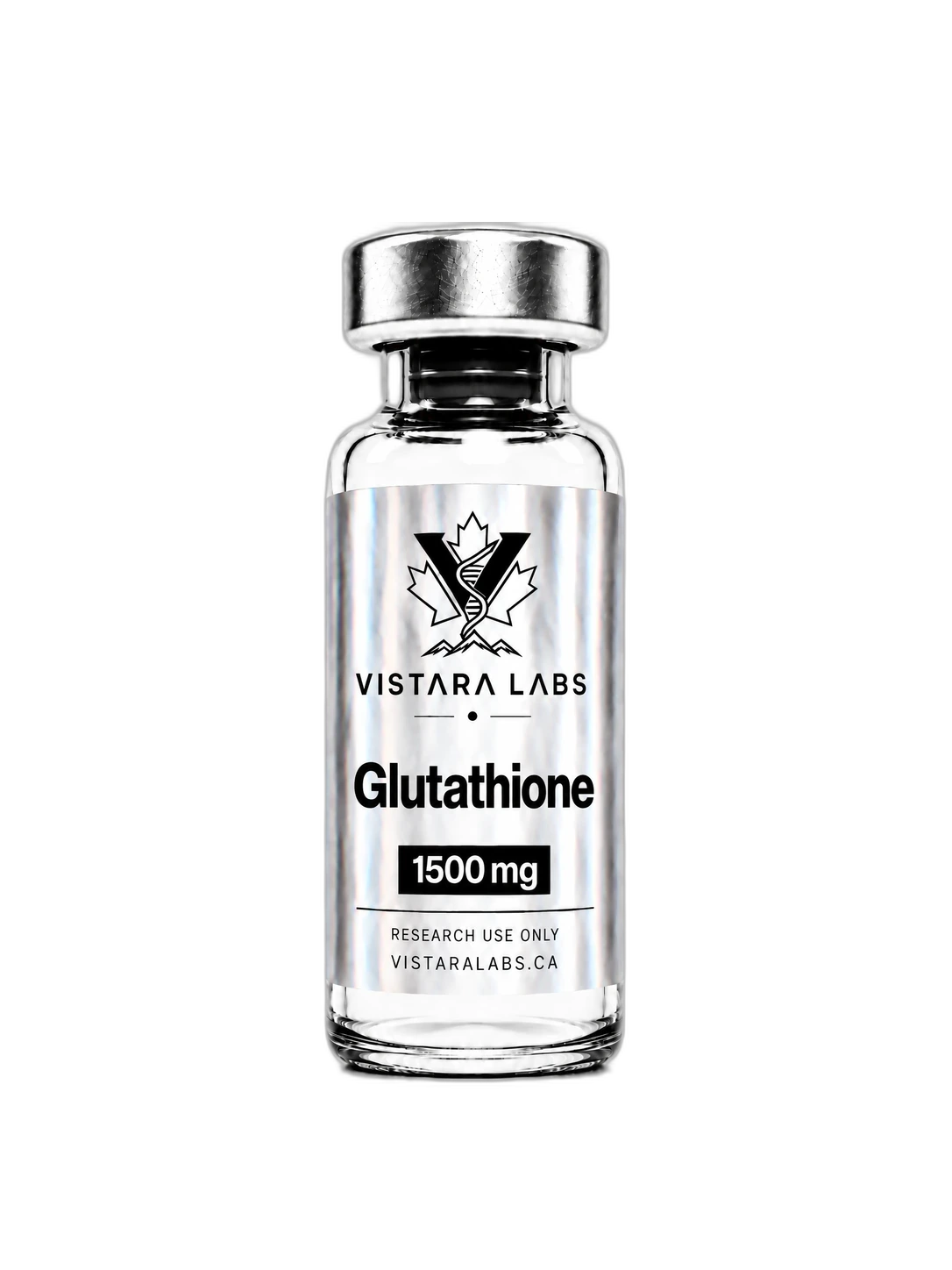
Verified identity and purity are what let laboratory results be compared with the clinical literature. Vistara Labs supplies Glutathione as a lyophilised vial. Every product is third-party tested, with certificates on the lab reports page. Mixing is covered in the glutathione reconstitution guide and stability in How Long Does Glutathione Last?
Glutathione is supplied by Vistara Labs for laboratory research use only. The human studies above were clinical research carried out under medical supervision.
Frequently asked questions
What side effects has glutathione research reported?
Intravenous, intranasal and oral studies found glutathione well tolerated, with adverse events similar to placebo. The exception was inhaled glutathione, which narrowed the airways of people with mild asthma in a 1997 study.
What did the intravenous glutathione trial show?
In a 2009 placebo-controlled pilot in 21 people with Parkinson’s disease, four weeks of intravenous glutathione was well tolerated, adverse events were similar in both groups, and nobody withdrew because of them.
What did intranasal glutathione studies show about safety?
In a three-month trial in 30 people, adverse events did not differ substantially from saline and all groups met tolerability criteria. A later trial in 45 people recorded a few withdrawals, including one case of cardiomyopathy whose link to glutathione was unclear.
What did the longest glutathione trial show?
A six-month trial of oral glutathione in 54 adults raised glutathione stores in blood and cells, with levels returning to baseline after a one-month washout.
Where can I buy glutathione in Canada?
Vistara Labs supplies glutathione as a lyophilised vial, third-party tested and shipped from within Canada by Canada Post Xpresspost.
Product details from vistaralabs.ca, October 2026. Sources: Hauser RA et al. Randomized, double-blind, pilot evaluation of intravenous glutathione in Parkinson’s disease. Mov Disord. 2009. PMID 19230029. Cascinu S et al. Neuroprotective effect of reduced glutathione on oxaliplatin-based chemotherapy in advanced colorectal cancer. J Clin Oncol. 2002. PMID 12177109. Davids LM et al. Intravenous glutathione for skin lightening: inadequate safety data. S Afr Med J. 2016. PMID 27499402. Mischley LK et al. A randomized, double-blind phase I/IIa study of intranasal glutathione in Parkinson’s disease. Mov Disord. 2015. PMID 26230671. Mischley LK et al. Phase IIb study of intranasal glutathione in Parkinson’s disease. J Parkinsons Dis. 2017. PMID 28436395. Arjinpathana N, Asawanonda P. Glutathione as an oral whitening agent: a randomized, double-blind, placebo-controlled study. J Dermatolog Treat. 2012. PMID 20524875. Richie JP et al. Randomized controlled trial of oral glutathione supplementation on body stores of glutathione. Eur J Nutr. 2015. PMID 24791752. Marrades RM et al. Nebulized glutathione induces bronchoconstriction in patients with mild asthma. Am J Respir Crit Care Med. 1997. PMID 9279219.
More on this: Buy Glutathione in Canada.
All products supplied by Vistara Labs are intended for laboratory research use only. They are not drugs, are not approved for human or veterinary use, and are not intended to diagnose, treat, cure or prevent any condition. Nothing on this page constitutes medical advice or guidance for use in humans.
References
Glutathione has several human trials. Skin findings are endpoint-specific and a systematic review judged the overall evidence inconclusive; an intravenous Parkinson's pilot found no significant benefit.
- Glutathione as an oral whitening agent: a randomized, double-blind, placebo-controlled studyRandomised, double-blind, placebo-controlled trial; 60 healthy participants, oral glutathione, 4 weeks. Significant between-group differences at only two of the measured sites.
- The clinical effect of glutathione on skin color and other related skin conditions: A systematic reviewSystematic review of four clinical skin studies including three placebo-controlled randomised trials; authors concluded the evidence remains inconclusive.
- Randomized, double-blind, pilot evaluation of intravenous glutathione in Parkinson's diseaseRandomised, double-blind pilot; 21 patients, intravenous glutathione in Parkinson's disease. No statistically significant improvement in UPDRS outcomes versus placebo.
Links open the study record on PubMed so the source can be checked directly. Listing a study is not a claim that its findings apply to any other use, product or route of administration. Research use only.