How Long Does Cerebrolysin Last? Storage Before and After Mixing
Lyophilised Cerebrolysin is kept sealed, dry, dark and cold, in the fridge or freezer; once mixed with bacteriostatic water it lasts 8 to 12 weeks at 2 to 8 °C under Vistara Labs’ handling guidance, with quality slowly fading from around week 6 to 8. No published stability study covers Cerebrolysin powder or solution, and no supplier data sheet we could verify gives a shelf-life figure, so both windows are the general peptide guidance. Because it is a mixture of hundreds of short peptides rather than one molecule, every common way peptides change in solution applies, and a mixed vial is never frozen.
Findings
- Cerebrolysin is produced by controlled digestion of porcine brain proteins (Gevaert et al., Drug Test Anal, 2015).
- Mass spectrometry of one sample identified 638 unique peptides, mainly fragments of tubulin alpha and beta chains, actin and myelin basic protein (same study).
- A research-chemical data sheet describes the material as a white to yellow powder, so a pale cream or yellow cake is not by itself a sign of damage.
- No verified supplier figure exists for Cerebrolysin shelf life as powder or in solution, so the general windows apply.
How long does Cerebrolysin powder last?
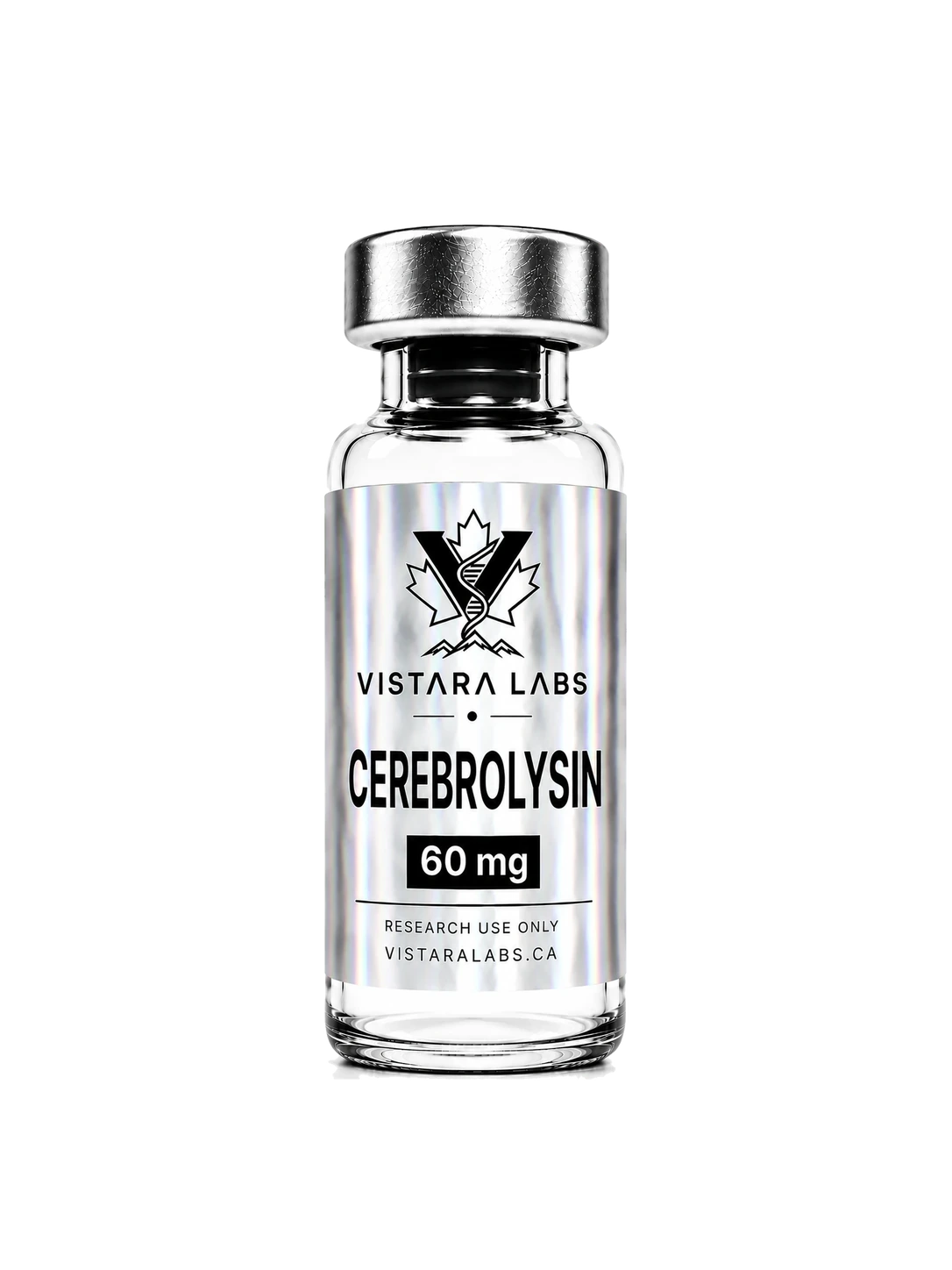
There is no published shelf-life figure for lyophilised Cerebrolysin that we could verify against a data sheet. The general approach for freeze-dried peptides is the one used here: the Cerebrolysin 60 mg vial is kept capped, boxed and dark, in the fridge for near-term work or the freezer for longer holds. Moisture is the main enemy of a freeze-dried cake: it lets the same reactions that happen in solution start in the solid. A cold vial is brought to room temperature before opening so that condensation does not form on the powder. The freeze-dried format is what keeps the peptides stable until they are mixed.
How long does Cerebrolysin last after mixing?
At 2 to 8 °C, dark and accessed only through a swabbed stopper, mixed Cerebrolysin lasts 8 to 12 weeks, with quality fading from around week 6 to 8. That is the general row in how long peptides last after mixing. The Cerebrolysin reconstitution page has the calculator for the 60 mg vial and the slow, down-the-wall mixing method.
What the composition says about stability
Most research peptides are one defined sequence, so their weak points can be read straight from the chain. Cerebrolysin is different. It is a standardised preparation of low-molecular-weight peptides and free amino acids made from pig brain protein. The most detailed public analysis found 638 distinct peptides in a single sample, drawn mostly from structural brain proteins: tubulin, actin and myelin basic protein. A mixture that large will include peptides containing methionine, asparagine, glutamine and cysteine, so oxidation, deamidation and the other usual chemical changes all have somewhere to happen (Manning et al., Pharm Res, 2010). No single residue sets the pace, and no sequence-based shortcut applies.
Two practical points follow. First, a solution of short peptides and amino acids is a rich medium, so sterile technique and the benzyl alcohol preservative in bacteriostatic water matter as much as temperature. Second, because the starting powder can be white to pale yellow, colour is a less reliable signal than it is for a single clear peptide. Clarity, the absence of particles, and the date on the label are the better guides. As with other peptides, the vial is swirled gently rather than shaken, which works air into the solution.
How long does Cerebrolysin last at room temperature?
There is no published figure for Cerebrolysin in solution at room temperature. A mixed vial is taken out of the fridge only for handling, because warmth speeds chemical change and, if the stopper has been contaminated, microbial growth.
Can Cerebrolysin be frozen?
The sealed powder can be held in the freezer, kept dry and brought to room temperature before opening. Single-use aliquots of solution can be frozen once, a standard laboratory practice. A working vial that will be opened again should not be frozen and thawed repeatedly, since freeze-thaw cycles aggregate peptides in solution.
How can you tell mixed Cerebrolysin has degraded?
- Cloudiness that does not clear within 10 to 15 minutes of mixing, or that appears later. Properly mixed Cerebrolysin is a clear solution with no visible particles.
- Strands, flakes or particles.
- Gel or thickening.
- Darkening, or a colour that changes after mixing.
Oxidation and deamidation are invisible, which is why the time window applies even to a vial that still looks perfect.
Cerebrolysin storage at a glance
| State | Where | How long |
|---|---|---|
| Powder, sealed | Freezer, dry, dark | No published figure; longer holds |
| Powder, sealed | 2 to 8 °C, dark | No published figure; near-term holds |
| Mixed with bacteriostatic water | 2 to 8 °C, dark | 8 to 12 weeks, fading from week 6 to 8 (store guidance) |
| Mixed, room temperature | Handling only | No published figure |
Certificates of analysis are on the lab reports page, and every order ships from within Canada by Canada Post Xpresspost.
Vistara Labs supplies Cerebrolysin as a laboratory research material. The windows on this page describe how long the peptide preparation stays in good condition.
Frequently asked questions
How long does Cerebrolysin last in the fridge after mixing?
Under Vistara Labs’ handling guidance, 8 to 12 weeks at 2 to 8 °C in the dark, with quality fading from around week 6 to 8.
How long does Cerebrolysin last at room temperature?
No published figure exists for Cerebrolysin in solution at room temperature. A mixed vial is kept in the fridge and taken out only for handling.
Can you freeze Cerebrolysin?
Yes as sealed powder, kept dry. Solution can be frozen once as single-use aliquots, but a working vial should not go through repeated freeze-thaw cycles.
Does Cerebrolysin go bad?
Yes. Its many peptides slowly oxidise and deamidate in solution, faster with warmth and light. Cloudiness, particles, gel or darkening mean it has degraded.
Is a yellowish Cerebrolysin powder normal?
It can be. A research-chemical data sheet describes the material as a white to yellow powder. What matters more is that the mixed solution is clear, with no particles, and that the colour does not change over time.
Handling windows: Vistara Labs, October 2026. Sources: Gevaert B et al. Peptide profiling of Internet-obtained Cerebrolysin using high performance liquid chromatography, electrospray ionization ion trap and ultra high performance liquid chromatography, ion mobility, quadrupole time of flight mass spectrometry. Drug Test Anal. 2015. PMID 26017115. Manning MC et al. Stability of protein pharmaceuticals: an update. Pharm Res. 2010. PMID 20143256. BIOZOL. Cerebrolysin, CAS 12656-61-0, USB-269076 (US Biological 269076), product data sheet: form and purity. Data sheet.
More on this: How Long Do Peptides Last After Mixing?
All products supplied by Vistara Labs are intended for laboratory research use only. They are not drugs, are not approved for human or veterinary use, and are not intended to diagnose, treat, cure or prevent any condition. Nothing on this page constitutes medical advice or guidance for use in humans.