How Long Does Dihexa Last? Storage Before and After Mixing
Lyophilised Dihexa keeps for up to 3 years sealed, dry and frozen at −20 °C on one supplier’s data sheet; once mixed with bacteriostatic water it lasts 8 to 12 weeks at 2 to 8 °C under Vistara Labs’ handling guidance, with quality slowly fading from around week 6 to 8. No published stability study covers Dihexa in bacteriostatic water, so that window is the general peptide guidance. What is published is a supplier’s powder and stock-solution data, and the design work that built Dihexa to resist breakdown in the body, which is a different question from shelf life.
Findings
- Dihexa is N-hexanoic-Tyr-Ile-(6) aminohexanoic amide, a capped two-amino-acid core built from an angiotensin IV analogue (McCoy et al., J Pharmacol Exp Ther, 2013).
- A chemical supplier’s data sheet rates the powder at 3 years at −20 °C and 2 years at 4 °C.
- The same sheet gives a solution in solvent 6 months at −80 °C and 1 month at −20 °C.
- The sheet lists solubility in DMSO at 100 mg/mL and gives no water figure: Dihexa dissolves more readily in organic co-solvents than in plain water.
- Its sequence has no methionine, cysteine, tryptophan, asparagine or glutamine, the residues most often behind chemical change in solution (Manning et al., Pharm Res, 2010).
How long does Dihexa powder last?
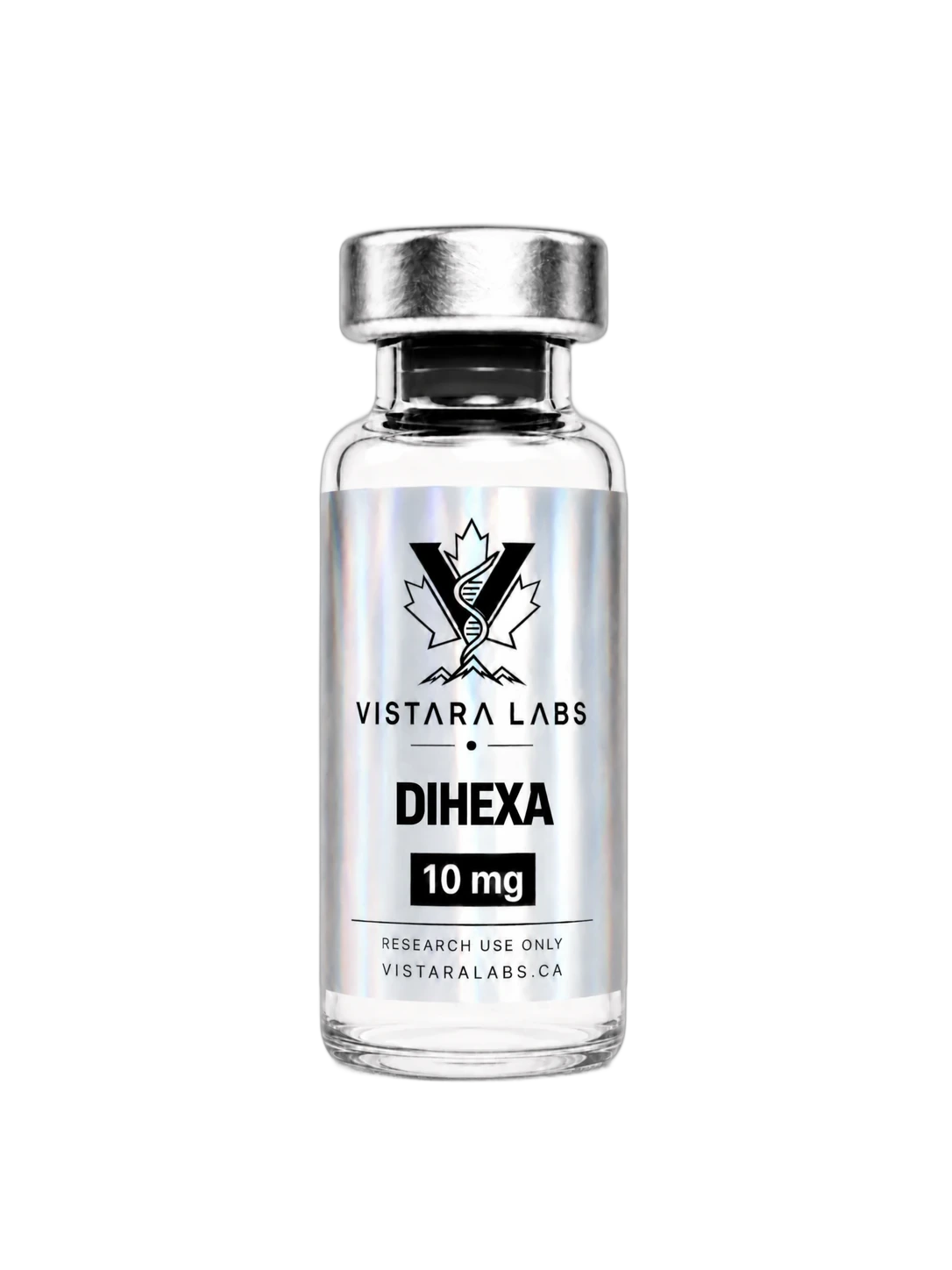
The MedChemExpress data sheet gives Dihexa powder 3 years at −20 °C and 2 years at 4 °C. That fridge figure is unusually long for a research compound, and it fits a small, capped molecule with few reactive groups. The freezer is still the place for long holds. Moisture is the main enemy of a freeze-dried cake, because it lets the reactions that happen in solution begin in the solid. The 10 mg vial is kept capped and boxed, and a cold vial is brought to room temperature before opening so that condensation does not form on the powder.
How long does Dihexa last after mixing?
At 2 to 8 °C, dark and accessed only through a swabbed stopper, mixed Dihexa lasts 8 to 12 weeks, with quality fading from around week 6 to 8. That is the general row in how long peptides last after mixing. Because Dihexa dissolves more readily in organic co-solvents than in water, the Dihexa reconstitution page explains how water volume affects dissolving, and has the calculator for the 10 mg vial.
What the structure says about stability
Dihexa is not a typical peptide. At its centre are just two amino acids, tyrosine and isoleucine, with a hexanoic acid cap on one end and a 6-aminohexanoic amide on the other. Its developers made those end changes to slow enzymatic breakdown, and later added hydrophobicity so it could cross biological barriers (McCoy et al., 2013). Enzymes are not the issue in a sealed vial, but the same simplicity helps on the shelf. The common chemical routes for peptides in solution are oxidation of methionine, cysteine and tryptophan, and deamidation of asparagine and glutamine (Manning et al., 2010). Dihexa has none of these. Tyrosine can oxidise slowly under light, so a mixed vial is still kept dark. The more practical concern is physical: a hydrophobic molecule can come out of solution in the cold, so the vial is checked for haze each time it is used.
What the frozen-solution figures mean
The supplier’s 6 months at −80 °C and 1 month at −20 °C apply to stock solutions in solvent, frozen once and kept sealed, a laboratory practice for single-use aliquots. They are not a reason to freeze a working vial of bacteriostatic water solution that will be thawed and opened again.
How long does Dihexa last at room temperature?
There is no published figure for Dihexa in solution at room temperature. A mixed vial is taken out of the fridge only for handling, because warmth speeds the slow reactions described above. Repeated swings between warm and cold are best avoided too.
Can Dihexa be frozen?
The powder can, and the supplier’s longest figure, 3 years, is a −20 °C figure. Single-use aliquots of solution can be frozen once. A working vial should not be frozen and thawed repeatedly, since freeze-thaw cycles aggregate peptides in solution, and a hydrophobic compound is more prone to falling out of solution as it chills.
How can you tell mixed Dihexa has degraded?
- Yellowing or any tint. Mixed Dihexa should be clear and colourless.
- Cloudiness that does not clear within 10 to 15 minutes of mixing, or that appears later.
- Particles, crystals or sediment, which can mean material has come out of solution.
- Gel or thickening.
Slow chemical change is invisible, which is why the time window applies even to a vial that still looks perfect.
Dihexa storage at a glance
| State | Where | How long |
|---|---|---|
| Powder, sealed | −20 °C, dry | 3 years (supplier data sheet) |
| Powder, sealed | 4 °C, fridge | 2 years (supplier data sheet) |
| Mixed with bacteriostatic water | 2 to 8 °C, dark | 8 to 12 weeks, fading from week 6 to 8 (store guidance) |
| Solution aliquots, frozen once | −20 °C / −80 °C | 1 month / 6 months (supplier data sheet) |
| Mixed, room temperature | Handling only | No published figure |
Certificates of analysis are on the lab reports page, and every order ships from within Canada by Canada Post Xpresspost.
Vistara Labs supplies Dihexa as a laboratory research material. The windows on this page describe how long the compound stays in good condition.
Frequently asked questions
How long does Dihexa last in the fridge after mixing?
Under Vistara Labs’ handling guidance, 8 to 12 weeks at 2 to 8 °C in the dark, with quality fading from around week 6 to 8.
How long does Dihexa last at room temperature?
No published figure exists for Dihexa in solution at room temperature. A mixed vial is kept in the fridge and taken out only for handling.
Can you freeze Dihexa?
Yes as powder: one supplier rates it at 3 years at −20 °C. Solution can be frozen once as single-use aliquots, but a working vial should not go through repeated freeze-thaw cycles.
Does Dihexa go bad?
Yes, though slowly. It lacks the residues that change fastest in solution, but warmth, light and time still take their toll. Cloudiness, particles, a tint or gel mean it is no longer in good condition.
Why does Dihexa keep so long as a powder?
It is a small, capped molecule with only two amino acids at its core. One supplier rates the sealed powder at 2 years even at 4 °C.
Handling windows: Vistara Labs, October 2026. Sources: McCoy AT et al. Evaluation of metabolically stabilized angiotensin IV analogs as procognitive/antidementia agents. J Pharmacol Exp Ther. 2013. PMID 23055539. Manning MC et al. Stability of protein pharmaceuticals: an update. Pharm Res. 2010. PMID 20143256. MedChemExpress. Dihexa, HY-16969, product data sheet: storage and solubility. PDF.
More on this: How Long Do Peptides Last After Mixing?
All products supplied by Vistara Labs are intended for laboratory research use only. They are not drugs, are not approved for human or veterinary use, and are not intended to diagnose, treat, cure or prevent any condition. Nothing on this page constitutes medical advice or guidance for use in humans.