PT-141 Side Effects: What the Research Reports
Sexual Health & Intimacy Research
In the two phase 3 RECONNECT trials of PT-141 (bremelanotide) in 1,247 women, the most common side effects were nausea (40.0% vs 1.3% on placebo), flushing (20.3%) and headache (11.3%), and most events were mild to moderate and short-lived. This guide sets out what the trials recorded, how often and how severe, and how PT-141 and the ready-mixed PT-141 Nasal Spray fit a laboratory research setting.
Findings
- Across its clinical development programme, bremelanotide was studied in 3,500 subjects in 43 completed studies, with no deaths (Clayton et al., 2022).
- Nausea was the most common effect: it usually began within an hour and lasted about two hours, and it was most frequent after the first dose (21%), falling to about 3% with later doses (FDA label, 2019).
- Blood pressure rose by at most 6 mmHg systolic and 3 mmHg diastolic, peaking 2-4 hours after a dose and usually back to baseline within 12 hours.
- In the 52-week open-label extension, 684 women continued on bremelanotide and no new safety signals were observed (Simon et al., 2019).
 View product →
What is PT-141?
PT-141, also called bremelanotide, is a synthetic seven-amino-acid cyclic peptide that activates melanocortin receptors, a family of receptors in the brain and skin involved in appetite, pigmentation and sexual response. It was developed from melanotan II, and in 2019 the US Food and Drug Administration approved it under the name Vyleesi for premenopausal women with acquired, generalised hypoactive sexual desire disorder (HSDD), meaning persistently low sexual desire that causes distress. Its background is covered in What Is PT-141? and the trial history in PT-141 Human Studies.
What side effects did the phase 3 trials record?
The RECONNECT programme was two identical 24-week, randomised, double-blind, placebo-controlled trials. Women on bremelanotide reported significant gains in sexual desire and lower distress, and the authors described the safety profile as favourable, with most treatment-emergent events mild or moderate and related to tolerability (Kingsberg et al., Obstet Gynecol, 2019). The prescribing information lists every effect reported by at least 2% of participants and more often than on placebo:
| Effect | PT-141 (n = 627) | Placebo (n = 620) |
|---|---|---|
| Nausea | 40.0% | 1.3% |
| Flushing | 20.3% | 0.3% |
| Injection-site reactions | 13.2% | 8.4% |
| Headache | 11.3% | 1.9% |
| Vomiting | 4.8% | 0.2% |
| Cough | 3.3% | 1.3% |
| Fatigue | 3.2% | 0.5% |
| Hot flush | 2.7% | 0.2% |
| Tingling (paraesthesia) | 2.6% | 0.0% |
| Dizziness | 2.2% | 0.5% |
| Nasal congestion | 2.1% | 0.5% |
Source: Vyleesi prescribing information (FDA, 2019).
Nausea
Nausea was the defining effect. Its median onset was within one hour of a dose and it lasted about two hours. It was reported by 21% of women after the first dose and by about 3% after later doses, so it eased with repeat exposure for most. Thirteen percent of women on bremelanotide received an anti-nausea medicine, and 8% left the trials because of nausea, against none on placebo (FDA label, 2019).
Flushing and headache
Flushing, a warm reddening of the face and neck, affected 20% of women. None of the flushing events were serious, fewer than 1% were severe, and 1% of participants withdrew because of it. Headache affected 11% against 2% on placebo; one headache was classed as serious, and 1% withdrew because of headache (FDA label, 2019).
How severe were the events overall?
Most events were rated mild (31%) or moderate (40%) and were transient. Serious adverse reactions were reported in 1.1% of women on bremelanotide and 0.5% on placebo. Overall, 18% of the bremelanotide group stopped because of an adverse reaction, against 2% on placebo, with nausea the leading reason (FDA label, 2019). Less common effects, each under 2%, included upper abdominal pain, diarrhoea, muscle and joint aches, restless legs, runny nose, raised creatine phosphokinase (a muscle enzyme) and focal skin darkening.
What did research show about blood pressure and heart rate?
Bremelanotide raises blood pressure slightly and briefly after each dose. In the clinical studies, the largest increases were 6 mmHg systolic and 3 mmHg diastolic, peaking 2-4 hours after dosing, with a matching fall in heart rate of up to 5 beats per minute; both usually returned to baseline within 12 hours, and repeat daily doses 24 hours apart showed no additive effect (FDA label, 2019). A dedicated trial in 397 premenopausal women using 24-hour ambulatory monitoring measured systolic increases of 2.4 and 3.0 mmHg over placebo in the first four hours, with peaks that typically lasted under 15 minutes (White et al., J Hypertens, 2017). The label advises against use in people at high cardiovascular risk and asks that blood pressure be well controlled.
What did research show about skin darkening?
PT-141 shares melanocortin activity with the tanning peptide melanotan II. In the phase 3 trials, focal hyperpigmentation (small darkened patches on the face, gums or breasts) was reported in 1% of women on bremelanotide and in none on placebo. In a separate study in which participants received it daily for eight consecutive days, 38% developed focal hyperpigmentation, and a further 14% did so after eight more days. Women with darker skin were more likely to develop it, and resolution was not confirmed in every case after stopping (FDA label, 2019). The family link is explained in PT-141 vs Melanotan II.
What did longer-term use show?
Women who completed the 24-week core trials without a serious adverse event could join a 52-week open-label extension. Of 856 eligible women, 684 enrolled and 272 completed it. The most common treatment-related events were the same as in the core phase: nausea (40.4%), flushing (20.6%) and headache (12.0%). No new safety signals appeared, and women showed sustained improvements in desire and distress scores (Simon et al., Obstet Gynecol, 2019). One case of acute hepatitis was reported in the extension; liver tests returned to normal within four months, the role of bremelanotide could not be excluded, and there was no imbalance in liver signals across the wider programme (FDA label, 2019).
What did the intranasal studies report?
Before the injectable form, PT-141 was studied as a nasal spray. In placebo-controlled studies in healthy men and men with mild to moderate erectile dysfunction, intranasal PT-141 produced erections within about 30 minutes, was well tolerated, and no maximum tolerated dose was identified. Flushing and nausea were again the most common effects, with no clinically significant changes in vital signs, laboratory tests, ECGs or physical examinations (Diamond et al., Int J Impot Res, 2004). For how long PT-141 circulates, see PT-141 Half-Life; for how it compares with another libido pathway, see Kisspeptin Side Effects.
Why research-grade quality and storage matter
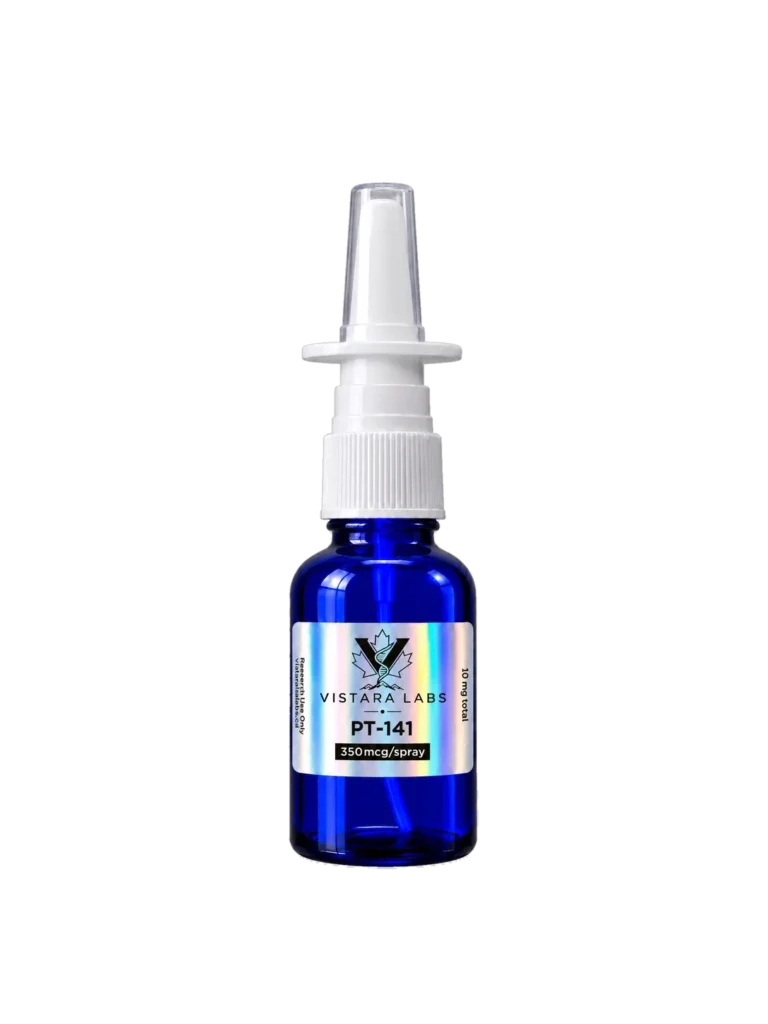
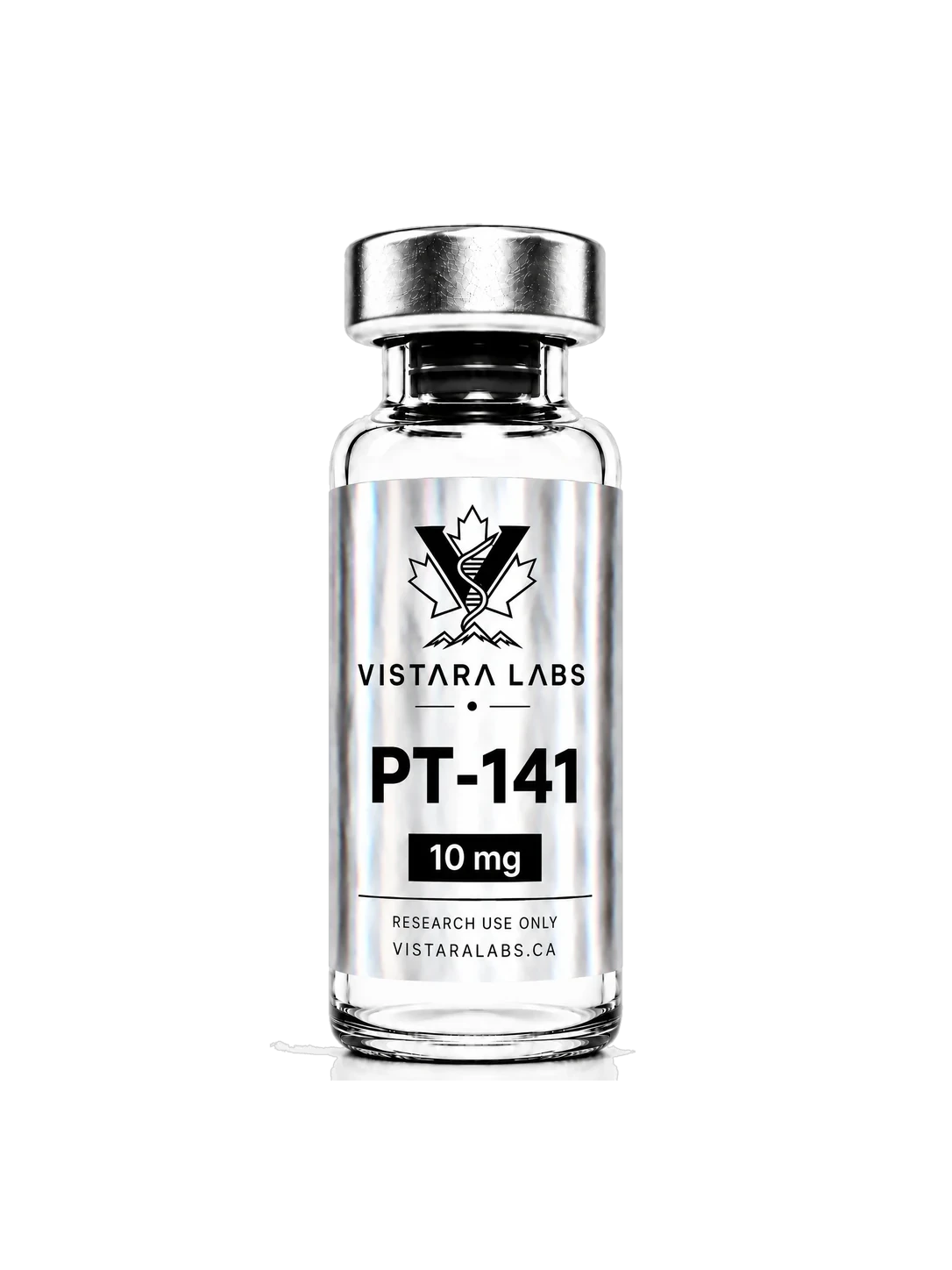
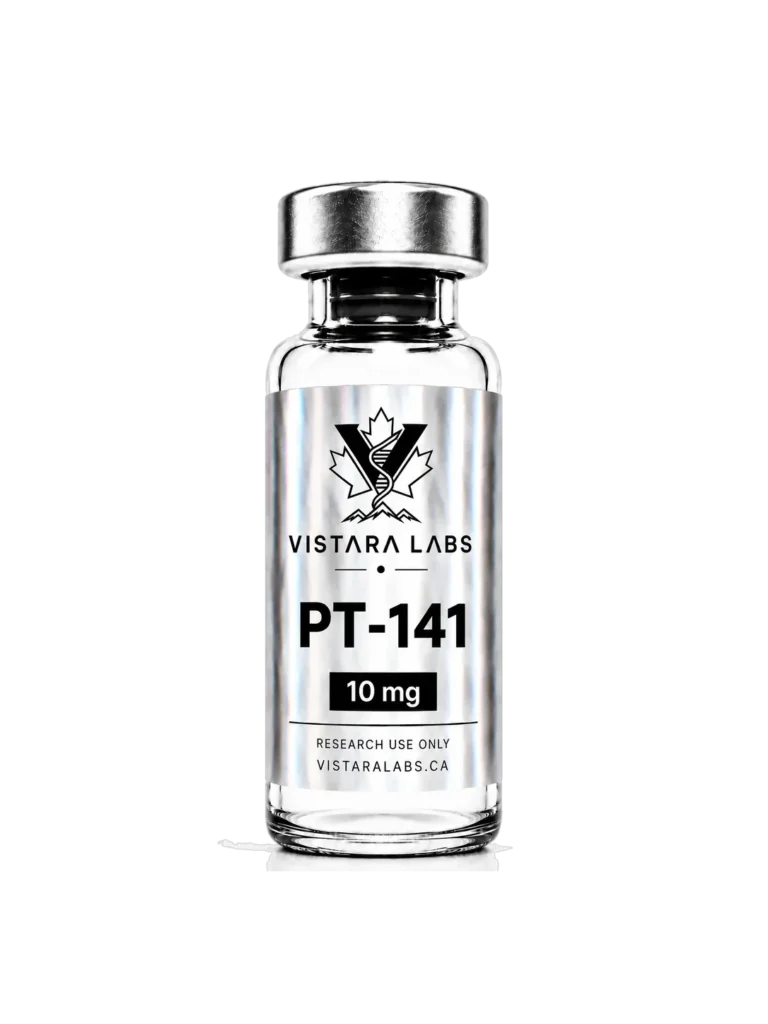
The trial figures above describe pharmaceutical-grade bremelanotide, and identity and purity determine whether laboratory results can be compared with that literature. Vistara Labs supplies PT-141 as a lyophilised vial and as a ready-mixed metered nasal spray. Every product is third-party tested, with certificates on the lab reports page. Mixing is covered in the PT-141 reconstitution guide and stability in How Long Does PT-141 Last?
PT-141 is supplied by Vistara Labs for laboratory research use only. The human studies above were clinical research carried out under medical supervision.
Frequently asked questions
What side effects has PT-141 research reported?
In the phase 3 trials in 1,247 women, the most common effects were nausea (40.0%), flushing (20.3%), injection-site reactions (13.2%) and headache (11.3%). Most were mild to moderate and transient, and serious adverse reactions occurred in 1.1% of women on bremelanotide and 0.5% on placebo.
How long did nausea last in the PT-141 trials?
Nausea usually began within one hour of a dose and lasted about two hours. It was reported by 21% of women after the first dose and by about 3% after later doses.
What did PT-141 research show about blood pressure?
Blood pressure rose by at most 6 mmHg systolic and 3 mmHg diastolic, peaking 2-4 hours after a dose, with heart rate falling by up to 5 beats per minute. Both usually returned to baseline within 12 hours.
What did the long-term PT-141 study show?
In a 52-week open-label extension, 684 women continued on bremelanotide. The most common related events were nausea, flushing and headache, no new safety signals were observed, and improvements in desire were sustained.
Where can I buy PT-141 in Canada?
Vistara Labs supplies PT-141 as a lyophilised vial and a ready-mixed nasal spray, third-party tested and shipped from within Canada by Canada Post Xpresspost.
Product details from vistaralabs.ca, October 2026. Sources: US Food and Drug Administration. Vyleesi (bremelanotide injection) prescribing information. 2019. FDA label. Kingsberg SA et al. Bremelanotide for the treatment of hypoactive sexual desire disorder: two randomized phase 3 trials. Obstet Gynecol. 2019. PMID 31599840. Simon JA et al. Long-term safety and efficacy of bremelanotide for hypoactive sexual desire disorder. Obstet Gynecol. 2019. PMID 31599847. Clayton AH et al. Safety profile of bremelanotide across the clinical development program. J Womens Health. 2022. PMID 35147466. White WB et al. Usefulness of ambulatory blood pressure monitoring to assess the melanocortin receptor agonist bremelanotide. J Hypertens. 2017. PMID 27977473. Diamond LE et al. Double-blind, placebo-controlled evaluation of the safety, pharmacokinetic properties and pharmacodynamic effects of intranasal PT-141. Int J Impot Res. 2004. PMID 14963471.
More on this: Peptides for Women’s Libido: What PT-141 and Oxytocin Research Shows.
All products supplied by Vistara Labs are intended for laboratory research use only. They are not drugs, are not approved for human or veterinary use, and are not intended to diagnose, treat, cure or prevent any condition. Nothing on this page constitutes medical advice or guidance for use in humans.