Semax Half-Life: How Long It Stays Active
Cognitive & Nootropic Research
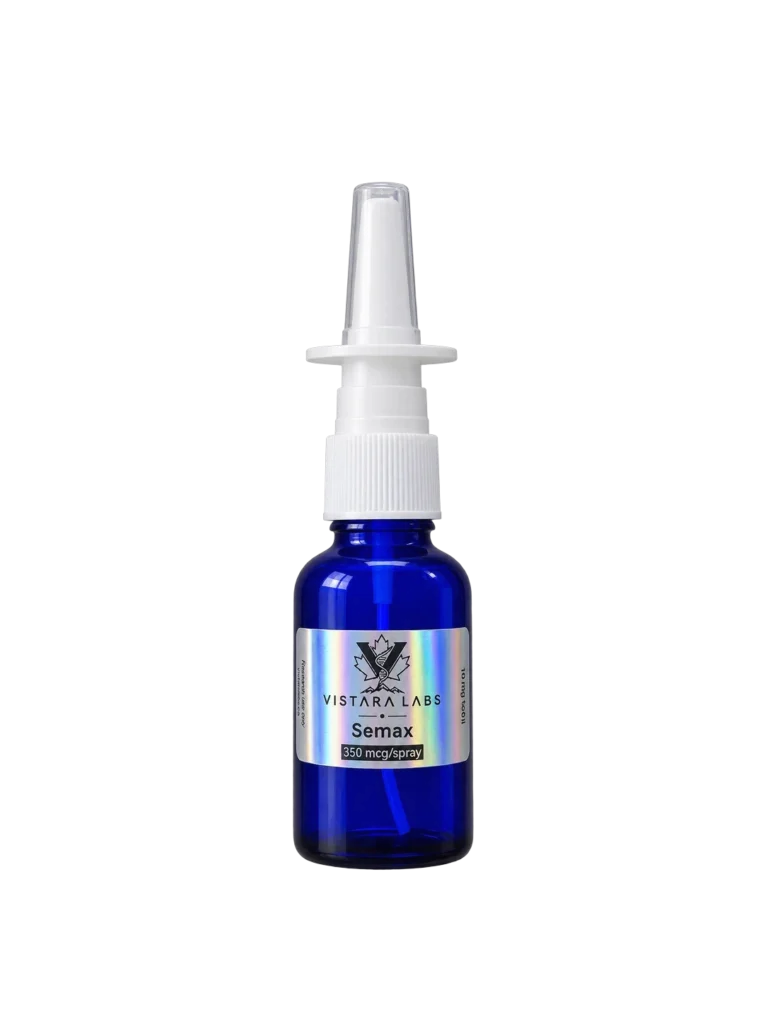
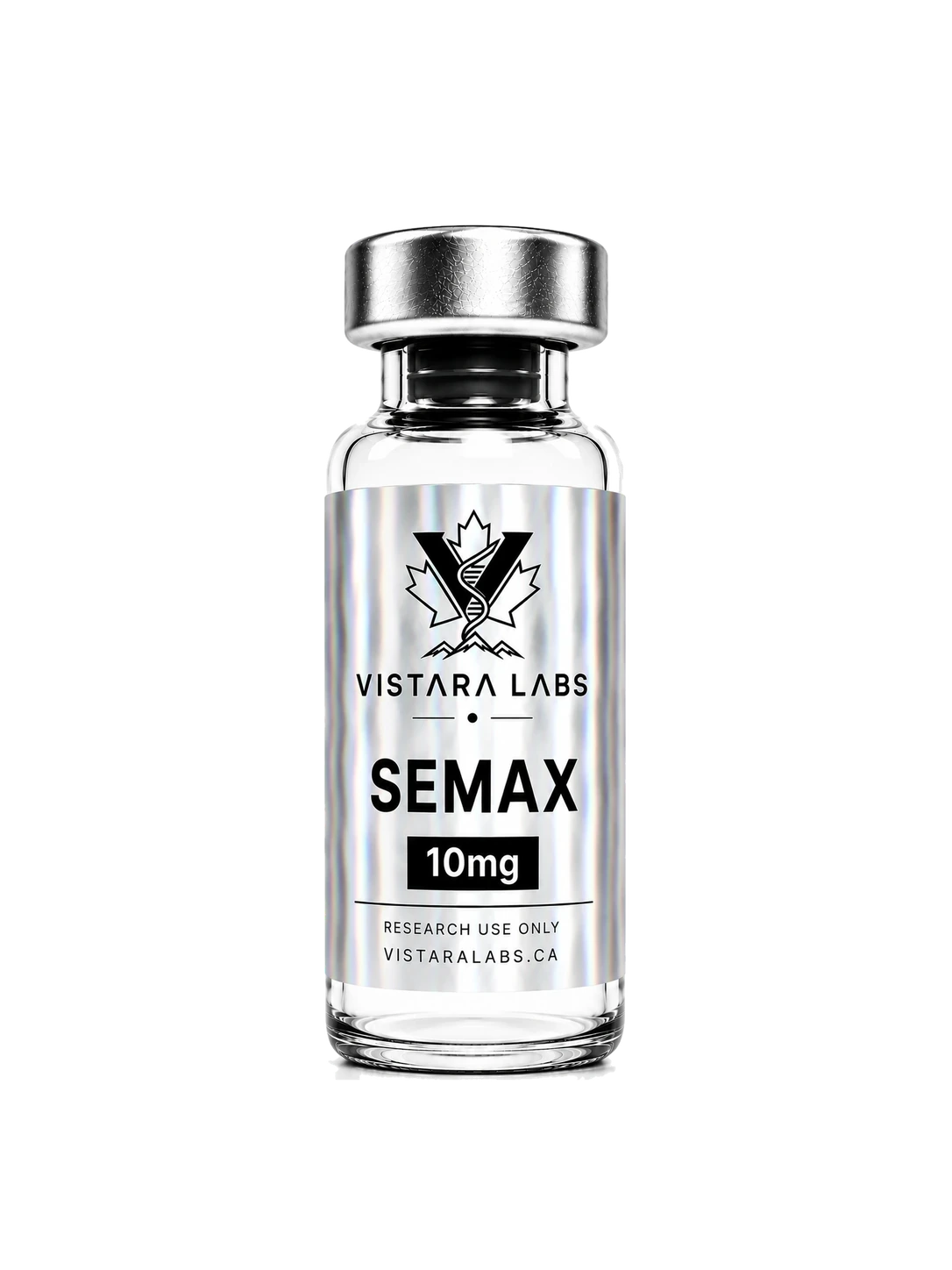
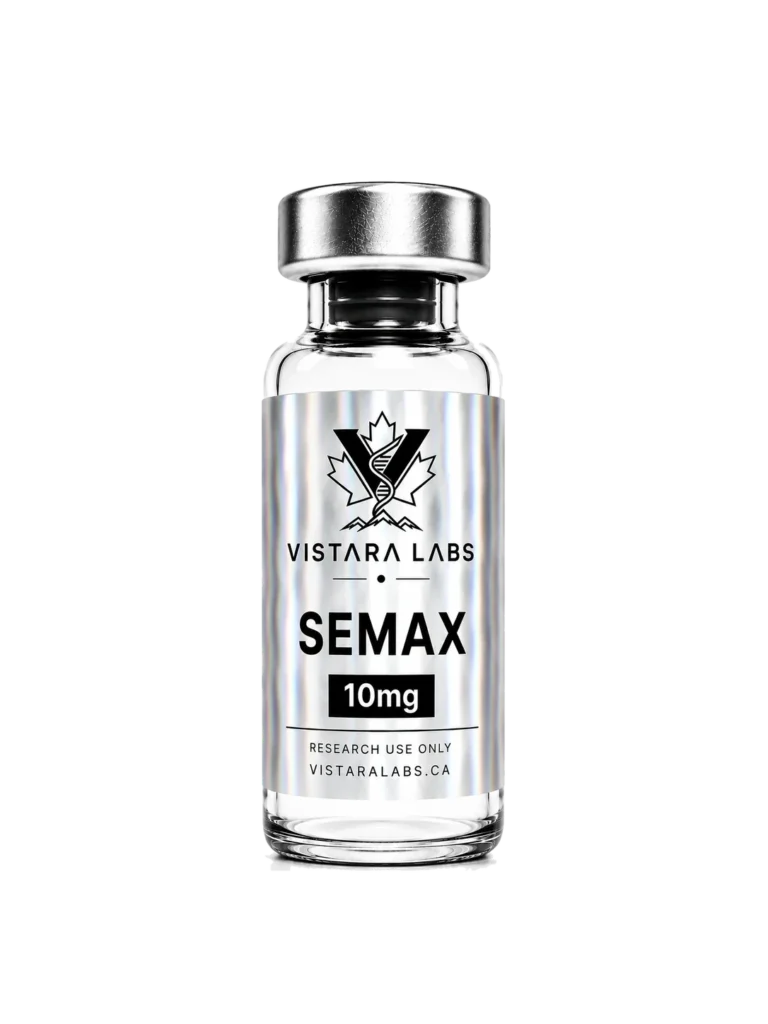
Semax has no single published half-life figure for humans; the Russian prescribing information for Semax nasal drops states that it is absorbed through the nasal lining (up to 60-70% of the active substance), spreads quickly to organs and tissues, crosses the blood-brain barrier and is broken down fairly rapidly once in the blood. Rat studies fill in the detail: after intranasal application, labelled Semax reached the brain within 2 minutes, mostly intact, and its breakdown in the body produces fragments that carry activity of their own. Vistara Labs supplies Semax as a 10 mg lyophilised vial, as a ready-mixed Semax Nasal Spray and in the Selank + Semax Nasal Spray.
Findings
- Russian prescribing information reports nasal absorption of up to 60-70%, rapid distribution to all organs and tissues, passage across the blood-brain barrier and excretion in urine.
- Two minutes after intranasal application in rats, labelled Semax was measurable in the brain, and 80% of that brain radioactivity was intact Semax (Shevchenko et al., 2006).
- Rat blood enzymes trim the first two amino acids, producing relatively stable intermediates, and Semax was more stable than natural ACTH(4-10) against other enzymes (Potaman et al., 1991).
- With rat brain cell membranes, Semax had a half-life of more than 1 hour, broken down step by step into the fragments HFPGP and PGP (Dolotov et al., 2004).
- Intranasal Semax raised BDNF in the rat basal forebrain at 3 hours, and its main fragments have binding sites of their own (Dolotov et al., 2006; Vyunova et al., 2017).
 View product →
What does half-life mean?
Elimination half-life is the time it takes for a compound’s concentration in the blood to fall by half. After one half-life half remains, after two a quarter, after four about one-sixteenth. It describes how fast a molecule is cleared, not how long its effects last and not how long a product keeps on the shelf. For Semax the distinction is sharper than usual, because the peptide is broken down quickly in blood while its effects in the brain are measured hours later and its fragments are themselves active.
What is Semax made of?
Semax is a seven-amino-acid peptide, Met-Glu-His-Phe-Pro-Gly-Pro, built as an analogue of the 4-10 fragment of adrenocorticotropic hormone (ACTH) (Dolotov et al., J Neurochem, 2006). Its first four amino acids match ACTH(4-7); the last three, Pro-Gly-Pro, form a glyproline, a family of proline-rich peptides that are notably stable and biologically active in their own right (Ashmarin et al., 2003; Misiura and Miltyk, Biofactors, 2019). The research behind the compound is covered in Semax Benefits: What the Research Shows and What Is Semax?
How is Semax broken down?
In blood
A 1991 study followed Semax and natural ACTH(4-10) in rat blood and serum. Between a third and a half of the serum’s breakdown activity came from an aminopeptidase, an enzyme that removed the first and second amino acids, methionine and glutamic acid, producing relatively stable intermediates. The degradation curves suggested those intermediates could contribute to the effects of the intact peptide, and Semax proved more stable than ACTH(4-10) against the other enzymes involved (Potaman et al., Biochem Biophys Res Commun, 1991).
At the brain
With plasma membranes from the rat basal forebrain, Semax’s half-life was longer than 1 hour. Dipeptidyl aminopeptidases cut it in sequence to the pentapeptide HFPGP and then the tripeptide PGP (Dolotov et al., Bioorg Khim, 2004). A study using Semax labelled with tritium on every amino acid confirmed HFPGP and PGP as the main products in the presence of nerve cells (Zolotarev et al., 2006).
Active fragments
Those fragments are not inert. HFPGP and PGP have their own binding sites on neuronal membranes, and the Moscow institute behind much of the Semax research describes the parent peptide and its main metabolites as a coordinated set of regulators, which they term a synacton (Vyunova et al., J Mol Recognit, 2017). That is one reason a plasma half-life for intact Semax would capture only part of its activity.
What the nasal route shows
Semax was developed as a nasal preparation, and the published data describe that route working well. In rats given tritium-labelled Semax intranasally, 0.093% of the administered radioactivity per gram was found in the brain 2 minutes later, and 80% of it belonged to intact Semax; the peptide then underwent rapid enzymatic breakdown, with PGP the dominant product in tissue (Shevchenko et al., Bioorg Khim, 2006). Intranasal Semax also raised levels of BDNF, brain-derived neurotrophic factor, a protein that supports nerve cell growth and connections, in the rat basal forebrain 3 hours after application, and specific high-affinity Semax binding sites were found in the same region (Dolotov et al., 2006). The two research routes are compared in Semax and Selank: Intranasal vs Subcutaneous Research Routes.
How does Semax compare with related compounds?
| Compound | Published stability data | Source |
|---|---|---|
| Semax | Rapid breakdown once in blood | Russian prescribing information |
| Semax | Half-life over 1 h with brain membranes | Rat, laboratory |
| ACTH(4-10) | Less stable than Semax in blood | Rat, laboratory |
| Selank | Broken down to TKPRP, TKP and short dipeptides | Plasma, laboratory |
Selank, Semax’s sister peptide, also ends in Pro-Gly-Pro; tritium labelling identified its main breakdown products in blood plasma as the pentapeptide TKPRP, the tripeptide TKP and the dipeptides RP and GP (Zolotarev et al., Bioorg Khim, 2006). The two are compared in Semax vs Selank: What Actually Separates Them, and a modified form of Semax is covered in N-Acetyl Semax Amidate.
What does this mean for study design?
- Measure fragments as well as the parent. Labelling every amino acid, as the Moscow researchers did, lets one experiment track Semax, HFPGP and PGP together.
- Sample early for distribution. Brain uptake after intranasal application was measurable at 2 minutes, so distribution studies start sampling within minutes.
- Read effects on their own timescale. BDNF changes were measured at 3 hours, long after the 2-minute uptake point, so outcome timing follows the biology rather than plasma levels.
The tolerability record is covered in Semax Side Effects.
Half-life in the body vs how long a vial or spray keeps
How quickly Semax is processed in the body says nothing about how long a vial or spray keeps. Shelf life is a question of chemical stability, which depends on temperature, light, moisture and whether the lyophilised (freeze-dried) powder has been mixed. Those timelines are in How Long Does Semax Last? Storage Before and After Mixing, and the chemistry is in Semax Stability: How It Degrades and How to Slow It. The nasal spray arrives ready-mixed in a sealed metered pump; its handling is covered in How to Store a Peptide Nasal Spray. Every product is third-party tested, with certificates on the lab reports page, and orders ship from within Canada by Canada Post Xpresspost.
Semax is supplied by Vistara Labs for laboratory research use only. The detailed figures above come from laboratory and animal research.
Frequently asked questions
What is the half-life of Semax?
No single human half-life figure has been published. Russian prescribing information describes Semax as broken down fairly rapidly once in the blood, and in rat studies it was quickly processed into the active fragments HFPGP and PGP.
How quickly does Semax reach the brain?
In rats, labelled Semax given intranasally was measurable in the brain 2 minutes later, and 80% of that brain radioactivity was intact Semax.
What does Semax break down into?
Enzymes trim Semax step by step to the pentapeptide HFPGP and the tripeptide PGP. These fragments have their own binding sites on nerve cell membranes, so they contribute to its activity.
What did research show about how long Semax’s effects last?
In rats, intranasal Semax raised BDNF in the basal forebrain 3 hours after application. With brain cell membranes, Semax had a half-life of more than 1 hour.
Is Semax’s half-life the same as how long a vial or spray lasts?
No. Half-life describes processing in the body. How long a vial or nasal spray keeps depends on storage and whether the powder has been mixed, which is covered in the Semax storage guide.
Product details from vistaralabs.ca, October 2026. Sources: Semax nasal drops 1%, prescribing information (Russian Federation; registration holder Peptogen), Vidal reference. vidal.ru. Shevchenko KV et al. Kinetics of Semax penetration into the brain and blood of rats after its intranasal administration. Bioorg Khim. 2006. PMID 16523722. Potaman VN et al. N-terminal degradation of ACTH(4-10) and its synthetic analog semax by the rat blood enzymes. Biochem Biophys Res Commun. 1991. PMID 1851003. Dolotov OV et al. The binding of Semax, ACTH 4-10 heptapeptide, to plasma membranes of the rat forebrain basal nuclei and its biodegradation. Bioorg Khim. 2004. PMID 15344653. Dolotov OV et al. Semax, an analogue of adrenocorticotropin (4-10), binds specifically and increases levels of brain-derived neurotrophic factor protein in rat basal forebrain. J Neurochem. 2006. PMID 16635254. Zolotarev IuA et al. Evenly tritium-labeled peptides and their in vivo and in vitro biodegradation. Bioorg Khim. 2006. PMID 16637290. Vyunova TV et al. Synacton and individual activity of synthetic and natural corticotropins. J Mol Recognit. 2017. PMID 27921334. Ashmarin IP et al. Highly stable regulatory oligopeptides: experience and applications. Patol Fiziol Eksp Ter. 2003. PMID 14682258. Misiura M, Miltyk W. Proline-containing peptides: new insight and implications. Biofactors. 2019. PMID 31430415.
More on this: Buy Semax Nasal Spray in Canada.
All products supplied by Vistara Labs are intended for laboratory research use only. They are not drugs, are not approved for human or veterinary use, and are not intended to diagnose, treat, cure or prevent any condition. Nothing on this page constitutes medical advice or guidance for use in humans.
References
Semax has human research, mostly small studies concentrated in Russian-language literature rather than large modern placebo-controlled trials.
- [The efficacy of semax in the tretament of patients at different stages of ischemic stroke]Clinical study of 110 people after ischaemic stroke, with and without Semax; not a large modern placebo-controlled randomised trial.
- Effects of Semax on the Default Mode Network of the BrainSmall human study; 24 healthy volunteers, intranasal Semax versus placebo, resting-state fMRI. Mechanistic — does not establish improved cognition.
- [Effectiveness of semax in acute period of hemispheric ischemic stroke (a clinical and electrophysiological study)]Clinical study; 30 acute ischaemic stroke patients against an 80-patient conventional-treatment control cohort.
Links open the study record on PubMed so the source can be checked directly. Listing a study is not a claim that its findings apply to any other use, product or route of administration. Research use only.