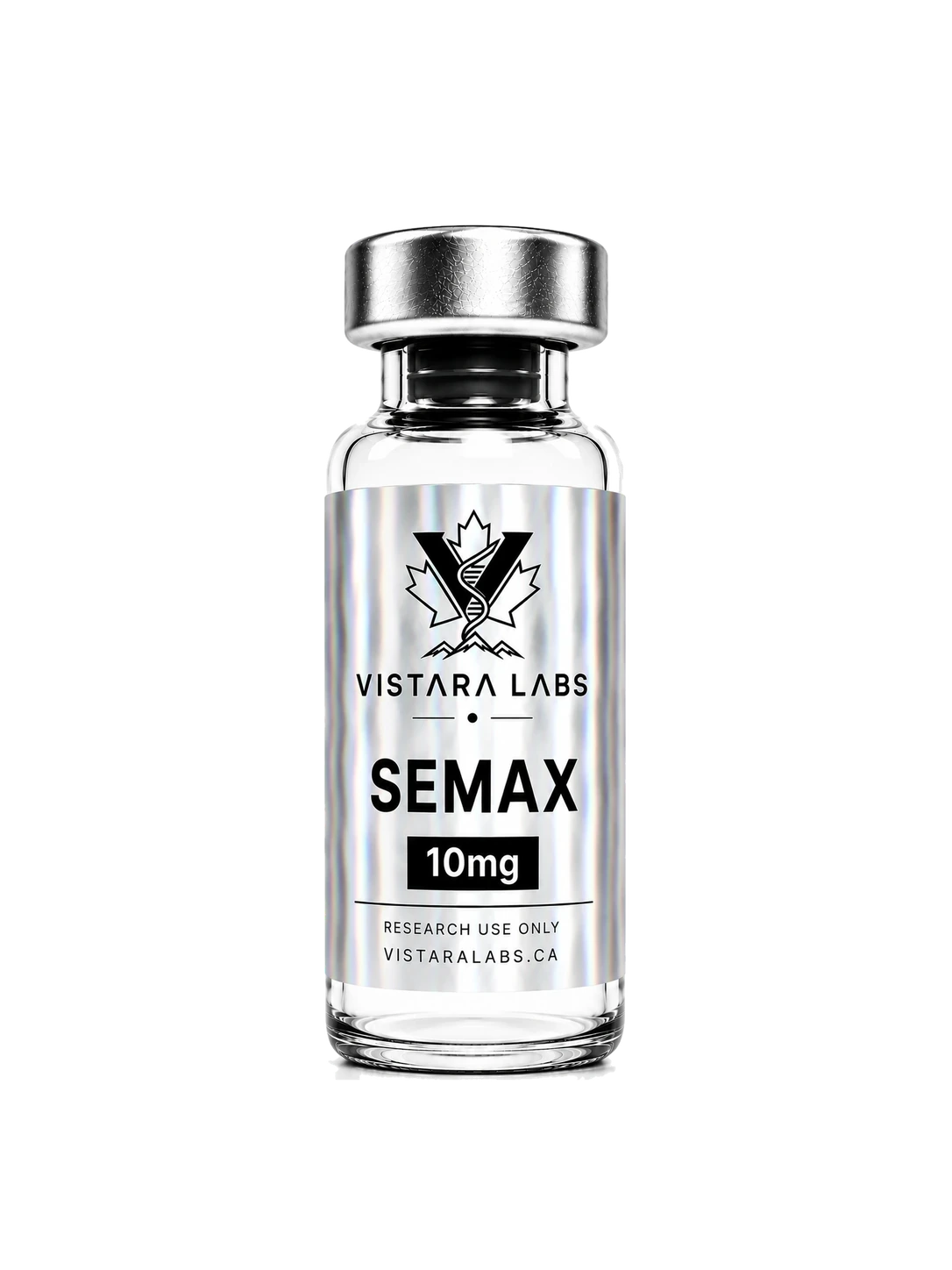
Semax myths: what the research does not show
Cognitive & Nootropic Research
Semax is a synthetic seven-amino-acid peptide modelled on a fragment of ACTH, studied mainly by Russian research groups, with rat work on brain growth factors and a small number of human studies in stroke and brain imaging. This page weighs the common claims about Semax against that record and marks where the claims outrun it.
Findings
- In 110 adults recovering from ischemic stroke, those given Semax had higher blood BDNF levels and better recovery scores on the Barthel index of daily living (2018).
- In rats, Semax raised BDNF protein in the basal forebrain within 3 hours (J Neurochem, 2006).
- In a placebo-controlled imaging study of 24 healthy adults, Semax changed activity in a resting brain network within 20 minutes (2018).
- The biggest gap: we found no large, blinded, multicentre trial of Semax for any use, and none measuring memory or focus in healthy people.
 View product →
Myth: Semax is a proven brain booster for healthy people
Not shown. The healthy-volunteer studies we found used brain scans, not memory or attention tests. In a 2018 study of 24 adults, a frontal part of the default mode network, a set of brain regions active at rest, was larger in the Semax group than with placebo. A 2020 study of 52 adults found changes in connections between the amygdala and the temporal cortex. Those are signs the peptide acts on brain networks. They are not evidence of sharper thinking.
Myth: Semax raises BDNF in the brain
Partly true, with a species caveat. In rats, Semax raised BDNF protein in one brain region, the basal forebrain, but not the cerebellum. In the 2018 stroke study, Semax raised BDNF measured in blood plasma. Brain BDNF in living people was not measured. “Raises BDNF in rat brain and in human blood after stroke” is supported; “raises your brain BDNF” is an extrapolation.
Myth: Semax is proven to speed stroke recovery
Partly true, on limited evidence. In the 2018 study of 110 adults, people who received Semax alongside rehabilitation showed higher BDNF and faster gains on the Barthel index. The abstract does not describe randomization or blinding, and the study was published in Russian. Earlier Russian work in acute stroke focused on inflammation markers. It is a promising signal from one research tradition, not a settled result.
Myth: Semax is an effective ADHD option
The human evidence is thin. A 2007 paper proposing Semax for ADHD was a hypothesis article, built on animal findings, with no new trial. In 2026, a Russian expert council on add-on medicines for childhood ADHD placed Semax in its group with a “limited evidence base”, below a product backed by a randomized trial. That is about as far as the published record goes.
Myth: Semax protects nerves in glaucoma and motor neuron disease
Too little data to judge. A 2001 Russian report described Semax as part of a combined neuroprotective regimen in glaucoma, and its abstract gives no figures. A 2007 open-label study in 27 people with motor neuron disease focused mainly on how nerve tests fluctuate over time. Neither study can show a protective effect on its own.
Myth: Semax acts like the stress hormone ACTH
False, according to the literature. Semax is built from the 4-10 fragment of ACTH, but the 2007 ADHD paper described it as completely devoid of hormonal activity. The interest in Semax is about its effects on the brain, not on the adrenal glands.
What Semax cannot promise
Semax has a consistent body of rat research and a modest set of human reports, most of them from a small number of Russian groups.
- It cannot promise better memory or focus in healthy people; that was not measured.
- It cannot promise stroke recovery; the human data are limited and not clearly blinded.
- It cannot promise ADHD benefit; experts rate the evidence as limited.
- It cannot promise that rat BDNF results apply to the human brain.
Where the evidence stands
Semax is not an approved medicine in Canada for any use. Nearly all of its research comes from Russia, and much of the human work is published only in Russian. Independent, blinded trials outside that tradition have not been published. Semax is offered strictly as a laboratory research material.
Vistara Labs supplies Semax as a laboratory research material. The page above is about the published research, not a claim about our product.
Frequently asked questions
Has Semax been tested in humans?
Yes, in a small number of studies, mostly Russian. They include a 110-person stroke rehabilitation study and brain imaging studies in healthy volunteers.
Does Semax improve memory?
We found no published trial measuring memory or attention in healthy people given Semax. The healthy-volunteer studies we found measured brain network activity on scans.
Is Semax approved in Canada?
No. Semax is not an approved medicine in Canada and is supplied for laboratory research.
Sources: Gusev EI, Martynov MY, Kostenko EV, et al. The efficacy of semax in the treatment of patients at different stages of ischemic stroke [in Russian]. Zh Nevrol Psikhiatr Im S S Korsakova. 2018. PMID 29798983. Miasoedova NF, Skvortsova VI, Nasonov EL, et al. Investigation of mechanisms of neuro-protective effect of semax in acute period of ischemic stroke [in Russian]. Zh Nevrol Psikhiatr Im S S Korsakova. 1999. PMID 10358912. Dolotov OV, Karpenko EA, Seredenina TS, et al. Semax, an analogue of adrenocorticotropin (4-10), binds specifically and increases levels of brain-derived neurotrophic factor protein in rat basal forebrain. J Neurochem. 2006. PMID 16635254. Lebedeva IS, Panikratova YR, Sokolov OY, et al. Effects of Semax on the default mode network of the brain. Bull Exp Biol Med. 2018. PMID 30225715. Panikratova YR, Lebedeva IS, Sokolov OY, et al. Functional connectomic approach to studying Selank and Semax effects. Dokl Biol Sci. 2020. PMID 32342318. Tsai SJ. Semax, an analogue of adrenocorticotropin (4-10), is a potential agent for the treatment of attention-deficit hyperactivity disorder and Rett syndrome. Med Hypotheses. 2007. PMID 16996699. Lapochkin OL, Zykov VP, Zavadenko NN, et al. Expert Council resolution: adjunctive pharmacotherapy for hyperkinetic disorders (attention deficit hyperactivity disorder) in children and adolescents [in Russian]. Zh Nevrol Psikhiatr Im S S Korsakova. 2026. PMID 42910684. Kurysheva NI, Shpak AA, Ioĭleva EE, et al. Semax in the treatment of glaucomatous optic neuropathy in patients with normalized ophthalmic tone [in Russian]. Vestn Oftalmol. 2001. PMID 11569188. Serdiuk AV, Levitskiĭ GN, Miasoedov NF, et al. The study of chronic partial denervation and quality of life in patients with motor neuron disease treated with semax [in Russian]. Zh Nevrol Psikhiatr Im S S Korsakova. 2007. PMID 18379501.
All products supplied by Vistara Labs are intended for laboratory research use only. They are not drugs, are not approved for human or veterinary use, and are not intended to diagnose, treat, cure or prevent any condition. Nothing on this page constitutes medical advice or guidance for use in humans.
References
Semax has human research, mostly small studies concentrated in Russian-language literature rather than large modern placebo-controlled trials.
- [The efficacy of semax in the tretament of patients at different stages of ischemic stroke]Clinical study of 110 people after ischaemic stroke, with and without Semax; not a large modern placebo-controlled randomised trial.
- Effects of Semax on the Default Mode Network of the BrainSmall human study; 24 healthy volunteers, intranasal Semax versus placebo, resting-state fMRI. Mechanistic — does not establish improved cognition.
- [Effectiveness of semax in acute period of hemispheric ischemic stroke (a clinical and electrophysiological study)]Clinical study; 30 acute ischaemic stroke patients against an 80-patient conventional-treatment control cohort.
Links open the study record on PubMed so the source can be checked directly. Listing a study is not a claim that its findings apply to any other use, product or route of administration. Research use only.