Retatrutide myths: what the research does not show
Retatrutide has one of the strongest human trial records of any research peptide: randomized phase 2 and phase 3 trials, thousands of participants, and large average weight changes, but all of it under trial supervision and none of it yet long enough to answer every question people ask. This page sets the common claims about retatrutide against what those trials actually reported.
Findings
- In a phase 3 trial of 2,339 adults with obesity, published in NEJM in 2026, mean body weight fell 25.0% over 80 weeks at the highest dose tested, against 3.9% on placebo.
- In a phase 3 trial of 1,152 adults with obesity and type 2 diabetes (Lancet, 2026), mean weight fell 18.8% at the highest dose against 5.1% on placebo.
- In a 98-person liver substudy (Nat Med, 2024), liver fat returned to the normal range in up to 86% of participants at 24 weeks, against none on placebo.
- The biggest gap: no published retatrutide trial has yet reported what happens to weight after the compound is stopped, or its effect on heart attacks and strokes.
 View product →
Myth: retatrutide is already an approved weight-loss medicine
False. Retatrutide is still investigational. Its first phase 3 results were published in 2026, in NEJM and The Lancet, and it is not an approved medicine in Canada. Strong trial results are a step toward approval, not the same thing as approval.
Myth: retatrutide is just a stronger GLP-1 drug
Partly true, partly not. Retatrutide does act on the GLP-1 receptor, but every trial paper describes it as a triple agonist: it also acts on the GIP and glucagon receptors. Whether the glucagon arm explains the larger weight changes has not been settled by a head-to-head phase 3 trial.
Myth: everyone loses a quarter of their body weight
The 24.2% figure is real, but it is the average of the highest-dose group in a phase 2 trial of 338 adults (NEJM, 2023). Lower doses gave smaller averages, and individuals spread around every average. In adults who also had type 2 diabetes, the 2026 phase 3 trial found a mean loss of 18.8% at the highest dose. An average from a supervised trial is not a forecast for any one person.
Myth: retatrutide burns fat but spares all muscle
Partly true. A body-composition substudy of 189 adults with type 2 diabetes (Lancet Diabetes Endocrinol, 2025) measured fat with DXA scans and found total fat mass fell by about 23% to 26% in the higher-dose groups at 36 weeks, against 4.5% on placebo. Lean mass still fell too. The authors reported that the share of lean mass in the weight lost was similar to other obesity drugs. So the honest reading is “mostly fat”, not “only fat”.
Myth: retatrutide has no side effects
False. Gastrointestinal events were the most common adverse events in every trial reviewed here. In the 2026 phase 3 trial in type 2 diabetes, diarrhoea was reported by 27% to 34% of retatrutide participants against 13% on placebo, and nausea by 14% to 28% against 8%. Low blood pressure and dysesthesia, an abnormal skin sensation, were also more frequent on retatrutide. In one dose group, 12% stopped the study drug for good because of adverse events or death, against 5% on placebo.
Myth: retatrutide reverses fatty liver disease
Partly true, with a limit. In the 2024 liver substudy, liver fat measured by MRI dropped by more than 80% on average in the two higher-dose groups at 24 weeks. That is a large and real result. But the substudy measured fat in the liver, not scarring or long-term liver outcomes, and it had 98 participants. “Reduced liver fat in a trial” is supported; “reverses liver disease” goes further than the published data.
Myth: the weight stays off once you stop
There is no evidence either way for retatrutide. We found no published retatrutide trial that stopped the compound and followed weight afterward. For a related single agonist, semaglutide, a one-year follow-up of 327 trial participants found they regained about two-thirds of the weight they had lost after stopping (Diabetes Obes Metab, 2022). That result belongs to a different compound and cannot simply be carried over to retatrutide. Until a withdrawal study is published, this claim is unsupported.
What retatrutide cannot promise
The results are strong, and they are trial results: selected adults, medical monitoring and 80 weeks of follow-up at most.
- It cannot promise the same result for every person; trial figures are group averages.
- It cannot promise lasting weight change after stopping; that has not been studied for retatrutide.
- It cannot promise freedom from side effects; gastrointestinal events were common.
- It cannot promise long-term heart or liver outcomes; those trials have not reported.
Where the evidence stands
Retatrutide has published phase 2 and phase 3 human trials in obesity, type 2 diabetes, knee osteoarthritis pain and sleep apnea. It is not an approved medicine in Canada for any use. Outside registered trials, it is supplied as a material for laboratory research.
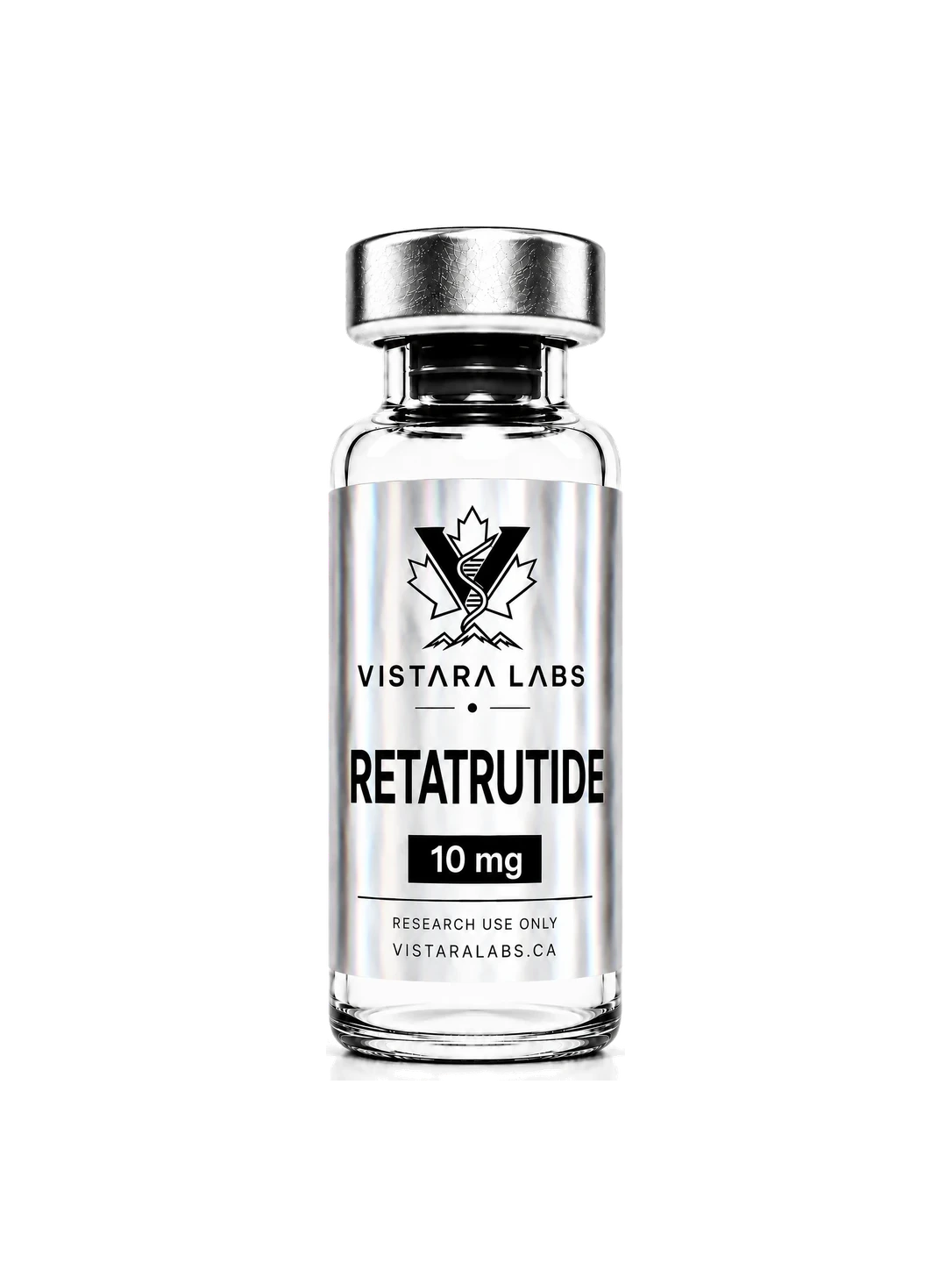
Vistara Labs supplies retatrutide as a laboratory research material. The page above is about the published research, not a claim about our product.
Frequently asked questions
Is retatrutide approved in Canada?
No. Retatrutide is an investigational compound and is not an approved medicine in Canada. Its first phase 3 trial results were published in 2026.
How much weight did people lose in the retatrutide trials?
In a 2026 phase 3 trial of 2,339 adults with obesity, mean weight fell 25.0% over 80 weeks at the highest dose tested, against 3.9% on placebo. In adults with obesity and type 2 diabetes, the mean was 18.8% against 5.1%.
Does retatrutide cause muscle loss?
Lean mass did fall in a 2025 body-composition substudy, alongside a much larger fall in fat mass. The authors reported that the share of lean mass in the weight lost was similar to other obesity drugs.
Sources: Jastreboff AM, Kaplan LM, Frías JP, et al. Triple-hormone-receptor agonist retatrutide for obesity: a phase 2 trial. N Engl J Med. 2023;389(6):514-526. PMID 37366315. Jastreboff AM, Kaplan LM, Davies MJ, et al. Retatrutide, a triple hormone receptor agonist, for treatment of obesity (TRIUMPH-1). N Engl J Med. 2026. PMID 42814954. Bellido V, le Roux CW, Ekinci EI, et al. Retatrutide in adults with obesity and type 2 diabetes (TRIUMPH-2): a double-blind, parallel-group, randomised, placebo-controlled, phase 3 trial. Lancet. 2026. PMID 42810372. Sanyal AJ, Kaplan LM, Frias JP, et al. Triple hormone receptor agonist retatrutide for metabolic dysfunction-associated steatotic liver disease: a randomized phase 2a trial. Nat Med. 2024. PMID 38858523. Coskun T, Wu Q, Schloot NC, et al. Effects of retatrutide on body composition in people with type 2 diabetes: a substudy of a phase 2, double-blind, parallel-group, placebo-controlled, randomised trial. Lancet Diabetes Endocrinol. 2025. PMID 40609566. Wilding JPH, Batterham RL, Davies M, et al. Weight regain and cardiometabolic effects after withdrawal of semaglutide: the STEP 1 trial extension. Diabetes Obes Metab. 2022. PMID 35441470.
All products supplied by Vistara Labs are intended for laboratory research use only. They are not drugs, are not approved for human or veterinary use, and are not intended to diagnose, treat, cure or prevent any condition. Nothing on this page constitutes medical advice or guidance for use in humans.
References
Retatrutide has been evaluated in randomised, placebo-controlled human trials through phase 3.
- Triple-Hormone-Receptor Agonist Retatrutide for Obesity - A Phase 2 TrialRandomised, double-blind, placebo-controlled phase 2 obesity trial, 48 weeks.
- Retatrutide, a GIP, GLP-1 and glucagon receptor agonist, for people with type 2 diabetes: a randomised, double-blind, placebo and active-controlled, parallel-group, phase 2 trial conducted in the USARandomised, double-blind, placebo- and active-controlled phase 2 trial; 281 participants with type 2 diabetes.
- Triple hormone receptor agonist retatrutide for metabolic dysfunction-associated steatotic liver disease: a randomized phase 2a trialRandomised phase 2a substudy; 98 participants with metabolic dysfunction-associated steatotic liver disease.
- Efficacy and safety of retatrutide, a GIP, GLP-1, and glucagon receptor agonist, in people with type 2 diabetes and inadequate glycaemic control with diet and exercise: a double-blind, randomised, phase 3 trialDouble-blind randomised phase 3 trial in type 2 diabetes.
Links open the study record on PubMed so the source can be checked directly. Listing a study is not a claim that its findings apply to any other use, product or route of administration. Research use only.