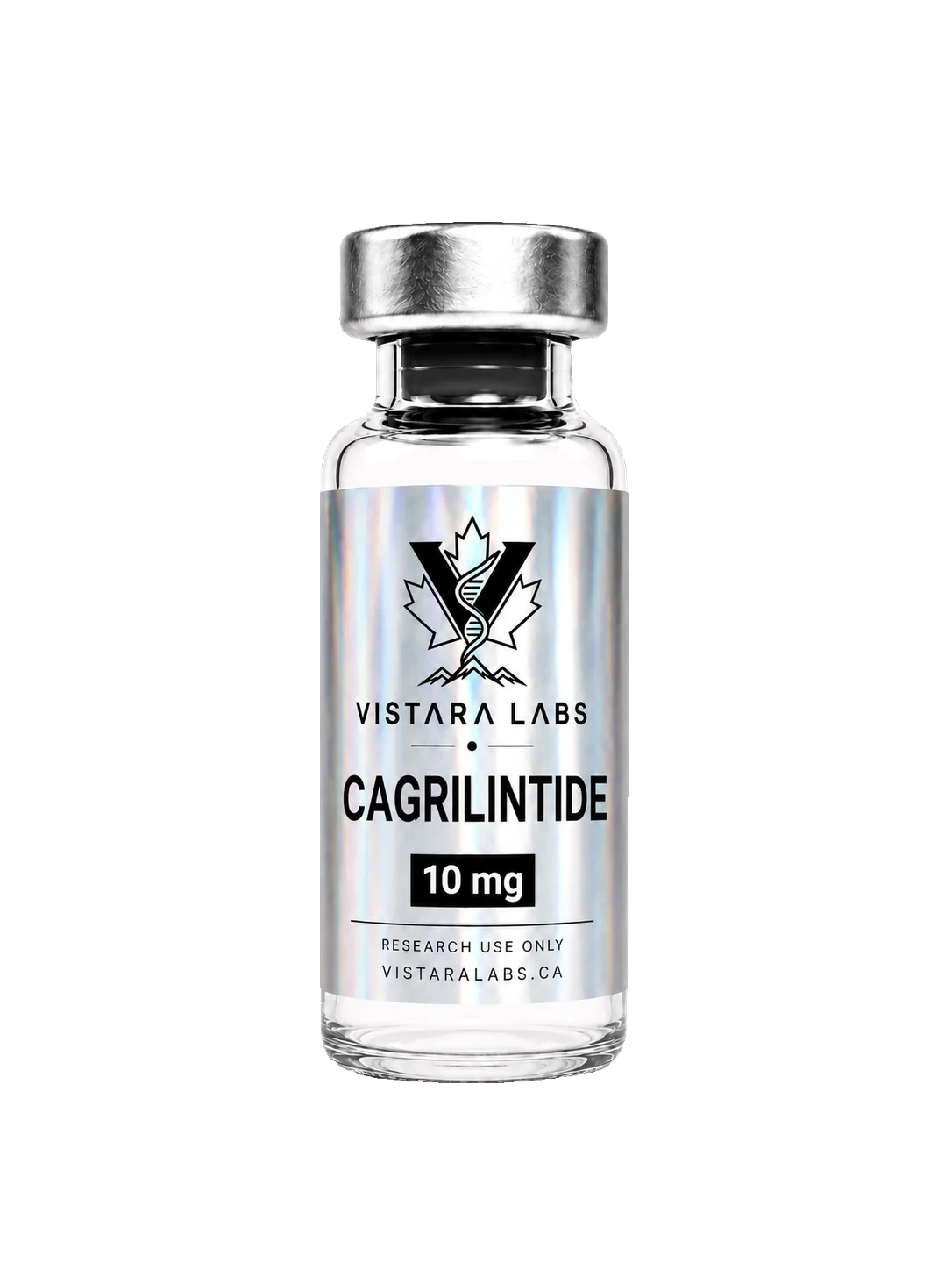
What Is Cagrilintide? The Long-Acting Amylin Analogue
Weight Loss & Metabolism Research
Cagrilintide is a long-acting, lipidated analogue of amylin, the satiety hormone released by the pancreas, engineered by Novo Nordisk to last about a week in circulation instead of minutes. On its own it produced up to 10.8% mean weight reduction in a 26-week Phase 2 trial, and paired with semaglutide as CagriSema it reached a 20.4% mean reduction at 68 weeks in a Phase 3 trial of more than 3,400 adults. This guide covers the hormone it copies, how the molecule was built, and what each trial reported.
Findings
- Amylin is a 37-amino-acid hormone made by the pancreatic beta cells, acting mainly on the circumventricular organs of the brain to regulate glucose and energy balance (2015 review).
- Cagrilintide is a stable, lipidated amylin analogue; in a Phase 1b study its half-life was 159 to 195 hours, which supports once-weekly administration (2021).
- In a Phase 2 trial of 706 adults, once-weekly cagrilintide produced 6.0% to 10.8% mean weight reduction at 26 weeks against 3.0% with placebo; the top dose also beat liraglutide 3.0 mg (2021).
- Combined with semaglutide 2.4 mg as CagriSema, it produced a 20.4% mean weight reduction at 68 weeks against 3.0% with placebo in the REDEFINE 1 trial (2025).
 View product →
What is amylin?
Amylin is a peptide hormone of 37 amino acids secreted by the same pancreatic beta cells that make insulin. A 2015 review in Pharmacological Reviews describes its main role as glucoregulatory and calls it an important regulator of energy metabolism in health and disease (Hay et al., Pharmacol Rev, 2015). It acts principally in the circumventricular organs of the central nervous system, brain regions that sample the blood directly, and it works alongside other appetite and metabolic signals such as cholecystokinin, leptin and estradiol.
Amylin’s receptors are unusual. Each one is built from a core receptor protein, the calcitonin receptor, paired with one of several receptor activity-modifying proteins (RAMPs), which yields multiple receptor subtypes from one core (Hay et al., 2015). That shared core is why amylin analogues are often discussed alongside calcitonin biology.
Why amylin was hard to turn into a drug
Human amylin has a strong tendency to clump into amyloid fibrils, which makes it a difficult starting point for drug design (Kruse et al., J Med Chem, 2021). The first amylin analogue to reach the clinic, pramlintide, solved the aggregation problem and is used in diabetes as an add-on to insulin, but its short half-life means it is given three times a day.
How cagrilintide was engineered
Novo Nordisk’s chemists set out to keep amylin’s satiety signal while fixing both weaknesses: instability and short duration. Their 2021 paper in the Journal of Medicinal Chemistry reports the structure-activity work that led to cagrilintide, a stable, lipidated long-acting amylin analogue selected for clinical development in obesity (Kruse et al., 2021).
Lipidation, also called acylation, means attaching a fatty-acid chain to the peptide. It is the same broad strategy used to give semaglutide its once-weekly profile, and for cagrilintide the result shows in the pharmacokinetics. In a 2021 Phase 1b study, cagrilintide’s half-life ranged from 159 to 195 hours, close to semaglutide’s 145 to 165 hours measured in the same participants, and cagrilintide did not change semaglutide’s exposure or elimination (Enebo et al., Lancet, 2021). Two molecules that last roughly a week each made a once-weekly pairing practical.
The Phase 2 monotherapy trial (Lancet, 2021)
The key study of cagrilintide alone was a multicentre, randomised, double-blind Phase 2 trial at 57 sites in ten countries, including Canada, led by a University of Calgary investigator (Lau et al., Lancet, 2021). It enrolled 706 adults without diabetes who had a body-mass index of at least 30, or at least 27 with high blood pressure or abnormal blood lipids. Participants received once-weekly cagrilintide at one of five strengths from 0.3 to 4.5 mg, once-daily liraglutide 3.0 mg as an active comparator, or placebo, for 26 weeks.
- Every cagrilintide group lost more weight than placebo: mean reductions of 6.0% to 10.8% (6.4 to 11.5 kg) against 3.0% (3.3 kg), with treatment differences of 3.0 to 7.8 percentage points.
- The 4.5 mg group outperformed liraglutide 3.0 mg: 10.8% (11.5 kg) against 9.0% (9.6 kg), an estimated difference of 1.8 percentage points.
- Tolerability: the authors described cagrilintide as well tolerated. The most frequent adverse events were gastrointestinal (nausea, constipation, diarrhoea) and administration-site reactions; treatment discontinuation was similar across groups.
CagriSema: cagrilintide with semaglutide
CagriSema is Novo Nordisk’s name for cagrilintide co-administered with semaglutide, the GLP-1 analogue sold as Ozempic and, at the 2.4 mg strength used here, Wegovy. The rationale is two separate satiety pathways, amylin and GLP-1, acting at once.
Phase 1b (Lancet, 2021)
In 95 adults who received treatment, cagrilintide at 1.2 and 2.4 mg with semaglutide 2.4 mg produced mean weight reductions of 15.7% and 17.1% at week 20, against 9.8% for semaglutide with placebo. Glycaemic measures improved in all groups, and most adverse events were mild to moderate (Enebo et al., 2021).
Phase 2 in type 2 diabetes (Lancet, 2023)
A 32-week trial in 92 adults with type 2 diabetes compared CagriSema with each component alone, all at 2.4 mg. HbA1c fell by 2.2 percentage points with CagriSema, 1.8 with semaglutide and 0.9 with cagrilintide. Body weight fell by 15.6% with CagriSema against 5.1% with semaglutide and 8.1% with cagrilintide, and time in the target glucose range rose from 45.9% to 88.9% in the CagriSema group. No level 2 or 3 hypoglycaemia was reported (Frias et al., Lancet, 2023).
Phase 3: REDEFINE 1 and REDEFINE 2 (NEJM, 2025)
REDEFINE 1 randomised 3,417 adults with obesity or overweight and at least one related condition, without diabetes, to CagriSema, semaglutide alone, cagrilintide alone or placebo for 68 weeks, alongside lifestyle intervention. Mean body weight fell by 20.4% with CagriSema against 3.0% with placebo, a difference of 17.3 percentage points, and more CagriSema participants reached the 20%, 25% and 30% weight-loss thresholds. Gastrointestinal events (79.6% against 39.9%) were mainly transient and mild to moderate (Garvey et al., N Engl J Med, 2025).
REDEFINE 2 randomised 1,206 adults with type 2 diabetes and a body-mass index of 27 or more. At 68 weeks, mean weight fell by 13.7% with CagriSema against 3.4% with placebo, and 73.5% of the CagriSema group reached an HbA1c of 6.5% or lower, against 15.9% on placebo (Davies et al., N Engl J Med, 2025).
Cagrilintide trials at a glance
| Trial | Population | Length | Main weight result |
|---|---|---|---|
| Phase 2, cagrilintide alone (2021) | 706 adults, no diabetes | 26 weeks | 6.0% to 10.8% vs 3.0% placebo |
| Phase 1b, CagriSema (2021) | 95 adults treated | 20 weeks | Up to 17.1% vs 9.8% semaglutide alone |
| Phase 2, CagriSema (2023) | 92 adults, type 2 diabetes | 32 weeks | 15.6% vs 5.1% semaglutide, 8.1% cagrilintide |
| REDEFINE 1 (2025) | 3,417 adults, no diabetes | 68 weeks | 20.4% vs 3.0% placebo |
| REDEFINE 2 (2025) | 1,206 adults, type 2 diabetes | 68 weeks | 13.7% vs 3.4% placebo |
How cagrilintide compares with other metabolic peptides
Most metabolic peptides in current research act on incretin receptors such as GLP-1 and GIP. Cagrilintide is the main long-acting compound working through amylin receptors instead, which is why it is studied both alone and as a partner to a GLP-1 analogue. Side-by-side comparisons are in Retatrutide vs Cagrilintide and Cagrilintide vs Tirzepatide, and the wider field is mapped in Peptides for Weight Loss.
Cagrilintide in Canada
Vistara Labs supplies cagrilintide as a 10 mg lyophilised research vial, shipped from within Canada by Canada Post Xpresspost. Lyophilised vials are reconstituted with bacteriostatic water; the method is in how to reconstitute peptides and the concentration arithmetic in the peptide calculator. Products are third-party tested, with certificates on the lab reports page.
Cagrilintide is supplied for laboratory research use only. The studies above were clinical research using pharmaceutical preparations under medical supervision.
Frequently asked questions
What is cagrilintide?
Cagrilintide is a long-acting, lipidated analogue of amylin, a 37-amino-acid satiety hormone made by the pancreas. Novo Nordisk developed it so that it lasts about a week in circulation, with a measured half-life of 159 to 195 hours, compared with the three-times-daily schedule of the older analogue pramlintide.
What has cagrilintide research shown?
In a 2021 Phase 2 trial of 706 adults, once-weekly cagrilintide produced mean weight reductions of 6.0% to 10.8% at 26 weeks against 3.0% with placebo, and the 4.5 mg group lost more than the liraglutide 3.0 mg group (10.8% against 9.0%).
What is CagriSema?
CagriSema is cagrilintide given together with semaglutide 2.4 mg. In the 68-week REDEFINE 1 trial of 3,417 adults it produced a 20.4% mean weight reduction against 3.0% with placebo, and in REDEFINE 2, in adults with type 2 diabetes, 13.7% against 3.4%.
What does the amylin hormone do?
Amylin is released by pancreatic beta cells and acts mainly on circumventricular regions of the brain. It helps regulate blood glucose and energy balance, and it works alongside signals such as cholecystokinin and leptin to promote satiety.
Where can I buy cagrilintide in Canada?
Vistara Labs supplies cagrilintide as a 10 mg lyophilised research vial, third-party tested and shipped from within Canada by Canada Post Xpresspost.
Product details from vistaralabs.ca, October 2026. Sources: Hay DL et al. Amylin: pharmacology, physiology, and clinical potential. Pharmacol Rev. 2015. PMID 26071095. Kruse T et al. Development of cagrilintide, a long-acting amylin analogue. J Med Chem. 2021. PMID 34288673. Lau DCW et al. Once-weekly cagrilintide for weight management in people with overweight and obesity: a multicentre, randomised, double-blind, placebo-controlled and active-controlled, dose-finding phase 2 trial. Lancet. 2021. PMID 34798060. Enebo LB et al. Safety, tolerability, pharmacokinetics, and pharmacodynamics of concomitant administration of multiple doses of cagrilintide with semaglutide 2.4 mg for weight management: a randomised, controlled, phase 1b trial. Lancet. 2021. PMID 33894838. Frias JP et al. Efficacy and safety of co-administered once-weekly cagrilintide 2.4 mg with once-weekly semaglutide 2.4 mg in type 2 diabetes: a multicentre, randomised, double-blind, active-controlled, phase 2 trial. Lancet. 2023. PMID 37364590. Garvey WT et al. Coadministered cagrilintide and semaglutide in adults with overweight or obesity. N Engl J Med. 2025. PMID 40544433. Davies MJ et al. Cagrilintide-semaglutide in adults with overweight or obesity and type 2 diabetes. N Engl J Med. 2025. PMID 40544432.
More on this: Weight Loss & Metabolism Research.
All products supplied by Vistara Labs are intended for laboratory research use only. They are not drugs, are not approved for human or veterinary use, and are not intended to diagnose, treat, cure or prevent any condition. Nothing on this page constitutes medical advice or guidance for use in humans.