What Is DSIP? Delta Sleep-Inducing Peptide Research
Cognitive & Nootropic Research
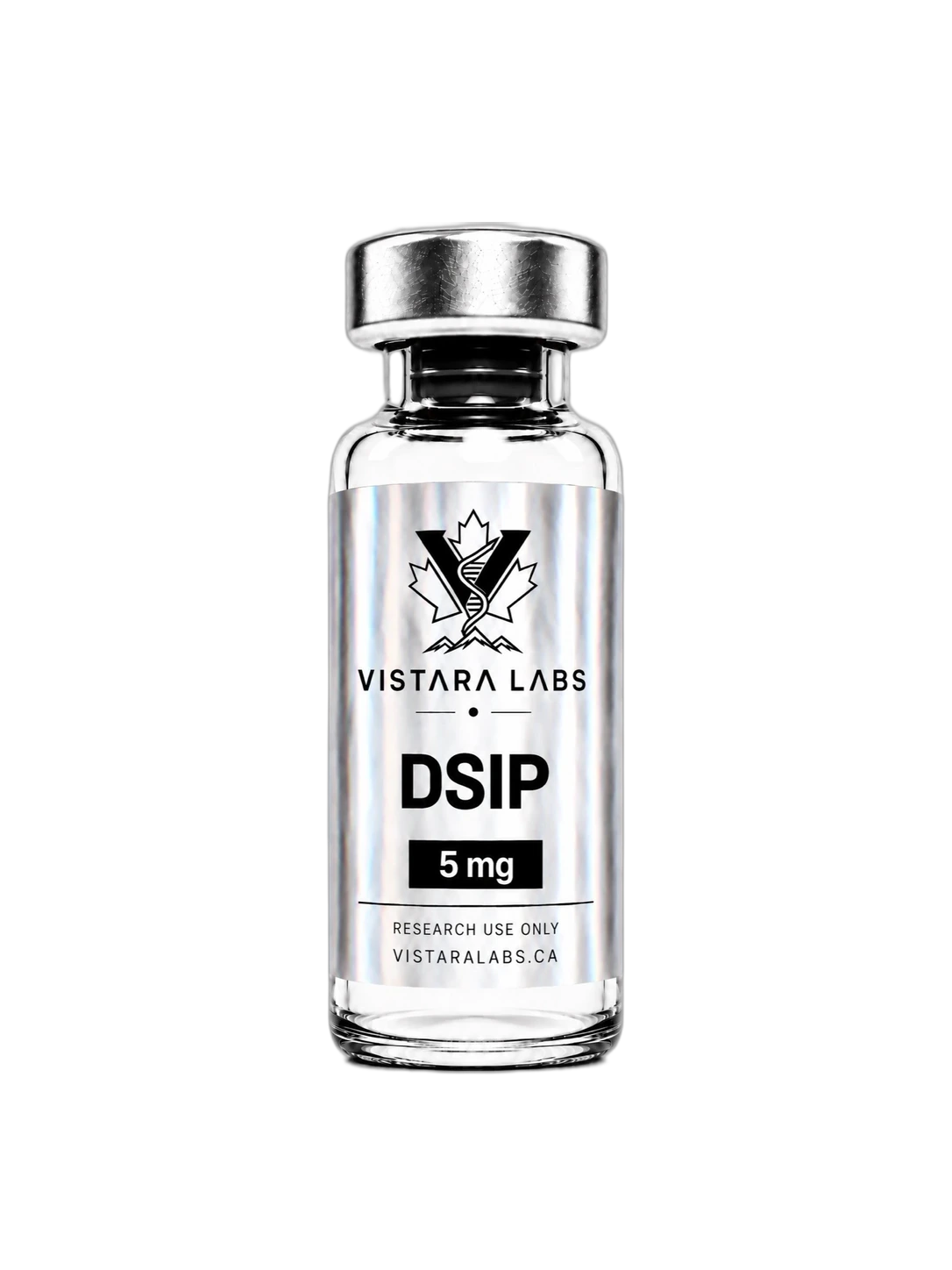
DSIP, short for delta sleep-inducing peptide, is a nine-amino-acid neuropeptide first isolated in animal research in Basel in 1977 and named for the deep, slow-wave (delta) sleep it produced in the first experiments. In the 1980s it moved into human sleep laboratories, where double-blind studies in chronic insomnia recorded better night sleep and sharper daytime function. Vistara Labs supplies DSIP as a 5 mg lyophilised vial and as a ready-mixed DSIP Nasal Spray. This guide covers where the DSIP peptide came from, what it is made of, and what the research recorded.
Findings
- DSIP is a nonapeptide, Trp-Ala-Gly-Gly-Asp-Ala-Ser-Gly-Glu, with a molecular weight of 849 (Schoenenberger and Monnier, 1977; Graf and Kastin, 1984).
- In the founding 1977 animal study, only the synthetic DSIP sequence, out of nine synthetic peptides tested, significantly enhanced delta and spindle EEG patterns.
- In a placebo-controlled, double-blind study of 14 adults with severe chronic insomnia, seven nights of DSIP brought night-time sleep efficiency up to the level of normal controls, with higher daytime alertness and performance (1987).
- Human studies also described good tolerability, improved stress tolerance, and fewer sleep attacks in a single narcolepsy case.
 View product →
Where did DSIP come from?
The delta sleep-inducing peptide grew out of a long search for a “sleep factor” in the blood. In the 1960s, Marcel Monnier’s group in Basel studied the humoral transmission of sleep in animals: blood from sleeping donor animals was dialysed and the dialysate given to recipient animals, whose brain and body responses were then recorded (Schneiderman, Monnier and Hösli, Pflügers Archiv, 1966).
That work culminated in 1977, when Guido Schoenenberger and Monnier reported a peptide, isolated in animal research, that enhanced slow-wave (delta) and spindle EEG activity when infused into the brain’s ventricles. They named it delta-sleep-inducing peptide, sequenced it and made it synthetically. They then synthesised five possible breakdown fragments, two nine-amino-acid analogues with two residues swapped, and a related tripeptide, and tested all nine compounds in an animal model under double-blind conditions. Across 58 animals including controls, with EEG from the neocortex and archicortex analysed by computer, only synthetic DSIP itself produced significant, specific enhancement of delta and spindle patterns (Schoenenberger and Monnier, PNAS, 1977). A later review records that the source material was animal cerebral venous blood (Kovalzon and Strekalova, J Neurochem, 2006).
What is the structure of DSIP?
DSIP is a nonapeptide, a chain of nine amino acids:
Trp-Ala-Gly-Gly-Asp-Ala-Ser-Gly-Glu (one-letter code WAGGDASGE)
A 1984 review gives its molecular weight as 849 and notes that it was one of only two sleep peptides purified to homogeneity and characterised by that time (Graf and Kastin, Neurosci Biobehav Rev, 1984). Its structure differs from every other known peptide family (Kovalzon and Strekalova, 2006). No DSIP gene or dedicated receptor has been isolated, so DSIP is defined by what it does in experiments rather than by a single target. Some researchers have proposed that a larger natural protein, or a DSIP-like peptide, accounts for the DSIP-like immunoreactivity found in the hypothalamus (Kovalzon and Strekalova, 2006).
What did animal research on DSIP show?
The 1984 review summarised the first wave of work: DSIP induced mainly delta sleep in several animal species and in humans, while in one species the effect on REM sleep was more pronounced. Its activity followed a U-shaped curve, with intermediate amounts and infusion times giving the clearest effects. DSIP-like material was measured in animal brain and peripheral organs and in the plasma of several mammals. Beyond sleep, researchers recorded effects on brain electrical activity, neurotransmitter levels, circadian and locomotor patterns, hormone levels, psychological performance, and drug withdrawal (Graf and Kastin, 1984).
What did the human sleep studies report?
Most human DSIP research came from one group in the 1980s, which gave DSIP by slow intravenous injection under double-blind conditions and recorded sleep in the laboratory.
Insomnia
Across five human studies with single and repeated injections, the researchers described good compatibility, a latency to sleep induction of about an hour, and complete normalisation of disturbed sleep in insomniacs after four consecutive injections. During waking hours, participants showed higher alertness and better performance (Schneider-Helmert and Schoenenberger, Neuropsychobiology, 1983). An earlier report on 6 insomniacs recorded longer sleep with fewer interruptions and no daytime sedation (Schneider-Helmert and Schoenenberger, Experientia, 1981).
The strongest result is a 1987 placebo-controlled, double-blind study of 14 middle-aged adults with severe chronic insomnia. Polysomnography was recorded at a placebo baseline, at the start and end of seven nights of DSIP, and on a placebo night afterwards. Night sleep improved with the first administration and further with repeats, and the gain held on the following placebo night. Sleep efficiency at night and daytime rest reached the levels of normal controls, and daytime alertness and performance rose significantly (Schneider-Helmert, Eur Neurol, 1987).
A 1986 study of 18 chronic insomniacs aged 29 to 83 reported that middle-aged participants reached normal sleep values within the week and kept them, while older participants normalised by the end of follow-up (Schneider-Helmert, Eur Neurol, 1986).
Narcolepsy
In a single case, a 35-year-old man with narcolepsy received repeated DSIP injections and was assessed by self-report, performance tests, the multiple sleep latency test and all-night polysomnography. DSIP reduced the frequency of sleep attacks, increased daytime activity, alertness and performance, and compressed the sleep period with enhanced REM sleep. The author attributed this to sharper circadian and ultradian rhythms (Schneider-Helmert, Eur Neurol, 1984).
What other research areas involve DSIP?
Stress
Stress is the second major theme. In the 1983 human studies, psychological tests and assessments by psychotherapists pointed to improved stress tolerance and coping ability (Schneider-Helmert and Schoenenberger, 1983). In an animal model of chronic restraint stress, DSIP lowered liver malondialdehyde, a marker of lipid oxidation, along with shifts in the antioxidant enzymes catalase and superoxide dismutase (Bobyntsev et al., Bull Exp Biol Med, 2016).
Withdrawal
In 1984, 107 inpatients in alcohol or opiate withdrawal received DSIP intravenously. Among those who could be evaluated, symptoms and signs disappeared or improved markedly in 97% of the opiate group and 87% of the alcohol group (Dick et al., Eur Neurol, 1984).
Newer delivery research
Recent work has looked at helping DSIP reach the brain. A 2024 animal study fused DSIP to blood-brain-barrier-crossing peptides; in an insomnia model, the fusion corrected serotonin, glutamate, dopamine and melatonin imbalances better than DSIP alone (Mu et al., Front Pharmacol, 2024).
How does DSIP compare with other sleep compounds?
DSIP sits alongside several other compounds in sleep research. DSIP vs Melatonin sets it against the body’s main circadian hormone, DSIP vs Selank against an anxiety-focused peptide, and Epitalon vs DSIP against a pineal peptide. The wider picture is in Peptides for Sleep: What the Research Shows.
How is DSIP supplied for research?
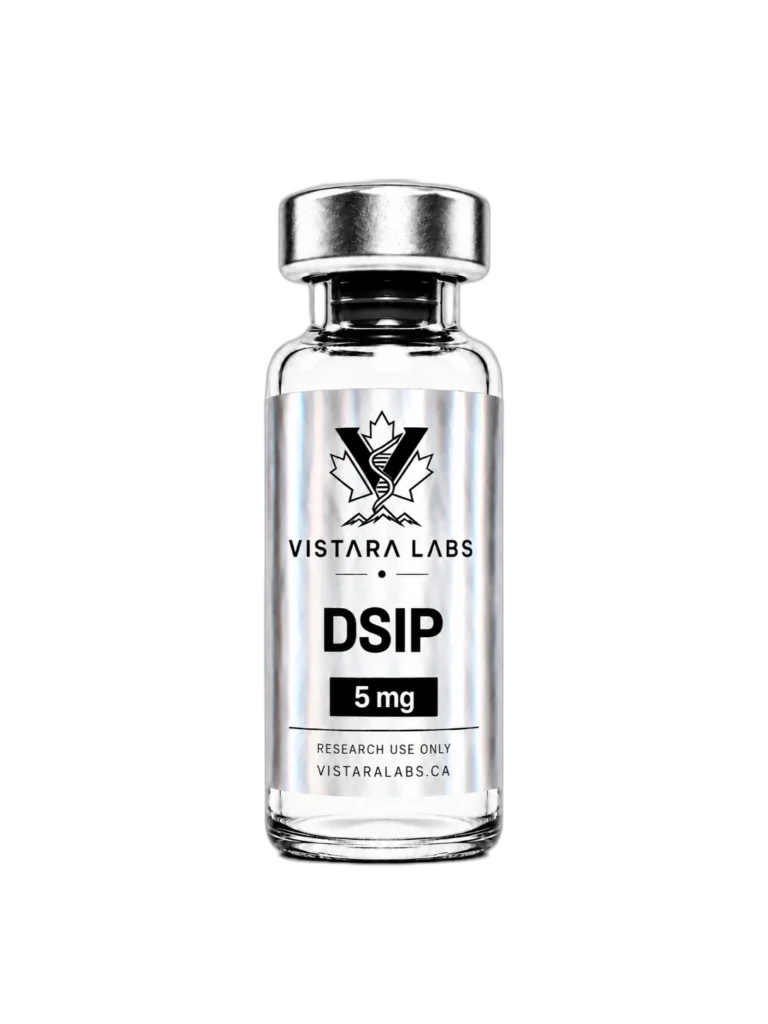
Vistara Labs stocks DSIP in two formats. The DSIP 5 mg vial is a lyophilised powder reconstituted with bacteriostatic water; the volumes are covered in the DSIP reconstitution guide. The DSIP Nasal Spray is a ready-mixed metered spray delivering 0.175 mL per press, and it is paired with Selank in the Sleep & Calm Spray Stack. Products are third-party tested, with certificates on the lab reports page, and ship from within Canada by Canada Post Xpresspost.
DSIP is supplied for laboratory research use only. The human studies above were clinical research using pharmaceutical preparations.
Frequently asked questions
What is DSIP?
DSIP (delta sleep-inducing peptide) is a nine-amino-acid neuropeptide, Trp-Ala-Gly-Gly-Asp-Ala-Ser-Gly-Glu, isolated in animal research by Schoenenberger and Monnier in Basel in 1977. It is named for the deep, delta-wave sleep it produced in the first experiments.
What has DSIP research shown in humans?
In a 1987 placebo-controlled, double-blind study of 14 adults with severe chronic insomnia, seven nights of DSIP brought sleep efficiency to the level of normal controls and raised daytime alertness and performance. Earlier double-blind studies described good tolerability and improved stress tolerance.
How was DSIP discovered?
Monnier’s group spent the 1960s studying sleep factors carried in animal blood. In 1977 they reported a peptide that, infused into the brain’s ventricles, enhanced delta and spindle EEG activity; of nine synthetic peptides tested in 58 animals, only the DSIP sequence did so.
What other areas has DSIP been studied in?
Stress and withdrawal. Human studies reported better stress tolerance and coping, animal studies recorded lower oxidative markers under chronic stress, and a 1984 study reported marked improvement in most evaluable patients in opiate or alcohol withdrawal.
Where can I buy DSIP in Canada?
Vistara Labs supplies DSIP as a 5 mg lyophilised vial and as a ready-mixed nasal spray, shipped from within Canada by Canada Post Xpresspost, with certificates on the lab reports page.
Product details from vistaralabs.ca, October 2026. Sources: Schneiderman N, Monnier M, Hösli L. Humoral transmission of sleep. IV. Cerebral and visceral effects of sleep dialysate. Pflugers Arch. 1966. PMID 5233560. Schoenenberger GA, Monnier M. Characterization of a delta-electroencephalogram (-sleep)-inducing peptide. Proc Natl Acad Sci USA. 1977. PMID 265572. Graf MV, Kastin AJ. Delta-sleep-inducing peptide (DSIP): a review. Neurosci Biobehav Rev. 1984. PMID 6145137. Kovalzon VM, Strekalova TV. Delta sleep-inducing peptide (DSIP): a still unresolved riddle. J Neurochem. 2006. PMID 16539679. Schneider-Helmert D, Schoenenberger GA. Effects of DSIP in man. Neuropsychobiology. 1983. PMID 6689058. Schneider-Helmert D, Schoenenberger GA. The influence of synthetic DSIP on disturbed human sleep. Experientia. 1981. PMID 7028502. Schneider-Helmert D. Effects of delta-sleep-inducing peptide on 24-hour sleep-wake behaviour in severe chronic insomnia. Eur Neurol. 1987. PMID 3622582. Schneider-Helmert D. Efficacy of DSIP to normalize sleep in middle-aged and elderly chronic insomniacs. Eur Neurol. 1986. PMID 3792404. Schneider-Helmert D. Effects of DSIP on narcolepsy. Eur Neurol. 1984. PMID 6548968. Bobyntsev II et al. Effect of delta sleep-inducing peptide on functional state of hepatocytes in rats during restraint stress. Bull Exp Biol Med. 2016. PMID 26902351. Dick P et al. DSIP in the treatment of withdrawal syndromes from alcohol and opiates. Eur Neurol. 1984. PMID 6548969. Mu X et al. Pichia pastoris secreted peptides crossing the blood-brain barrier and DSIP fusion peptide efficacy in PCPA-induced insomnia mouse models. Front Pharmacol. 2024. PMID 39444618.
More on this: Buy DSIP in Canada and Buy DSIP Nasal Spray in Canada.
All products supplied by Vistara Labs are intended for laboratory research use only. They are not drugs, are not approved for human or veterinary use, and are not intended to diagnose, treat, cure or prevent any condition. Nothing on this page constitutes medical advice or guidance for use in humans.