What Is Pinealon? The EDR Brain Peptide Explained
Cognitive & Nootropic Research
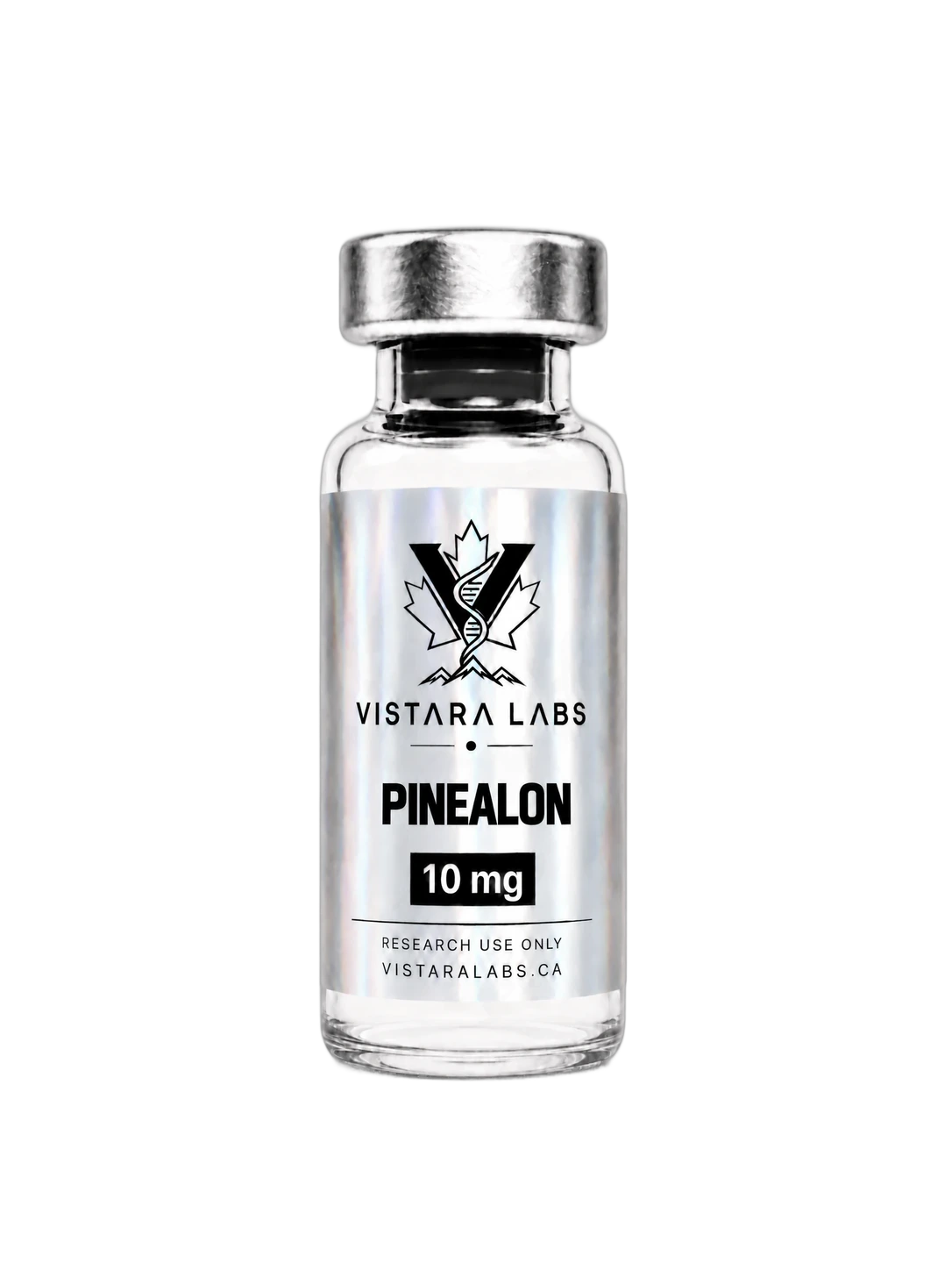
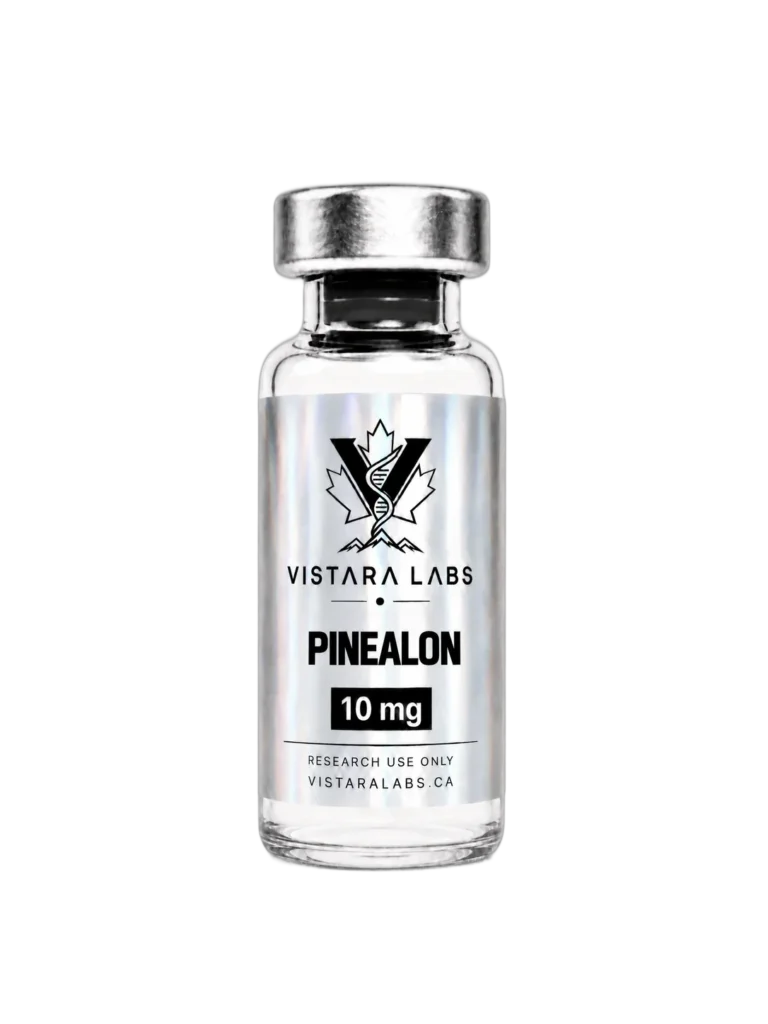
Pinealon is a synthetic tripeptide, Glu-Asp-Arg (EDR), developed in Vladimir Khavinson’s short-peptide bioregulator programme in Saint Petersburg and studied as a protector of brain cells. In laboratory work it limited oxidative damage in neurons, protected the brains of rat offspring exposed to high homocysteine before birth, improved learning in rats under low oxygen and preserved synapses in Alzheimer’s disease models, and small Russian studies in adults reported better biological-age indicators. Its developers propose that a peptide this small enters the cell nucleus and adjusts gene activity. Vistara Labs supplies it as a Pinealon 10 mg lyophilised vial.
Findings
- Pinealon is just three amino acids, glutamic acid, aspartic acid and arginine, with a molecular weight of about 418 (PubChem).
- Researchers at the Saint Petersburg institute describe EDR as derived from Cortexin, a polypeptide preparation from calf brain cortex (2019).
- Labelled Pinealon entered the nucleus and nucleolus of cultured cells, and EDR binds the major groove of DNA (2011, 2019).
- It restricted reactive oxygen species and necrotic death in neurons, and in rat offspring exposed to high homocysteine it improved learning and neuron survival (2011, 2012).
- In amyloid-treated neurons it raised mushroom spines by 71%, back to normal (2017), and in Alzheimer’s model mice it restored hippocampal spine density (2021).
 View product →
What Pinealon is and where it came from
Pinealon has the formula C15H26N6O8 and a molecular weight of about 418.4 (PubChem CID 10273502). In the literature it appears as Pinealon, EDR, Glu-Asp-Arg and, in culture work, as T-33 (Voicekhovskaya et al., Bull Exp Biol Med, 2012).
The bioregulator programme
Khavinson’s group began by extracting polypeptide complexes from animal organs, such as Cortexin from the brain cortex and Thymalin from the thymus, and then set out to find the short peptides that carried each extract’s activity. In a 2015 comparison, extracts from seven tissues each stimulated the growth of cultures of their own tissue in young and old rats, the tissue-specific idea behind the programme (Ryzhak et al., Advances in Gerontology, 2015). Synthetic di-, tri- and tetrapeptides followed, of which Epitalon is the best known.
A brain peptide with a pineal name
Despite the name, Pinealon’s research record is about the brain rather than the pineal gland. In rat pineal gland cultures, it was Epitalon (Ala-Glu-Asp-Gly) that stimulated the growth and secretory activity of pineal cells (Khavinson et al., Bull Exp Biol Med, 2011). Researchers from the institute describe EDR as one of two short peptides derived from Cortexin (Kuznik et al., Molecular Biology, 2019), and a 2021 paper describes it as found in Cortexin with similar neuroprotective activity (Khavinson et al., Pharmaceuticals, 2021).
How Pinealon works
Inside the nucleus
The group’s central idea is that very short peptides can cross cell and nuclear membranes and interact with DNA or with histones, the proteins that package DNA. Fluorescently labelled Pinealon appeared in the cytoplasm, nucleus and nucleolus of HeLa cells, and in solution it bound preferentially to DNA sequences containing CAG (Fedoreyeva et al., Biochemistry (Moscow), 2011). A physics group at Saint Petersburg State University found that EDR partly enters the major groove of DNA and contacts guanine, an interaction helped by magnesium ions (Silanteva et al., J Phys Chem B, 2019).
How it gets into cells is still being modelled. Computer docking ranked EDR among the most effective ligands for the LAT1, LAT2 and PEPT1 transporters, which carry amino acids and small peptides across membranes (Khavinson et al., Biomolecules, 2023).
Antioxidant and survival signalling
In cell work, Pinealon limited reactive oxygen species and necrotic death, and its protection came with a delayed activation of ERK 1/2, a growth and survival signalling pathway. Because the antioxidant effect levelled off at low concentrations while cell-cycle effects continued at higher ones, the authors proposed a direct action on the genome alongside the antioxidant one (Khavinson et al., Rejuvenation Research, 2011). A 2020 review lists the proteins EDR has been linked to: caspase-3 and p53 in cell death, the antioxidant enzymes SOD2 and GPX1, the transcription factors PPARA and PPARG, serotonin and calmodulin (Khavinson et al., Molecules, 2020).
What the research has shown
Protecting neurons
Homocysteine is an amino acid that damages neurons at high levels. When pregnant rats were loaded with methionine to raise it, Pinealon given to the mothers improved the offspring’s spatial learning, cut oxidant-induced reactive oxygen species in their cerebellar neurons by about a third and lowered necrotic neurons from 17.7% to 7.0%. The authors noted the protection came from reduced neurotoxicity rather than lower homocysteine (Arutjunyan et al., Int J Clin Exp Med, 2012).
Low oxygen and ageing
In a hypobaric hypoxia model, Pinealon had the most pronounced protective effect of four Khavinson peptides tested, an effect linked to the cell’s own antioxidant enzymes (Kozina, Advances in Gerontology, 2008). In young and old rats under acute hypoxia it improved Morris water maze learning more than Cortexin (Mendzheritskii et al., Advances in Gerontology, 2013), and in old rats the authors linked it to increased neurogenesis and reduced neuroinflammatory reactions (Mendzheritskii et al., Advances in Gerontology, 2014). EDR also stimulated serotonin expression in ageing brain cortex cultures (Khavinson et al., Bull Exp Biol Med, 2014).
Synapses in Alzheimer’s disease models
Mushroom spines are the mature, stable dendritic spines that hold long-lasting synapses. In hippocampal neurons exposed to amyloid, EDR at 200 ng/mL raised their number by 71% and restored the normal level (Kraskovskaya et al., Bull Exp Biol Med, 2017). In 5xFAD mice, a strain that builds amyloid plaques, two months of EDR restored total spine density in the CA1 hippocampus to the level of control mice (Khavinson et al., Pharmaceuticals, 2021).
Studies in people
Russian groups have published small studies in adults. In 32 people aged 41 to 83 with organic brain syndrome, Pinealon and Vesugen improved central nervous system activity and biological-age indicators (Meshchaninov et al., Advances in Gerontology, 2015). In professional lorry drivers, peptide bioregulators improved psychoemotional indices, most of all when Pinealon and Vesugen were combined (Bashkireva and Artamonova, Advances in Gerontology, 2012).
Forms we stock
Vistara Labs supplies Pinealon as a 10 mg lyophilised vial, third-party tested with certificates on the lab reports page. Mixing volumes are in Pinealon reconstitution, and ordering details are in Buy Pinealon in Canada. Related programme peptides we stock are Epitalon and Cartalax; other brain peptides are on our Cognitive & Nootropic Research page, including Cerebrolysin.
Pinealon is supplied by Vistara Labs for laboratory research use only. Most of the studies above were laboratory research.
Frequently asked questions
What is Pinealon?
Pinealon is the synthetic tripeptide Glu-Asp-Arg (EDR), a short-peptide bioregulator from Vladimir Khavinson’s programme in Saint Petersburg, studied mainly as a protector of brain cells.
Is Pinealon related to the pineal gland?
Despite its name, its research is about the brain. Researchers at the Saint Petersburg institute describe EDR as derived from Cortexin, a calf brain cortex preparation.
How does Pinealon work?
Its developers propose that it enters the cell nucleus and adjusts gene activity. In cells it limited reactive oxygen species, delayed ERK 1/2 activation and has been linked to caspase-3, SOD2, PPARG and serotonin.
What did Pinealon research show in Alzheimer’s disease models?
In amyloid-treated neurons EDR raised mushroom spines by 71%, back to normal, and in 5xFAD mice two months of EDR restored hippocampal spine density to the level of control mice.
Has Pinealon been studied in people?
Yes, in small Russian studies. Adults aged 41 to 83 with organic brain syndrome showed improved nervous system activity and biological-age indicators, and lorry drivers showed better psychoemotional indices.
Product details from vistaralabs.ca, October 2026. Compound data from PubChem (CID 10273502). Sources: Kozina LS. Adv Gerontol. 2008. PMID 18546825. Khavinson V et al. Rejuvenation Res. 2011. PMID 21978084. Khavinson VKh et al. Effect of short peptides on expression of signaling molecules in organotypic pineal cell culture. Bull Exp Biol Med. 2011. PMID 22803060. Fedoreyeva LI et al. Biochemistry (Mosc). 2011. PMID 22117547. Voicekhovskaya MA et al. Bull Exp Biol Med. 2012. PMID 22803085. Arutjunyan A et al. Int J Clin Exp Med. 2012. PMID 22567179. Bashkireva AS, Artamonova VG. Adv Gerontol. 2012. PMID 23734521. Mendzheritskii AM et al. Adv Gerontol. 2013. PMID 28976148. Mendzheritskii AM et al. Adv Gerontol. 2014. PMID 25051764. Khavinson VKh et al. Bull Exp Biol Med. 2014. PMID 24909721. Ryzhak AP et al. Adv Gerontol. 2015. PMID 26390619. Meshchaninov VN et al. Adv Gerontol. 2015. PMID 26390612. Kraskovskaya NA et al. Bull Exp Biol Med. 2017. PMID 28853087. Silanteva IA et al. J Phys Chem B. 2019. PMID 30762356. Kuznik BI et al. Mol Biol (Mosk). 2019. PMID 31099784. Khavinson V et al. EDR peptide: possible mechanism of gene expression and protein synthesis regulation involved in the pathogenesis of Alzheimer’s disease. Molecules. 2020. PMID 33396470. Khavinson V et al. Pharmaceuticals. 2021. PMID 34071923. Khavinson VK et al. Feasibility of transport of 26 biologically active ultrashort peptides via LAT and PEPT family transporters. Biomolecules. 2023. PMID 36979488.
More on this: Buy Pinealon in Canada: The 10 mg EDR Research Vial.
All products supplied by Vistara Labs are intended for laboratory research use only. They are not drugs, are not approved for human or veterinary use, and are not intended to diagnose, treat, cure or prevent any condition. Nothing on this page constitutes medical advice or guidance for use in humans.