Semax vs Selank: What Actually Separates Them
Cognitive & Nootropic Research
Semax and Selank get compared constantly, and the comparison is slightly misleading. They came out of the same Russian institute, they were built using the same stabilising trick, and they are sold side by side everywhere. But they are derived from unrelated parent molecules and are studied around different systems. Asking which is better is a bit like asking whether a throttle is better than a brake.
 View product →
Findings
- Same Russian institute, same stabilising design, but different parent molecules and different research territories.
- Semax is the activating side: BDNF, plasticity, stroke and attention research.
- Selank is the calming side: anxiety and stress research via the GABA system.
- They are studied together because they complement rather than overlap.
The short version
| Semax | Selank | |
|---|---|---|
| Derived from | ACTH(4–10) fragment | Tuftsin |
| Parent molecule’s day job | Adrenal hormone signalling | Immune signalling |
| Main research theme | BDNF, neurotrophic signalling, plasticity | GABAergic modulation, enkephalinase inhibition |
| Studied in | Stroke, brain injury, attention and memory models | Anxiety and stress models |
| Loose characterisation | The activating side | The calming side |
| Russian clinical status | Registered; essential medicines list | In clinical use since the 1990s |
What they genuinely share
Three things, and they are the reason the two are permanently linked:
- The same institute. Both came out of Russian neuropeptide research programmes in the same era.
- The same stabilising design. Each takes a fragile natural fragment and attaches a Pro-Gly-Pro sequence to protect it from the enzymes that would otherwise destroy it within minutes. That is a design decision, not a mechanism.
- The same delivery question. Both are studied predominantly as intranasal formulations, for the same reason — peptides cross the blood–brain barrier poorly.
What they do not share is a receptor, a pathway, or a research literature. The shared surname is chemistry, not biology.
Where they diverge
Semax: the plasticity arm
The consistent thread through the Semax literature is BDNF — brain-derived neurotrophic factor — and its TrkB receptor. BDNF is the protein most closely associated in neuroscience with synaptic plasticity, meaning the brain’s capacity to strengthen and reorganise connections. The Semax work sits on top of an original programme aimed at ischaemic stroke, which is why a surprising amount of it is neuroprotection research rather than cognitive-enhancement research.
Selank: the inhibitory arm
Selank’s literature centres on GABAergic modulation — GABA being the brain’s main inhibitory signal — and on inhibiting the enzymes that break down enkephalins, the body’s own short opioid-like signalling peptides. The clinical use in Russia is for anxiety rather than cognition. Its defining design claim was anxiolytic activity without sedation, which is the specific thing that made it interesting.
Why they are studied together
The pairing has a community nickname — the Russian nootropic stack — and the rationale behind it is the same rationale behind any sensible peptide stack: the two compounds address different, non-overlapping parts of one system.
Put simply, one is studied around excitatory and plasticity signalling and the other around inhibitory and stress signalling. Compounds that pull on separate levers are more interesting to study together than compounds that pull on the same one, where you cannot tell which is responsible for what you observe. Pairing two GABAergic compounds tells you very little; pairing a plasticity-oriented compound with an inhibitory one at least gives you two distinguishable variables.
This is a research rationale built from each compound’s own literature. Published work on the two in combination is still limited, so the pairing draws on what is known about each separately, which is also where a study of the stack would naturally begin.
A third component: Cerebrolysin
Where a stack extends beyond the two, the usual third is Cerebrolysin — a mixture of low-molecular-weight peptides derived from porcine brain tissue, studied as a broad neurotrophic-factor mimetic.
It is worth knowing because it adds international trial data to the evidence picture. Cerebrolysin has been through international randomised controlled trials in dementia, stroke and traumatic brain injury. The results across those trials are mixed, and the trials were run outside Russia and published in widely read journals. That record makes it a natural third component alongside Semax and Selank.
Which one, if you are only picking one
The choice comes down to research design, and the right compound depends on what is being investigated. Semax is the one with the neurotrophic and plasticity literature behind it; Selank is the one with the anxiolytic and stress literature. Neither is a stronger compound than the other in any general sense — they have barely been compared head to head, because they were never developed to do the same job.
Where the evidence stands for both
Both compounds have a genuine clinical history, most of it built through Russian trials, alongside a smaller and growing body of international work. The trials are largely published in Russian-language journals. Neither is approved in Canada, and Health Canada has assessed neither for safety or efficacy.
That combination, a long clinical record in one country and an international literature still catching up, is the single most important thing to understand about this pair. It is also why the published studies themselves are the best place to start when reading about either compound.
The reason no Western sponsor has taken either compound through trials is not scientific but economic, and it applies across most of this category: why peptides like these never reach approval.
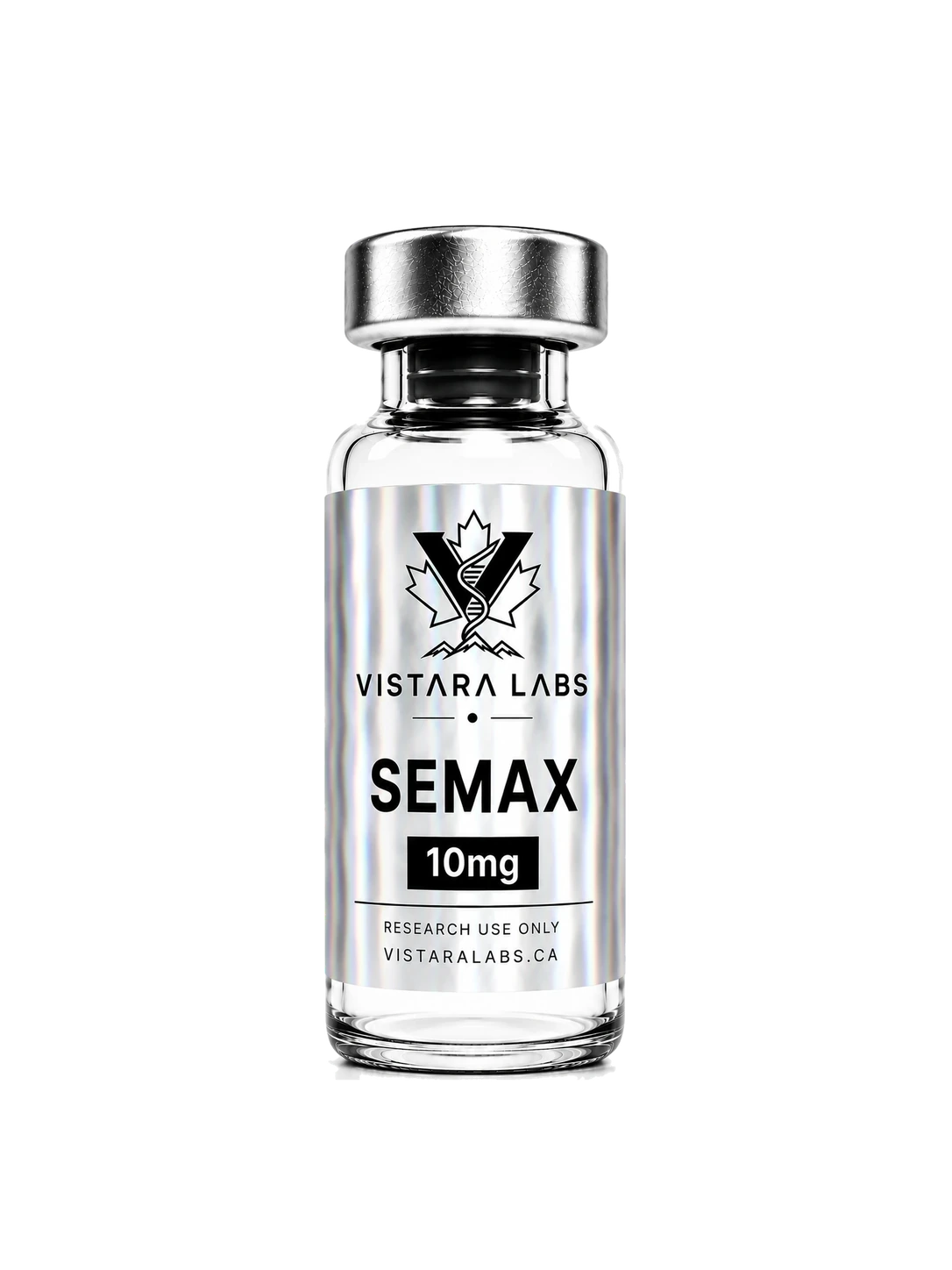
Vistara Labs stocks Semax, Selank and Cerebrolysin as individual research vials, and together in a research stack. All shipped from within Canada to every province.
Researchers comparing the two can buy Selank in Canada and buy Semax in Canada directly, both third-party tested.
Frequently asked questions
What is the difference between Semax and Selank?
Semax is derived from an ACTH fragment and is studied around BDNF, neurotrophic signalling and plasticity. Selank is derived from tuftsin and is studied around GABAergic modulation and anxiety models. They share a research lineage and a stabilising design, not a mechanism.
Can Semax and Selank be studied together?
They are frequently paired in research settings because they address separate, non-overlapping systems. However, there is very little published work on the combination itself — the rationale is inferred from what is known about each compound individually.
Which is better, Semax or Selank?
Neither, in any general sense. They were developed for different purposes and have barely been compared directly. Which is more relevant depends entirely on what is being investigated.
Is Selank a sedative and Semax a stimulant?
Neither description is accurate. Selank was specifically designed for anxiolytic activity without sedation, and Semax has no stimulant-class mechanism. The activating and calming characterisations are loose shorthand for which systems each is studied around.
Are Semax and Selank approved in Canada?
No. Neither holds Canadian marketing authorisation and Health Canada has not assessed either compound. Both are supplied as research materials.
All products supplied by Vistara Labs are intended for laboratory research use only. They are not drugs, are not approved for human or veterinary use, and are not intended to diagnose, treat, cure or prevent any condition. Nothing on this page constitutes medical advice or guidance for use in humans.
References
Semax has human research, mostly small studies concentrated in Russian-language literature rather than large modern placebo-controlled trials.
- [The efficacy of semax in the tretament of patients at different stages of ischemic stroke]Clinical study of 110 people after ischaemic stroke, with and without Semax; not a large modern placebo-controlled randomised trial.
- Effects of Semax on the Default Mode Network of the BrainSmall human study; 24 healthy volunteers, intranasal Semax versus placebo, resting-state fMRI. Mechanistic — does not establish improved cognition.
- [Effectiveness of semax in acute period of hemispheric ischemic stroke (a clinical and electrophysiological study)]Clinical study; 30 acute ischaemic stroke patients against an 80-patient conventional-treatment control cohort.
Links open the study record on PubMed so the source can be checked directly. Listing a study is not a claim that its findings apply to any other use, product or route of administration. Research use only.