BPC-157 + TB-500 Blend Reconstitution: How Much Bacteriostatic Water
A 10 mg BPC-157 + TB-500 vial (5 mg of each) reconstituted with 2 mL of bacteriostatic water gives 5 mg/mL in total, which is 2.5 mg/mL of each peptide. A 20 mg vial (10 mg of each) with 2 mL gives 10 mg/mL in total, 5 mg/mL of each. Because both peptides dissolve in the same water, they always stay in the same 1:1 ratio, whatever volume is added.
There is no single correct volume. Adding more water does not change how much is in the vial. It spreads the same quantity through a larger volume, which changes how many syringe units correspond to a given amount. The tables on this page use volumes that produce round numbers on a U-100 syringe and show the total and each component; other volumes work identically as long as the resulting concentration is written on the vial.
Peptide reconstitution calculator
Set to this vial below. Change the vial size, water volume, amount or syringe and it recalculates the concentration and the syringe units. For laboratory research use only.
All products are sold strictly for laboratory research use only and are not for human or veterinary consumption. This calculator is provided as a general reference tool.
How much bacteriostatic water for 10 mg BPC-157 + TB-500?
Add 2 mL of bacteriostatic water to a 10 mg BPC-157 + TB-500 vial for 5 mg/mL in total (2.5 mg/mL of each peptide), so 0.1 mL (10 units) holds 0.5 mg: 0.25 mg of BPC-157 and 0.25 mg of TB-500. With 1 mL the total is 10 mg/mL; with 5 mL it is 2 mg/mL.
| Water added | Concentration | Amount in 0.1 mL (10 units on a U-100 syringe) |
|---|---|---|
| 1 mL | 10 mg/mL (5 mg/mL BPC-157, 5 mg/mL TB-500) | 1 mg (0.5 mg BPC-157 + 0.5 mg TB-500) |
| 2 mL | 5 mg/mL (2.5 mg/mL BPC-157, 2.5 mg/mL TB-500) | 0.5 mg (0.25 mg BPC-157 + 0.25 mg TB-500) |
| 3 mL | 3.33 mg/mL (1.67 mg/mL BPC-157, 1.67 mg/mL TB-500) | 0.33 mg (0.17 mg BPC-157 + 0.17 mg TB-500) |
| 5 mL | 2 mg/mL (1 mg/mL BPC-157, 1 mg/mL TB-500) | 0.2 mg (0.1 mg BPC-157 + 0.1 mg TB-500) |
How much bacteriostatic water for 20 mg BPC-157 + TB-500?
Add 2 mL of bacteriostatic water to a 20 mg BPC-157 + TB-500 vial for 10 mg/mL in total (5 mg/mL of each peptide), so 0.1 mL (10 units) holds 1 mg: 0.5 mg of BPC-157 and 0.5 mg of TB-500. With 4 mL the total is 5 mg/mL, which matches the 10 mg vial with 2 mL.
| Water added | Concentration | Amount in 0.1 mL (10 units on a U-100 syringe) |
|---|---|---|
| 1 mL | 20 mg/mL (10 mg/mL BPC-157, 10 mg/mL TB-500) | 2 mg (1 mg BPC-157 + 1 mg TB-500) |
| 2 mL | 10 mg/mL (5 mg/mL BPC-157, 5 mg/mL TB-500) | 1 mg (0.5 mg BPC-157 + 0.5 mg TB-500) |
| 4 mL | 5 mg/mL (2.5 mg/mL BPC-157, 2.5 mg/mL TB-500) | 0.5 mg (0.25 mg BPC-157 + 0.25 mg TB-500) |
| 5 mL | 4 mg/mL (2 mg/mL BPC-157, 2 mg/mL TB-500) | 0.4 mg (0.2 mg BPC-157 + 0.2 mg TB-500) |
Before choosing a larger volume, check that the vial has headspace for it. One multi-dose vial of bacteriostatic water covers several research vials.
Reading the concentration on a U-100 syringe
A U-100 insulin syringe is graduated in units, and 100 units equal 1 mL. Units are therefore millilitres multiplied by 100: 0.1 mL is 10 units and 0.25 mL is 25 units. A 0.5 mL syringe carries 50 units and a 0.3 mL syringe carries 30 units on the same scale, with finer markings that make small volumes easier to read.
To find the volume that contains a given amount, divide the amount by the concentration. At 5 mg/mL in total (a 10 mg vial with 2 mL, or a 20 mg vial with 4 mL), the volume that contains 1 mg of blend is 1 divided by 5, which is 0.2 mL, or 20 units, and that 1 mg is 0.5 mg of each peptide. The table below runs the same calculation for four arbitrary amounts of blend. They illustrate the arithmetic and nothing else.
| Amount of blend (illustrative) | Volume at 5 mg/mL total | U-100 units |
|---|---|---|
| 0.25 mg | 0.05 mL | 5 units |
| 0.5 mg | 0.1 mL | 10 units |
| 1 mg | 0.2 mL | 20 units |
| 2 mg | 0.4 mL | 40 units |
Each amount in the left-hand column is half BPC-157 and half TB-500. At 10 mg/mL in total, which the 20 mg vial gives with 2 mL of water, every volume in the table halves: a 1 mg draw of blend measures 10 units instead of 20. Volumes below about 0.1 mL are hard to read accurately on a 1 mL syringe. Either move to a 0.3 mL or 0.5 mL syringe, or reconstitute with more water so that the same mass occupies a larger, more legible volume.
The BPC-157 + TB-500 blend is supplied by Vistara Labs as a lyophilised material for research use. The quantities on this page illustrate the arithmetic of dilution and measurement only.
The BPC-157 + TB-500 vial
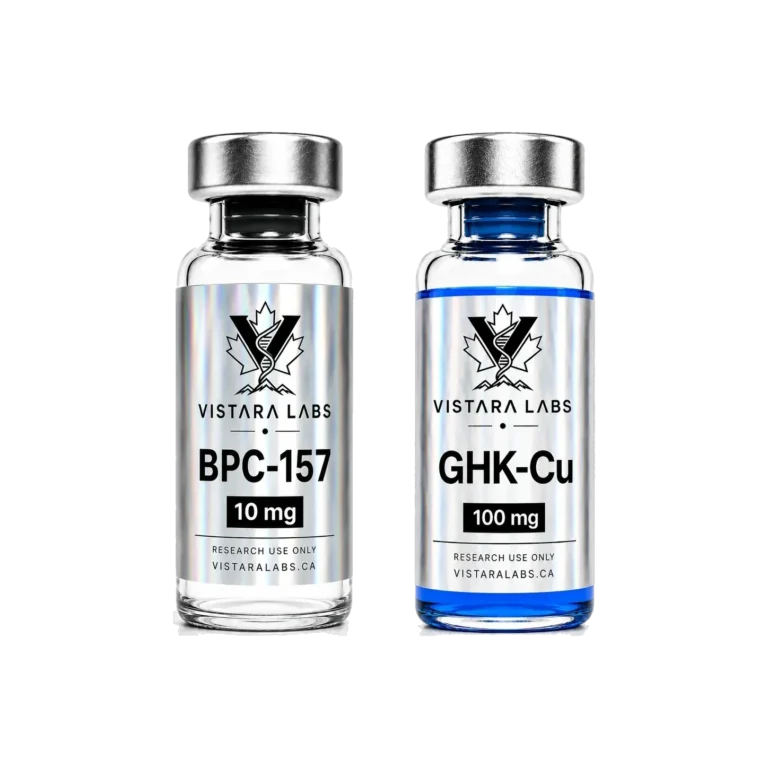
Vistara Labs supplies the BPC-157 + TB-500 blend, often called the Wolverine blend, as a lyophilised vial in two sizes: 10 mg (5 mg BPC-157 + 5 mg TB-500) and 20 mg (10 mg BPC-157 + 10 mg TB-500). Both are prepared with bacteriostatic water. Certificates of analysis for the catalogue are published on the Lab Results page.
The two peptides are also sold on their own. The single-peptide pages are BPC-157 reconstitution and TB-500 reconstitution; the arithmetic on this page differs only in that every concentration covers two peptides at once.
What the BPC-157 + TB-500 blend is
BPC-157 is a synthetic 15-amino-acid peptide, described in the research literature as a stable gastric pentadecapeptide. TB-500 is a short synthetic peptide built on the active region of thymosin beta-4; a doping-control laboratory identified the acetylated 17-23 fragment of thymosin beta-4 in material sold as TB-500 (Esposito 2012).
The pairing itself has human data. In a retrospective review of 16 patients with knee pain, 14 (87.5%) reported relief after intra-articular BPC-157 alone or BPC-157 combined with thymosin beta-4 (Lee and Padgett 2021). In a pilot study of 12 women with interstitial cystitis, 10 reported complete resolution of symptoms after a single BPC-157 treatment, with no adverse events reported (Lee 2024). In a phase 2 randomized trial, thymosin beta-4 eye drops improved signs and symptoms of severe dry eye compared with vehicle (Sosne 2015).
Sources: Lee E, Padgett B. Intra-Articular Injection of BPC 157 for Multiple Types of Knee Pain. Altern Ther Health Med. 2021. PMID 34324435. Lee E et al. Effect of BPC-157 on Symptoms in Patients with Interstitial Cystitis: A Pilot Study. Altern Ther Health Med. 2024. PMID 39325560. Sosne G et al. Thymosin β4 significantly improves signs and symptoms of severe dry eye in a phase 2 randomized trial. Cornea. 2015. PMID 25826322. Esposito S et al. Synthesis and characterization of the N-terminal acetylated 17-23 fragment of thymosin beta 4 identified in TB-500, a product suspected to possess doping potential. Drug Test Anal. 2012. PMID 22962027.
Reconstitution technique
Let the vial reach room temperature, swab both stoppers, and run the measured water slowly down the inside wall of the vial rather than onto the powder. Swirl or tilt gently until the cake dissolves, never shake, and give any remaining powder a few minutes to settle into solution. Label the vial with the date and the concentration, then keep it refrigerated at 2 to 8 °C and protected from light. The full method, with the reason behind each step, is in how to reconstitute peptides with bacteriostatic water.
Why the solution should look clear
Properly reconstituted BPC-157 + TB-500 forms a clear, colourless solution. Cloudiness, strands or a gel that will not disperse usually mean the water went in too fast or the vial was shaken; haze that appears later points to warm or bright storage. The causes are covered in why peptides gel or go cloudy.
Bacteriostatic water, not sterile water
Bacteriostatic water is sterile water with 0.9% benzyl alcohol, a preservative that allows a refrigerated vial to be accessed more than once; plain sterile water is intended for single access. The difference is explained in bacteriostatic water explained.
Frequently asked questions
How much bac water for a 10 mg BPC-157 + TB-500 vial?
There is no single correct volume. With 2 mL of bacteriostatic water a 10 mg BPC-157 + TB-500 vial gives 5 mg/mL in total, 2.5 mg/mL of each peptide, so 0.1 mL (10 units) holds 0.25 mg of each. With 1 mL it gives 10 mg/mL in total. Write the concentration you chose on the vial.
How much bac water for a 20 mg BPC-157 + TB-500 vial?
There is no single correct volume. With 2 mL of bacteriostatic water a 20 mg BPC-157 + TB-500 vial gives 10 mg/mL in total, 5 mg/mL of each peptide, so 0.1 mL (10 units) holds 0.5 mg of each. With 4 mL it gives 5 mg/mL in total, the same as the 10 mg vial with 2 mL.
How many units on a U-100 syringe contain 1 mg of blend at 5 mg/mL?
At 5 mg/mL in total, the volume that contains 1 mg of blend is 1 divided by 5, which is 0.2 mL, or 20 units, and that 1 mg is 0.5 mg of BPC-157 and 0.5 mg of TB-500. Units are millilitres multiplied by 100, so 0.1 mL is 10 units. The amounts on this page illustrate the arithmetic only.
What should reconstituted BPC-157 + TB-500 look like?
Properly reconstituted BPC-157 + TB-500 forms a clear, colourless solution. Cloudiness, strands or a gel that will not disperse usually mean the water went in too fast or the vial was shaken; haze that appears later points to warm or bright storage. More on the causes in why peptides gel or go cloudy.
Can I use sterile water instead of bacteriostatic water?
Only for a vial that will be accessed once. Bacteriostatic water is sterile water with 0.9% benzyl alcohol, a preservative that allows a refrigerated vial to be accessed more than once; plain sterile water is intended for single access. Details in bacteriostatic water explained.
How should a reconstituted BPC-157 + TB-500 vial be stored?
Refrigerated at 2 to 8 °C, protected from light and labelled with the date and the concentration. Unopened lyophilised vials are kept cold and dark until they are needed. The full storage guide is how to store research peptides.
Work it out for a different vial or concentration
Our peptide calculator opens pre-set for a 10 mg vial with 2 mL of water and marks a 1 mg draw of blend (0.5 mg of each peptide) at 20 units on a syringe diagram. For the 20 mg vial, set the vial to 20 mg. Change the vial size, water volume, amount or syringe and it recalculates.
Products: BPC-157 + TB-500 blend, TB-500 10 mg and bacteriostatic water.
All products supplied by Vistara Labs are intended for laboratory research use only. They are not drugs, are not approved for human or veterinary use, and are not intended to diagnose, treat, cure or prevent any condition. Nothing on this page constitutes medical advice or guidance for use in humans.