DSIP research: what the human studies show
Cognitive & Nootropic Research
DSIP (delta sleep-inducing peptide) is a nine-amino-acid peptide first isolated in 1977 and tested in small human sleep-laboratory studies in the 1980s. Here is what the research found.
Findings
- In a placebo-controlled, double-blind study of 14 chronic insomniacs treated for seven nights, night-sleep efficiency reached the levels of normal controls and daytime alertness rose significantly.
- In 18 chronic insomniacs aged 29 to 83, the whole sample showed normal sleep patterns after a one-week course and a follow-up week.
- In six healthy volunteers given a morning infusion under double-blind crossover conditions, total sleep time rose 59% (median) within 130 minutes compared with placebo.
- In 107 inpatients withdrawing from alcohol or opiates, symptoms disappeared or improved markedly in 97% and 87% of evaluable patients respectively.
- In a pilot study of seven chronic pain patients, pain levels fell significantly in 6 of 7.
 View product →
Chronic insomnia: sleep normalised under placebo control (Eur Neurol, 1987)
The most rigorous DSIP study followed 14 middle-aged chronic insomniacs in a sleep laboratory. DSIP was given intravenously on seven successive nights under placebo-controlled, double-blind conditions, with polysomnograms at baseline, during treatment and on a placebo night afterwards. Night sleep improved substantially with the first dose and further with repeated doses. Efficiency of night sleep and daytime rest reached the levels of normal controls, the gains held on the post-treatment placebo night, and daytime alertness and mental performance increased significantly.
An earlier study from the same laboratory (Eur Neurol, 1986) gave 18 chronic insomniacs six injections over one week, then followed them for a further week. The middle-aged group (29 to 59) reached normal sleep values by the end of treatment and kept them through follow-up. The older group (60 to 83) began with sleep disturbance twice as severe, responded more strongly at first, and reached full normalisation by the end of the follow-up week. The whole sample showed normal sleep patterns at the end, and the effect size tracked the severity of the original disturbance.
First human studies: more sleep within two hours (Int J Clin Pharmacol Ther Toxicol, 1981)
The first human DSIP study used six healthy volunteers, four men and two women, in a double-blind crossover design with a slow morning infusion. Subjects reported an immediate feeling of sleep pressure, and median total sleep time increased by 59% within a 130-minute window compared with placebo. The following night, sleep onset was shorter, stage 1 sleep was reduced and sleep efficiency improved. Behavioural and EEG analysis found no classic pharmacological sedation, and no side effects were observed.
In the same year (Experientia, 1981), a single intravenous dose was tested in six middle-aged chronic insomniacs. Sleep was longer, with fewer interruptions and slightly more REM sleep. The effect began in the second hour after injection and lasted up to six hours, with no daytime sedation.
Alcohol and opiate withdrawal: symptoms cleared in most patients (Eur Neurol, 1984)
A Geneva group led by Dick gave intravenous DSIP to 107 inpatients, 47 in alcohol withdrawal and 60 in opiate withdrawal. Response was judged clinically by physicians and nursing staff. Among evaluable patients, signs and symptoms disappeared or improved markedly and rapidly in 97% of opiate patients and 87% of alcohol patients. Anxiety resolved more slowly, and opiate patients needed more injections over a longer course. Tolerance was good, aside from headaches in a few patients.
Chronic pain: pain lowered in 6 of 7 patients (Eur Neurol, 1984)
Larbig and colleagues ran a clinical pilot study in seven patients with migraine episodes, vasomotor headaches, chronic tinnitus or psychogenic pain attacks. DSIP was given intravenously on five consecutive days, then five more times at 48 to 72 hour intervals. Compared with each patient’s baseline, pain levels fell significantly in six of the seven, and the accompanying depressive states fell significantly too.
What DSIP is
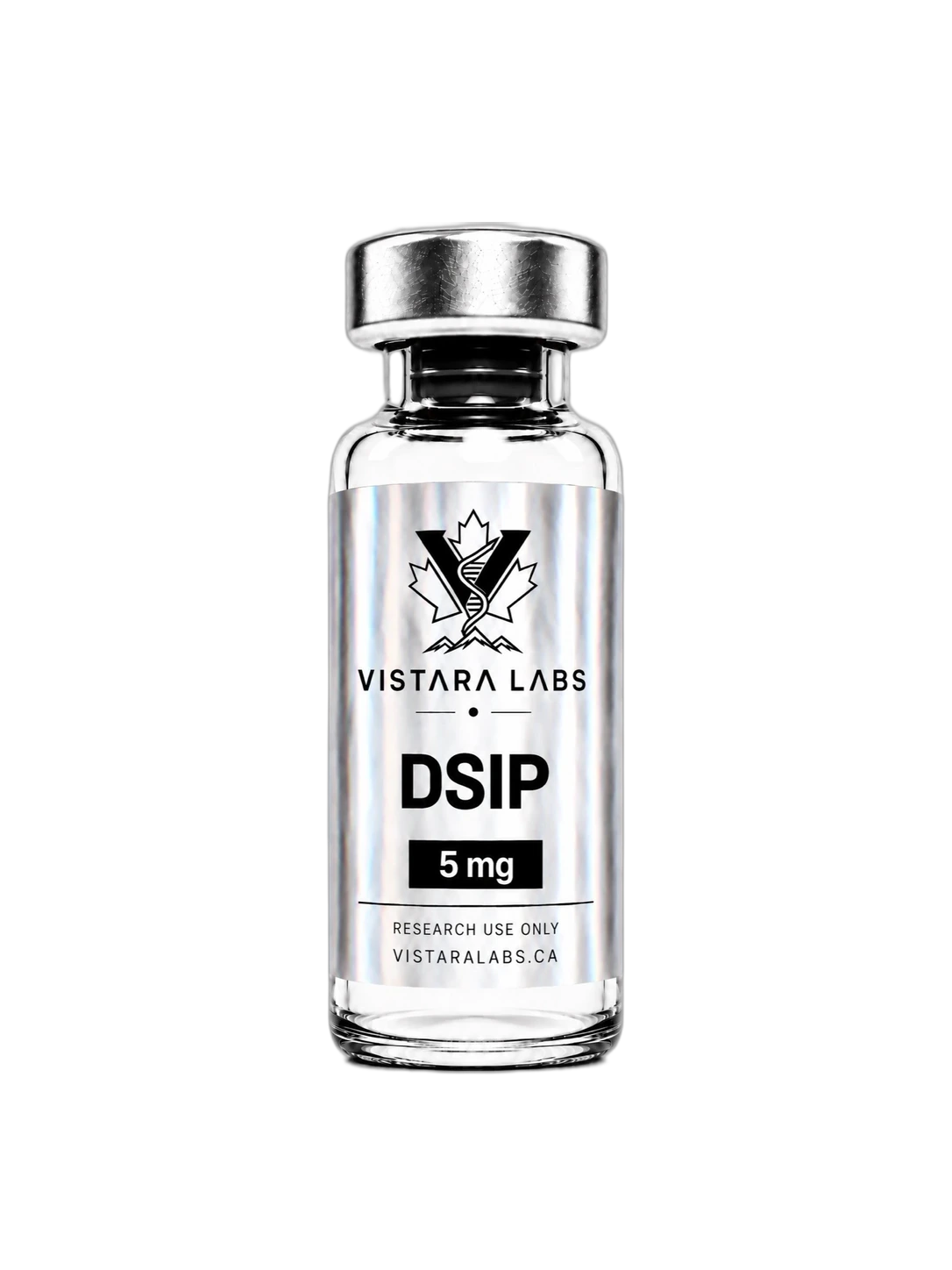
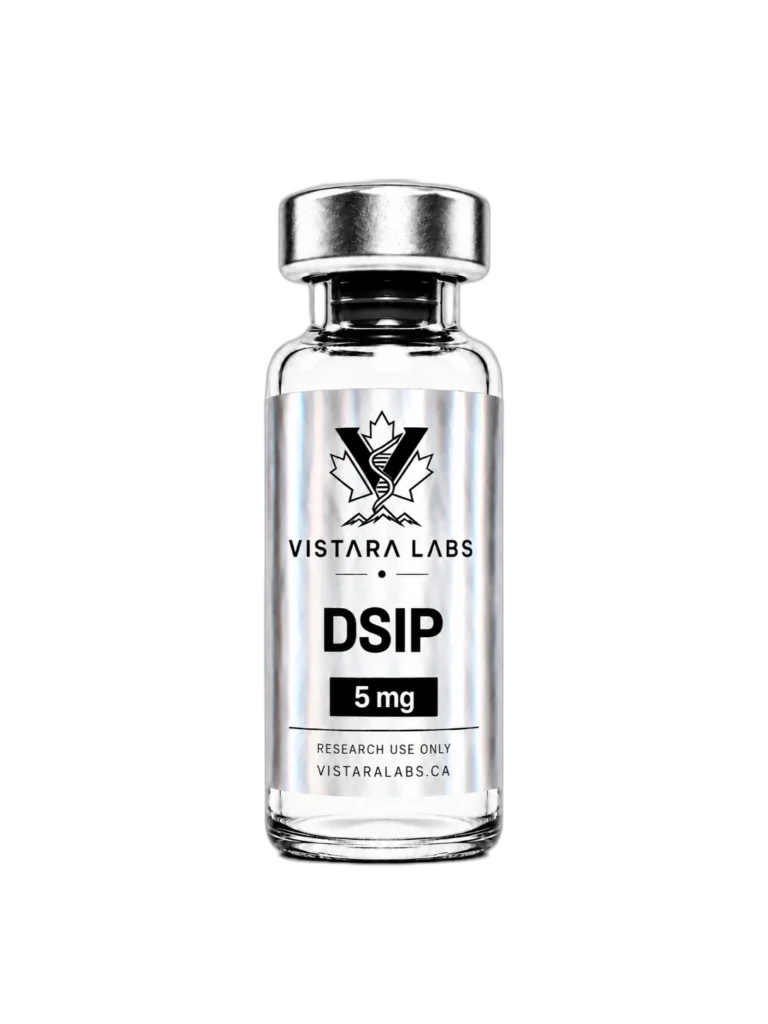
DSIP is a nonapeptide (Trp-Ala-Gly-Gly-Asp-Ala-Ser-Gly-Glu) isolated from rabbit blood by the Schoenenberger and Monnier group in Basel in 1977 and named for its apparent delta (slow-wave) sleep activity. Its gene and receptor have never been identified, and a 2006 review in J Neurochem called its biology a still unresolved riddle. DSIP is supplied as a lyophilised powder; our DSIP reconstitution guide covers preparing it with bacteriostatic water for research use.
Vistara Labs stocks DSIP research vials and a ready-mixed DSIP nasal spray, shipped from within Canada to every province.
Frequently asked questions
Has DSIP shown positive results in humans?
Yes, in small sleep-laboratory studies from the 1980s. In a placebo-controlled, double-blind study of 14 chronic insomniacs, seven nights of DSIP brought night-sleep efficiency to the level of normal controls and increased daytime alertness. In six healthy volunteers, median total sleep time rose 59% within 130 minutes compared with placebo.
Which conditions has DSIP been studied in?
Chronic insomnia, where the strongest and most repeated results were reported; alcohol and opiate withdrawal, where symptoms cleared or improved markedly in 97% and 87% of evaluable inpatients; and chronic pain, where a seven-patient pilot found significant pain reduction in six.
What is DSIP?
DSIP (delta sleep-inducing peptide) is a nine-amino-acid peptide isolated from rabbit blood in 1977 and named for its apparent slow-wave-sleep-promoting activity. Its receptor has not been identified, and it is studied as a research material.
Sources: Schneider-Helmert D. Effects of delta-sleep-inducing peptide on 24-hour sleep-wake behaviour in severe chronic insomnia. Eur Neurol. 1987;27(2):120-9. PMID 3622582. Schneider-Helmert D. Efficacy of DSIP to normalize sleep in middle-aged and elderly chronic insomniacs. Eur Neurol. 1986;25(6):448-53. PMID 3792404. Schneider-Helmert D, Gnirss F, Monnier M, Schenker J, Schoenenberger GA. Acute and delayed effects of DSIP (delta sleep-inducing peptide) on human sleep behavior. Int J Clin Pharmacol Ther Toxicol. 1981;19(8):341-5. PMID 6895513. Schneider-Helmert D, Schoenenberger GA. The influence of synthetic DSIP (delta-sleep-inducing-peptide) on disturbed human sleep. Experientia. 1981;37(9):913-7. PMID 7028502. Dick P, Costa C, Fayolle K, Grandjean ME, Khoshbeen A, Tissot R. DSIP in the treatment of withdrawal syndromes from alcohol and opiates. Eur Neurol. 1984;23(5):364-71. PMID 6548969. Larbig W, Gerber WD, Kluck M, Schoenenberger GA. Therapeutic effects of delta-sleep-inducing peptide (DSIP) in patients with chronic, pronounced pain episodes. A clinical pilot study. Eur Neurol. 1984;23(5):372-85. PMID 6548970. Kovalzon VM, Strekalova TV. Delta sleep-inducing peptide (DSIP): a still unresolved riddle. J Neurochem. 2006;97(2):303-9. PMID 16539679.
All products supplied by Vistara Labs are intended for laboratory research use only. They are not drugs, are not approved for human or veterinary use, and are not intended to diagnose, treat, cure or prevent any condition. Nothing on this page constitutes medical advice or guidance for use in humans.