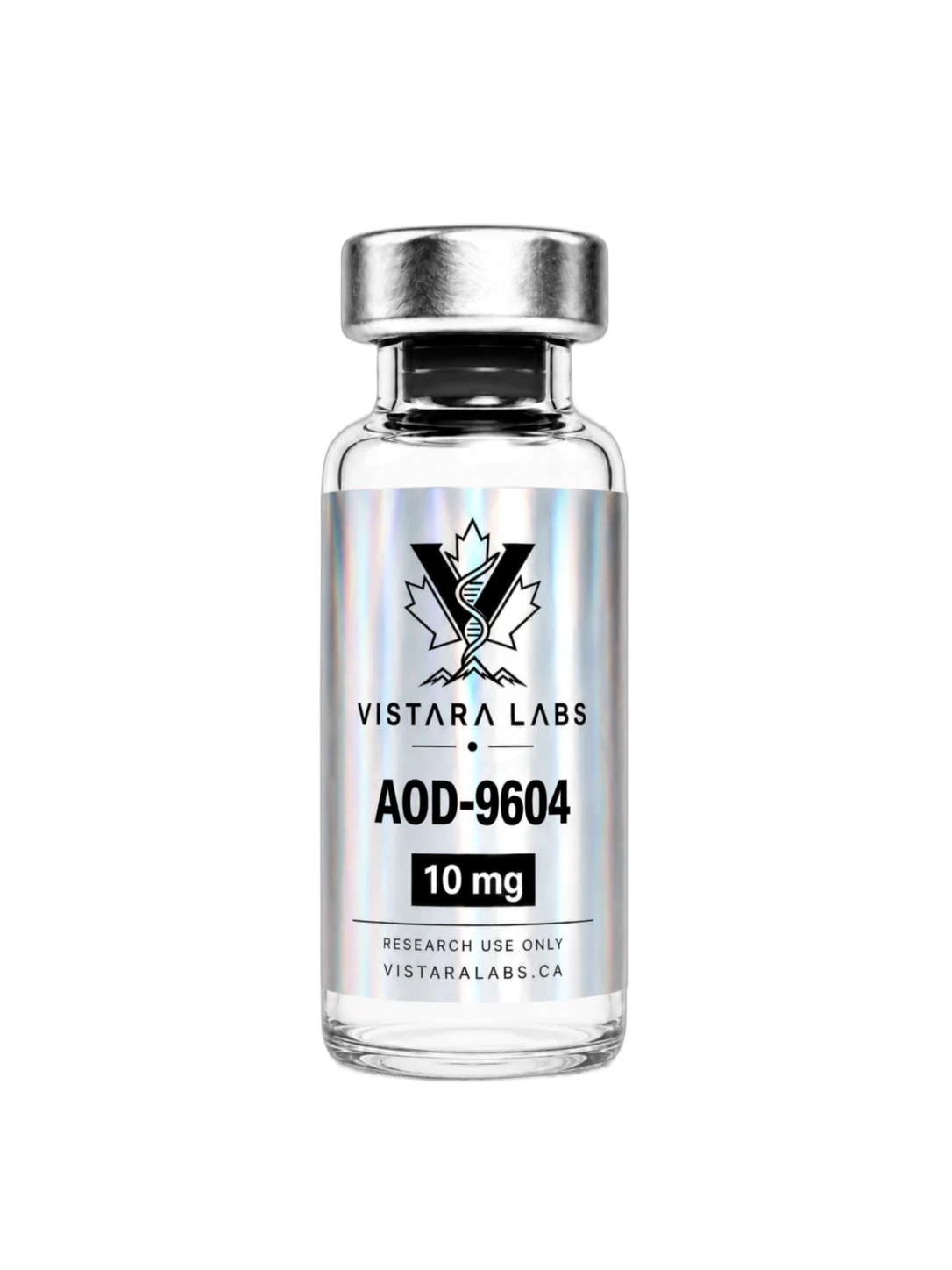
AOD-9604 research: what the human studies show
AOD-9604 is a synthetic fragment of human growth hormone (residues 176-191) that went through six placebo-controlled human trials in the 2000s. Here is what the research found.
Findings
- Across six randomised, double-blind, placebo-controlled trials in 893 adults, adverse-event rates on AOD-9604 matched placebo and no serious event was judged related.
- Unlike full-length growth hormone, AOD-9604 produced no change in IGF-1 and did not disturb glucose tolerance in any trial.
- No anti-AOD-9604 antibodies were detected in any participant tested.
- In the 12-week oral study of 300 obese adults, the sponsor reported an average loss of 2.8 kg in the lowest-dose group against 0.8 kg on placebo, with small improvements in cholesterol and glucose tolerance.
- In a rabbit model of knee osteoarthritis, AOD-9604 injected with hyaluronic acid gave better cartilage scores and shorter lameness than either agent alone.
 View product →
Safety across six human trials: 893 adults (J Endocrinol Metab, 2013)
The safety record is the strongest human finding. Stier and colleagues pooled six randomised, double-blind, placebo-controlled studies run between 2001 and 2006: two intravenous and two short oral studies in healthy or obese men, a 12-week oral study in 300 obese adults, and a 24-week oral study in 502 obese adults at 16 centres. In total 893 adults took part.
In the 24-week study, 78.7% of participants reported at least one adverse event, ranging from 75.6% in the lowest AOD-9604 group to 83.2% on placebo. Eighteen participants (3.6%) had a serious adverse event, spread evenly across groups, none classed as definitely related to treatment. The authors concluded that the safety profile was indistinguishable from placebo.
Growth-hormone side effects not seen: IGF-1 and glucose unchanged (J Endocrinol Metab, 2013)
Because AOD-9604 is cut from growth hormone, the trials looked hard for growth-hormone effects and did not find them. Serum IGF-1 did not change against placebo in any study (24-week trial: P = 0.51 and 0.76 at 12 and 24 weeks). Oral glucose tolerance tests were unchanged after 7 days, 12 weeks and 24 weeks, with a non-significant trend toward better glucose tolerance in the 12-week study. Antibody testing at baseline and weeks 4, 8 and 12 found no anti-AOD-9604 antibodies in anyone. The same review records that an expert GRAS panel judged the peptide Generally Recognised As Safe for its intended food uses.
Obesity: the 12-week oral study in 300 adults (J Endocrinol Metab, 2013; sponsor announcement, 2004)
The 12-week study enrolled 300 obese adults (body-mass index 35 or above) at five Australian centres, randomised 50 per group to five oral doses of AOD-9604 or placebo. In the sponsor’s announcement of the results, the lowest-dose group lost an average of 2.8 kg over 12 weeks against 0.8 kg on placebo, cholesterol profiles improved slightly but consistently, and fewer patients had impaired glucose tolerance at the end. Those weight figures come from the company release, not a peer-reviewed paper. The later 24-week study in 502 adults (ACTRN12605000067673) did not separate from placebo on body weight, and the programme closed there with the safety dataset above as its legacy.
Knee osteoarthritis: cartilage findings in the laboratory (Ann Clin Lab Sci, 2015)
Kwon and Park induced knee osteoarthritis in 32 rabbits with collagenase, then gave weekly knee injections for four weeks: saline, hyaluronic acid alone, AOD-9604 alone, or both together. At eight weeks, gross and microscopic cartilage scores were worse on saline than in all three treated groups, and best in the combination group; lameness lasted longest on saline and shortest on the combination. The authors concluded that AOD-9604 enhanced cartilage regeneration and that the combination beat either agent alone. The published osteoarthritis work on AOD-9604 to date is laboratory research; no human joint trial is indexed on PubMed.
What AOD-9604 is
AOD-9604 is a 16-amino-acid synthetic peptide built from the C-terminal end of human growth hormone, the region linked to fat metabolism, with one tyrosine added for stability. In laboratory work it increased fat oxidation and lipolysis in obese mice, cut weight gain in obese rats by more than half over 19 days (15.8 g against 35.6 g in controls), did not bind the growth-hormone receptor, did not drive cell proliferation, and did not impair insulin sensitivity. Our AOD-9604 reconstitution page covers handling of the research vial.
Vistara Labs stocks AOD-9604 research vials, shipped from within Canada to every province.
Frequently asked questions
What did the human trials of AOD-9604 show about safety?
Six randomised, double-blind, placebo-controlled trials in 893 adults found adverse-event rates on AOD-9604 that matched placebo, no serious event judged related to the compound, no change in IGF-1, no effect on glucose tolerance, and no anti-AOD-9604 antibodies.
Has AOD-9604 been studied for weight or fat loss in humans?
Yes. Oral studies of 12 weeks (300 obese adults) and 24 weeks (502 obese adults) ran in Australia between 2004 and 2006. The sponsor reported greater weight loss than placebo in the lowest-dose group of the 12-week study, with small cholesterol and glucose-tolerance improvements; the 24-week study did not separate from placebo on weight.
What is AOD-9604?
AOD-9604 is a 16-amino-acid synthetic fragment of the C-terminal region of human growth hormone, studied for its effect on fat metabolism without the IGF-1 and glucose effects of the full hormone.
Sources: Stier H, Vos E, Kenley D. Safety and tolerability of the hexadecapeptide AOD9604 in humans. J Endocrinol Metab. 2013;3(1-2):7-15. DOI 10.4021/jem157w. Metabolic Pharmaceuticals Ltd. Announcement of 12-week AOD9604 trial results, December 2004 (company release; not peer-reviewed). The effect of AOD9604 on weight loss in obese adults, 24-week study. ACTRN12605000067673. Kwon DR, Park GY. Effect of intra-articular injection of AOD9604 with or without hyaluronic acid in rabbit osteoarthritis model. Ann Clin Lab Sci. 2015;45(4):426-32. PMID 26275694. Heffernan MA, et al. Increase of fat oxidation and weight loss in obese mice caused by chronic treatment with human growth hormone or a modified C-terminal fragment. Int J Obes Relat Metab Disord. 2001;25(10):1442-9. PMID 11673763. Heffernan M, et al. The effects of human GH and its lipolytic fragment (AOD9604) on lipid metabolism following chronic treatment in obese mice and beta(3)-AR knock-out mice. Endocrinology. 2001;142(12):5182-9. PMID 11713213. Ng FM, et al. Metabolic studies of a synthetic lipolytic domain (AOD9604) of human growth hormone. Horm Res. 2000;53(6):274-8. PMID 11146367.
All products supplied by Vistara Labs are intended for laboratory research use only. They are not drugs, are not approved for human or veterinary use, and are not intended to diagnose, treat, cure or prevent any condition. Nothing on this page constitutes medical advice or guidance for use in humans.