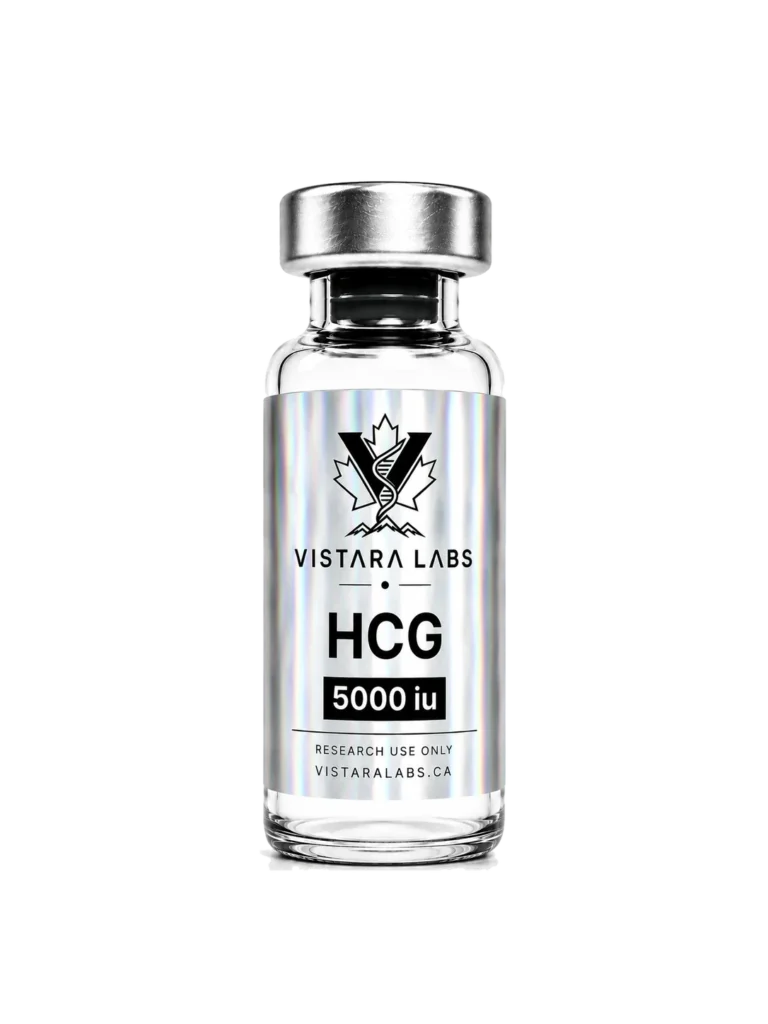


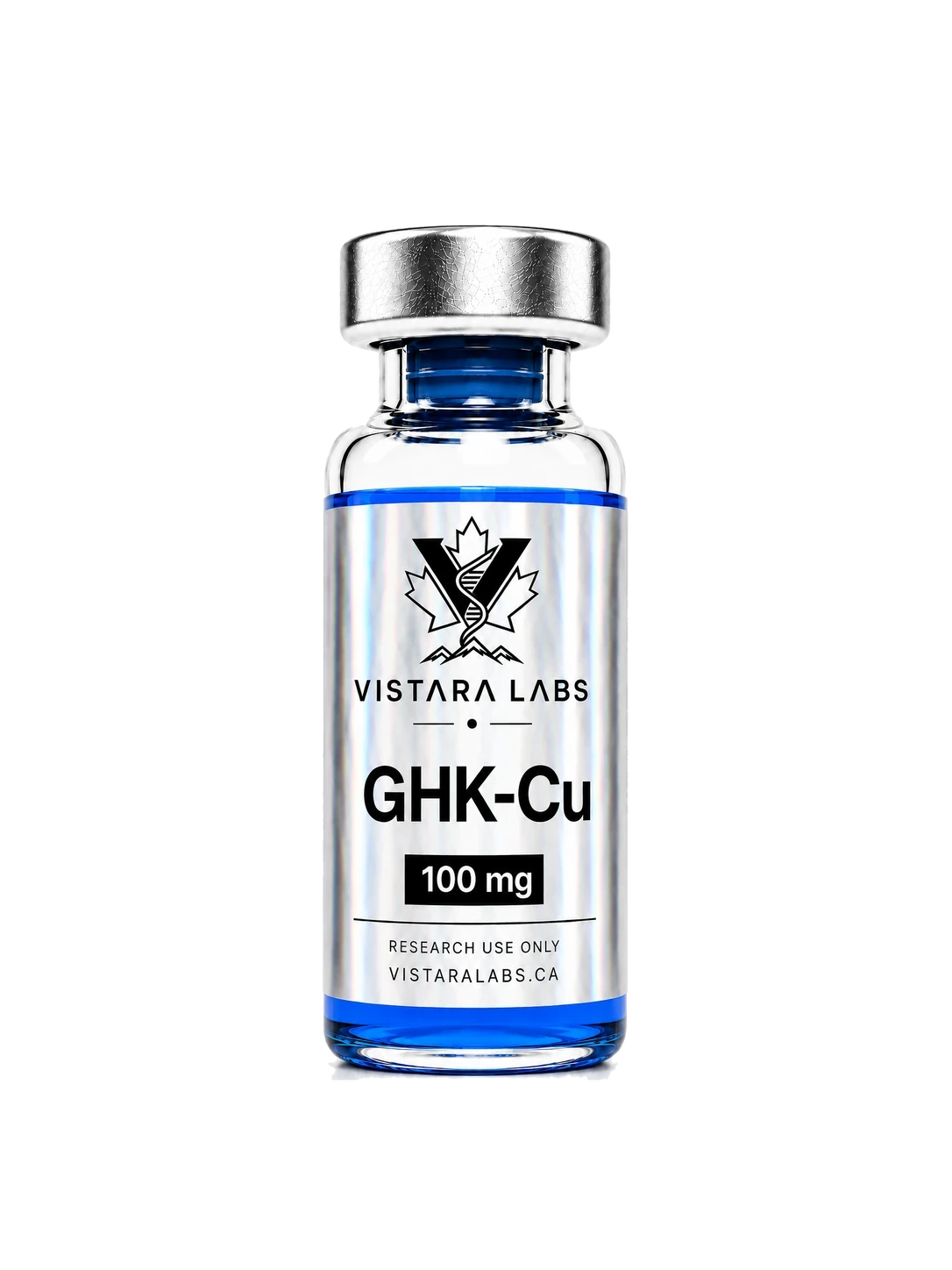
How Much Bacteriostatic Water for a GHK-Cu 50 mg or 100 mg Vial?
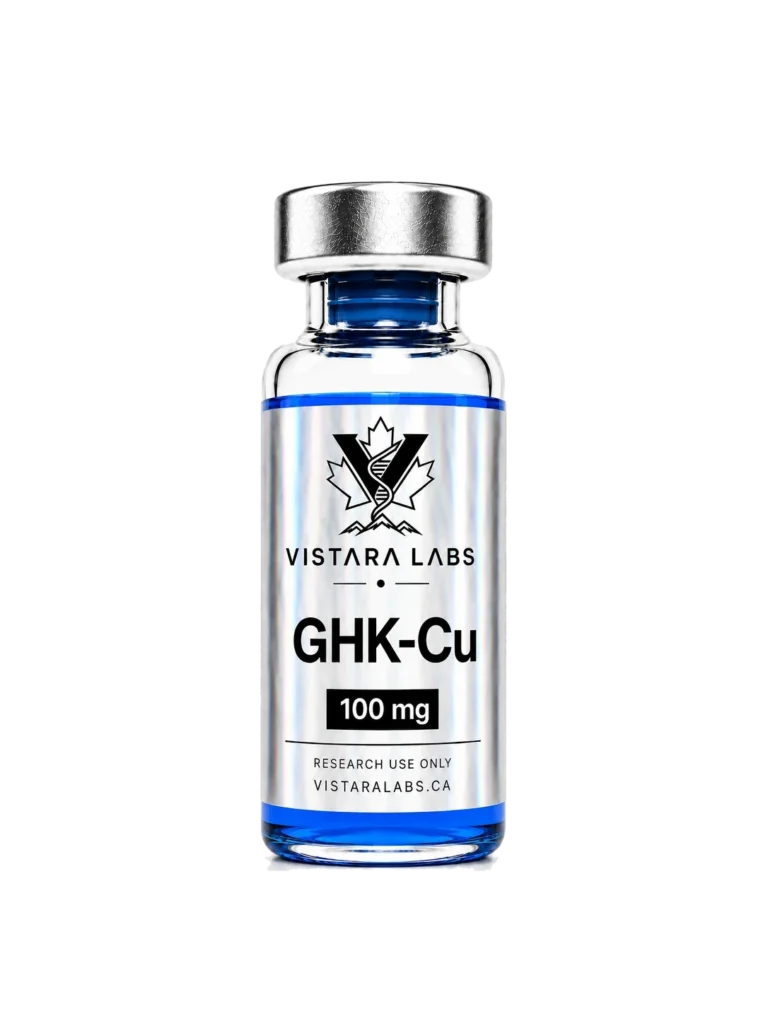
A 50 mg vial of GHK-Cu reconstituted with 2 mL of bacteriostatic water gives a concentration of 25 mg/mL; the 100 mg vial gives 50 mg/mL with 2 mL and 20 mg/mL with 5 mL. GHK-Cu vials carry far more peptide than most of the catalogue, so the concentrations run higher and the syringe volumes that contain a given mass run smaller. The calculation is the same: peptide mass divided by water volume.
 Voir le produit →
There is no single correct volume. Adding more water does not change how much peptide is in the vial. It spreads the same quantity through a larger volume, which changes how many syringe units correspond to a given mass. With a 100 mg vial the practical question is usually the opposite of a 10 mg vial: how much water fits, since the mass is large enough that small volumes become hard to read on a syringe.
Concentration by water volume
The right-hand column converts each concentration into the number of U-100 units that contain 1 mg. At the higher concentrations that figure drops below 5 units, which is why the larger water volumes are the ones people usually choose for GHK-Cu.
| Vial | Bacteriostatic water added | Concentration | Units containing 1 mg |
|---|---|---|---|
| 50 mg GHK-Cu | 1 mL | 50 mg/mL | 2 units |
| 50 mg | 2 mL | 25 mg/mL | 4 units |
| 50 mg | 3 mL | 16.67 mg/mL | 6 units |
| 50 mg | 5 mL | 10 mg/mL | 10 units |
| 100 mg GHK-Cu | 2 mL | 50 mg/mL | 2 units |
| 100 mg | 3 mL | 33.33 mg/mL | 3 units |
| 100 mg | 5 mL | 20 mg/mL | 5 units |
| 100 mg | 10 mL | 10 mg/mL | 10 units |
Check the vial’s capacity before drawing up a large volume: a lyophilised cake occupies almost no space, but the glass has a fixed volume and needs a little headspace to mix. Reconstituting a 100 mg vial with 10 mL of water uses an entire 10 mL vial of bacteriostatic water.
Reading the concentration on a U-100 syringe
A U-100 insulin syringe is graduated in units, and 100 units equal 1 mL. Units are therefore millilitres multiplied by 100: 0.1 mL is 10 units and 0.25 mL is 25 units. A 0.5 mL syringe carries 50 units and a 0.3 mL syringe carries 30 units on the same scale, with finer markings that make small volumes easier to read.
To find the volume that contains a given mass, divide the mass by the concentration. At 20 mg/mL (a 100 mg vial with 5 mL of water), the volume that contains 1 mg is 1 divided by 20, which is 0.05 mL, or 5 units; 5 mg occupies 25 units. The table below runs the same calculation for four arbitrary amounts. They illustrate the arithmetic and nothing else.
| Mass (illustrative) | Volume at 20 mg/mL | U-100 units |
|---|---|---|
| 1 mg | 0.05 mL | 5 units |
| 2 mg | 0.1 mL | 10 units |
| 5 mg | 0.25 mL | 25 units |
| 10 mg | 0.5 mL | 50 units |
At 25 mg/mL, which the 50 mg vial gives with 2 mL of water, the same masses occupy 4, 8, 20 and 40 units. Volumes below about 0.1 mL are hard to read accurately on a 1 mL syringe. Either move to a 0.3 mL or 0.5 mL syringe, or reconstitute with more water so that the same mass occupies a larger, more legible volume.
GHK-Cu is supplied by Vistara Labs as a lyophilised material for research use. The quantities on this page illustrate the arithmetic of dilution and measurement only.
Why the solution is blue
GHK-Cu is the tripeptide glycyl-L-histidyl-L-lysine complexed with a copper(II) ion, and the copper complex is what gives the lyophilised powder its blue colour. A correctly reconstituted vial is a clear blue solution, deeper in colour at higher concentration and paler as more water is added. Blue is expected and is not a sign of contamination; what to look for is clarity. Cloudiness, visible particles or a colour that has shifted towards green or brown suggest the vial has been mishandled or stored badly, and the causes are covered in why peptides gel or go cloudy. Vistara Labs supplies GHK-Cu in 50 mg and 100 mg vials; certificates of analysis are published on the Résultats de laboratoire page.
Reconstitution technique
The steps are the same for any lyophilised peptide vial.
- Let the unopened peptide vial reach room temperature before you begin. A cold vial draws condensation onto the stopper and the powder.
- Swab the stoppers of both vials. Draw the measured volume of bacteriostatic water into a syringe and check it against the graduations rather than estimating.
- Introduce the water slowly through the peptide vial’s stopper, aiming the stream at the glass wall so it runs down onto the powder rather than striking it. Lyophilised peptide is a light cake, and a direct jet can foam it.
- Swirl or tilt the vial gently until the cake has dissolved. Never shake it. If powder remains, leave the vial to stand for a few minutes rather than agitating it.
- Inspect the solution against a light.
- Label the vial with the date and the concentration in mg/mL, then store it refrigerated at 2 to 8 °C and protected from light. Unopened lyophilised vials are kept cold and dark until they are needed.
Bacteriostatic water, not sterile water
Bacteriostatic water is sterile water with 0.9% benzyl alcohol added. The benzyl alcohol inhibits bacterial growth inside the vial, which is what allows a reconstituted vial to be accessed more than once over a period of refrigerated storage. Plain sterile water contains no preservative and is intended for single access. The longer explanation is in bacteriostatic water explained.
Questions fréquentes
How much bacteriostatic water do I add to a 50 mg vial of GHK-Cu?
There is no single correct volume. With 2 mL of bacteriostatic water a 50 mg vial of GHK-Cu gives 25 mg/mL; the 100 mg vial gives 50 mg/mL with 2 mL. Adding more water does not change the quantity in the vial, it spreads it through a larger volume, so write the concentration you chose on the vial.
Does a 100 mg vial need a whole 10 mL vial of bacteriostatic water?
Reconstituting a 100 mg vial with 10 mL of water uses an entire 10 mL vial of bacteriostatic water. Check that the peptide vial has headspace for the volume before choosing a larger one.
How many units on a U-100 syringe contain 1 mg at 20 mg/mL?
At 20 mg/mL (a 100 mg vial with 5 mL of water), the volume that contains 1 mg is 1 divided by 20, which is 0.05 mL, or 5 units; 5 mg occupies 25 units. Units are millilitres multiplied by 100, so 0.1 mL is 10 units. The amounts on this page illustrate the arithmetic only.
What should reconstituted GHK-Cu look like?
GHK-Cu is the tripeptide glycyl-L-histidyl-L-lysine complexed with a copper(II) ion, and the copper complex is what gives the lyophilised powder its blue colour. A correctly reconstituted vial is a clear blue solution, deeper in colour at higher concentration and paler as more water is added. Blue is expected and is not a sign of contamination; what to look for is clarity. Cloudiness, visible particles or a colour that has shifted towards green or brown suggest the vial has been mishandled or stored badly. More on the causes in why peptides gel or go cloudy.
Can I use sterile water instead of bacteriostatic water?
Only for a vial that will be accessed once. Bacteriostatic water is sterile water with 0.9% benzyl alcohol added. The benzyl alcohol inhibits bacterial growth inside the vial, which is what allows a reconstituted vial to be accessed more than once over a period of refrigerated storage. Plain sterile water contains no preservative and is intended for single access. Details in bacteriostatic water explained.
How should a reconstituted GHK-Cu vial be stored?
Refrigerated at 2 to 8 °C, protected from light and labelled with the date and the concentration. Unopened lyophilised vials are kept cold and dark until they are needed. The full storage guide is how to store research peptides.
Work it out for a different vial or concentration
Our calculateur de peptides opens pre-set for a 100 mg vial with 5 mL of water and marks the 5 mg draw of 25 units on a syringe diagram. Change the vial size, water volume, mass or syringe and it recalculates. The 50 mg preset shows 5 mg at 20 units on 2 mL of water.
Products: GHK-Cu 50 mg and 100 mg et bacteriostatic water 10 mL.
Références
Les données humaines les plus solides sur le GHK-Cu sont topiques et liées aux plaies. Elles n'établissent pas d'effets pour un usage systémique ou injectable, et une étude cosmétique randomisée n'a trouvé aucun avantage objectif.
- Enhanced healing of ulcers in patients with diabetes by topical treatment with glycyl-l-histidyl-l-lysine copperEssai multicentrique randomisé, contrôlé par placebo, à l'insu de l'évaluateur; GHK-Cu topique dans les ulcères neuropathiques diabétiques.
- Effects of topical copper tripeptide complex on CO2 laser-resurfaced skinEssai randomisé après resurfaçage au laser CO2; 13 patients l'ont complété. Aucun avantage objectif significatif trouvé pour l'érythème, les rides ou la qualité globale de la peau.
Les liens ouvrent la fiche de l'étude sur PubMed afin que la source puisse être vérifiée directement. Citer une étude ne signifie pas que ses résultats s'appliquent à un autre usage, produit ou mode d'administration. Usage laboratoire uniquement.