What Is Cartalax? The AED Cartilage Peptide Explained
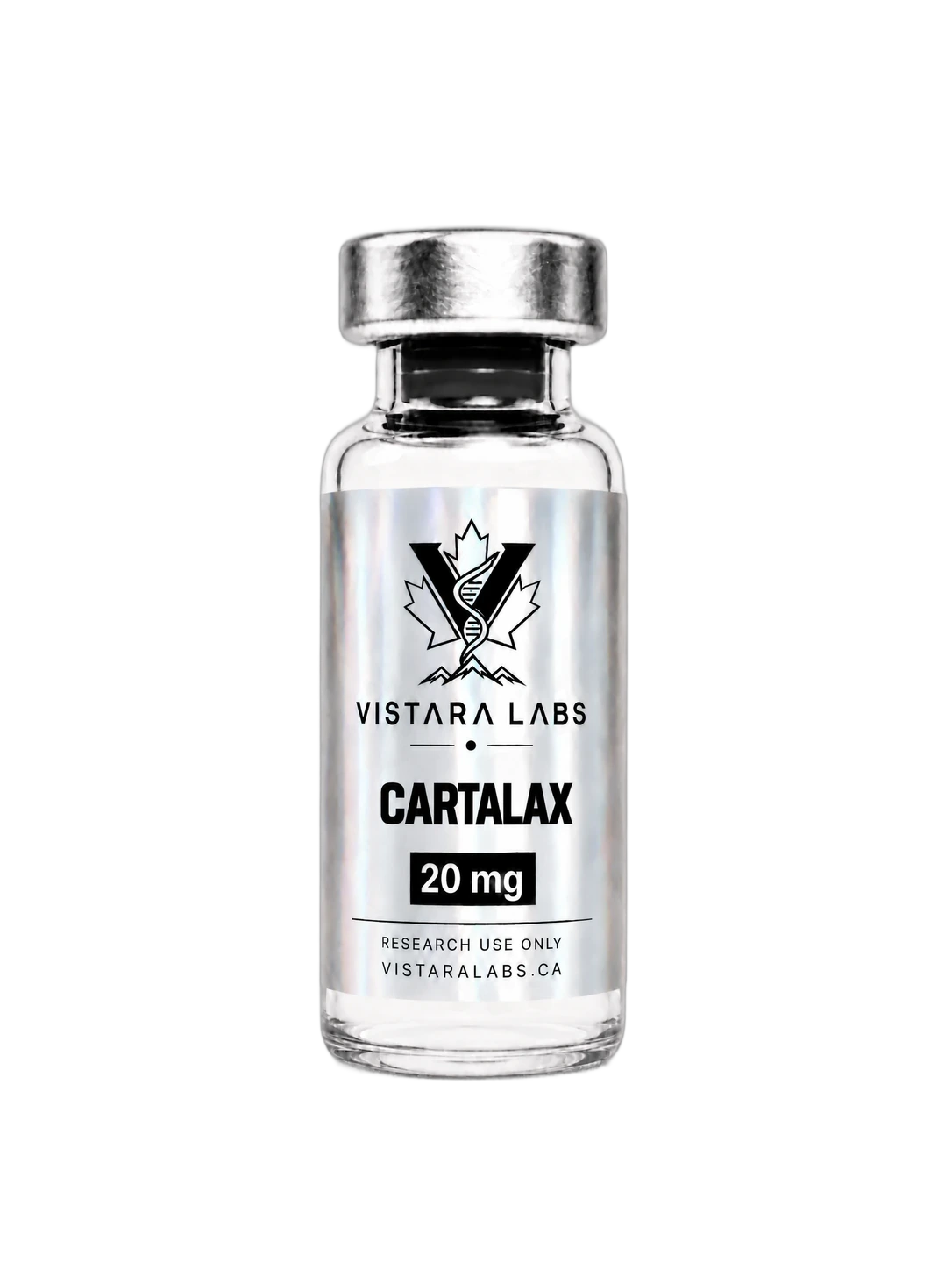
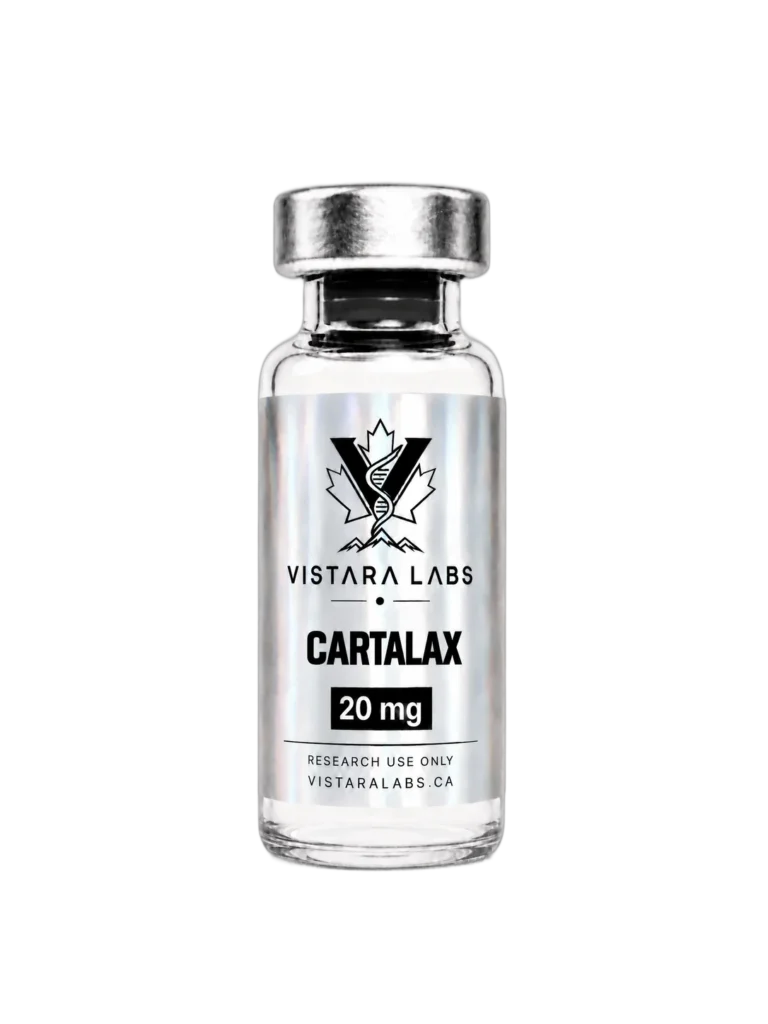
Cartalax is a synthetic tripeptide, Ala-Glu-Asp (AED), from Vladimir Khavinson’s short-peptide bioregulator programme in Saint Petersburg, identified as a component of a polypeptide complex from bovine cartilage. In laboratory studies it increased the growth of cartilage cells, pushed ageing human stem cells towards cartilage formation, protected bone density in a model of osteoporosis and raised collagen and sirtuin levels in ageing skin cells. Its developers propose that it works on gene activity inside the cell. Vistara Labs supplies it as a Cartalax 20 mg lyophilised vial.
Findings
- Cartalax is three amino acids, alanine, glutamic acid and aspartic acid, with a molecular weight of about 333 (PubChem); the same three open the sequence of Epitalon.
- In the literature it appears as AED, T-31 and Kartalax, and it is described as a constituent of a bovine cartilage polypeptide complex (2015, 2023).
- In ageing human stem cell cultures, the short peptides tested, AED among them, raised IGF1 gene expression 3.5-5.6-fold (2020).
- It increased chondrocyte numbers by up to 2.1-fold in cultures from old rats and activated cartilage-formation genes in ageing human stem cells (2023).
- In ageing kidney cells it lowered the ageing markers p16, p21 and p53 and raised SIRT-6 (2014).
 View product →
What Cartalax is and where it came from
Cartalax has the formula C12H19N3O8 and a molecular weight of about 333.3 (PubChem CID 87815447). The Khavinson group’s papers use the laboratory code T-31 for AED (Chalisova et al., Bull Exp Biol Med, 2015), and a 2023 review names the AED tripeptide as Kartalax (Myakisheva et al., Advances in Gerontology, 2023).
From cartilage extract to tripeptide
The programme started with polypeptide complexes extracted from calf tissues. A 2015 comparison tested seven such extracts, including Chondrolux from cartilage, and found that each stimulated the growth of cultures of its own tissue in young and old rats (Ryzhak et al., Advances in Gerontology, 2015). The group then looked for the short peptides that carried that activity. Researchers at the Saint Petersburg Institute of Bioregulation and Gerontology describe AED as a constituent of a polypeptide complex isolated from bovine cartilage (Myakisheva et al., Vrach, 2023), and their 2023 review discusses it alongside Sigumir, a complex from the cartilage and bone of young animals.
Its place among the bioregulators
Cartalax’s sequence matches the first three amino acids of Epitalon (Ala-Glu-Asp-Gly), the programme’s best-known tetrapeptide. The programme’s brain tripeptide is Pinealon (Glu-Asp-Arg). Each is studied for a different tissue.
How Cartalax works
The working model is the same for all of the group’s short peptides: they are small enough to enter the cell and its nucleus and to interact with DNA and histones, adjusting which genes are active. In computer docking, AED formed its most favourable complexes with the ACCT sequence of DNA (Khavinson et al., Bull Exp Biol Med, 2016), and a 2014 modelling study placed it in the minor groove of AT-rich DNA (Khavinson et al., Advances in Gerontology, 2014).
The cell studies point to a few recurring targets:
- Sirtuins. These enzymes protect cells and their DNA as they age. AED raised sirtuin-1 and sirtuin-6 in ageing human skin fibroblasts (Fridman et al., Bull Exp Biol Med, 2020), SIRT-6 in kidney cells (Khavinson et al., 2014) and normalised Sirt1 in ageing chondrocytes (Myakisheva et al., Advances in Gerontology, 2023).
- Growth signals. In human embryonic bone marrow stem cells aged in culture, adding the peptides AED, KED or KE raised IGF1 gene expression 3.5-5.6-fold, and all three stimulated NF-κB gene expression (Ashapkin et al., Mol Biol Rep, 2020).
- Cell renewal. Across tissues, AED raised the proliferation marker Ki-67 and reduced markers of apoptosis, the programmed death of cells (Lin’kova et al., Bull Exp Biol Med, 2016; Chalisova et al., 2015).
What the research has shown
Cartilage
Chondrocytes are the cells that build and maintain cartilage. In chondrocyte cultures from 3-month-old and 20-month-old rats, AED at 200 ng/mL increased cell numbers 1.4-1.8-fold in young cultures and 1.6-2.1-fold in old ones (Myakisheva et al., Vrach, 2023). In human mesenchymal stem cells during replicative ageing, the same concentration activated the genes and proteins of cartilage formation: SOX9, aggrecan, type II collagen and COMP (Myakisheva et al., Advances in Gerontology, 2023). Ageing chondrocytes produce more p16, p21, p53, TNF-α and IL-1α and less Sirt1, and AED normalised that profile (Myakisheva et al., Advances in Gerontology, 2023).
Bone
In ovariectomised rats, a model of post-menopausal bone loss, T-31 prevented the fall in bone mineral density and raised density that had already dropped (Povoroznyuk et al., Advances in Gerontology, 2007).
Skin
In human skin fibroblasts during replicative ageing, AED activated synthesis of type I collagen as well as sirtuin-1 and sirtuin-6 (Fridman et al., 2020). In fibroblasts ageing in culture it lowered MMP-9, a matrix-degrading enzyme that rises with age, raised Ki-67 and CD98hc and suppressed caspase-dependent apoptosis (Lin’kova et al., 2016).
Kidney and other tissues
In young and aged kidney cell cultures, AED increased cell proliferation, lowered the ageing markers p16, p21 and p53 and raised SIRT-6 (Khavinson et al., 2014). In kidney tissue from young and old rats it stimulated proliferation and reduced apoptosis (Chalisova et al., 2015), and in old rats the kidney polypeptide complex and AED lowered urinary protein and protein excretion 1.5-2.8-fold (Zamorskii et al., Advances in Gerontology, 2018). In tissue cultures from young and old rats, AED stimulated growth of mesodermal and endodermal tissues (Chalisova et al., Molekulyarnaya Meditsina, 2022).
The published work we could review is laboratory research. The institute’s 2023 review also describes animal osteoarthritis models and oral use in older patients with osteoarthritis; those reports are in Russian and are not indexed in PubMed.
Forms we stock
Vistara Labs supplies Cartalax as a 20 mg lyophilised vial, third-party tested with certificates on the lab reports page. Mixing volumes are in Cartalax reconstitution, and ordering details are in Buy Cartalax in Canada. Other connective-tissue compounds are on our Injury Recovery Research page, and collagen research on Skin, Hair & Tissue Research, including GHK-Cu skin research.
Cartalax is supplied by Vistara Labs for laboratory research use only. The studies above were laboratory research.
Frequently asked questions
What is Cartalax?
Cartalax is the synthetic tripeptide Ala-Glu-Asp (AED), also coded T-31, a short-peptide bioregulator from Vladimir Khavinson’s programme in Saint Petersburg, identified in a polypeptide complex from bovine cartilage.
How does Cartalax work?
Its developers propose that it enters the cell and adjusts gene activity. In cell studies it raised sirtuins, Ki-67 and IGF1 gene expression and reduced markers of ageing and apoptosis.
What has Cartalax research shown?
In laboratory studies AED increased chondrocyte growth, activated cartilage-formation genes in ageing human stem cells, protected bone density in ovariectomised rats and raised collagen and sirtuins in ageing skin fibroblasts.
How is Cartalax related to Epitalon?
Both come from the same Khavinson programme. Cartalax (Ala-Glu-Asp) matches the first three amino acids of Epitalon (Ala-Glu-Asp-Gly), but each is studied for a different tissue.
Product details from vistaralabs.ca, October 2026. Compound data from PubChem (CID 87815447). Sources: Povoroznyuk VV et al. Adv Gerontol. 2007. PMID 18306703. Khavinson VKh et al. Tripeptides slow down aging process in renal cell culture. Adv Gerontol. 2014. PMID 25946838. Chalisova NI et al. Bull Exp Biol Med. 2015. PMID 26033601. Ryzhak AP et al. Polypeptides influence on tissue cell cultures regeneration of various age rats. Adv Gerontol. 2015. PMID 26390619. Lin’kova NS et al. Bull Exp Biol Med. 2016. PMID 27259496. Khavinson VK et al. Short peptides regulate gene expression. Bull Exp Biol Med. 2016. PMID 27909961. Zamorskii II et al. The influence of peptides on the morphofunctional state of old rats kidneys. Adv Gerontol. 2018. PMID 30607912. Ashapkin V et al. Gene expression in human mesenchymal stem cell aging cultures: modulation by short peptides. Mol Biol Rep. 2020. PMID 32399807. Fridman NV et al. Bull Exp Biol Med. 2020. PMID 33231794. Chalisova NI et al. Effect of tripeptides on growth of organotypic culture of different genesis tissues. Molekulyarnaya Meditsina. 2022. doi:10.29296/24999490-2022-03-04. Myakisheva SN et al. Adv Gerontol. 2023. PMID 37356100. Myakisheva SN et al. Adv Gerontol. 2023. PMID 37782637. Myakisheva SN et al. Adv Gerontol. 2023. PMID 37782646. Myakisheva SN et al. Vrach. 2023. doi:10.29296/25877305-2023-10-09.
More on this: Buy Cartalax in Canada: The 20 mg AED Research Vial.
All products supplied by Vistara Labs are intended for laboratory research use only. They are not drugs, are not approved for human or veterinary use, and are not intended to diagnose, treat, cure or prevent any condition. Nothing on this page constitutes medical advice or guidance for use in humans.