What Is Snap-8? The Extended Argireline Peptide Explained
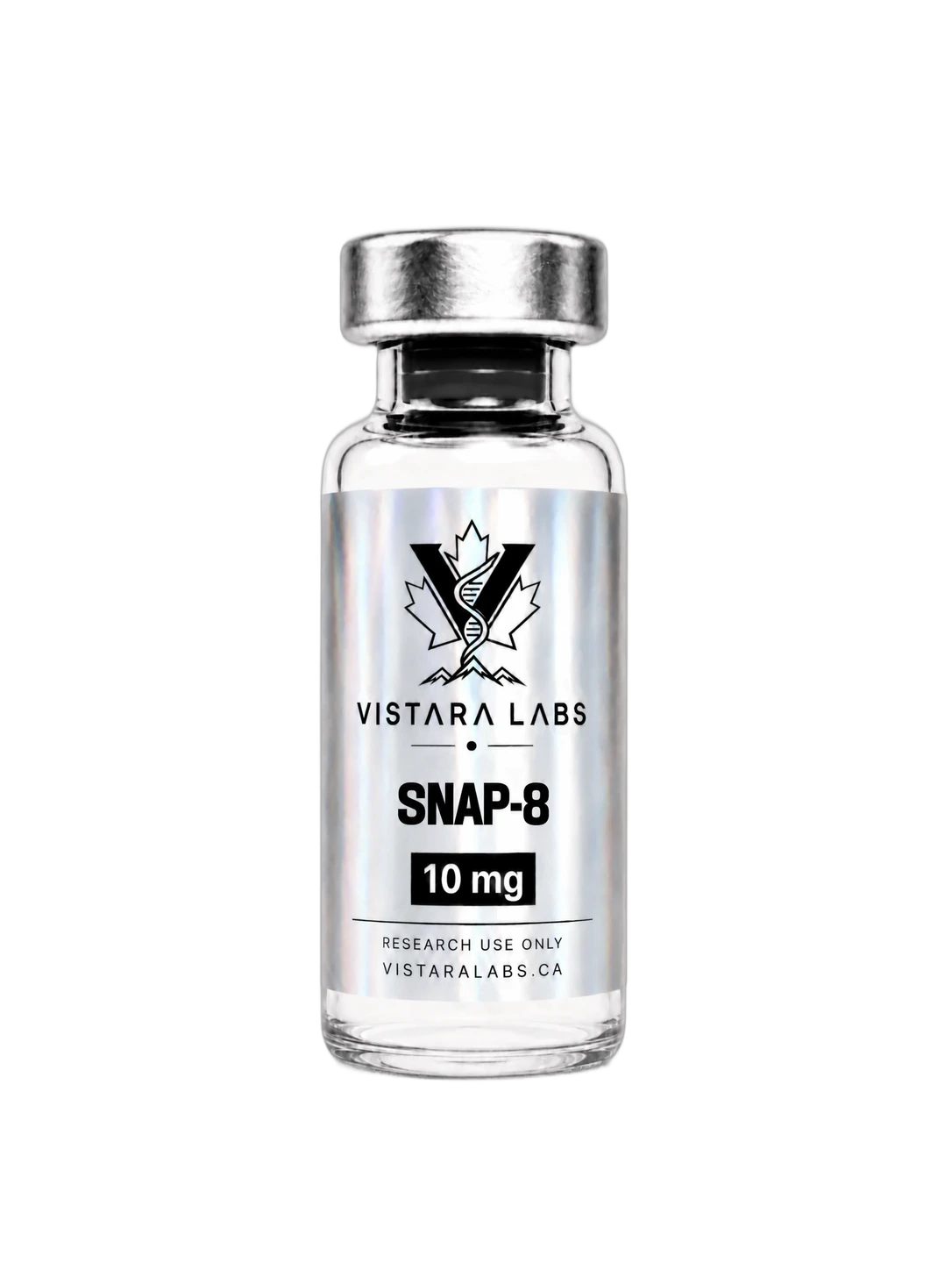
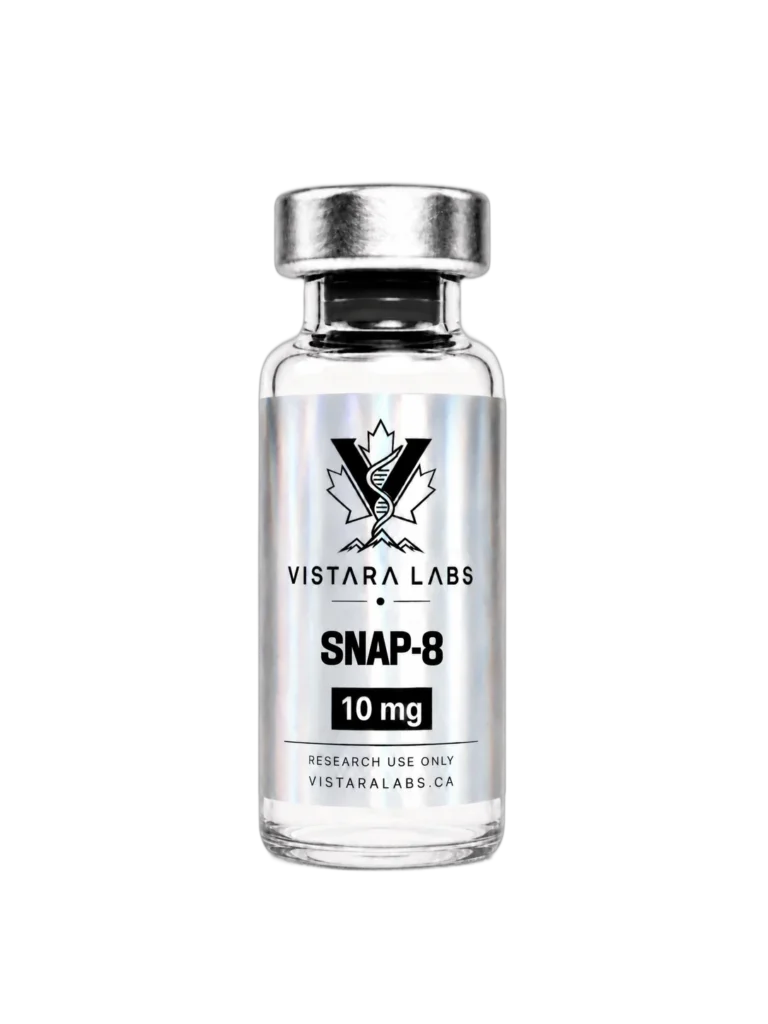
Snap-8 (acetyl octapeptide-3) is a synthetic eight-amino-acid peptide, Ac-Glu-Glu-Met-Gln-Arg-Arg-Ala-Asp-NH2, designed to mimic the start of the nerve protein SNAP-25 and so dampen the signal that makes facial muscles contract. It is a two-amino-acid extension of Argireline, the first “topical botulinum-toxin-like” peptide, and was developed in Spain as a cosmetic ingredient for expression wrinkles. Its parent peptide has peer-reviewed human trials behind it, while most figures for Snap-8 itself come from its developer and from studies of multi-ingredient formulas. Vistara Labs supplies it as a Snap-8 10 mg lyophilised vial.
Findings
- Snap-8 is Argireline plus alanine and aspartic acid, both modelled on the N-terminal end of SNAP-25, a core protein of the nerve cell’s release machinery.
- Argireline inhibited neurotransmitter release with a potency similar to botulinum toxin A, though with much lower efficacy, and showed no oral toxicity or primary irritation at high doses (2002).
- In a 60-person randomised trial, Argireline showed 48.9% total anti-wrinkle efficacy against 0% for placebo after 4 weeks (2013).
- In human skin samples, Argireline crossed the outer skin barrier, reached deeper layers and significantly increased collagen in aged skin (2025).
- Microneedle patches containing Snap-8 with other actives improved wrinkles, hydration and elasticity in two human studies (2020, 2024).
 View product →
What is Snap-8 and where did it come from?
The botulinum toxin problem
Expression lines, such as crow’s feet and forehead lines, form where facial muscles contract over and over. Botulinum toxins relax those muscles with a strong, long-lasting effect, but their high neurotoxicity limits their use, which led researchers to look for non-toxic molecules that act on the same machinery (Blanes-Mira et al., Int J Cosmet Sci, 2002).
Argireline, 2002
A group in Alicante, Spain, used rational design to find a short peptide that mimics the N-terminal end of SNAP-25. The result was the hexapeptide Ac-EEMQRR-NH2, named Argireline and now listed as acetyl hexapeptide-8 (also acetyl hexapeptide-3). It interfered with the formation and stability of the SNARE complex and significantly inhibited neurotransmitter release (Blanes-Mira et al., 2002).
Snap-8, the eight-residue version
Snap-8 continues the SNAP-25 sequence by two more amino acids, alanine and aspartic acid, giving an octapeptide that is acetylated at the start and amidated at the end, as Argireline is. Reviews describe it as the elongated form of Argireline, developed for wrinkles in ageing skin (Yang et al., Front Immunol, 2018), and as a Lipotec ingredient (Errante et al., Front Chem, 2020).
| Feature | Argireline | Snap-8 |
|---|---|---|
| Ingredient name | Acetyl hexapeptide-8 | Acetyl octapeptide-3 |
| Length | 6 amino acids | 8 amino acids |
| Sequence | Ac-EEMQRR-NH2 | Ac-EEMQRRAD-NH2 |
| Human data | Randomised trials | Multi-ingredient studies |
How Snap-8 works
When a nerve tells a muscle to contract, it releases acetylcholine from small vesicles. Those vesicles fuse with the nerve cell membrane through the SNARE complex, a tight bundle of proteins that SNAP-25 helps form; the process depends on calcium (Blanes-Mira et al., 2002). SNARE complexes drive vesicle fusion in many cell types, from neurons to mast cells (Yang et al., 2018).
Snap-8 and Argireline are built to look like the end of SNAP-25. The working model is that they compete with the native protein for a place in the SNARE complex and destabilise it, so fewer vesicles release their contents and the muscle contracts less forcefully (Errante et al., 2020). Unlike botulinum toxin, they do not cut SNAP-25; they compete with it.
The evidence for the mechanism is strongest for Argireline. In the original work, it inhibited neurotransmitter release with a potency similar to botulinum toxin A, though as expected with much lower efficacy (Blanes-Mira et al., 2002). For Snap-8, the developer’s data, summarised in the 2020 review, report 43% inhibition of glutamate release at 1.5 mM in a laboratory assay (Errante et al., 2020).
What the research has shown
Argireline in human studies
- First volunteer study, 2002. An oil-in-water emulsion containing 10% Argireline reduced wrinkle depth by up to 30% over 30 days in healthy women, measured by skin topography (Blanes-Mira et al., 2002).
- Randomised trial, 2013. Sixty Chinese adults were randomised 3:1 to Argireline or placebo, applied to the eye area twice daily for 4 weeks. Total anti-wrinkle efficacy was 48.9% with Argireline and 0% with placebo, and all skin-roughness measures on silicone replicas fell in the Argireline group (Wang et al., Am J Clin Dermatol, 2013).
- Skin penetration and collagen, 2025. In ex vivo human skin, Argireline crossed the stratum corneum and built up in deeper layers. In a skin model containing sensory neurons it suppressed acetylcholine release, raised the antioxidant enzyme SOD2 and stimulated type I collagen, and in aged skin samples it significantly increased collagen (Martin et al., ACS Biomater Sci Eng, 2025).
Snap-8 in human studies
Two peer-reviewed human studies have included Snap-8, each as one ingredient of a dissolving hyaluronic acid microneedle patch. In 24 adults over 28 days, a patch with acetyl octapeptide-3 and two other actives improved eye-area wrinkles, elasticity and barrier function against a placebo patch, with no adverse effects (Shin et al., Ann Dermatol, 2024). In a 12-week study of a five-ingredient patch, fine lines and wrinkles fell by 25.8% and hydration rose by 15.4% (Avcil et al., J Cosmet Dermatol, 2020). Because each patch combined several actives, the results describe the formula rather than Snap-8 alone.
Developer data
Beyond those studies, the figures quoted for Snap-8 come from its developer: a maximum wrinkle-depth reduction of 63% over 28 days in women volunteers (Lipotec, Personal Care, 2016), and in a laboratory assay, 47% inhibition of glutamate release when combined with the pentapeptide Leuphasyl (Errante et al., 2020). These results have not been published as peer-reviewed trials. The buying guide sets out the full list.
Forms we stock
Vistara Labs supplies Snap-8 as a 10 mg lyophilised vial, third-party tested, with certificates on the lab reports page. Reconstitution arithmetic is on Snap-8 reconstitution, and ordering details are in Buy Snap-8 in Canada. For skin peptides that work on repair rather than nerve signalling, see GHK-Cu: The Skin Research, KLOW vs GLOW and Peptides for Skin.
Frequently asked questions
What is Snap-8?
Snap-8 (acetyl octapeptide-3) is a synthetic eight-amino-acid peptide modelled on the N-terminal end of the nerve protein SNAP-25. It is a two-amino-acid extension of Argireline, developed as a cosmetic ingredient for expression wrinkles.
How does Snap-8 work?
It is designed to compete with SNAP-25 for a place in the SNARE complex, the protein machinery nerve cells use to release neurotransmitters, which reduces the signal for muscle contraction. Unlike botulinum toxin, it does not cut SNAP-25.
Is Snap-8 a peptide version of Botox?
It acts on the same release machinery as botulinum toxin but by a different, much gentler mechanism. Its parent peptide, Argireline, matched botulinum toxin A in potency in the laboratory but with much lower efficacy.
What did research show for Argireline, Snap-8’s parent peptide?
In a 2013 randomised, placebo-controlled trial in 60 adults, Argireline showed 48.9% total anti-wrinkle efficacy against 0% for placebo after 4 weeks. A 2025 study found it crossed the outer skin barrier and increased collagen in aged skin samples.
What did human studies including Snap-8 show?
Microneedle patches containing Snap-8 with other actives improved eye-area wrinkles, elasticity and barrier function over 28 days (2024), and reduced fine lines by 25.8% with 15.4% better hydration over 12 weeks (2020).
Product details from vistaralabs.ca, October 2026. Sources: Blanes-Mira C, et al. A synthetic hexapeptide (Argireline) with antiwrinkle activity. Int J Cosmet Sci. 2002. PMID 18498523. Wang Y, et al. Am J Clin Dermatol. 2013. PMID 23417317. SNAP-8 peptide: an octapeptide to express yourself at ease. Lipotec. Personal Care. 2016. personalcaremagazine.com. Yang Y, et al. Front Immunol. 2018. PMID 29696021. Avcil M, et al. J Cosmet Dermatol. 2020. PMID 31134751. Errante F, et al. Front Chem. 2020. PMID 33195061. Shin JY, et al. Ann Dermatol. 2024. PMID 39082657. Martin BA, et al. ACS Biomater Sci Eng. 2025. PMID 40410664.
More on this: Buy Snap-8 in Canada: Acetyl Octapeptide-3 Research Vial.
All products supplied by Vistara Labs are intended for laboratory research use only. They are not drugs, are not approved for human or veterinary use, and are not intended to diagnose, treat, cure or prevent any condition. Nothing on this page constitutes medical advice or guidance for use in humans.