How Long Does GLOW Last? Storage Before and After Mixing
Lyophilised GLOW keeps sealed and dry for the weeks a vial is in use at 2 to 8 °C and for months at −20 °C; once mixed with bacteriostatic water it lasts 8 to 12 weeks at 2 to 8 °C under Vistara Labs’ handling guidance, kept dark, with quality slowly fading from around week 6 to 8. No published stability study covers the three peptides together, so that window is the general guidance each component already takes. The blend is handled to suit its most demanding peptide, GHK-Cu, whose copper makes light and colour the things to watch.
Findings
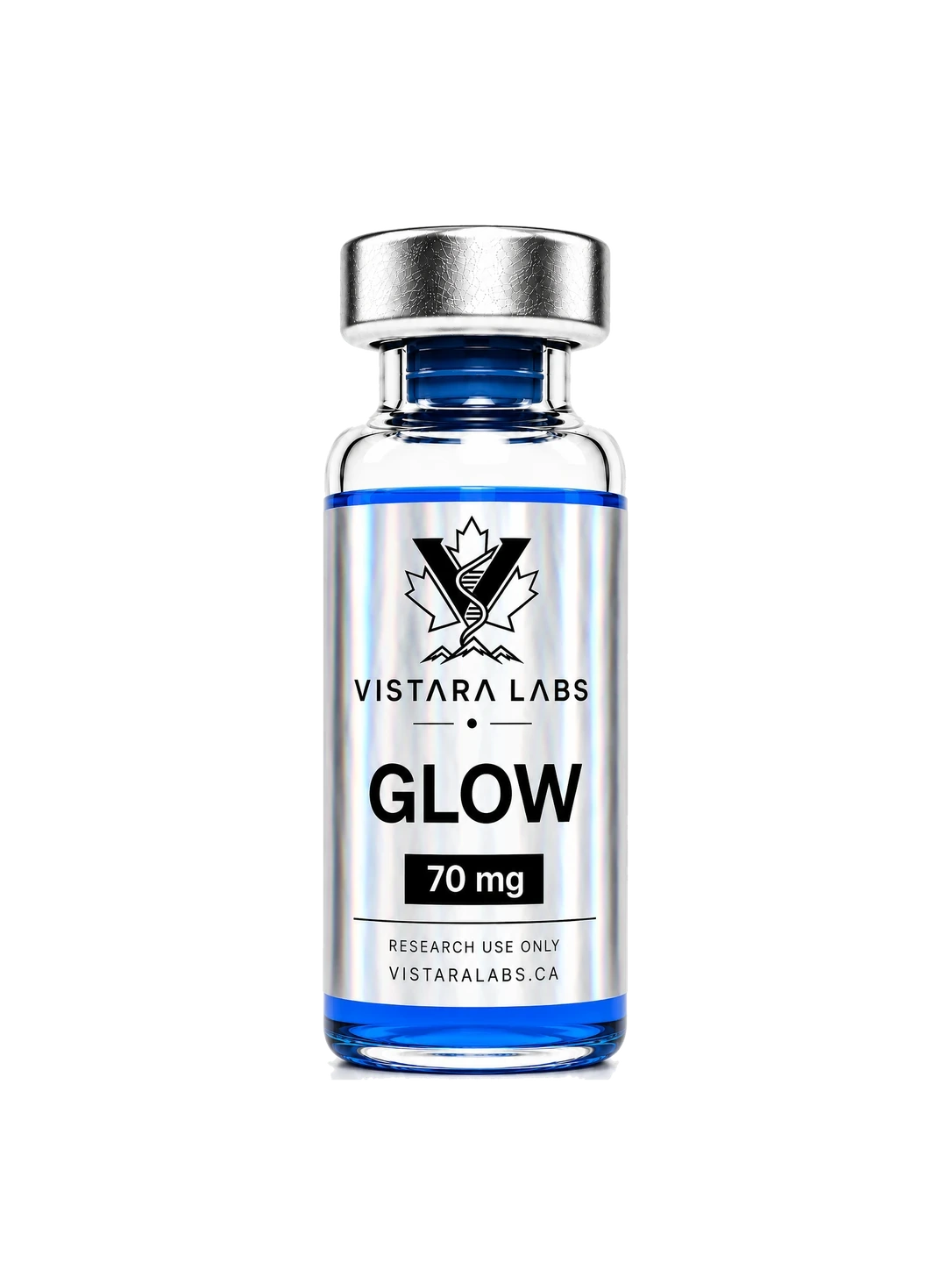
- A GLOW vial holds 50 mg GHK-Cu, 10 mg BPC-157 and 10 mg TB-500, 70 mg in total (Vistara Labs product listing).
- In a preformulation study, GHK-Cu was stable in water and pH 4.5 to 7.4 buffers for at least two weeks at 60 °C, but broke down under alkaline and oxidative stress (Badenhorst et al., Pharm Dev Technol, 2016).
- A 2026 review notes that the copper complex can come apart without any loss of peptide, and that both the peptide and its copper centre may be light-sensitive (Mateescu et al., Pharmaceutics, 2026).
- BPC-157 has no methionine, cysteine, tryptophan, asparagine or glutamine; its main chemical weak point is slow hydrolysis at the Asp10 to Asp11 bond (Mateescu et al., Pharmaceutics, 2026).
- The peptide identified in TB-500 is Ac-LKKTETQ, the acetylated 17 to 23 fragment of thymosin beta-4, a sequence with no methionine or cysteine (Esposito et al., Drug Test Anal, 2012).
How long does GLOW powder last?
No supplier publishes a stability data sheet for the blend, so the powder windows follow the component pages. Sealed and dry, the GLOW Blend 70 mg vial keeps at 2 to 8 °C for the weeks it is in use and at −20 °C for months, in its box. The cake is blue because the copper in GHK-Cu is already bound; the colour is not a dye. Moisture is the main enemy of a freeze-dried cake, so a cold vial is brought to room temperature before the stopper is pierced, which stops condensation forming on the powder.
How long does GLOW last after mixing?
At 2 to 8 °C, dark and accessed only through a swabbed stopper, mixed GLOW lasts 8 to 12 weeks, with quality fading from around week 6 to 8. GHK-Cu, GLOW and KLOW share one row in how long peptides last after mixing, with “kept dark” added. The GLOW reconstitution page has the calculator for the 70 mg vial. Once mixed, the three peptides share one solution and one clock, so the vial is treated as lasting only as long as its most demanding component.
What the components say about stability
Each component has its own storage page: how long GHK-Cu lasts, BPC-157 and TB-500. None has a published solution shelf life shorter than the general window, and all three give the same 8 to 12 weeks. What differs is the weak point.
GHK-Cu makes up 50 of the 70 mg, and it has two ways to lose quality: the peptide chain can break, or the copper can leave or change partners while the chain stays intact. The 2026 review lists histidine, amino acids, phosphate, citrate and proteins among things that can redistribute copper, and flags the copper centre as possibly light-sensitive, which is why a GLOW vial lives in its box. The same review warns that a test measuring only the peptide can miss copper loss, which is why colour matters so much here.
The other two are forgiving. BPC-157 lacks the residues that oxidise or deamidate, leaving slow hydrolysis between its two aspartic acids. TB-500’s seven-residue fragment has no methionine, the residue that oxidises in full-length thymosin beta-4. Neither has a published solution shelf life, and whether the three peptides affect each other in solution has not been studied, so the general window and the colour check carry the weight.
How long does GLOW last at room temperature?
There is no published figure for GLOW in solution at room temperature. GHK-Cu held up for two weeks at 60 °C in one study, but that was a stress test of one component, not a figure for the blend. A mixed vial is taken out of the fridge only for handling.
Can GLOW be frozen?
The sealed powder can: −20 °C is the standard for holding it for months. A working vial should not be frozen and thawed, since freeze-thaw cycles aggregate peptides in solution. Laboratories that need long holding freeze single-use aliquots once instead.
How can you tell mixed GLOW has degraded?
- Clear blue is normal. The colour comes from the copper complex, whose absorption band at 580 to 600 nm shifts when the copper’s surroundings change.
- Fading, yellowing or darkening means the copper environment has changed.
- Cloudy blue that does not clear within 10 to 15 minutes of mixing, or that appears later.
- Particles, strands or gel.
Breakdown of BPC-157 or TB-500 gives colourless fragments, so a vial that still looks right is not proof of full strength. The mixing date matters as much as the look.
How long does GLOW nasal spray last?
The GLOW Nasal Spray arrives ready-mixed: the same 70 mg in 10 mL of sterile saline, in a sealed metered pump. Once opened it is kept at 2 to 8 °C, upright, capped and in the dark, and never frozen. It lasts as long as its label allows; the vial window above does not carry over, because a spray in saline is a different preparation. Date the bottle when first opened, and discard it sooner if the clear blue changes, clouds or shows particles. Full rules: how to store a peptide nasal spray.
Travelling with GLOW
Sealed powder vials are the form to travel with, boxed and out of heat. A mixed vial or opened spray travels upright and dark in an insulated case with a cold pack that does not touch the glass.
GLOW storage at a glance
| State | Where | How long |
|---|---|---|
| Powder, sealed | −20 °C, dry | Months (store guidance) |
| Powder, sealed | 2 to 8 °C, dark | The weeks the vial is in use (store guidance) |
| Mixed with bacteriostatic water | 2 to 8 °C, dark | 8 to 12 weeks, fading from week 6 to 8 (store guidance) |
| Mixed, room temperature | Handling only | No published figure |
Certificates of analysis are on the lab reports page, and every order ships from within Canada by Canada Post Xpresspost.
Vistara Labs supplies GLOW as a laboratory research material. The windows on this page describe how long the blend stays in good condition.
Frequently asked questions
How long does GLOW last in the fridge after mixing?
Under Vistara Labs’ handling guidance, 8 to 12 weeks at 2 to 8 °C in the dark, with quality fading from around week 6 to 8.
How long does GLOW last at room temperature?
No published figure exists for GLOW in solution at room temperature. A mixed vial is kept in the fridge and taken out only for handling.
Can you freeze GLOW?
Yes as sealed powder, which keeps for months at −20 °C. A mixed vial that will be opened again should not be frozen, because freeze-thaw cycles aggregate peptides in solution.
Does GLOW go bad?
Yes. In solution GHK-Cu can lose or exchange its copper, faster with light, and BPC-157 and TB-500 slowly break into colourless fragments. A change from clear blue, cloudiness or particles mean it has degraded.
Is GLOW stored differently from KLOW?
No. Both carry 50 mg of GHK-Cu, so both are kept cold and dark and checked by colour, with the same 8 to 12 week window once mixed. KLOW adds 10 mg of KPV, compared in KLOW vs GLOW.
Handling windows: Vistara Labs, October 2026. Sources: Badenhorst T, Svirskis D, Wu Z. Physicochemical characterization of native glycyl-L-histidyl-L-lysine tripeptide for wound healing and anti-aging: a preformulation study for dermal delivery. Pharm Dev Technol. 2016. PMID 25384620. Mateescu DM et al. GHK-Cu as a bioactive metallopeptide and drug-delivery cargo: coordination chemistry, formulation science, therapeutic evidence, and a translational roadmap. Pharmaceutics. 2026. PMID 42797253. Mateescu DM et al. BPC-157 as an investigational peptide therapeutic: biopharmaceutical challenges, formulation strategies, and translational development barriers. Pharmaceutics. 2026. PMID 42198317. Esposito S et al. Synthesis and characterization of the N-terminal acetylated 17-23 fragment of thymosin beta 4 identified in TB-500, a product suspected to possess doping potential. Drug Test Anal. 2012. PMID 22962027. Huff T, Zerzawy D, Hannappel E. Interactions of beta-thymosins, thymosin beta 4-sulfoxide, and N-terminally truncated thymosin beta 4 with actin. Eur J Biochem. 1995. PMID 7607239.
More on this: How Long Do Peptides Last After Mixing?
All products supplied by Vistara Labs are intended for laboratory research use only. They are not drugs, are not approved for human or veterinary use, and are not intended to diagnose, treat, cure or prevent any condition. Nothing on this page constitutes medical advice or guidance for use in humans.