N-Acetyl Selank Amidate: What It Is and How It Differs from Selank
N-acetyl Selank amidate is Selank with both ends capped: an acetyl group on the front threonine and an amide in place of the acid at the back, giving Ac-Thr-Lys-Pro-Arg-Pro-Gly-Pro-NH2 (calculated C35H60N12O9, about 793 g/mol). The seven-amino-acid sequence of Selank is unchanged; the caps are aimed at the enzymes that break short peptides down from their ends. The capped form has no papers on PubMed, so its published research base is Selank itself, which has 136 PubMed records, including clinical studies in anxiety disorders and brain imaging in healthy volunteers. This guide explains the chemistry, what has been published and how it compares with Selank.
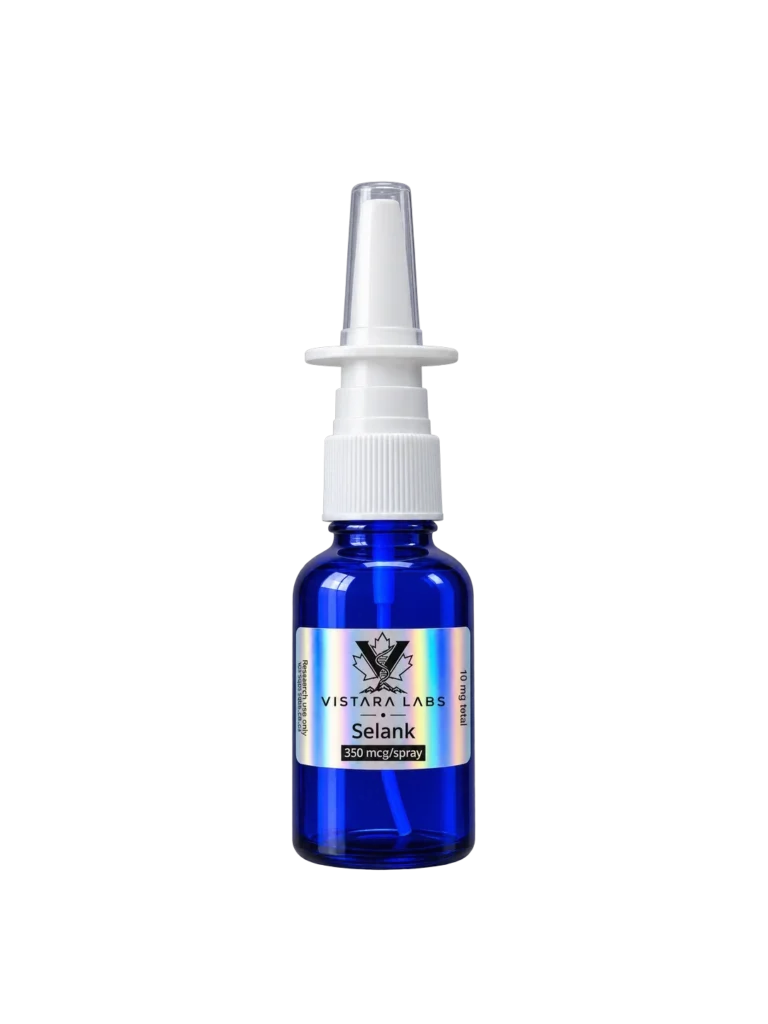
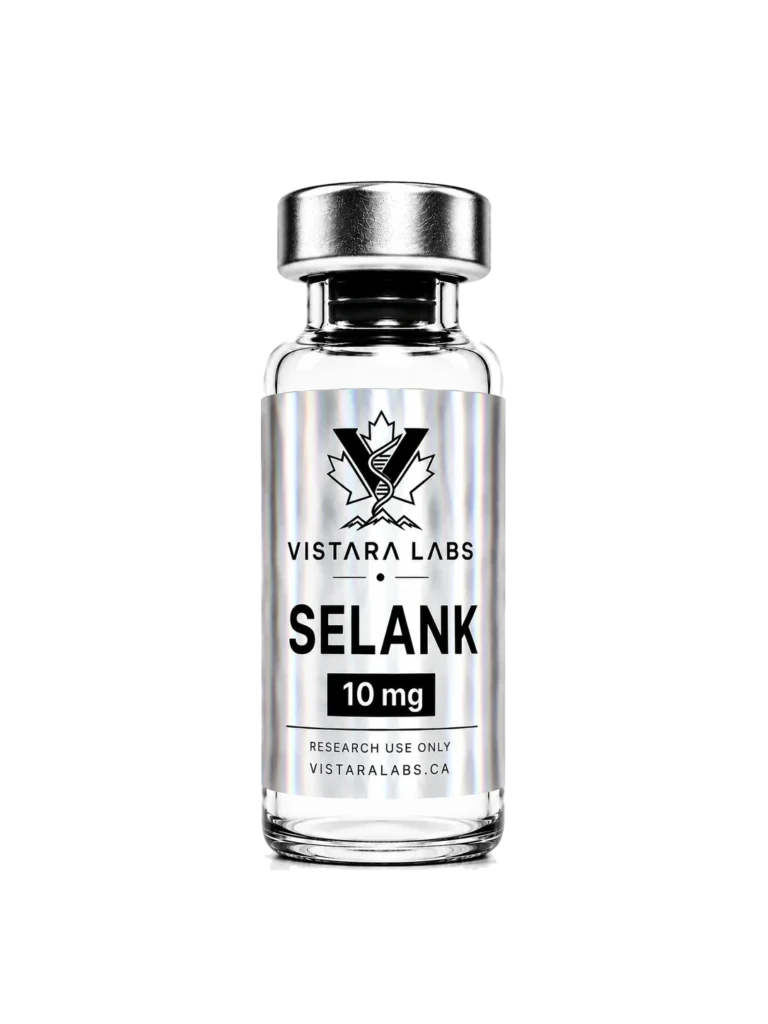
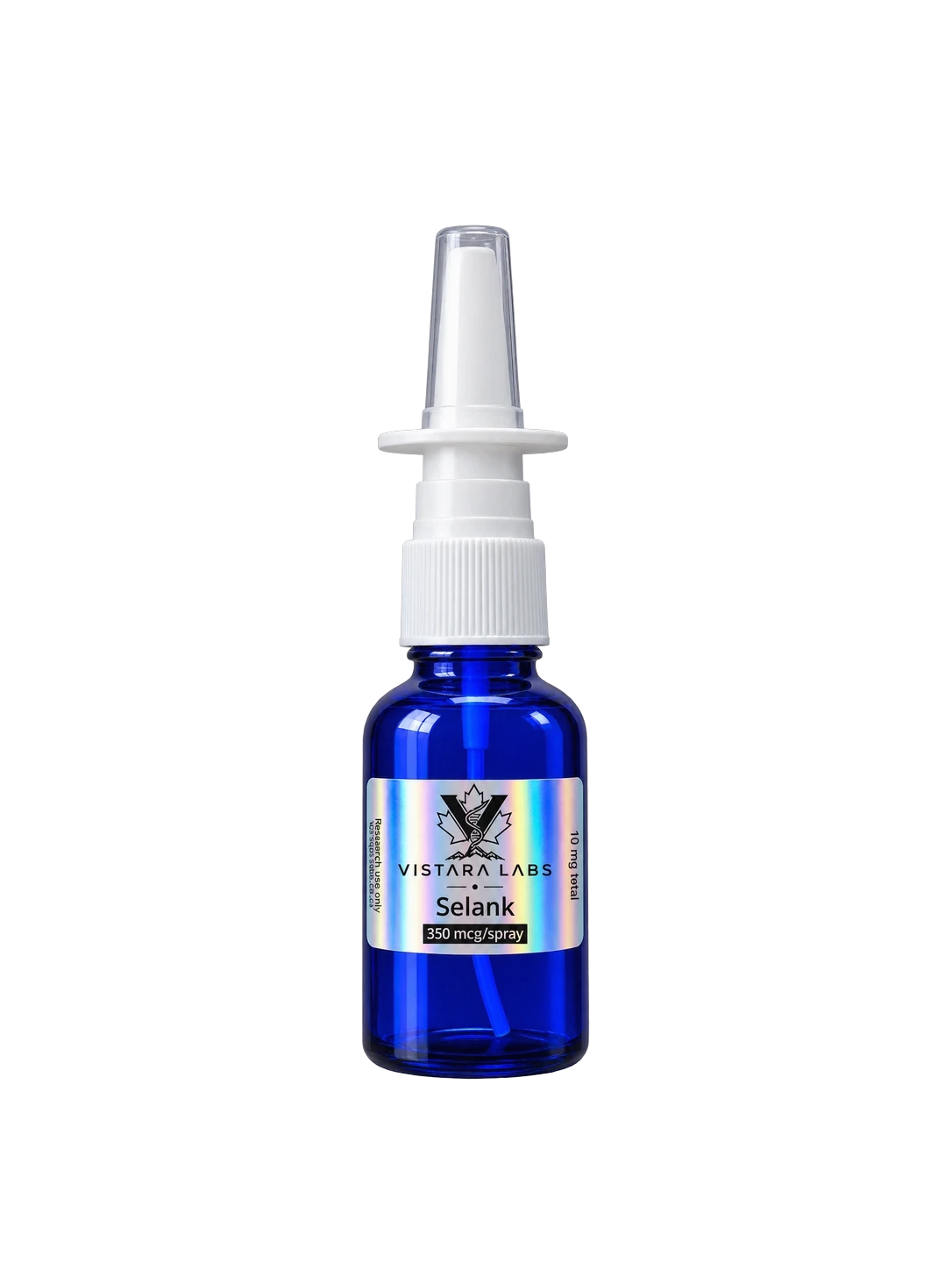
Vistara Labs does not currently stock N-acetyl Selank amidate, but you can request it: contact us and we will source it for you. The closest product we sell is Selank itself: the ready-mixed Selank Nasal Spray (10 mg in 5 mL, about 28 sprays, or 20 mg in 10 mL, about 57 sprays, 350 mcg per spray) and the lyophilised Selank 10 mg vial.
Findings
- Selank is the heptapeptide Thr-Lys-Pro-Arg-Pro-Gly-Pro (Zozulya, Bull Exp Biol Med, 2001): the tuftsin sequence Thr-Lys-Pro-Arg with a Pro-Gly-Pro tail (PubChem).
- In 62 patients with generalised anxiety disorder or neurasthenia, Selank’s anti-anxiety effect matched medazepam’s, with added anti-fatigue and stimulating effects (Zozulia, Zh Nevrol Psikhiatr Im S S Korsakova, 2008).
- In 60 patients with anxiety disorders compared against phenazepam, Selank showed a pronounced anti-anxiety and mild nootropic effect that lasted a week after the last administration (Medvedev, 2014).
- Selank inhibited the enzymes that break down enkephalins in human plasma (IC50 15 µM), more potently than standard peptidase inhibitors (Zozulya, 2001).
- In human plasma, N-terminal acetylation and C-terminal amidation markedly prolonged the stability of a short peptide whose uncapped half-life was 22 seconds (Brinckerhoff, Int J Cancer, 1999).
What is N-acetyl Selank amidate?
The name describes two changes to Selank. “N-acetyl” means an acetyl group (CH3CO) is attached to the free amino group at the front of the chain, on threonine. “Amidate” means the carboxylic acid at the back, on the final proline, is replaced by an amide (CONH2).
The middle of the molecule stays the same. Selank is built from tuftsin, the four-amino-acid peptide Thr-Lys-Pro-Arg, extended with the Pro-Gly-Pro tail that Semax also carries. PubChem lists Selank as C33H57N11O9, 751.9 g/mol (CID 11765600). Adding an acetyl group and converting the acid to an amide gives C35H60N12O9, about 793 g/mol; this is our calculation, as PubChem holds no compound record for the capped form.
It is often shortened to NA-Selank-amidate or N-acetyl Selank. It should not be confused with Selank acetate, which is the ordinary salt form of unmodified Selank.
Why cap the ends of Selank?
Most enzymes that break down short peptides work from the ends: aminopeptidases from the front, carboxypeptidases from the back. An acetyl group removes the free amino group aminopeptidases recognise, and an amide removes the free acid at the other end. In human plasma, capping a short test peptide this way markedly prolonged its stability (Brinckerhoff, 1999).
The same approach has been applied to Semax, Selank’s sister peptide, in N-acetyl Semax amidate, which is registered in PubChem (CID 172638603). N-acetyl Selank amidate is the Selank counterpart.
What has been published about N-acetyl Selank amidate?
PubMed indexes no paper on N-acetyl Selank or N-acetyl Selank amidate (search, October 2026), and PubChem has no compound record for it. It is a supplier-made analogue. The published research for this peptide is the research on Selank, set out below.
What does Selank research show?
Human studies
- Generalised anxiety and neurasthenia, 2008. In 62 patients, Selank (30 patients) was compared with medazepam (32 patients) on the Hamilton, Zung and CGI scales. The anti-anxiety effects were similar, and Selank also had anti-fatigue and stimulating effects. Patients had low levels of a blood marker of enkephalin activity, and that marker rose during Selank treatment, mostly in generalised anxiety (Zozulia, 2008).
- Anxiety disorders, 2014. In 60 patients with phobic, anxiety and somatoform disorders, Selank was compared with phenazepam. Selank showed a pronounced anti-anxiety and mild nootropic effect, which lasted for a week after the last administration, and improved quality of life (Medvedev, Zh Nevrol Psikhiatr Im S S Korsakova, 2014).
- Brain connectivity, 2020. In 52 healthy participants, Selank and Semax each changed resting-state functional connectivity between the right amygdala, a key region for anxiety, and the right temporal cortex (Panikratova, Dokl Biol Sci, 2020).
Mechanism
- Enkephalin protection. Selank inhibited enkephalin-degrading enzymes in human plasma, with an IC50 of 15 µM, more potently than the peptidase inhibitors bacitracin and puromycin (Zozulya, 2001).
- GABA receptors. In brain membrane studies, Selank acted as a positive allosteric modulator of GABA binding, the receptor system targeted by benzodiazepines, at a site that only partly overlaps theirs (Vyunova, Protein Pept Lett, 2018).
For how Selank and Semax divide the work, see Semax vs Selank; for comparisons with prescription anxiolytics, see Selank vs Xanax and Selank vs SSRIs.
N-acetyl Selank amidate vs Selank: how do they differ?
| Selank | N-acetyl Selank amidate | |
|---|---|---|
| Sequence | Thr-Lys-Pro-Arg-Pro-Gly-Pro | Ac-Thr-Lys-Pro-Arg-Pro-Gly-Pro-NH2 |
| Formula, weight | C33H57N11O9, 751.9 g/mol | C35H60N12O9, about 793 g/mol (calculated) |
| Front end | Free amino group | Acetyl cap |
| Back end | Free acid | Amide |
| PubMed records | 136 (October 2026) | None |
| Human studies | Anxiety disorders, brain imaging | None |
| At Vistara Labs | Nasal spray and 10 mg vial | Sourced on request |
- Selank is the choice for protocols that need published reference points: two clinical comparisons with benzodiazepines, imaging data and defined mechanisms on enkephalin enzymes and GABA receptors.
- N-acetyl Selank amidate suits stability and structure-activity work: comparing a fully capped Selank against the parent under the same enzymes or media.
Selank for research in Canada
Vistara Labs supplies the Selank Nasal Spray ready-mixed in sterile saline in a sealed metered pump that delivers 0.175 mL per press: 10 mg in 5 mL (about 28 sprays) or 20 mg in 10 mL (about 57 sprays), at 350 mcg per spray. The Selank + Semax Nasal Spray holds 10 mg of each in 10 mL, about 57 sprays, and Selank is also in the Sleep & Calm Spray Stack and the Cognitive Clarity Spray Stack. The lyophilised Selank 10 mg vial is the powder format. Orders ship from within Canada by Canada Post Xpresspost, with certificates on the lab reports page. See Buy Selank Nasal Spray in Canada for the full spray range.
Selank and its derivatives are supplied for laboratory research use only. The human studies above were clinical research using pharmaceutical preparations under medical supervision.
Frequently asked questions
What is N-acetyl Selank amidate?
It is Selank with an acetyl group on the front threonine and an amide at the back proline: Ac-Thr-Lys-Pro-Arg-Pro-Gly-Pro-NH2, calculated as C35H60N12O9, about 793 g/mol.
How is N-acetyl Selank amidate different from Selank?
The amino-acid sequence is the same. Selank has a free amino group at the front and a free acid at the back; N-acetyl Selank amidate caps both, which targets the enzymes that break short peptides down from their ends.
Is N-acetyl Selank the same as Selank acetate?
No. N-acetyl Selank has an acetyl group bonded to the peptide chain. Selank acetate is unmodified Selank supplied as an acetate salt.
Has N-acetyl Selank amidate been studied?
PubMed indexes no paper on it. The published research is on Selank, including clinical comparisons with medazepam (62 patients, 2008) and phenazepam (60 patients, 2014) and a 52-person brain-imaging study (2020).
Does Vistara Labs sell N-acetyl Selank amidate?
Vistara Labs does not currently stock N-acetyl Selank amidate, but you can request it: contact us and we will source it for you. Vistara Labs sells Selank as a ready-mixed nasal spray (10 mg or 20 mg, 350 mcg per spray), in the Selank + Semax Nasal Spray and as a 10 mg vial.
Product details from vistaralabs.ca, October 2026. Sources: Zozulya AA et al. The inhibitory effect of Selank on enkephalin-degrading enzymes as a possible mechanism of its anxiolytic activity. Bull Exp Biol Med. 2001. PMID 11550013. Zozulia AA et al. Efficacy and possible mechanisms of action of a new peptide anxiolytic selank in the therapy of generalized anxiety disorders and neurasthenia. Zh Nevrol Psikhiatr Im S S Korsakova. 2008. PMID 18454096. Medvedev VE et al. A comparison of the anxiolytic effect and tolerability of selank and phenazepam in the treatment of anxiety disorders. Zh Nevrol Psikhiatr Im S S Korsakova. 2014. PMID 25176261. Panikratova YR et al. Functional Connectomic Approach to Studying Selank and Semax Effects. Dokl Biol Sci. 2020. PMID 32342318. Vyunova TV et al. Peptide-based Anxiolytics: The Molecular Aspects of Heptapeptide Selank Biological Activity. Protein Pept Lett. 2018. PMID 30255741. Brinckerhoff LH et al. Terminal modifications inhibit proteolytic degradation of an immunogenic MART-1(27-35) peptide: implications for peptide vaccines. Int J Cancer. 1999. PMID 10495424. PubChem. Selank, CID 11765600; Tuftsin, CID 156080; N-acetyl Semax amidate, CID 172638603.
More on this: Buy Selank in Canada, How Long Does Selank Last? and Semax and Selank: Intranasal vs Subcutaneous Research Routes.
All products supplied by Vistara Labs are intended for laboratory research use only. They are not drugs, are not approved for human or veterinary use, and are not intended to diagnose, treat, cure or prevent any condition. Nothing on this page constitutes medical advice or guidance for use in humans.