PT-141 Half-Life: How Long It Stays Active
Sexual Health & Intimacy Research
PT-141 (bremelanotide) has a mean terminal half-life of about 2.7 hours in humans after subcutaneous injection, with a range of 1.9 to 4.0 hours, according to its 2019 FDA prescribing information. By the intranasal route in healthy men, published half-lives were 1.85-2.09 hours. Blood levels peak about an hour after injection, absorption is close to complete, and the peptide is cleared mainly by enzymes cutting its amide bonds. This guide explains what those numbers mean, why PT-141 lasts hours rather than minutes or days, how it compares with kisspeptin, and how half-life differs from the shelf life of a vial or PT-141 Nasal Spray.
Findings
- After subcutaneous injection in humans, mean terminal half-life was about 2.7 hours (range 1.9-4.0 hours) and mean clearance 6.5 L per hour (FDA label, 2019).
- Peak blood levels arrived at about 1 hour (range 0.5-1.0 hours), and absolute bioavailability was about 100%.
- Only 21% binds to serum protein, and the main route of breakdown is hydrolysis of the amide bonds in its ring.
- By the intranasal route in healthy men, mean half-life was 1.85-2.09 hours with peak levels at 0.5 hours (Diamond et al., 2004), and an intranasal formulation later reached a 2.5-fold higher mean peak level than the approved injection (FDA label, 2019).
 View product →
What is PT-141?
PT-141 is bremelanotide, a synthetic cyclic heptapeptide: seven amino acids, Ac-Nle-cyclo(Asp-His-D-Phe-Arg-Trp-Lys)-OH, with a molecular weight of 1025.2. It is a melanocortin receptor agonist that activates several receptor subtypes, of which MC1R and MC4R matter most; MC4R is found on neurons across the central nervous system (FDA label, 2019). It came out of the Melanotan II programme, a story told in Melanotan II: the clinical history and the PT-141 connection, and is introduced in What is PT-141?
What does half-life mean?
Half-life is the time it takes for the concentration of a compound in the blood to fall by half. With a 2.7-hour half-life, about half of a PT-141 peak remains after 2.7 hours, a quarter after about 5.4 hours, and roughly 3% after five half-lives, about 13.5 hours. The terminal half-life describes the final, steady decline once absorption is complete. Half-life is a property of the molecule in a particular species by a particular route, so the label figure applies to subcutaneous injection in humans.
The full pharmacokinetic picture from the FDA label
The prescribing information gives a complete human profile for subcutaneous bremelanotide (FDA label, 2019):
- Absorption: median time to peak about 1.0 hour (range 0.5-1.0 hours); absolute bioavailability about 100%. Abdomen and thigh sites gave the same exposure.
- Distribution: 21% bound to human serum protein; mean volume of distribution 25.0 L.
- Elimination: mean terminal half-life about 2.7 hours (range 1.9-4.0); mean clearance 6.5 L per hour.
- Metabolism: multiple hydrolyses of the amide bonds of the cyclic peptide.
- Excretion: after a radiolabelled dose, 64.8% of radioactivity was recovered in urine and 22.8% in faeces.
Exposure rose less than proportionally across the range studied, with peak levels reaching a plateau at the top of that range.
Why does PT-141 last hours, not minutes or days?
Two features explain the figure. First, PT-141 is a small cyclic peptide, and the label identifies enzymatic hydrolysis of its amide bonds as the main clearance pathway, so its fate is set by the body’s peptidases. Second, only 21% is bound to serum protein. Long-acting peptides such as tirzepatide carry a fatty acid chain that binds albumin and holds them in circulation for days; PT-141 has no such reservoir, so most of it stays free to act and to be cleared.
Some effects follow a different clock from the half-life. In a 127-woman blood pressure study, small, transient rises peaked 4-8 hours after administration for systolic pressure and 0-4 hours for diastolic, and values 12-24 hours later were similar to pre-dose readings (FDA label, 2019). The full safety record is in PT-141 side effects.
What does the research show about the nasal route?
The first published human pharmacokinetic data for PT-141 came from the nasal route. In a double-blind, placebo-controlled study in healthy men, intranasal PT-141 reached peak blood levels at a median of 0.50 hours, mean half-life ranged from 1.85 to 2.09 hours across the doses studied, and peak levels and total exposure rose in step with the dose. In men with erectile dysfunction, the first erection occurred about 30 minutes after administration, and PT-141 was well tolerated in both studies (Diamond et al., Int J Impot Res, 2004). The wider history is in PT-141 human studies: from nasal spray to Phase 3 trials.
The FDA label also reports a clinical pharmacology study in 12 healthy men and 12 healthy women that used the intranasal formulation. At the intranasal dose tested, mean peak concentration was 2.5-fold higher than that of the approved injection, alcohol had no effect on its pharmacokinetic profile, and it did not prolong the QTc interval of the heart to any clinically relevant extent (FDA label, 2019).
How does PT-141 compare with other libido research peptides?
| Peptide | Route and species | Published half-life |
|---|---|---|
| PT-141 (bremelanotide) | Subcutaneous, humans | About 2.7 hours |
| PT-141 (bremelanotide) | Intranasal, healthy men | 1.85-2.09 hours |
| Kisspeptin-54 | Intravenous infusion, men | 27.6 minutes |
| Kisspeptin-10 | Intravenous, men | About 3.8 minutes |
The intranasal PT-141 figure is from Diamond et al. (Int J Impot Res, 2004); kisspeptin figures are from Dhillo et al. (J Clin Endocrinol Metab, 2005) and Jayasena et al. (J Clin Endocrinol Metab, 2011). PT-141 acts on melanocortin receptors in the brain, while kisspeptin acts upstream of the reproductive hormones, so the two answer different research questions; see PT-141 vs Kisspeptin and Kisspeptin half-life.
What does this mean for study design?
A 2.7-hour half-life with a peak at about an hour means the informative window after subcutaneous administration is the first several hours: sampling at short intervals early catches the peak, and sampling out to 12-24 hours covers both elimination and the slower blood pressure changes the label describes. Because the peak plateaus at higher exposures, designs comparing levels need to account for the less-than-proportional rise. And because route changes the peak, as the intranasal data show, a study should record the route alongside every concentration.
Half-life in the body vs how long a vial or spray keeps
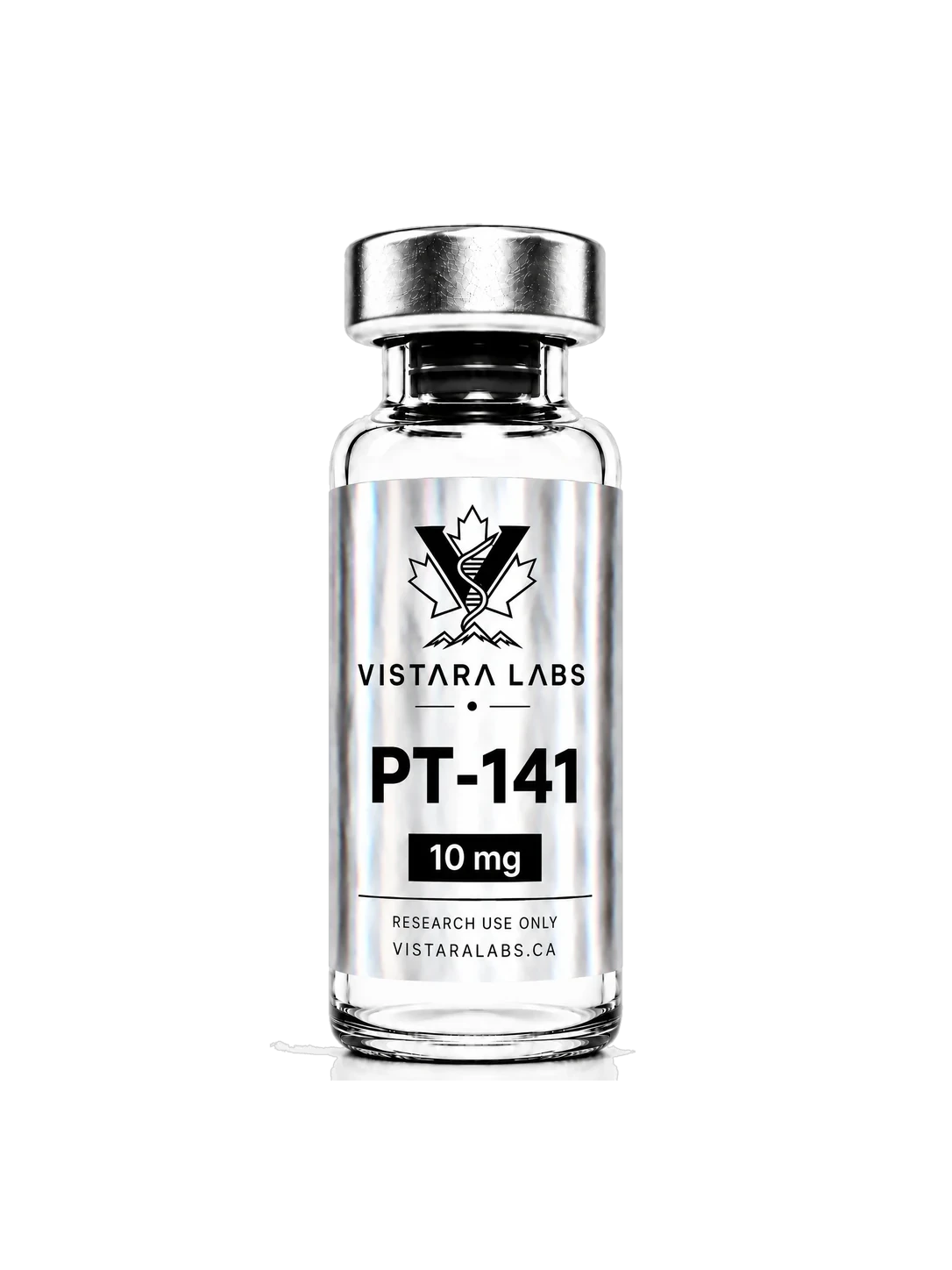
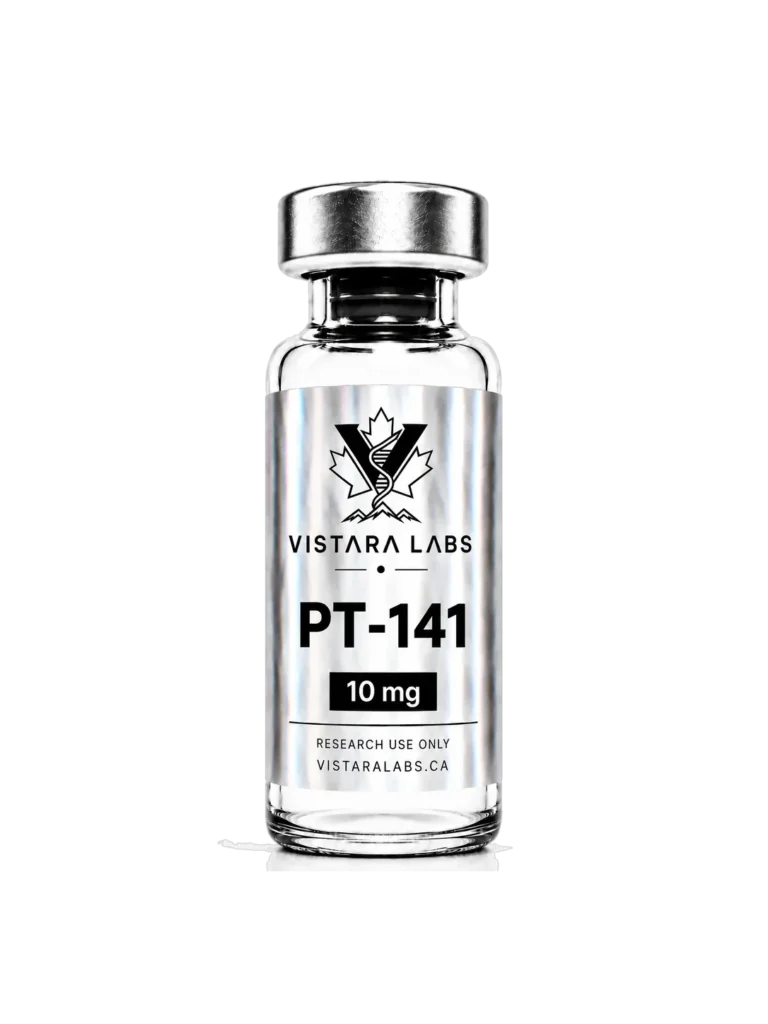
The 2.7-hour figure says nothing about shelf life. How long a lyophilised (freeze-dried) PT-141 vial keeps before and after mixing, and how long a ready-mixed nasal spray keeps once opened, depends on temperature, light and handling. Those answers are in How long does PT-141 last? and How to store a peptide nasal spray. Vials are reconstituted with bacteriostatic water (see the PT-141 reconstitution guide), and certificates for every product are on the lab reports page.
PT-141 is supplied for laboratory research use only. The figures above come from clinical research using a pharmaceutical preparation.
Frequently asked questions
What is the half-life of PT-141?
According to its 2019 FDA prescribing information, bremelanotide has a mean terminal half-life of about 2.7 hours, with a range of 1.9 to 4.0 hours, after subcutaneous injection in humans.
How quickly does PT-141 reach peak levels?
The FDA label reports a median time to peak plasma concentration of about 1.0 hour, with a range of 0.5 to 1.0 hours, and an absolute bioavailability of about 100% after subcutaneous injection.
What did research show about intranasal PT-141?
In healthy men, intranasal PT-141 peaked at a median of 0.50 hours with a mean half-life of 1.85 to 2.09 hours. The FDA label also reports an intranasal formulation reaching a 2.5-fold higher mean peak concentration than the approved injection at the dose tested.
How is PT-141 broken down?
The main pathway is multiple hydrolyses of the amide bonds of the cyclic peptide. After a radiolabelled dose, 64.8% of radioactivity was recovered in urine and 22.8% in faeces.
Is half-life the same as how long PT-141 lasts in the vial?
No. Half-life describes the peptide in the body. How long a vial or ready-mixed nasal spray keeps depends on storage temperature, light and handling, covered in the PT-141 storage guide.
Sources: Bremelanotide injection, full prescribing information. US Food and Drug Administration, 2019. FDA label. Diamond LE et al. Double-blind, placebo-controlled evaluation of the safety, pharmacokinetic properties and pharmacodynamic effects of intranasal PT-141, a melanocortin receptor agonist, in healthy males and patients with mild-to-moderate erectile dysfunction. Int J Impot Res. 2004. PMID 14963471. Dhillo WS et al. Kisspeptin-54 stimulates the hypothalamic-pituitary gonadal axis in human males. J Clin Endocrinol Metab. 2005. PMID 16174713. Jayasena CN et al. The effects of kisspeptin-10 on reproductive hormone release show sexual dimorphism in humans. J Clin Endocrinol Metab. 2011. PMID 21976724.
More on this: Peptides for Libido: What the Research Shows and Buy PT-141 (Bremelanotide) in Canada.
All products supplied by Vistara Labs are intended for laboratory research use only. They are not drugs, are not approved for human or veterinary use, and are not intended to diagnose, treat, cure or prevent any condition. Nothing on this page constitutes medical advice or guidance for use in humans.