Peptide Capsules vs Vials: How the Two Formats Differ
A peptide capsule holds a fixed, pre-measured amount of dry peptide, so there is nothing to reconstitute, measure or keep in solution. A vial holds lyophilised powder that the researcher dissolves in bacteriostatic water to a concentration they choose. Capsules trade flexibility for simplicity; vials trade extra handling steps for control over concentration.
Findings
- A capsule’s amount is fixed at manufacture and stated on its product page; a vial’s concentration is set by the researcher through the water volume.
- Capsules need no bacteriostatic water, syringes or swabs; vials need all three.
- Both stay dry until used. A vial changes state once reconstituted and is then kept refrigerated as a solution.
- Vial certificates are published on the Lab Results page; the capsule certificates were listed as pending there as of 18 November 2026.
What a peptide capsule is
A capsule is a solid, pre-measured unit. Vistara Labs supplies its peptide capsules at 60 capsules per bottle, and each product page states the amount in every capsule; KPV Capsules, for example, list 500 mcg per capsule. Nothing is mixed or measured before use: the amount per unit was set when the capsules were filled.
What a lyophilised vial is
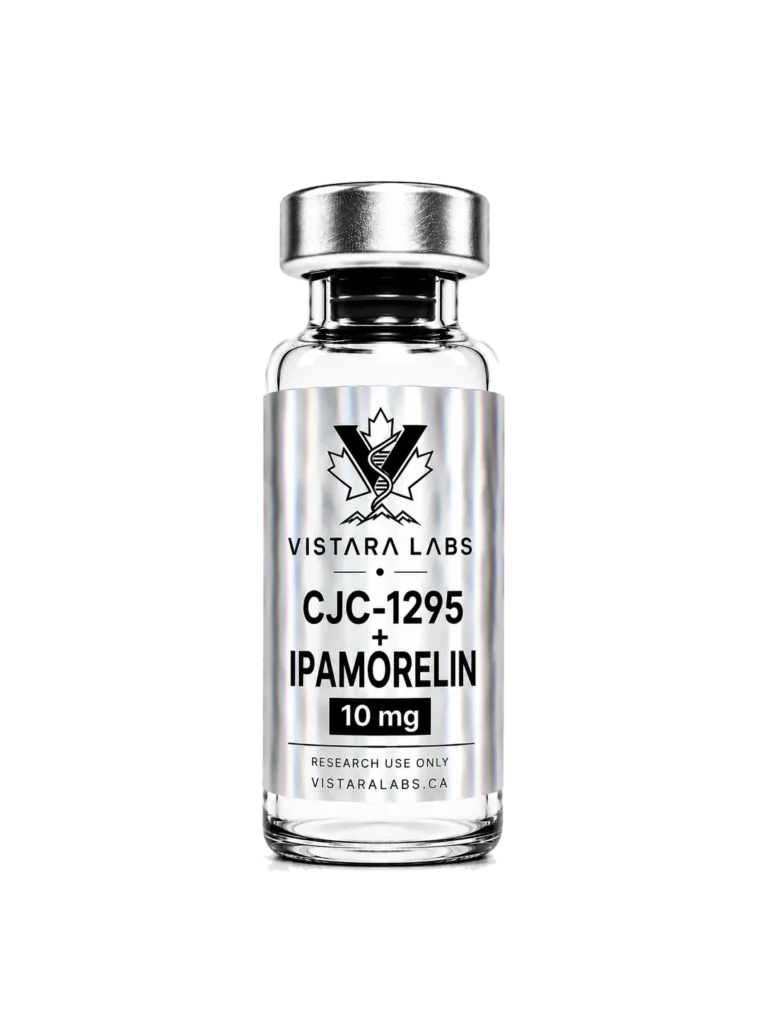
A vial holds freeze-dried peptide as a dry cake or powder under a rubber stopper. Before laboratory use it is reconstituted with bacteriostatic water, and the volume of water decides the concentration: a 10 mg vial gives 5 mg/mL with 2 mL and 10 mg/mL with 1 mL. The method is in how to reconstitute peptides, and the arithmetic for any vial is in the peptide calculator.
How the two formats differ in handling
- Preparation. Capsules: none. Vials: reconstitution, which takes a few minutes and some technique; water run too fast onto the powder or a shaken vial can leave a cloudy solution (see why peptides gel or go cloudy).
- Amount per unit. Capsules: fixed, the same in every capsule. Vials: chosen, by deciding how much water to add and how much solution to draw.
- Equipment. Capsules: none. Vials: bacteriostatic water, syringes and alcohol swabs.
- Repeated access. Capsules: each unit is used once and the rest stay sealed in the bottle. Vials: a reconstituted vial is accessed through the same stopper several times, which is why the stopper is swabbed before each access.
- Physical state over time. Capsules: dry throughout. Vials: dry until reconstituted, then a solution kept at 2 to 8 °C.
Storage
For vials, our storage guide sets out the standard: sealed lyophilised vials at 2 to 8 °C for the weeks they are in use or −20 °C for longer holding, and a reconstituted vial at 2 to 8 °C, never frozen and thawed repeatedly. The capsule product pages do not publish a separate storage period, so the bottle label is the reference. The general rule for any dry peptide material, kept sealed, dry and away from heat and light, is a sensible baseline.
Certificates and traceability
Certificates of analysis from independent laboratories are published on the Lab Results page and linked from each product page. As of 18 November 2026, the vial certificates are published, and both capsule products were listed there as pending. Check that page for the current status before relying on a capsule certificate in your records.
Which format fits which study design?
- A fixed, repeatable amount per unit with no solution prep: a capsule.
- A concentration the researcher sets, or very small measured amounts: a vial.
- Long holds before work begins: either format kept dry and sealed; a vial stays lyophilised until the day it is reconstituted.
- A compound that is not offered as a capsule: a vial or, where one exists, a ready-mixed spray.
Not every compound comes in every format. The peptide capsules and peptide nasal sprays pages list what is available, and choosing a peptide format walks through vial, spray and capsule together.
Capsules and vials are supplied by Vistara Labs for laboratory research use only and ship from the Vancouver area by Canada Post Xpresspost. For the spray format, see peptide nasal spray vs vial.
Frequently asked questions
Do peptide capsules need to be reconstituted?
No. A capsule holds a pre-measured amount of dry peptide, so there is no bacteriostatic water, syringe or mixing step. Only lyophilised vials are reconstituted.
Can you choose the concentration with a peptide capsule?
No. The amount in each capsule is fixed when it is filled and is stated on the product page. A vial is the format to use when the concentration needs to be set by the researcher.
How should peptide capsules be stored?
Follow the directions on the bottle label. The product pages do not publish a separate storage period; keeping the bottle sealed, dry and away from heat and light is the general rule for dry peptide material.
Do Vistara Labs peptide capsules have a certificate of analysis?
As of 18 November 2026, both capsule products were listed as pending on the Vistara Labs Lab Results page, while the vial certificates are published. Check the Lab Results page for the current status.
Which peptides come as capsules?
The current range is on the peptide capsules page. Not every compound is offered as a capsule; most are supplied as lyophilised vials and many as ready-mixed nasal sprays.
More on this: Choosing a peptide format · Peptide nasal spray vs vial · How to store research peptides.
All products supplied by Vistara Labs are intended for laboratory research use only. They are not drugs, are not approved for human or veterinary use, and are not intended to diagnose, treat, cure or prevent any condition. Nothing on this page constitutes medical advice or guidance for use in humans.