How Long Does IGF-1 LR3 Last? Storage Before and After Mixing
Lyophilised IGF-1 LR3 keeps for 6 months sealed in the fridge and 1 to 2 years frozen on supplier data sheets; once mixed with bacteriostatic water, Vistara Labs’ general handling window is 8 to 12 weeks at 2 to 8 °C, with quality slowly fading from around week 6 to 8. No published stability study covers IGF-1 LR3 in bacteriostatic water, and the supplier figures for refrigerated solution are shorter, 1 week to 1 month, so a mixed vial is best used early in that window. As a folded protein with disulfide bonds and three methionines, it is kept cold, dark and still, and a working vial is never frozen.
Findings
- IGF-1 LR3 is an 83-amino-acid analogue of IGF-I with a 13-residue N-terminal extension and arginine in place of glutamic acid at position 3 (Francis et al., J Mol Endocrinol, 1992; OriGene data sheet).
- One supplier rates the powder at 2 years at −20 °C; another at 6 months at 2 to 8 °C or long term at −20 °C, with a shelf life of one year from despatch.
- Refrigerated solution is rated at 1 week by one supplier and one month undiluted by another, with longer storage as frozen aliquots.
- In human IGF-I, methionine 59 oxidises faster with light, oxygen and warmth, and light also drives covalent dimers (Fransson et al., Pharm Res, 1996; J Pharm Sci, 1997).
How long does IGF-1 LR3 powder last?
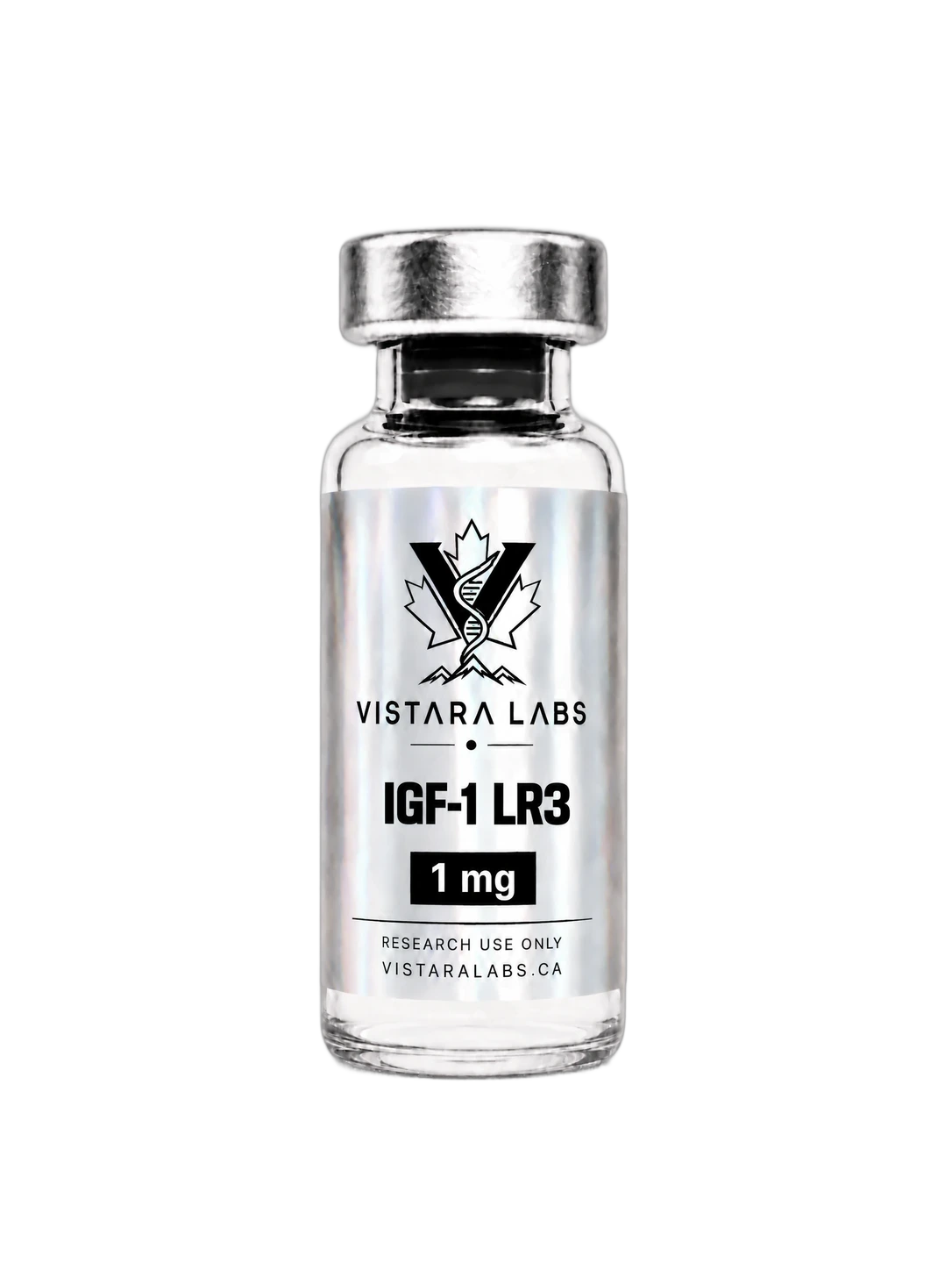
The MedChemExpress data sheet gives the lyophilised powder 2 years at −20 °C from the date of receipt. The OriGene data sheet is more cautious: 6 months at 2 to 8 °C, or −20 °C for long-term storage, with a stated shelf life of one year from despatch. Both are recombinant IGF-1 LR3 made in E. coli and sold for laboratory use. The IGF-1 LR3 1 mg vial is kept capped and boxed, in the fridge for near-term work or the freezer for longer holds. A cold vial is brought to room temperature before opening so that condensation does not form on the powder. Moisture lets the same reactions that happen in solution start in the solid, and one study of human IGF-I found methionine oxidised at similar rates in the dry state and in solution, so dry and dark matter for the powder too.
How long does IGF-1 LR3 last after mixing?
Vistara Labs’ general row in how long peptides last after mixing is 8 to 12 weeks at 2 to 8 °C, in the dark and accessed only through a swabbed stopper, with quality fading from around week 6 to 8. IGF-1 LR3 is not named in that table, and the figures published for it are shorter. MedChemExpress rates reconstituted protein at 1 week at 4 °C. OriGene rates the undiluted solution at one month at 2 to 8 °C and diluted working solutions at 1 week. Those are figures for plain water without a preservative, so they are not a direct match for bacteriostatic water, but they are the only published numbers. The sensible reading is to mix close to use and treat the early weeks as the best period. The IGF-1 LR3 reconstitution page has the calculator for the 1 mg vial.
What the structure says about stability
IGF-1 LR3 is larger than most research peptides, a single chain of 83 residues and about 9.1 kDa. Its sequence carries six cysteines that pair into disulfide bonds and hold the protein in its folded shape. The original papers describe refolding the reduced chain to obtain active protein (King et al. and Francis et al., J Mol Endocrinol, 1992). The sequence also has three methionines, two of them in the N-terminal extension and one matching methionine 59 of IGF-I, plus two asparagines that can deamidate. Studies on human IGF-I show methionine 59 oxidation is driven by light, dissolved oxygen and storage temperature, and that light also forms covalent dimers through disulfide scrambling. Oxidation and aggregation are among the commonest ways proteins change in solution (Manning et al., Pharm Res, 2010). In practice that means a dark fridge, a tight stopper and gentle swirling rather than shaking, which works air into the solution.
How long does IGF-1 LR3 last at room temperature?
There is no published figure for IGF-1 LR3 in solution at room temperature. One supplier ships the sealed powder at room temperature within the continental US, but a mixed vial is taken out of the fridge only for handling, because warmth speeds methionine oxidation.
Can IGF-1 LR3 be frozen?
The powder can, and the longest supplier figure, 2 years, is a −20 °C figure. Both data sheets recommend freezing solution as single-use aliquots for longer storage, and MedChemExpress also recommends adding a carrier protein such as 0.1% BSA for long-term storage of solution. OriGene warns against repeated freezing and thawing. A working vial that will be opened again should not be frozen, since freeze-thaw cycles aggregate proteins in solution.
How can you tell mixed IGF-1 LR3 has degraded?
- Yellowing or any tint. Properly mixed IGF-1 LR3 is a clear, colourless solution.
- Cloudiness that does not clear within 10 to 15 minutes of mixing, or that appears later.
- Strands, flakes or particles.
- Gel or thickening.
Oxidation and disulfide scrambling are invisible, which is why the time window applies even to a vial that still looks perfect.
IGF-1 LR3 storage at a glance
| State | Where | How long |
|---|---|---|
| Powder, sealed | −20 °C, dry | 1 to 2 years (supplier data sheets) |
| Powder, sealed | 2 to 8 °C, dark | 6 months (supplier data sheet) |
| Mixed with bacteriostatic water | 2 to 8 °C, dark | 8 to 12 weeks, fading from week 6 to 8 (store guidance); supplier water figures 1 week to 1 month |
| Solution aliquots, frozen once | −20 °C / −80 °C | Recommended for longer storage; no duration published |
| Mixed, room temperature | Handling only | No published figure |
Certificates of analysis are on the lab reports page, and every order ships from within Canada by Canada Post Xpresspost.
Vistara Labs supplies IGF-1 LR3 as a laboratory research material. The windows on this page describe how long the protein stays in good condition.
Frequently asked questions
How long does IGF-1 LR3 last in the fridge after mixing?
Vistara Labs’ general handling window is 8 to 12 weeks at 2 to 8 °C in the dark, with quality fading from around week 6 to 8. Supplier figures for the protein in plain water are shorter, 1 week to 1 month, so a mixed vial is best used early.
How long does IGF-1 LR3 last at room temperature?
No published figure exists for IGF-1 LR3 in solution at room temperature. A mixed vial is kept in the fridge and taken out only for handling.
Can you freeze IGF-1 LR3?
Yes as powder: one supplier rates it at 2 years at −20 °C. Solution can be frozen once as single-use aliquots, but a working vial should not go through repeated freeze-thaw cycles.
Does IGF-1 LR3 go bad?
Yes. Its methionines oxidise and its disulfide bonds can scramble, faster with warmth, light and air. Cloudiness, particles, a tint or gel mean it has degraded.
Is IGF-1 LR3 more delicate than smaller peptides?
In one way, yes. At 83 residues it relies on a folded shape held by disulfide bonds, so physical changes such as aggregation matter more than for short peptides, and supplier solution figures are shorter.
Handling windows: Vistara Labs, October 2026. Sources: Francis GL et al. Novel recombinant fusion protein analogues of insulin-like growth factor (IGF)-I indicate the relative importance of IGF-binding protein and receptor binding for enhanced biological potency. J Mol Endocrinol. 1992. PMID 1378742. King R et al. Production and characterization of recombinant insulin-like growth factor-I (IGF-I) and potent analogues of IGF-I, with Gly or Arg substituted for Glu3, following their expression in Escherichia coli as fusion proteins. J Mol Endocrinol. 1992. PMID 1311930. Fransson J et al. Oxidation of human insulin-like growth factor I in formulation studies: kinetics of methionine oxidation in aqueous solution and in solid state. Pharm Res. 1996. PMID 8865322. Fransson J, Hagman A. Oxidation of human insulin-like growth factor I in formulation studies, II. Effects of oxygen, visible light, and phosphate on methionine oxidation in aqueous solution and evaluation of possible mechanisms. Pharm Res. 1996. PMID 8899837. Fransson JR. Oxidation of human insulin-like growth factor I in formulation studies. 3. Factorial experiments of the effects of ferric ions, EDTA, and visible light on methionine oxidation and covalent aggregation in aqueous solution. J Pharm Sci. 1997. PMID 9294820. Manning MC et al. Stability of protein pharmaceuticals: an update. Pharm Res. 2010. PMID 20143256. MedChemExpress. LR3 IGF-I/IGF-1 Protein, Human (83a.a, E51R), HY-P70783, product data sheet: storage and stability. PDF. OriGene. Insulin-like growth factor I / IGF1 (Long R3) Human Protein, AR31185PU-S, product data sheet: sequence, storage and reconstitution. PDF.
More on this: How Long Do Peptides Last After Mixing?
All products supplied by Vistara Labs are intended for laboratory research use only. They are not drugs, are not approved for human or veterinary use, and are not intended to diagnose, treat, cure or prevent any condition. Nothing on this page constitutes medical advice or guidance for use in humans.