IGF-1 LR3 research: what the studies actually show
Hormonal, Growth Hormone & Body Composition Research
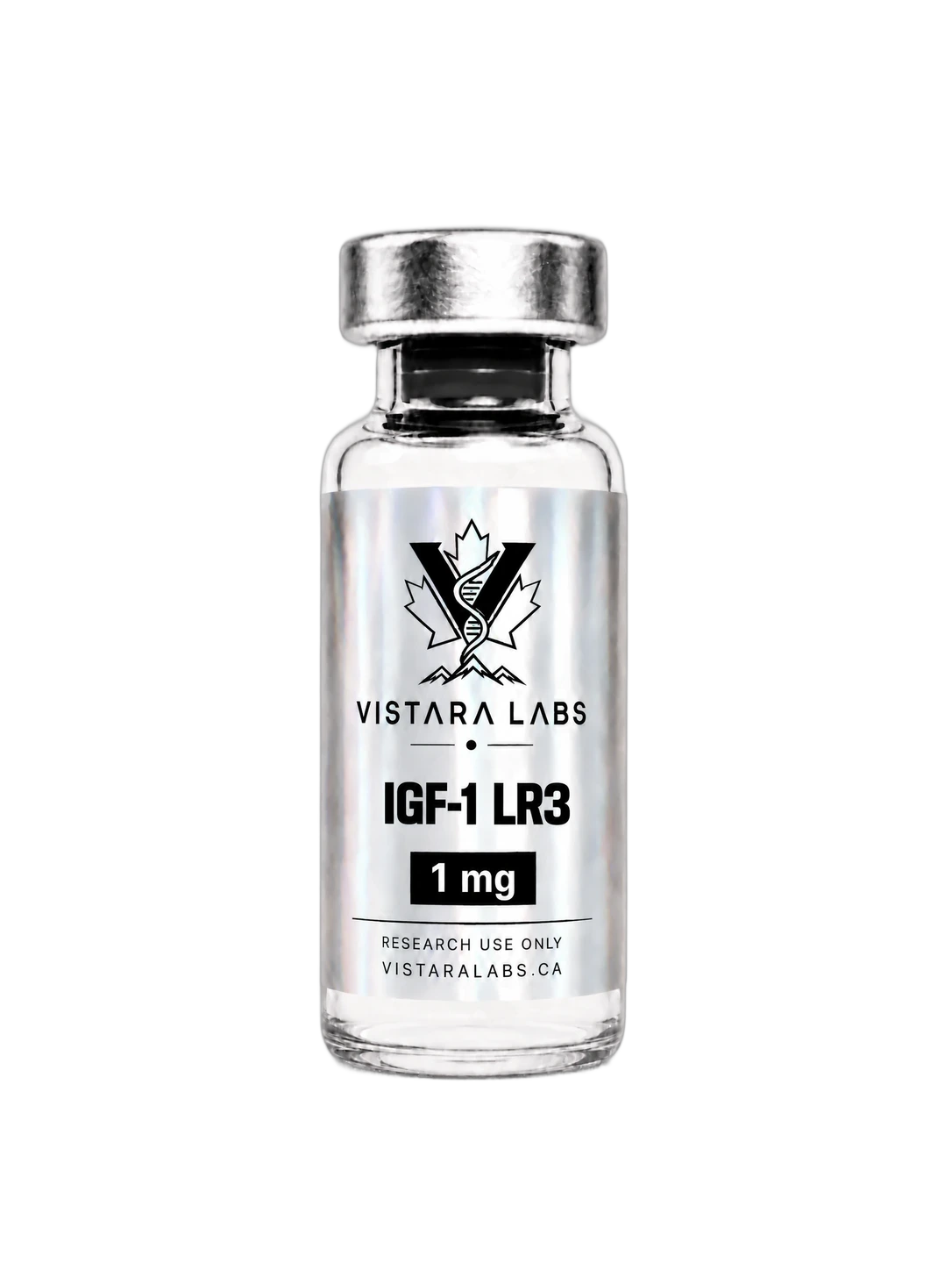
IGF-1 LR3 (Long R3 IGF-1) is a laboratory-made analogue of insulin-like growth factor 1, designed to bind the body’s IGF-binding proteins far less tightly than the native hormone. Here is what the research found.
Findings
- In rats made catabolic with a steroid, LR3 IGF-1 was about 2.5-fold more potent than native IGF-1 at restoring weight gain and slowing muscle breakdown (Biochem J, 1992).
- The Adelaide group that designed the analogue showed its extra potency tracks its reduced binding to IGF-binding proteins, not stronger receptor binding (J Mol Endocrinol, 1992).
- Infused LR3 IGF-1 was 1.5 to 2-fold more potent than IGF-1, and kept an advantage on several measures when injected instead (J Endocrinol, 1996).
- The published work to date on LR3 IGF-1 itself is laboratory research: cell culture and animal studies, with no human trials.
- Native IGF-1 (mecasermin) has a large human record: in 76 children with severe IGF-1 deficiency, growth rose from 2.8 to 8.0 cm per year in the first year, and the FDA approved it in 2005.
 View product →
Catabolic rats: about 2.5 times the potency of IGF-1 (Biochem J, 1992)
Tomas and colleagues at the University of Adelaide treated young male rats with dexamethasone, a steroid that drives muscle wasting, then infused native IGF-1, des(1-3)IGF-1 or LR3 IGF-1 for seven days. Native IGF-1 partly reversed the wasting: at the highest dose the rats gained 6 g over the week, against a 19 g loss on the steroid alone. The two analogues were about 2.5-fold more potent than IGF-1, and muscle breakdown, measured by urinary 3-methylhistidine, fell toward the level of healthy pair-fed controls. The authors credited reduced binding to IGF-binding proteins, which otherwise hold IGF-1 in the blood and limit its transfer into tissue.
Infusion versus injection: the advantage held (J Endocrinol, 1996)
A follow-up study from the same group compared continuous infusion with daily injection of IGF-1 and LR3 IGF-1 in normal and dexamethasone-treated rats over seven days. Infusion gave the larger effects. Infused LR3 IGF-1 was 1.5 to 2-fold more potent than IGF-1, and when injected it kept its lead on several measures, with about three times IGF-1’s effect on 3-methylhistidine excretion.
Binding-protein interaction: why the analogue behaves differently (J Mol Endocrinol, 1992)
Francis and colleagues built IGF-1 analogues carrying an N-terminal peptide extension, among them Long [Arg3]-IGF-1, now known as IGF-1 LR3. In L6 rat myoblasts, which secrete IGF-binding proteins, every analogue beat native IGF-1 at stimulating protein and DNA synthesis and slowing protein breakdown. In chick embryo fibroblasts, which release no detectable binding proteins, that advantage was absent, so the authors concluded that binding-protein interaction, not receptor affinity, explains the potency gain.
Native IGF-1 in humans: growth failure, type 1 diabetes and ALS (J Clin Endocrinol Metab, 2007; Diabetes Care, 1999; Neurology, 1997)
The human record belongs to native IGF-1 (mecasermin), not the LR3 analogue. Chernausek and colleagues followed 76 children with severe IGF-1 deficiency from growth hormone insensitivity, treated for up to 12 years. Height velocity rose from 2.8 cm per year at baseline to 8.0 cm per year in the first year (P < 0.0001) and stayed elevated for up to eight years. The FDA approved mecasermin for this condition in August 2005.
In a 12-week double-blind trial of 223 people with type 1 diabetes, adding rhIGF-1 to insulin lowered HbA1c by 1.2 points, against 0.7 with intensified insulin alone (P ≤ 0.01), and daily insulin use fell by 11 to 19%. In ALS, a nine-month placebo-controlled trial of 266 patients found functional decline 26% slower on the higher rhIGF-1 dose than on placebo (P = 0.01); a later two-year trial of 330 patients did not repeat that benefit.
What IGF-1 LR3 is
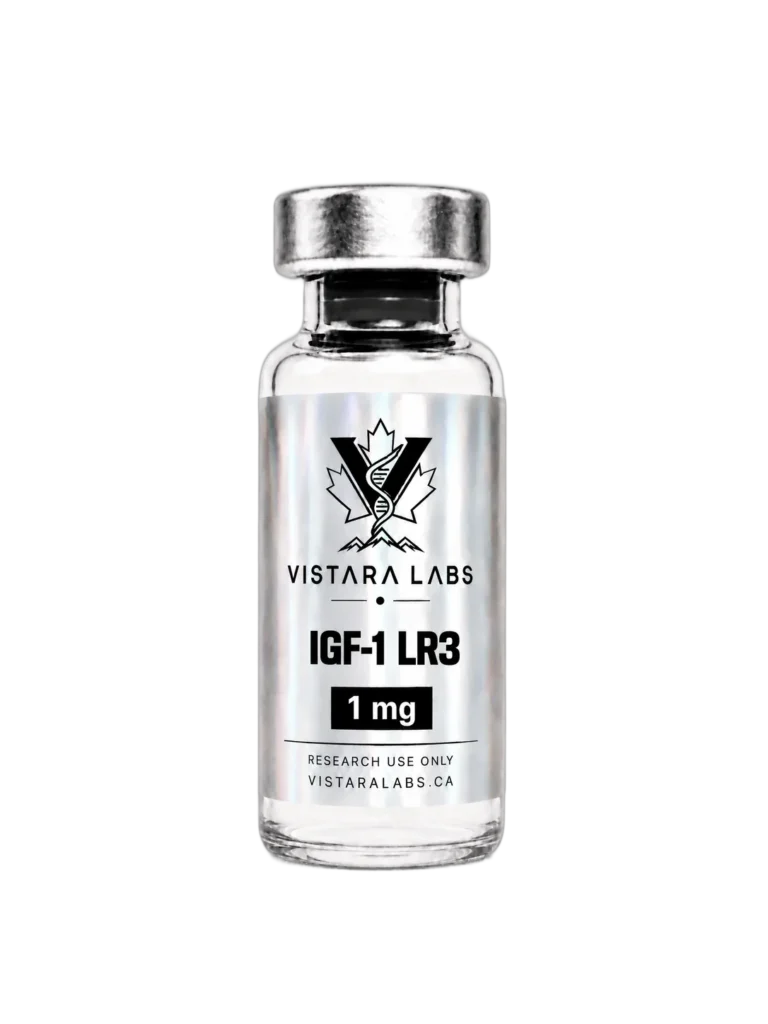
IGF-1 LR3 is a recombinant analogue of human IGF-1 with an arginine substituted at position 3 and a peptide extension at the N-terminus. Both changes reduce its affinity for IGF-binding proteins, which is why it outperforms native IGF-1 in cell culture and the Adelaide rat studies, and why it is a common growth-medium supplement. It is supplied as a lyophilised powder; our IGF-1 LR3 reconstitution page covers preparing it with bacteriostatic water.
Vistara Labs stocks IGF-1 LR3 research vials, shipped from within Canada to every province.
Frequently asked questions
What has the research on IGF-1 LR3 itself shown?
Laboratory and animal results. In dexamethasone-treated rats, LR3 IGF-1 was about 2.5-fold more potent than native IGF-1 at restoring weight gain and slowing muscle breakdown, and in cell culture it was more potent than IGF-1 wherever binding proteins were present. There are no published human trials of LR3 IGF-1.
Why is IGF-1 LR3 more potent than IGF-1 in those studies?
Because it binds IGF-binding proteins much less tightly. Those proteins hold native IGF-1 in the blood and limit its transfer to tissue, and the Adelaide group showed the analogue’s extra potency tracks its reduced binding-protein affinity rather than stronger receptor binding.
What have human studies of native IGF-1 shown?
In 76 children with severe IGF-1 deficiency, mecasermin raised height velocity from 2.8 to 8.0 cm per year in the first year, and it was FDA-approved in 2005. In type 1 diabetes it lowered HbA1c by 1.2 points over 12 weeks alongside insulin, and in ALS a nine-month trial slowed functional decline by 26%.
Sources: Tomas FM, et al. Insulin-like growth factor-I (IGF-I) and especially IGF-I variants are anabolic in dexamethasone-treated rats. Biochem J. 1992;282:91-97. PMID 1371669. Tomas FM, et al. Superior potency of infused IGF-I analogues [with reduced IGF-binding-protein affinity] is maintained when administered by injection. J Endocrinol. 1996;150:77-84. PMID 8708565. Francis GL, et al. Novel recombinant fusion protein analogues of IGF-I indicate the relative importance of IGF-binding protein and receptor binding for enhanced biological potency. J Mol Endocrinol. 1992;8:213-223. PMID 1378742. Chernausek SD, et al. Long-term treatment with recombinant IGF-I in children with severe IGF-I deficiency due to growth hormone insensitivity. J Clin Endocrinol Metab. 2007;92:902-910. PMID 17192294. Thrailkill KM, et al. Cotherapy with recombinant human IGF-I and insulin improves glycemic control in type 1 diabetes. Diabetes Care. 1999;22:585-592. PMID 10189536. Lai EC, et al. Effect of recombinant human IGF-I on progression of ALS: a placebo-controlled study. Neurology. 1997;49:1621-1630. PMID 9409357. Sorenson EJ, et al. Subcutaneous IGF-1 in a 2-year ALS trial. Neurology. 2008;71:1770-1775. PMID 19029516.
All products supplied by Vistara Labs are intended for laboratory research use only. They are not drugs, are not approved for human or veterinary use, and are not intended to diagnose, treat, cure or prevent any condition. Nothing on this page constitutes medical advice or guidance for use in humans.