How Long Does HCG Last? Storage Before and After Mixing
Lyophilised HCG keeps well sealed, dry and frozen at about −20 °C, the storage temperature on supplier and reference-standard data sheets; once mixed with bacteriostatic water it lasts 8 to 12 weeks at 2 to 8 °C under Vistara Labs’ handling guidance, with quality slowly fading from around week 6 to 8. No published laboratory study we could open gives a refrigerated window for HCG in bacteriostatic water, so that window is the general guidance. HCG is a glycoprotein hormone made of two subunits and measured in international units (IU), not milligrams; its main storage risk is warmth, which can pull the two subunits apart, so a mixed vial is kept cold and is never frozen.
Findings
- HCG potency is measured in international units against a WHO International Standard: the 5th standard (NIBSC 07/364) carries 179 IU per ampoule for immunoassays and 162 IU for bioassays.
- In accelerated thermal degradation testing of that standard, no significant loss in immunoreactivity or bioactivity was found at any elevated temperature; the freeze-dried material is stored at −20 °C.
- A protein supplier’s data sheet rates lyophilised hCG as stable at room temperature for 3 weeks, to be stored desiccated below −18 °C.
- Aqueous solutions of hCG were rapidly inactivated above 50 °C (Manjunath and Sairam, J Biol Chem, 1983).
- In samples held for 72 hours, splitting of intact hCG into its subunits was undetectable at 3 °C but measurable at 20 °C and 30 °C, and at 30 °C it also occurred in purified hCG in a protease-free medium (Sancken and Bahner, Prenat Diagn, 1995).
How long does HCG powder last?
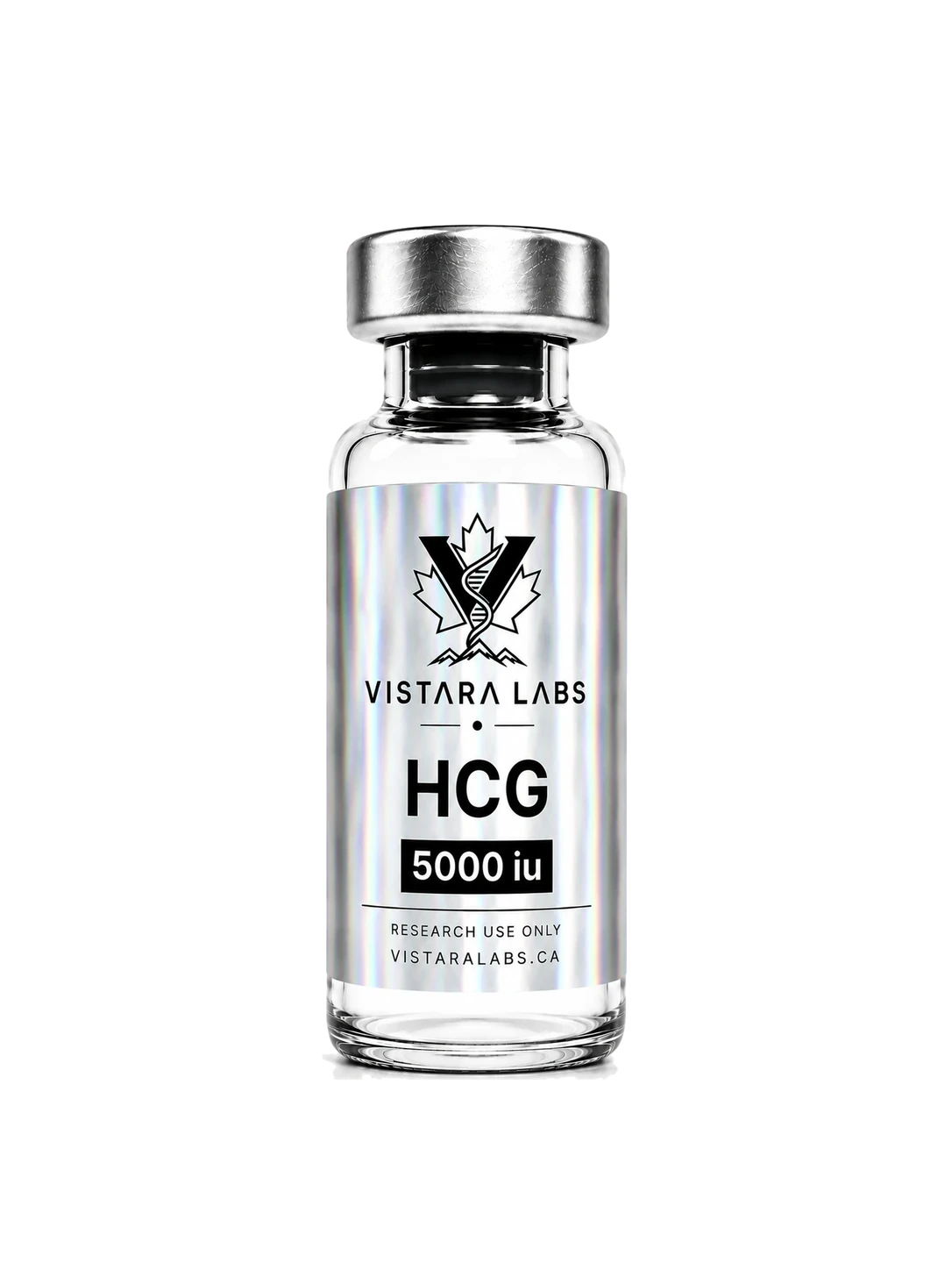
The NIBSC instructions for the WHO standard store unopened ampoules at −20 °C, note that the material may be shipped at ambient temperature because lyophilised material is inherently stable, and report no significant loss in accelerated degradation testing. WHO assigns no expiry date to its reference materials. ProSpec’s data sheet rates its lyophilised hCG as stable at room temperature for 3 weeks, but stored desiccated below −18 °C. Neither gives a number of years. NIBSC lists the powder as hygroscopic, so moisture is the main enemy of the cake. The HCG 5000 IU vial is kept capped, boxed, cold, dry and dark, in the fridge for near-term work or the freezer for longer holds, and a cold vial is brought to room temperature before opening so that condensation does not form on the powder.
How long does HCG last after mixing?
At 2 to 8 °C, dark and accessed only through a swabbed stopper, mixed HCG lasts 8 to 12 weeks, with quality fading from around week 6 to 8. That is the general row in how long peptides last after mixing, applied here because no compound-specific figure exists. The HCG reconstitution page has the calculator for the 5000 IU vial.
Supplier sheets for laboratory hCG are more cautious, and they describe different solutions. ProSpec’s sheet, written for its additive-free powder dissolved in pure water, gives 2 to 7 days at 4 °C and recommends a carrier protein for longer storage. NIBSC advises against water for its standard, notes its ampoules contain no bacteriostat, and leaves the stability of reconstituted material for each laboratory to determine. Neither is a measured breakdown time for a vial mixed with bacteriostatic water and kept cold.
What the structure says about stability
HCG is not a short peptide. It is a large glycoprotein of around 37 kDa built from two subunits, alpha and beta, with sugar chains making up a large share of its mass. Because it is a folded two-part protein, its stability in solution depends on keeping that shape and keeping the two halves together. Heat is the clearest threat: solutions of hCG lost activity rapidly above 50 °C and, when heated further, dissociated into subunits (Manjunath and Sairam, 1983). Splitting also showed up at ordinary warmth, over three days at 20 °C and 30 °C, and not at 3 °C (Sancken and Bahner, 1995). Beyond that, proteins in solution are subject to both chemical and physical instability, including aggregation (Manning et al., Pharm Res, 2010). The practical result is a cold, dark vial, mixed by gentle swirling rather than shaking, which works air into the solution.
How long does HCG last at room temperature?
There is no published figure for HCG mixed with bacteriostatic water at room temperature. In the 1995 study, intact hCG in samples held for 72 hours measurably split into its subunits at 20 °C and 30 °C, while no splitting was detectable at 3 °C, so a mixed vial is taken out of the fridge only for handling. The powder is more forgiving: one supplier rates it at 3 weeks at room temperature.
Can HCG be frozen?
The powder can, and −20 °C is the storage temperature on both data sheets. Laboratories sometimes freeze single-use aliquots of solution, but ProSpec’s sheet asks users to prevent freeze-thaw cycles, and the HCG product page states that reconstituted material should not be frozen. A working vial is refrigerated, never frozen.
How can you tell mixed HCG has degraded?
- Yellowing or any tint. Mixed HCG should be clear and colourless.
- Cloudiness that does not clear within 10 to 15 minutes of mixing, or that appears later.
- Particles or sediment.
- Strands, gel or thickening that will not disperse.
Loss of activity itself is invisible, which is why the time window applies even to a vial that still looks perfect.
Travelling with HCG
Sealed powder vials are the form to travel with. A mixed vial travels upright in an insulated case with a cold pack that does not touch the glass, kept out of the light and away from heat. HCG is supplied as a 5000 IU lyophilised vial only; there is no nasal spray.
HCG storage at a glance
| State | Where | How long |
|---|---|---|
| Powder, sealed | −20 °C, dry | No expiry assigned to the reference standard; no number of years on supplier sheets |
| Powder, sealed | 2 to 8 °C, dry | Near-term holds; one supplier rates the powder at 3 weeks even at room temperature |
| Mixed with bacteriostatic water | 2 to 8 °C, dark | 8 to 12 weeks, fading from week 6 to 8 (store guidance) |
| Mixed, room temperature | Handling only | No published figure; subunits measurably separate within 72 hours at 20 °C |
The certificate of analysis for HCG is linked from the HCG product page, and every order ships from within Canada by Canada Post Xpresspost.
Vistara Labs supplies HCG as a laboratory research material. The windows on this page describe how long the hormone stays in good condition.
Frequently asked questions
How long does HCG last in the fridge after mixing?
Under Vistara Labs’ handling guidance, 8 to 12 weeks at 2 to 8 °C in the dark, with quality fading from around week 6 to 8.
How long does HCG last at room temperature?
No published figure exists for mixed HCG at room temperature, and its subunits measurably separate within 72 hours at 20 °C. A mixed vial is kept in the fridge and taken out only for handling.
Can you freeze HCG?
Yes as powder: supplier and reference-standard sheets store it at about −20 °C. Reconstituted HCG is refrigerated, not frozen, and freeze-thaw cycles are avoided.
Does HCG go bad?
Yes. As a two-subunit glycoprotein it loses activity with warmth, and its subunits can come apart in solution. Cloudiness, particles, a tint or gel mean it has degraded.
Why is HCG measured in IU instead of milligrams?
Because its biological activity, not its weight, is what is standardised. HCG is calibrated in international units against a WHO International Standard; the 5th standard is assigned 179 IU per ampoule for immunoassays and 162 IU for bioassays.
Handling windows: Vistara Labs, October 2026. Sources: Manjunath P, Sairam MR. Enhanced thermal stability of chemically deglycosylated human choriogonadotropin. J Biol Chem. 1983. PMID 6300050. Sancken U, Bahner D. The effect of thermal instability of intact human chorionic gonadotropin (ihCG) on the application of its free beta-subunit (free beta hCG) as a serum marker in Down syndrome screening. Prenat Diagn. 1995. PMID 7479591. Manning MC et al. Stability of protein pharmaceuticals: an update. Pharm Res. 2010. PMID 20143256. NIBSC. WHO 5th International Standard, Chorionic Gonadotrophin, NIBSC code 07/364, instructions for use, version 3.0, 2013: unitage, storage and accelerated degradation. PDF. ProSpec. hCG Human, HOR-250, product data sheet: formulation and stability. Data sheet.
More on this: How Long Do Peptides Last After Mixing?
All products supplied by Vistara Labs are intended for laboratory research use only. They are not drugs, are not approved for human or veterinary use, and are not intended to diagnose, treat, cure or prevent any condition. Nothing on this page constitutes medical advice or guidance for use in humans.