How Long Does Pinealon Last? Storage Before and After Mixing
Lyophilised Pinealon keeps for a year or more sealed, dry and frozen; once mixed with bacteriostatic water it lasts 8 to 12 weeks at 2 to 8 °C under Vistara Labs’ handling guidance, with quality slowly fading from around week 6 to 8. No published stability study covers Pinealon in solution, so that window is the general peptide guidance. Its three residues, glutamic acid, aspartic acid and arginine, point to two slow reactions worth knowing about, and both are slowed by cold.
Findings
- Pinealon is the synthetic tripeptide Glu-Asp-Arg (Khavinson et al., Rejuvenation Res, 2011).
- A chemical supplier’s data sheet rates the powder at 2 years at −80 °C and 1 year at −20 °C, sealed away from moisture.
- The same sheet gives a stock solution 6 months at −80 °C and 1 month at −20 °C, and lists water solubility of at least 100 mg/mL.
- An N-terminal glutamic acid can cyclise to pyroglutamic acid without any enzyme, with least change near pH 6.2 (Chelius et al., Anal Chem, 2006).
- Aspartic acid residues can isomerise through a ring intermediate, though far more slowly than asparagine (Geiger and Clarke, J Biol Chem, 1987).
How long does Pinealon powder last?
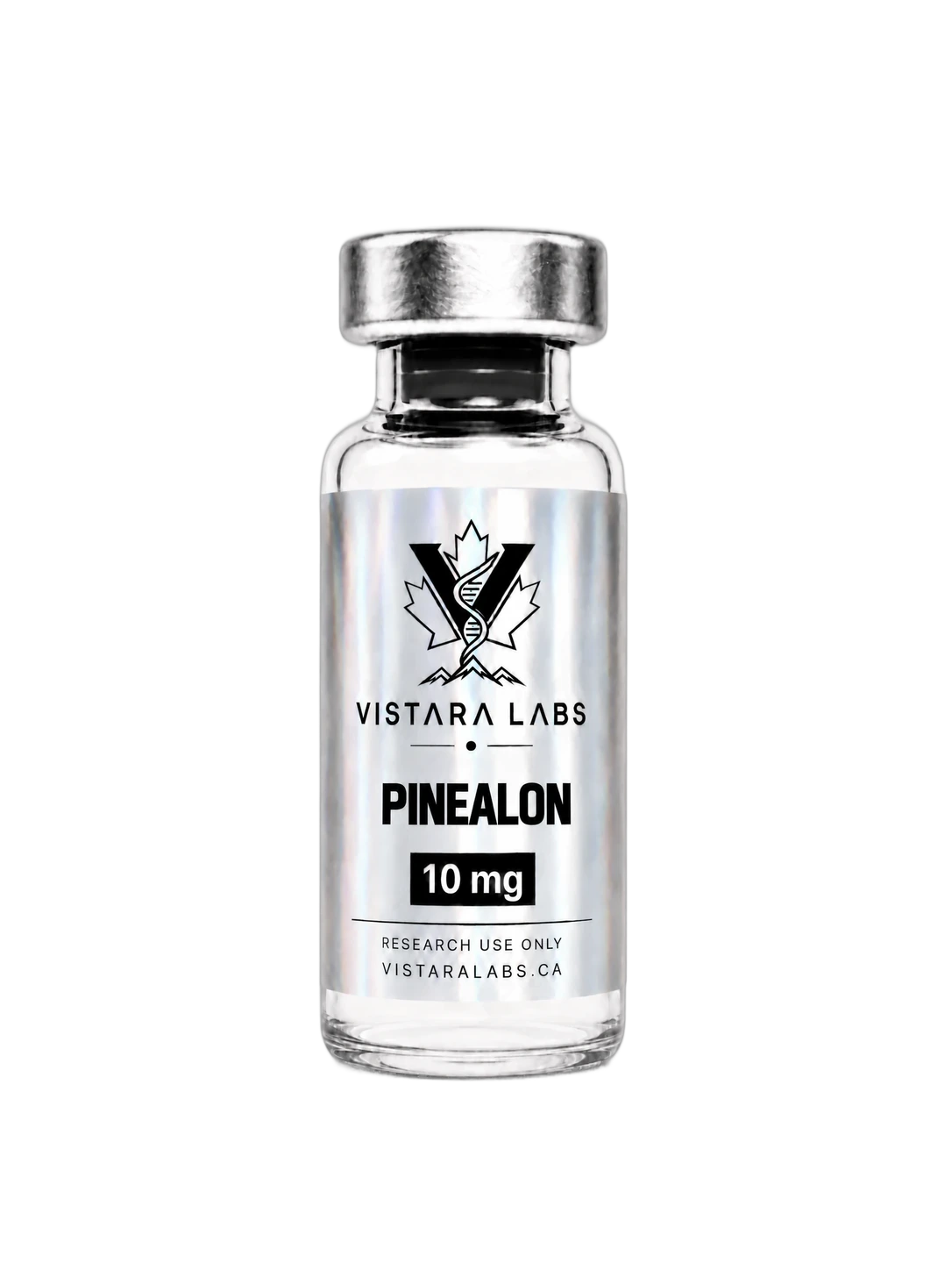
The data sheet from MedChemExpress gives Pinealon powder 2 years at −80 °C and 1 year at −20 °C, stored sealed and away from moisture. The sheet gives no fridge figure for the powder, so the fridge is for near-term work and the freezer for longer holds. Moisture is the main enemy of a freeze-dried cake: it lets the same reactions that happen in solution start in the solid. The 10 mg vial is kept capped and boxed, and a cold vial is brought to room temperature before opening so that condensation does not form on the powder.
How long does Pinealon last after mixing?
At 2 to 8 °C, dark and accessed only through a swabbed stopper, mixed Pinealon lasts 8 to 12 weeks, with quality fading from around week 6 to 8. That is the general row in how long peptides last after mixing. The Pinealon reconstitution page has the calculator for the vial.
What the sequence says about stability
Pinealon dissolves readily in water; the supplier sheet lists solubility of at least 100 mg/mL, so dissolving is not the concern. Its sensitivities are chemical. Nothing has been published on Pinealon’s own breakdown in solution, so the picture comes from what each residue is known to do.
The first residue is a free glutamic acid. An N-terminal glutamic acid can close into a ring, pyroglutamic acid, by a slow reaction that needs no enzyme. In a study of antibodies, this was detectable after a few weeks at 37 and 45 °C, was smallest near pH 6.2 and rose at pH 4 and pH 8; at pH 4.1 and 45 °C the half-life of the N-terminal glutamic acid was about 9 months (Chelius et al., 2006). Fridge temperatures slow it further.
The second residue is aspartic acid, followed by arginine. Aspartic acid can form a ring intermediate with the next residue’s backbone and reopen as the isomer isoaspartate. In model peptides, aspartic acid did this about 34 times more slowly than asparagine (Geiger and Clarke, 1987), so it is a slow route, not a fast one. Against both, Pinealon has no methionine, cysteine, tryptophan, asparagine or glutamine, the residues most often behind oxidation and deamidation (Manning et al., Pharm Res, 2010). The practical result is the same window as most peptides, kept cold and dark.
What the frozen-solution figures mean
The supplier’s 1 month at −20 °C and 6 months at −80 °C apply to stock solutions frozen once and kept sealed, a laboratory practice for single-use aliquots. They are not a reason to freeze a working vial that will be thawed and opened again.
How long does Pinealon last at room temperature?
There is no published figure for Pinealon in solution at room temperature. A mixed vial is taken out of the fridge only for handling, because warmth speeds both the cyclisation and the isomerisation described above.
Can Pinealon be frozen?
The powder can, and the supplier’s longest figure, 2 years, is a −80 °C figure. Single-use aliquots of solution can be frozen once. A working vial should not be frozen and thawed repeatedly, since freeze-thaw cycles aggregate peptides in solution.
How can you tell mixed Pinealon has degraded?
- Yellowing or any tint. Mixed Pinealon should be clear and colourless.
- Cloudiness that does not clear within 10 to 15 minutes of mixing, or that appears later.
- Particles or sediment.
- Gel or thickening.
Cyclisation and isomerisation are invisible, which is why the time window applies even to a vial that still looks perfect.
Pinealon storage at a glance
| State | Where | How long |
|---|---|---|
| Powder, sealed | −20 °C, dry | 1 year (supplier data sheet) |
| Powder, sealed | −80 °C | 2 years (supplier data sheet) |
| Powder, sealed | 2 to 8 °C, fridge | No published figure; near-term only |
| Mixed with bacteriostatic water | 2 to 8 °C, dark | 8 to 12 weeks, fading from week 6 to 8 (store guidance) |
| Solution aliquots, frozen once | −20 °C / −80 °C | 1 month / 6 months (supplier data sheet) |
| Mixed, room temperature | Handling only | No published figure |
Certificates of analysis are on the lab reports page, and every order ships from within Canada by Canada Post Xpresspost.
Vistara Labs supplies Pinealon as a laboratory research material. The windows on this page describe how long the peptide stays in good condition.
Frequently asked questions
How long does Pinealon last in the fridge after mixing?
Under Vistara Labs’ handling guidance, 8 to 12 weeks at 2 to 8 °C in the dark, with quality fading from around week 6 to 8.
How long does Pinealon last at room temperature?
No published figure exists for Pinealon in solution at room temperature. A mixed vial is kept in the fridge and taken out only for handling.
Can you freeze Pinealon?
Yes as powder: one supplier rates it at 1 year at −20 °C and 2 years at −80 °C. Solution can be frozen once as single-use aliquots, but a working vial should not go through repeated freeze-thaw cycles.
Does Pinealon go bad?
Yes, slowly. Its N-terminal glutamic acid can cyclise and its aspartic acid can isomerise in solution, faster with warmth. Cloudiness, particles, a tint or gel mean it has degraded.
Is a three-amino-acid peptide more stable than a longer one?
Not automatically. A short peptide has fewer residues that can react, but Pinealon still has two with known slow reactions, so it keeps the general window rather than a longer one.
Handling windows: Vistara Labs, October 2026. Sources: Khavinson V et al. Pinealon increases cell viability by suppression of free radical levels and activating proliferative processes. Rejuvenation Res. 2011. PMID 21978084. Chelius D et al. Formation of pyroglutamic acid from N-terminal glutamic acid in immunoglobulin gamma antibodies. Anal Chem. 2006. PMID 16579622. Geiger T, Clarke S. Deamidation, isomerization, and racemization at asparaginyl and aspartyl residues in peptides. J Biol Chem. 1987. PMID 3805008. Manning MC et al. Stability of protein pharmaceuticals: an update. Pharm Res. 2010. PMID 20143256. MedChemExpress. Pinealon, HY-P4052, product data sheet: storage and solubility. PDF.
More on this: How Long Do Peptides Last After Mixing?
All products supplied by Vistara Labs are intended for laboratory research use only. They are not drugs, are not approved for human or veterinary use, and are not intended to diagnose, treat, cure or prevent any condition. Nothing on this page constitutes medical advice or guidance for use in humans.