Pinealon research: what the human and lab studies show
Cognitive & Nootropic Research
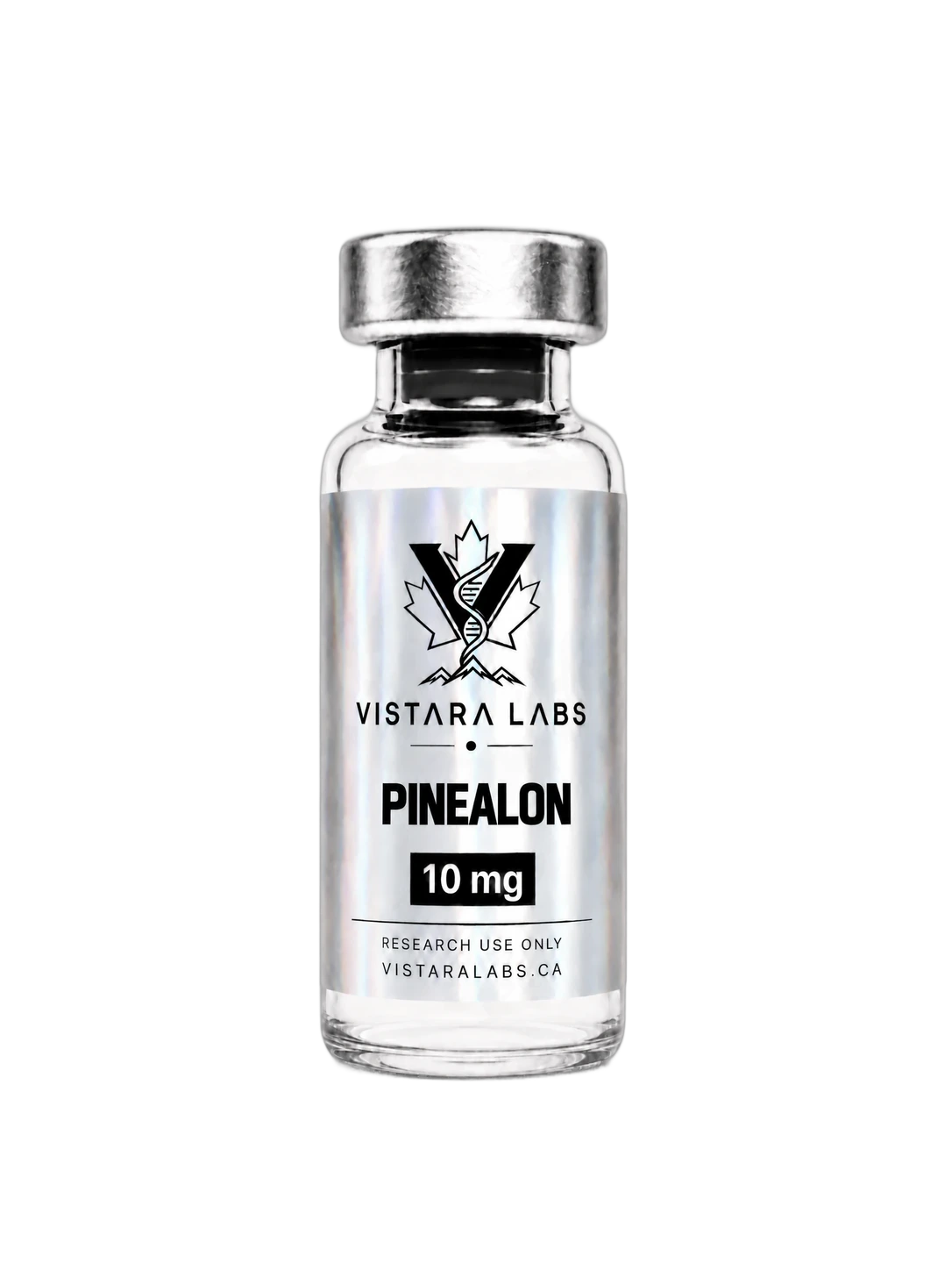
Pinealon (Glu-Asp-Arg, also written EDR) is a synthetic tripeptide developed by the Khavinson group in St Petersburg and studied for its effects on brain cells and markers of ageing. Here is what the research found.
Findings
- In 32 patients aged 41 to 83 with organic brain syndrome in remission, a course of Pinealon or its sister peptide Vesugen improved central nervous system activity and slowed biological-age indicators (Adv Gerontol, 2015).
- A 2020 review in Molecules reports a clinical series of 72 patients with after-effects of traumatic brain injury in which oral Pinealon added to standard care improved memory and reduced headaches.
- In 150 professional truck drivers, Pinealon combined with Vesugen gave the best improvement in psycho-emotional indices (Adv Gerontol, 2012).
- In rat offspring exposed to prenatal oxidative stress, Pinealon cut necrotic cerebellar neurons from 12.6% to 3.4% and improved water-maze learning (Int J Clin Exp Med, 2012).
- In cultured neurons and other cells, Pinealon dose-dependently limited reactive oxygen species, reduced necrotic cell death and raised serotonin expression in ageing cortex cultures (Rejuvenation Res, 2011; Bull Exp Biol Med, 2014).
 View product →
Organic brain syndrome: slower biological ageing in 32 patients (Adv Gerontol, 2015)
The clearest human report with a stated sample size is from Meshchaninov and colleagues: 32 participants aged 41 to 83 with chronic polymorbidity and organic brain syndrome in remission, treated with Pinealon or Vesugen, two short tripeptides used to correct biological age. Both produced a significant anabolic effect and improved the activity of the central nervous system and other vital organs, slowing the clinic’s biological-age indicators. Neither peptide changed chromatin condensation. The authors recommend both as geroprotectors for organic brain syndrome of vascular or traumatic origin, with Vesugen showing the larger effect of the two.
Brain injury and working adults: memory and adaptation reports (Molecules, 2020; Adv Gerontol, 2012)
Khavinson’s 2020 review of the EDR peptide summarises a series of 72 patients with the sequelae of traumatic brain injury and cerebrasthenia. Oral Pinealon alongside standard therapy was reported to improve memory, reduce headache duration and intensity and steady emotional balance. The review attributes these results to a 2013 Russian-language paper by Umnov, Lin’kova and Khavinson.
Two occupational studies add data in working adults. Bashkireva and Artamonova compared 150 male truck drivers (mean age 43) with 150 metal craftsmen. Peptide correction improved psycho-emotional indices (p between 0.001 and 0.05), and the best effect came from Pinealon combined with Vesugen. Nazimko and colleagues gave railway locomotive crews a two-week course of Pinealon and reported improved biological-age and adaptation indicators.
Prenatal oxidative stress: offspring learning in rats (Int J Clin Exp Med, 2012)
This is laboratory research. Arutjunyan and colleagues loaded pregnant Wistar rats with methionine to raise homocysteine, a model of prenatal oxidative stress, six litters per group, and gave Pinealon to the dams beforehand. At 45 days, offspring of treated dams found the Morris water-maze platform in 137 seconds on the second-day trial against 170 seconds in the untreated methionine group (p below 0.05). In cerebellar neurons from 10-day-old pups, necrotic cells fell from 12.6% to 3.4%, and after a hydrogen peroxide challenge ROS fluorescence was 108.6 versus 158.7 units. Pup weight returned to control levels, while plasma homocysteine itself was unchanged.
Cell cultures: fewer free radicals, more serotonin, longer dendrites (Rejuvenation Res, 2011; Bull Exp Biol Med, 2014; Int J Mol Sci, 2024)
In the 2011 Rejuvenation Research paper, Pinealon dose-dependently limited ROS accumulation in cerebellar granule cells, neutrophils and PC12 cells under oxidative stress and reduced necrotic death. In 2014, Khavinson and Lin’kova showed that Pinealon increased serotonin expression in ageing cortex cultures. In 2008, Kozina found Pinealon the most antihypoxic of four short peptides in a hypobaric hypoxia model. In 2024, Kraskovskaya and colleagues treated neurons induced from elderly donors’ fibroblasts and found that EDR increased primary dendrite number and total dendrite length and reduced oxidative DNA damage.
What Pinealon is
Pinealon is a three-amino-acid peptide, glutamic acid, aspartic acid and arginine, designed by the Khavinson group as a short analogue of pineal regulatory peptides. It is small enough to enter cells and, in cell-free experiments, binds directly to DNA, the proposed route by which it shifts gene expression. Our Pinealon reconstitution guide covers handling and storage.
Vistara Labs stocks Pinealon research vials, shipped from within Canada to every province.
Frequently asked questions
What have the human studies of Pinealon shown?
In 32 patients aged 41 to 83 with organic brain syndrome in remission, a course of Pinealon or Vesugen improved central nervous system activity and slowed biological-age indicators. A 72-patient series in people with after-effects of brain injury, summarised in a 2020 review, reported better memory and fewer, shorter headaches. These are open clinical reports from Russian gerontology clinics, not placebo-controlled trials.
What has Pinealon done in laboratory and animal studies?
Pinealon dose-dependently limited reactive oxygen species and necrotic cell death in cultured neurons, raised serotonin expression in ageing cortex cultures, lengthened dendrites in neurons derived from elderly donors, and in rat offspring exposed to prenatal oxidative stress cut necrotic cerebellar neurons from 12.6% to 3.4% and improved water-maze learning.
What is Pinealon?
Pinealon is the synthetic tripeptide Glu-Asp-Arg (EDR), developed by the Khavinson group as a short pineal-derived peptide bioregulator and studied for its effects on brain cells, oxidative stress and markers of ageing.
Sources: Meshchaninov VN, et al. Effect of synthetic peptides on aging of patients with chronic polymorbidity and organic brain syndrome of the central nervous system in remission. Adv Gerontol. 2015;28(1):62-67. PMID 26390612. Khavinson V, Linkova N, Kozhevnikova E, Trofimova S. EDR peptide: possible mechanism of gene expression and protein synthesis regulation involved in the pathogenesis of Alzheimer’s disease. Molecules. 2020;26(1):159. PMID 33396470. Umnov RS, Lin’kova NS, Khavinson VKh. Neuroprotective effects of peptide bioregulators in people of various age. Adv Gerontol. 2013;26(4):671-678. PMID 24738258. Bashkireva AS, Artamonova VG. The peptide correction of neurotic disorders among professional truck-drivers. Adv Gerontol. 2012;25(4):718-728. PMID 23734521. Nazimko VA, et al. Analysis of some parameters of biological age and adaptation possibilities of workers of locomotive brigades. Adv Gerontol. 2012;25(1):57-62. PMID 22708445. Arutjunyan A, et al. Pinealon protects the rat offspring from prenatal hyperhomocysteinemia. Int J Clin Exp Med. 2012;5(2):179-185. PMID 22567179. Khavinson V, et al. Pinealon increases cell viability by suppression of free radical levels and activating proliferative processes. Rejuvenation Res. 2011;14(5):535-541. PMID 21978084. Khavinson VKh, Lin’kova NS, et al. Short peptides stimulate serotonin expression in cells of brain cortex. Bull Exp Biol Med. 2014;157(1):77-80. PMID 24909721. Kozina LS. Investigation of antihypoxic properties of short peptides. Adv Gerontol. 2008;21(1):61-67. PMID 18546825. Kraskovskaya N, et al. Short peptides protect fibroblast-derived induced neurons from age-related changes. Int J Mol Sci. 2024;25(21):11363. PMID 39518916.
All products supplied by Vistara Labs are intended for laboratory research use only. They are not drugs, are not approved for human or veterinary use, and are not intended to diagnose, treat, cure or prevent any condition. Nothing on this page constitutes medical advice or guidance for use in humans.