Kisspeptin for Libido: What the Sexual Desire Trials Found
Sexual Health & Intimacy Research
Kisspeptin is the newest peptide in libido research, and its human trials are some of the most detailed: in placebo-controlled studies at Imperial College London, it changed how the brain responds to sexual images in men and women, and in men with low sexual desire it increased penile tumescence by up to 56% more than placebo. Best known as the switch at the top of the reproductive hormone axis, kisspeptin also acts on the brain’s emotional and reward circuits. Here is what each trial found, and how kisspeptin sits beside PT-141 (bremelanotide) and oxytocin. Vistara Labs supplies it as a Kisspeptin 10 mg vial and a ready-mixed Kisspeptin Nasal Spray.
Findings
- In 29 healthy young men, kisspeptin enhanced limbic brain activity in response to sexual and couple-bonding images and lessened negative mood (2017).
- Kisspeptin’s effect on resting brain networks tracked increased limbic responses to sexual stimuli in a follow-up study (2018).
- In 32 premenopausal women with low sexual desire, kisspeptin modulated brain processing of erotic videos and attractive faces, and the change was linked to less sexual aversion (2022).
- In 32 men with low sexual desire, kisspeptin increased penile tumescence by up to 56% more than placebo and increased happiness about sex (2023).
- In both trials in people with low desire, kisspeptin was well tolerated.
 View product →
Why kisspeptin is studied for libido
Kisspeptin is best known for switching on the GnRH neurons that drive LH, FSH and, in men, testosterone, a story told in Kisspeptin and Testosterone. But its receptors are also found in limbic structures of the brain, the regions that handle emotion, reward and sexual motivation. That raised a second question: does kisspeptin act on desire directly, not only through hormones? The Imperial College London team, led by Waljit Dhillo and Alexander Comninos, answered it with functional brain imaging.
What the libido trials found
Healthy men, 2017: sexual and bonding images
In a randomised, double-blind, placebo-controlled study, 29 healthy heterosexual young men received kisspeptin or a placebo infusion and then viewed sexual images, images of couples and other pictures inside an MRI scanner. Kisspeptin enhanced activity in limbic brain structures specifically in response to the sexual and couple-bonding images. The size of that enhancement correlated with the men’s own scores for reward, drive, mood and sexual aversion, and kisspeptin lessened negative mood (Comninos et al., J Clin Invest, 2017).
Healthy men, 2018: the resting brain
A follow-up looked at the brain at rest. Kisspeptin modulated connectivity in the default mode network, and that change was linked to the increased limbic response to sexual stimuli and to measures of sexual and emotional function (Comninos et al., JCI Insight, 2018).
Women with low sexual desire, 2022
The team then moved to people with hypoactive sexual desire disorder (HSDD), low desire that causes distress. In a double-blind, placebo-controlled crossover trial, 32 premenopausal women who had lived with HSDD for at least six months each received a 75-minute kisspeptin-54 infusion and a placebo infusion. While they viewed erotic videos and faces, kisspeptin modulated brain processing of sexual stimuli and facial attractiveness. Increased activity in the posterior cingulate cortex when viewing attractive faces was linked to less sexual aversion, and kisspeptin was well tolerated (Thurston et al., JAMA Netw Open, 2022).
Men with low sexual desire, 2023
The companion trial enrolled 32 men with HSDD, mean age 37.9, in the same crossover design with a 75-minute kisspeptin infusion and a placebo. While the men watched sexual videos, kisspeptin significantly modulated activity in key structures of the brain’s sexual-processing network (P = .003). It increased penile tumescence in response to the videos by up to 56% more than placebo (P = .02), and the men reported more happiness about sex (P = .02). The authors wrote that kisspeptin has potential as the first pharmacological treatment for men with low sexual desire (Mills et al., JAMA Netw Open, 2023).
| Study | Who | What kisspeptin did |
|---|---|---|
| Comninos, 2017 | 29 healthy men | More limbic response to sexual and bonding images |
| Comninos, 2018 | Healthy men | Resting-brain changes tied to sexual response |
| Thurston, 2022 | 32 women with HSDD | Changed processing of erotic videos and faces |
| Mills, 2023 | 32 men with HSDD | Tumescence up to 56% more than placebo |
How kisspeptin differs from PT-141 and oxytocin
The three peptides in libido research work on three different systems. PT-141, also called bremelanotide, is a melanocortin-receptor agonist that acts on central desire pathways, and it has the largest trial record, including two 2019 phase 3 trials in 1,267 women. Oxytocin is the bonding hormone released at orgasm, studied for orgasm intensity, contentment and partner attraction. Kisspeptin works upstream on the reproductive hormone axis and on limbic circuits for sexual and emotional processing. PT-141 vs kisspeptin and kisspeptin vs oxytocin compare them in detail, and Peptides for Libido covers the PT-141 and oxytocin trials.
The Libido Trifecta Spray Stack
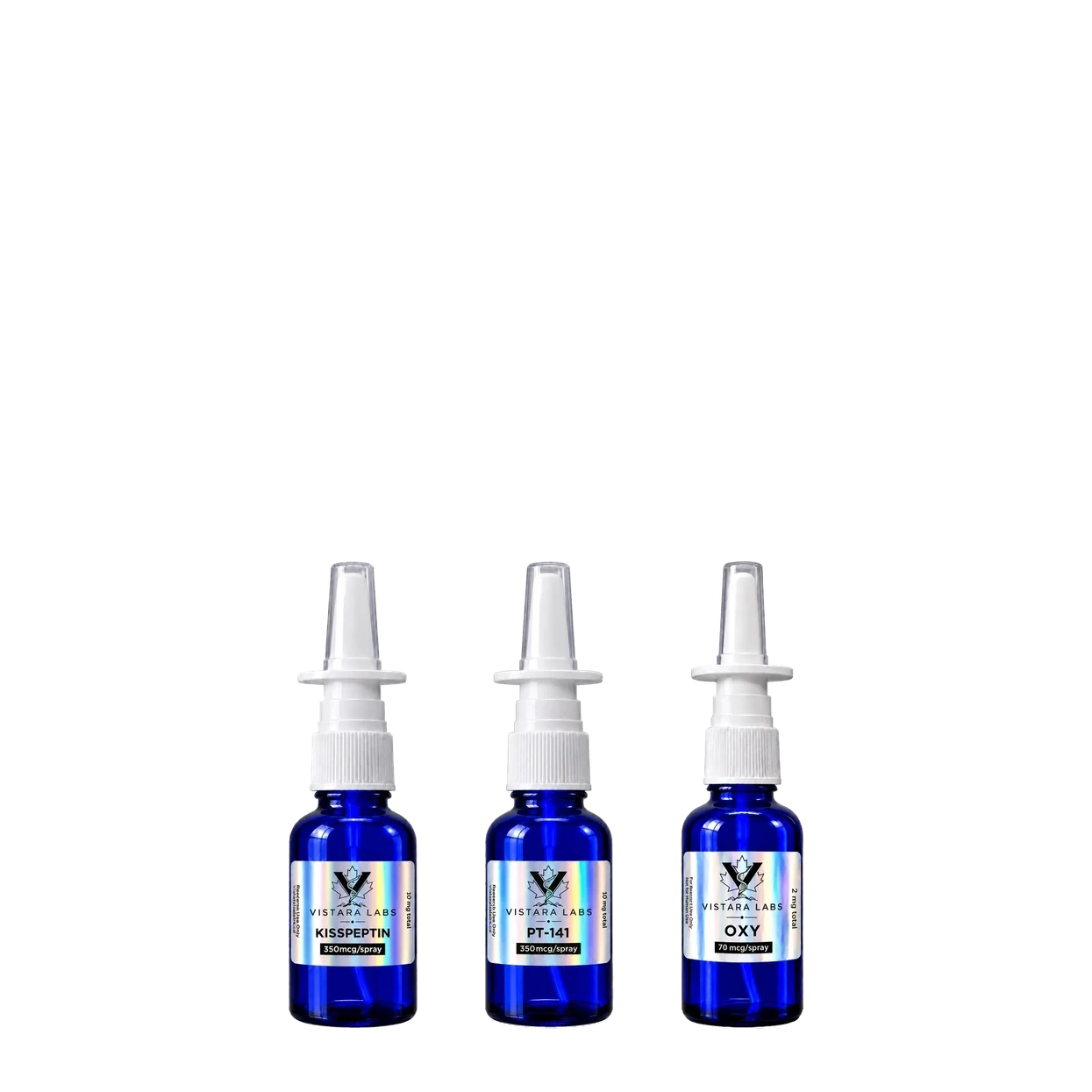
Because the three peptides act on separate pathways, they are grouped in the Libido Trifecta Spray Stack: the 10 mg Kisspeptin Nasal Spray, the 10 mg PT-141 (bremelanotide) Nasal Spray and a 2 mg or 10 mg Oxytocin Nasal Spray, all ready-mixed in metered atomisers. The two-spray Libido Spray Stack pairs PT-141 and oxytocin without kisspeptin.
Kisspeptin vial or nasal spray
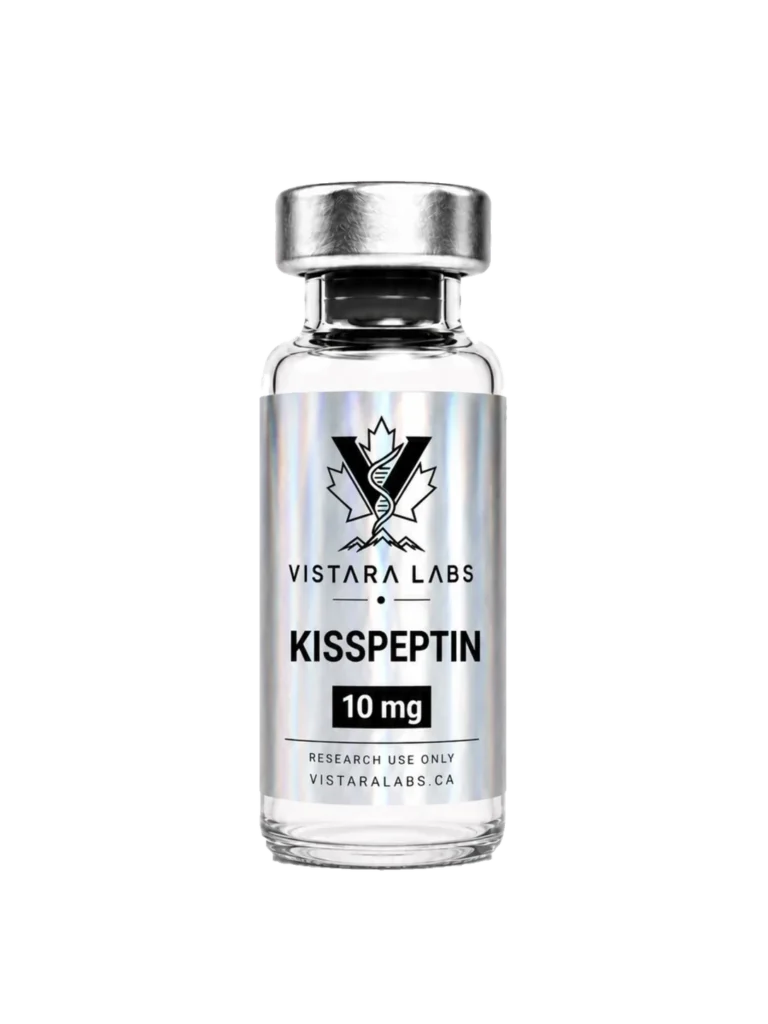
The libido trials gave kisspeptin by intravenous infusion. For laboratory work, Vistara Labs supplies the Kisspeptin 10 mg lyophilised vial, reconstituted with bacteriostatic water (see the kisspeptin reconstitution guide), and the ready-mixed Kisspeptin Nasal Spray, 10 mg in 5 mL at about 350 mcg per spray. Both are independently tested, with the certificate of analysis on our Lab Reports page, and ship from within Canada; see buying kisspeptin in Canada.
Frequently asked questions
Does kisspeptin increase libido?
In placebo-controlled trials, kisspeptin changed how the brain processed sexual stimuli in healthy men (2017) and in women (2022) and men (2023) with low sexual desire. In the 2023 trial in men, it increased penile tumescence by up to 56% more than placebo and increased happiness about sex.
What did the kisspeptin trial in women show?
In 32 premenopausal women with hypoactive sexual desire disorder, a kisspeptin infusion modulated brain processing of erotic videos and attractive faces against placebo, the change was linked to less sexual aversion, and it was well tolerated (2022).
What did the kisspeptin trial in men show?
In 32 men with hypoactive sexual desire disorder, kisspeptin significantly modulated activity in the brain’s sexual-processing network, increased penile tumescence to sexual videos by up to 56% more than placebo, and increased happiness about sex (2023).
How is kisspeptin different from PT-141?
PT-141 (bremelanotide) is a melanocortin-receptor agonist acting on central desire pathways. Kisspeptin acts on the reproductive hormone axis and on limbic brain circuits for sexual and emotional processing.
Is there a stack with kisspeptin and PT-141?
Yes. The Libido Trifecta Spray Stack combines the 10 mg Kisspeptin Nasal Spray, the 10 mg PT-141 (bremelanotide) Nasal Spray and a 2 mg or 10 mg Oxytocin Nasal Spray.
Sources: Comninos AN et al. Kisspeptin modulates sexual and emotional brain processing in humans. J Clin Invest. 2017. PMID 28112678. Comninos AN et al. Modulations of human resting brain connectivity by kisspeptin enhance sexual and emotional functions. JCI Insight. 2018. PMID 30333302. Thurston L et al. Effects of kisspeptin administration in women with hypoactive sexual desire disorder: a randomized clinical trial. JAMA Netw Open. 2022. PMID 36287566. Mills EG et al. Effects of kisspeptin on sexual brain processing and penile tumescence in men with hypoactive sexual desire disorder: a randomized clinical trial. JAMA Netw Open. 2023. PMID 36735255. Kingsberg SA et al. Obstet Gynecol. 2019. PMID 31599840.
More on this: Peptides for Sex: What the Research Shows in Men and Couples.
All products supplied by Vistara Labs are intended for laboratory research use only. They are not drugs, are not approved for human or veterinary use, and are not intended to diagnose, treat, cure or prevent any condition. Nothing on this page constitutes medical advice or guidance for use in humans.