What Is Oxytocin? The Bonding Hormone Explained
Sexual Health & Intimacy Research
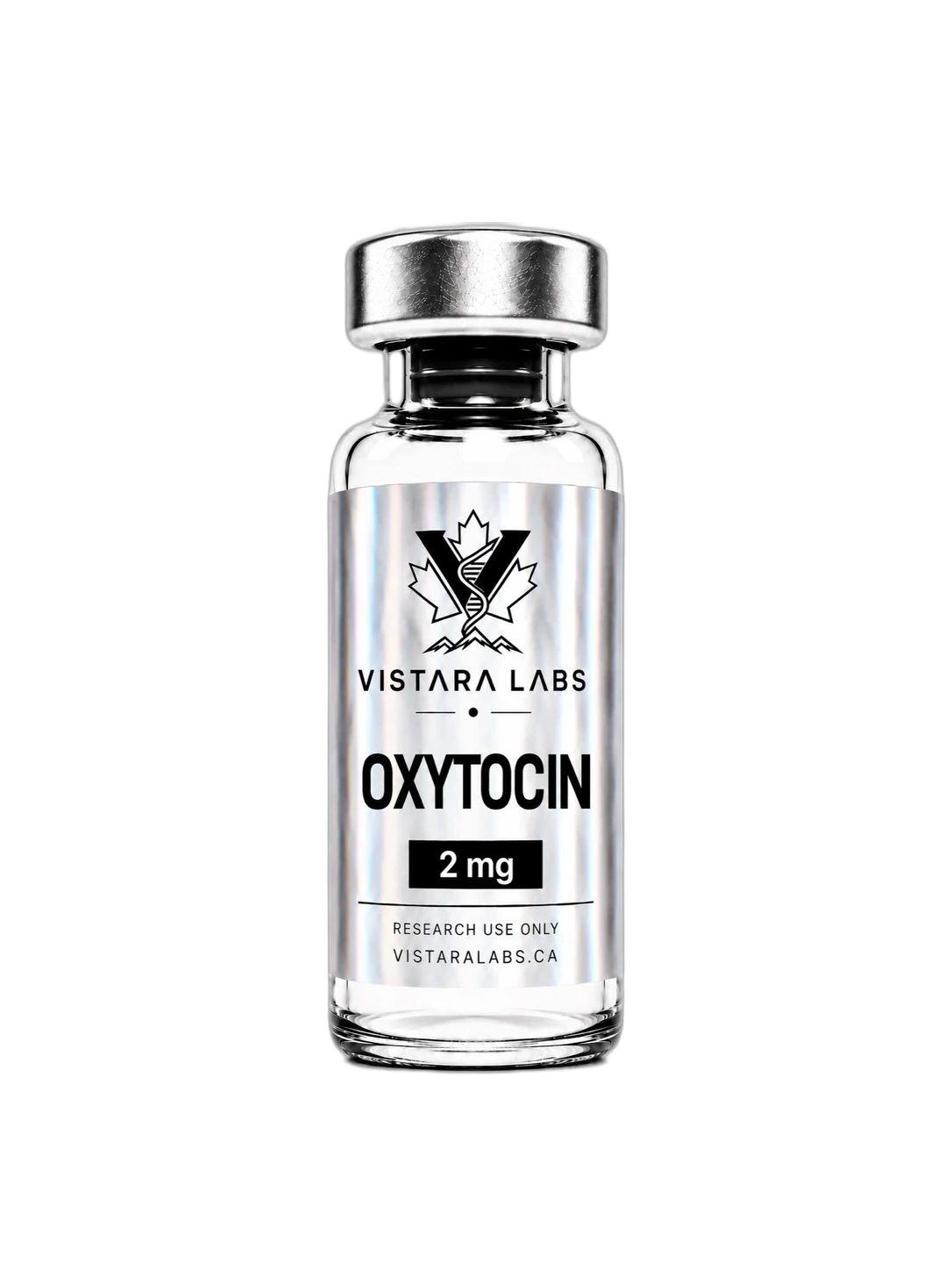
Oxytocin is a nine-amino-acid peptide hormone made in the hypothalamus and released from the posterior pituitary gland, best known for driving uterine contractions in labour and milk let-down in breastfeeding, and studied in the brain for its role in social bonding, stress and intimacy. It was the first polypeptide hormone to be synthesised, work that earned a Nobel Prize in 1955, and synthetic oxytocin remains a standard obstetric medicine. Vistara Labs supplies it as an Oxytocin 2 mg lyophilised vial and a ready-mixed Oxytocin nasal spray.
Findings
- Oxytocin is Cys-Tyr-Ile-Gln-Asn-Cys-Pro-Leu-Gly-NH2, a nine-amino-acid chain with a sulphur bridge between its two cysteines.
- Its sequence was worked out in 1953, and Vincent du Vigneaud received the 1955 Nobel Prize in Chemistry for the first synthesis of a polypeptide hormone.
- In a Cochrane review of 10,018 women, preventive oxytocin after birth roughly halved the risk of blood loss of 500 mL or more compared with no uterotonic or placebo (2019).
- Intranasal oxytocin reduced amygdala activation to fear-inducing images in a 2005 brain-imaging study, and lowered anxiety during a stress test in a 2003 trial of 37 men.
- In 29 couples, intranasal oxytocin increased orgasm intensity and contentment after sex (2014).
 View product →
What is oxytocin?
Oxytocin is a neurohypophysial hormone, meaning it is made by nerve cells in the hypothalamus and stored in and released from the back part of the pituitary gland. The main production sites are the large neurons of the paraventricular and supraoptic nuclei. Stimuli such as suckling, labour and some kinds of stress release it into the bloodstream, and oxytocin-producing neurons also project widely within the brain. It is also made in peripheral tissues, including the uterus, placenta, testis and heart (Gimpl and Fahrenholz, Physiol Rev, 2001).
Chemically it is a short peptide of nine amino acids. Six of them are closed into a ring by a disulphide (sulphur-sulphur) bridge, and a three-amino-acid tail hangs off the ring (Lee et al., Prog Neurobiol, 2009). Its formula is C43H66N12O12S2 and its molecular weight is about 1007 (PubChem). Its closest relative is vasopressin, the water-balance hormone, which differs from oxytocin at only two positions (Pitocin prescribing information, DailyMed).
Where the name and the science came from
The name comes from Greek for “quick birth”. Henry Dale described its uterine-contracting properties in 1906, the nine-amino-acid sequence was worked out in 1953 and the hormone was synthesised soon after (Lee et al., 2009). Vincent du Vigneaud received the 1955 Nobel Prize in Chemistry for this work, cited as the first synthesis of a polypeptide hormone (NobelPrize.org). That made oxytocin one of the first hormones that could be made in a laboratory rather than extracted from animal glands.
How oxytocin works
Oxytocin acts through a single receptor, the oxytocin receptor, a G protein-coupled receptor that mainly signals through the Gq pathway to phospholipase C, raising calcium inside the cell (Gimpl and Fahrenholz, 2001). Where that receptor sits decides what happens:
- Uterus. Before labour, the number of oxytocin receptors in the uterine muscle rises sharply, and the uterus becomes far more sensitive to the hormone.
- Breast. Oxytocin contracts the cells around milk ducts, producing the milk let-down reflex, which studies in oxytocin-deficient mice confirmed is essential.
- Brain. Receptors in areas such as the amygdala, a centre for fear and social signals, link oxytocin to anxiety, social recognition and bonding.
The first two actions are the classical ones described in the receptor literature (Gimpl and Fahrenholz, 2001). The brain actions are the focus of the intranasal research below.
A short life in the blood
In plasma, oxytocin has a half-life of about 1 to 6 minutes, shorter still in late pregnancy and during breastfeeding, and it is cleared mainly by the kidney and liver (Pitocin prescribing information, DailyMed). That short life is one reason researchers studying its brain effects have turned to the intranasal route, which is the route used in the human studies below. How long the product itself keeps before and after mixing is a separate question, covered in How Long Does Oxytocin Last?
What the research has shown
Labour and birth
Synthetic oxytocin is approved in the United States for starting or strengthening labour contractions when there is a medical reason, and for controlling bleeding after birth (Pitocin prescribing information, DailyMed). The largest body of evidence concerns that second use. A 2019 Cochrane review covered 24 trials, with 23 contributing data from 10,018 women. Compared with no uterotonic (a drug that contracts the uterus) or placebo, preventive oxytocin cut the risk of blood loss of 500 mL or more by about half (risk ratio 0.51) and of 1,000 mL or more by about 40% (risk ratio 0.59), and reduced the need for additional uterotonic drugs (Salati et al., Cochrane Database Syst Rev, 2019). The relationship between research oxytocin and the branded clinical product is explained in Oxytocin vs Pitocin.
Fear and stress in the brain
In a double-blind crossover study, 15 healthy men received intranasal oxytocin or placebo and then viewed fear-inducing images in an MRI scanner. Oxytocin markedly reduced activation of the amygdala and weakened its coupling to brainstem regions that drive the physical signs of fear. It was the first direct human evidence of oxytocin changing brain function (Kirsch et al., J Neurosci, 2005).
In a placebo-controlled, double-blind trial, 37 healthy men took the Trier Social Stress Test, a standard public-speaking and mental-arithmetic challenge. Intranasal oxytocin had an anti-anxiety effect, and men who received both oxytocin and support from their best friend had the lowest cortisol levels, the most calm and the least anxiety during the stress (Heinrichs et al., Biol Psychiatry, 2003).
Intimacy and couples
In 29 heterosexual couples studied in a naturalistic setting, intranasal oxytocin increased the intensity of orgasm and contentment after sex. Men reported greater sexual satiety, women felt more relaxed, and subgroups of women reported a better ability to share sexual desires and to empathise with their partner (Behnia et al., Horm Behav, 2014). More of the human intranasal work is gathered on Oxytocin Nasal Spray: What the Human Research Shows, and the wider field is on Sexual Health & Intimacy Research.
Oxytocin at a glance
| Question | Answer |
|---|---|
| Type | Nine-amino-acid peptide hormone |
| Made in | Hypothalamus; released from posterior pituitary |
| Receptor | Oxytocin receptor (Gq-coupled) |
| Plasma half-life | About 1-6 minutes |
| Human research | Birth, stress, fear circuitry, intimacy |
Forms Vistara Labs stocks
Oxytocin comes in two formats. The 2 mg lyophilised vial is a freeze-dried powder; the concentration arithmetic is in how much bacteriostatic water for an Oxytocin 2 mg vial. The Oxytocin nasal spray is a ready-mixed metered spray, matching the intranasal route used in the brain and couples studies above. Injection raises blood levels quickly, while the nasal route is the one built around the brain research; the two are compared in Oxytocin Nasal Spray vs Injection. Certificates of analysis are on the lab reports page, and ordering details are in Buy Oxytocin in Canada.
Oxytocin is supplied by Vistara Labs for laboratory research use only. The human studies above are described as published facts, not as guidance.
Frequently asked questions
What is oxytocin?
Oxytocin is a nine-amino-acid peptide hormone made in the hypothalamus and released from the posterior pituitary. Its classical roles are uterine contraction during labour and milk let-down during breastfeeding, and in the brain it is studied for social bonding, stress and intimacy.
What has oxytocin research shown in humans?
A 2019 Cochrane review of 10,018 women found preventive oxytocin roughly halved the risk of heavy bleeding after birth. Intranasal studies found it reduced amygdala responses to fear images (2005), lowered anxiety under stress (2003) and increased orgasm intensity and contentment in couples (2014).
How does oxytocin work?
It binds the oxytocin receptor, a G protein-coupled receptor that raises calcium inside cells. In the uterus and breast this causes muscle contraction, and in brain areas such as the amygdala it shapes fear, stress and social responses.
Who discovered oxytocin?
Henry Dale described its uterine-contracting effect in 1906. Its nine-amino-acid sequence was worked out in 1953, and Vincent du Vigneaud received the 1955 Nobel Prize in Chemistry for the first synthesis of a polypeptide hormone.
What is the half-life of oxytocin?
In plasma it is about 1 to 6 minutes, shorter in late pregnancy and during breastfeeding, according to the Pitocin prescribing information. It is cleared mainly by the kidney and liver.
Product details from vistaralabs.ca, October 2026. Compound data from PubChem (CID 439302). Sources: Gimpl G, Fahrenholz F. The oxytocin receptor system: structure, function, and regulation. Physiol Rev. 2001. PMID 11274341. Lee HJ et al. Oxytocin: the great facilitator of life. Prog Neurobiol. 2009. PMID 19482229. The Nobel Prize in Chemistry 1955, NobelPrize.org. Pitocin (oxytocin) injection prescribing information, DailyMed. Salati JA et al. Prophylactic oxytocin for the third stage of labour to prevent postpartum haemorrhage. Cochrane Database Syst Rev. 2019. PMID 31032882. Kirsch P et al. Oxytocin modulates neural circuitry for social cognition and fear in humans. J Neurosci. 2005. PMID 16339042. Heinrichs M et al. Social support and oxytocin interact to suppress cortisol and subjective responses to psychosocial stress. Biol Psychiatry. 2003. PMID 14675803. Behnia B et al. Differential effects of intranasal oxytocin on sexual experiences and partner interactions in couples. Horm Behav. 2014. PMID 24503174.
More on this: Kisspeptin vs Oxytocin: How They Differ.
All products supplied by Vistara Labs are intended for laboratory research use only. They are not drugs, are not approved for human or veterinary use, and are not intended to diagnose, treat, cure or prevent any condition. Nothing on this page constitutes medical advice or guidance for use in humans.