SS-31 myths: what the research does not show
Cellular Energy & Mitochondrial Research
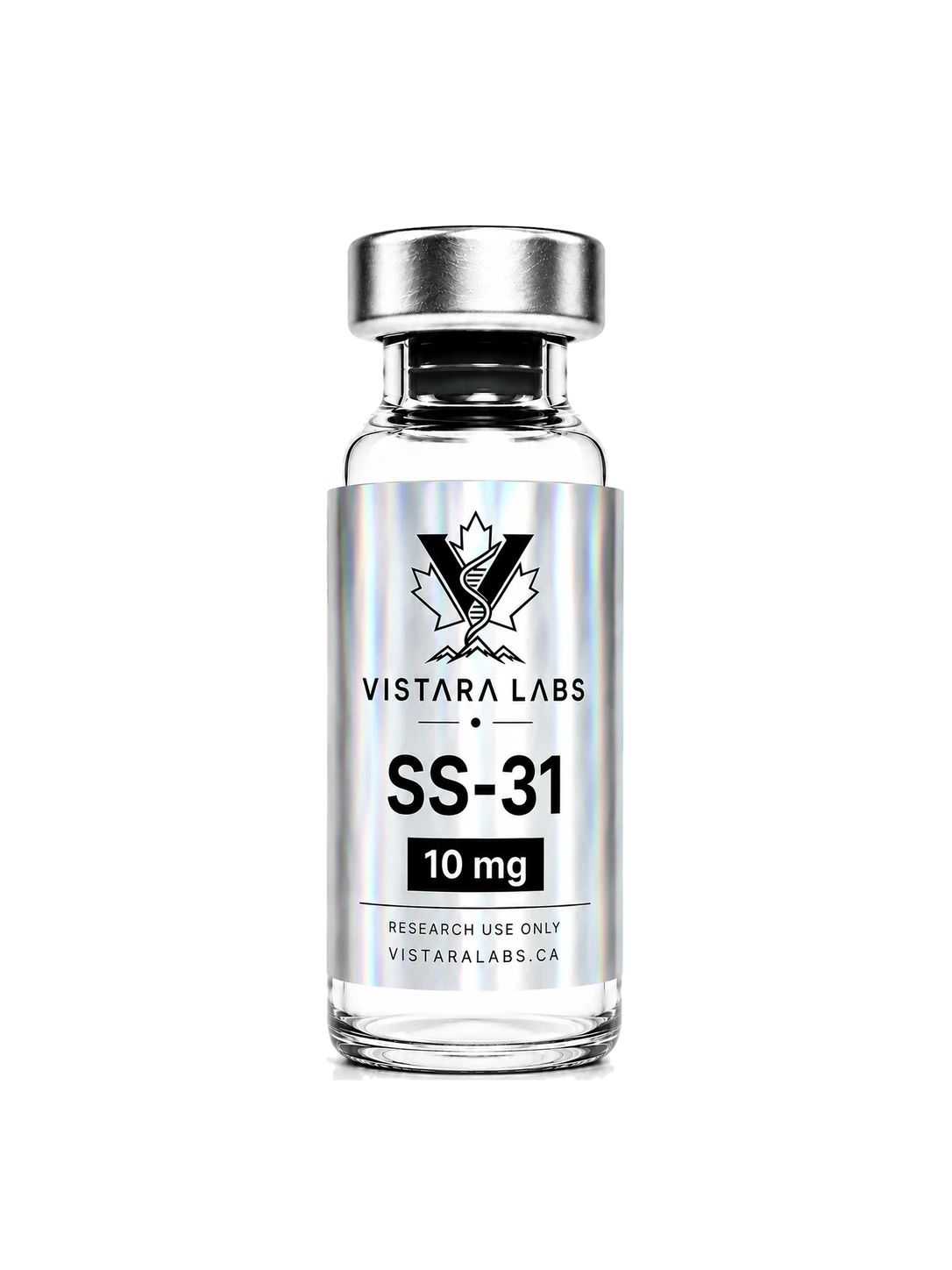
SS-31, also called elamipretide, is a four-amino-acid peptide that binds cardiolipin inside mitochondria, and its human trials are mixed: small positive signals, several missed primary endpoints and one narrow rare-disease approval in the USA. This page sets the longevity claims against what those trials and the mouse studies measured.
Findings
- In 39 healthy older adults, one infusion raised mitochondrial energy capacity in a hand muscle straight afterwards, compared with placebo (PLoS One, 2021).
- In Barth syndrome, people in an open-label extension walked a cumulative 96.1 m further at week 168, with 8 reaching that visit (Genet Med, 2024).
- In aged mice, 8 weeks of SS-31 reversed the age-related fall in maximum mitochondrial ATP production and improved treadmill endurance (Free Radic Biol Med, 2019).
- The biggest gap: the largest muscle trial, a 218-person phase 3 study, did not meet its primary endpoints (Neurology, 2023).
 View product →
Myth: SS-31 reverses ageing
Shown in mice, for specific measures, and not in people. In the 2019 study, aged female mice regained mitochondrial output and ran longer. A 2023 follow-up found 8 months of intermittent use preserved exercise tolerance but did not affect kidney function. The human evidence is one randomized study of older adults, and its rise in energy capacity had gone by day 7. No study we found measured ageing itself or lifespan in people.
Myth: SS-31 restores your energy and stops fatigue
Not supported by the largest trial. A small 2018 study of 36 adults with mitochondrial myopathy hinted at a longer walk over 5 days: 64.5 m in the top dose group against 20.4 m on placebo. The 24-week phase 3 trial then found no significant difference from placebo in walking distance or fatigue score. In the older adults above, fatigue resistance in the tested muscle did not change either, despite the higher energy capacity. A change inside the cell did not show up as better performance.
Myth: SS-31 is an approved anti-ageing drug
False. In September 2025, elamipretide received accelerated approval in the USA for one purpose: improving muscle strength in Barth syndrome, an ultra-rare inherited disorder. A condition of that approval is a confirmatory trial. Nothing about it covers ageing, energy, sports performance or general health.
Myth: the Barth syndrome trial proved SS-31 works
Partly true, and less tidy than the headlines. The randomized phase of that trial had 12 people and met neither primary endpoint. The gains came later, in an open-label extension with no placebo group: 95.9 m at week 36 and 96.1 m at week 168. Those numbers are encouraging for a rare disease with few options. They are also harder to interpret than a blinded result, and only 8 people reached the final visit.
Myth: SS-31 repairs a failing heart
Not shown. A 2017 trial gave a single 4-hour infusion to people with heart failure with reduced ejection fraction, and heart volumes fell in the highest dose group at the end of the infusion. Its 36 participants were followed for 24 hours, and the authors said long-term safety and efficacy still needed study. A brief change on an ultrasound is a reason for more research, not evidence of repair.
Myth: SS-31 brings back eyesight
Not shown on the main measures. In a 176-person phase 2 trial in dry macular degeneration, neither primary endpoint reached significance. Secondary results were more hopeful: 43% less progression of a retinal layer loss, and 14.6% against 2.1% gaining at least 10 letters of vision in low light, all with nominal P values. A 12-person trial of eye drops in an inherited optic nerve disease also missed its primary vision endpoint. The phase 3 programme is what will settle this.
Myth: SS-31 has no side effects because it is natural
False on both counts. SS-31 is a synthetic peptide, not a natural substance. In the 176-person eye trial, adverse events were reported by 86% on elamipretide and 71% on placebo, most often reactions at the site where it was given. The phase 3 muscle trial described most events as mild to moderate, which is reassuring but is not the same as none.
What SS-31 cannot promise
The mechanism is well studied and the rare-disease work is real, but the wider claims rest mostly on mice and on secondary measures.
- It cannot promise slower ageing in people; that has not been measured.
- It cannot promise less tiredness; the phase 3 fatigue result showed no benefit.
- It cannot promise lasting mitochondrial change; the single-infusion effect faded within a week.
- It cannot promise better vision; primary eye endpoints were missed.
Where the evidence stands
Elamipretide’s US accelerated approval covers one pharmaceutical product for Barth syndrome, and later-stage work continues in dry macular degeneration and mitochondrial myopathies. SS-31 is not an approved medicine in Canada for ageing, energy, heart or eye uses. Research-grade SS-31 is a separate material from that approved product and is supplied for laboratory research.
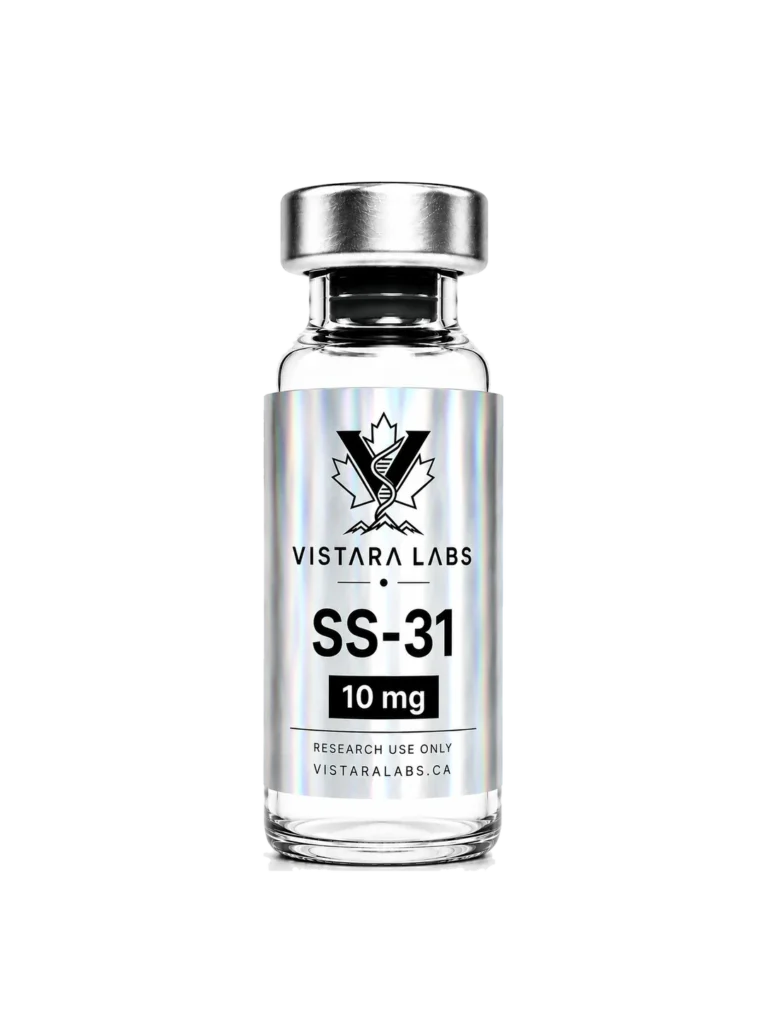
Vistara Labs supplies SS-31 as a laboratory research material. The page above is about the published research, not a claim about our product.
Frequently asked questions
Are SS-31 and elamipretide the same thing?
They are two names for the same peptide sequence. The US approval applies to one pharmaceutical product, and research-grade SS-31 is a separate material that is not an approved medicine.
Does SS-31 slow ageing in humans?
We found no human study that measured it. The ageing results come from mice, and the one randomized study in older adults saw a short-lived change in muscle energy capacity with no change in fatigue resistance.
Did elamipretide work in the phase 3 mitochondrial myopathy trial?
It did not meet its primary endpoints for walking distance or fatigue in 218 adults. A later analysis suggested a possible benefit in a genetic subgroup, and a follow-up trial was designed to test that.
Sources: Roshanravan B, Liu SZ, Ali AS, et al. In vivo mitochondrial ATP production is improved in older adult skeletal muscle after a single dose of elamipretide in a randomized trial. PLoS One. 2021. PMID 34264994. Thompson WR, Manuel R, Abbruscato A, et al. Long-term efficacy and safety of elamipretide in patients with Barth syndrome: 168-week open-label extension results of TAZPOWER. Genet Med. 2024. PMID 38602181. Campbell MD, Duan J, Samuelson AT, et al. Improving mitochondrial function with SS-31 reverses age-related redox stress and improves exercise tolerance in aged mice. Free Radic Biol Med. 2019. PMID 30597195. Karaa A, Bertini E, Carelli V, et al. Efficacy and Safety of Elamipretide in Individuals With Primary Mitochondrial Myopathy: The MMPOWER-3 Randomized Clinical Trial. Neurology. 2023. PMID 37268435. Campbell MD, Samuelson AT, Chiao YA, et al. Intermittent treatment with elamipretide preserves exercise tolerance in aged female mice. Geroscience. 2023. PMID 36840897. Karaa A, Haas R, Goldstein A, et al. Randomized dose-escalation trial of elamipretide in adults with primary mitochondrial myopathy. Neurology. 2018. PMID 29500292. Shirley M. Elamipretide: First Approval. Drugs. 2026. PMID 41335372. Zhao C, Zhuang X, Gao J. Elamipretide: The first cardiolipin-directed mitochondrial therapeutic for Barth syndrome approved under accelerated approval. Drug Discov Ther. 2026. PMID 41260682. Reid Thompson W, Hornby B, Manuel R, et al. A phase 2/3 randomized clinical trial followed by an open-label extension to evaluate the effectiveness of elamipretide in Barth syndrome, a genetic disorder of mitochondrial cardiolipin metabolism. Genet Med. 2021. PMID 33077895. Daubert MA, Yow E, Dunn G, et al. Novel Mitochondria-Targeting Peptide in Heart Failure Treatment: A Randomized, Placebo-Controlled Trial of Elamipretide. Circ Heart Fail. 2017. PMID 29217757. Ehlers JP, Hu A, Boyer D, et al. ReCLAIM-2: A Randomized Phase II Clinical Trial Evaluating Elamipretide in Age-related Macular Degeneration, Geographic Atrophy Growth, Visual Function, and Ellipsoid Zone Preservation. Ophthalmol Sci. 2025. PMID 39605874. Karanjia R, Sadun AA. Elamipretide Topical Ophthalmic Solution for the Treatment of Subjects with Leber Hereditary Optic Neuropathy: A Randomized Trial. Ophthalmology. 2024. PMID 37923251. Karaa A, Bertini E, Carelli V, et al. Genotype-specific effects of elamipretide in patients with primary mitochondrial myopathy: a post hoc analysis of the MMPOWER-3 trial. Orphanet J Rare Dis. 2024. PMID 39574155.
All products supplied by Vistara Labs are intended for laboratory research use only. They are not drugs, are not approved for human or veterinary use, and are not intended to diagnose, treat, cure or prevent any condition. Nothing on this page constitutes medical advice or guidance for use in humans.
References
SS-31 (elamipretide) has a mature clinical programme. Mechanistic evidence is strong and human exposure substantial, but efficacy results are mixed and indication-dependent — including trials that missed their primary endpoints.
- Efficacy and Safety of Elamipretide in Individuals With Primary Mitochondrial Myopathy: The MMPOWER-3 Randomized Clinical TrialRandomised, double-blind phase 3 trial (MMPOWER-3), 24 weeks. The primary exercise and fatigue endpoints were not met.
- A randomized crossover trial of elamipretide in adults with primary mitochondrial myopathyRandomised crossover trial in adults with genetically confirmed primary mitochondrial myopathy.
- Effects of Elamipretide on Left Ventricular Function in Patients With Heart Failure With Reduced Ejection Fraction: The PROGRESS-HF Phase 2 TrialRandomised phase 2 trial; 71 patients. No significant improvement in left-ventricular end-systolic volume or ejection fraction versus placebo.
Links open the study record on PubMed so the source can be checked directly. Listing a study is not a claim that its findings apply to any other use, product or route of administration. Research use only.