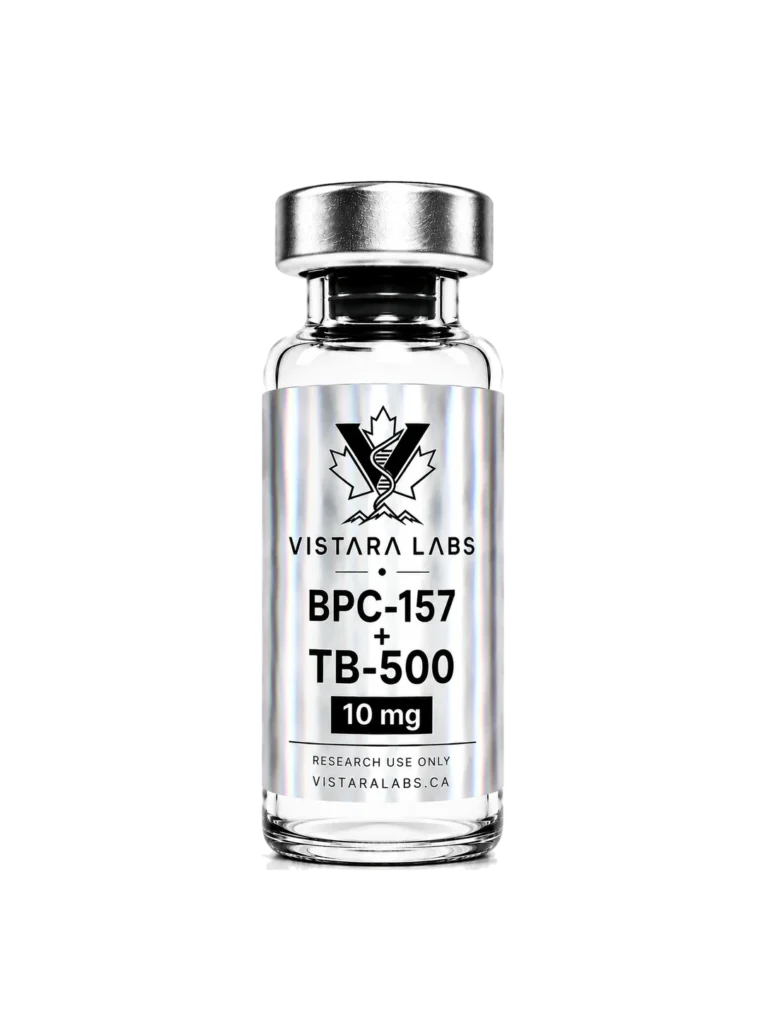
BPC-157 vs KPV: How They Differ
BPC-157 is a 15-amino-acid peptide from a gastric juice protein, studied for repairing the gut lining, tendons and blood vessels. KPV is a three-amino-acid peptide, lysine, proline and valine, cut from the end of the hormone alpha-MSH and studied for switching down inflammatory signalling, mainly in the colon. Both turn up in gut research, but they answer different questions: BPC-157 is studied for rebuilding damaged tissue, KPV for calming the inflammation that damages it. Here is how they compare, what each literature shows, and where the two meet in KLOW.
Findings
- KPV is alpha-MSH residues 11 to 13. It keeps the parent hormone’s anti-inflammatory action without its pigment effect (2008 review).
- At nanomolar concentrations KPV blocked NF-kappaB and MAP kinase signalling in human gut and immune cells, entering them through the PepT1 transporter, and oral KPV reduced two forms of colitis in mice (2008).
- BPC-157 is GEPPPGKPADDAGLV, described as stable in human gastric juice, and reached phase II testing in inflammatory bowel disease (2012).
- In rats, BPC-157 healed colitis and colon anastomoses that controls could not heal (2013). Human data for BPC-157 total three small pilot studies; we found no published human trial of KPV.
What is BPC-157?
BPC-157 is a 15-residue partial sequence of body protection compound, a protein isolated from human gastric juice (Chang et al., J Appl Physiol, 2011). Its developers describe it as stable in gastric juice, effective in the upper and lower gut, and tested in phase II for inflammatory bowel disease under the code PL 14736 (Sikiric et al., Curr Med Chem, 2012). That gut origin is what separates it from most repair peptides.
The gut research
In a rat model of cysteamine-induced colitis combined with a colon-to-colon anastomosis, controls healed neither; BPC-157, given by injection or in drinking water, healed both at the same time (Klicek et al., J Physiol Pharmacol, 2013). The same group reports anastomosis healing, reversal of short-bowel syndrome and fistula healing in animal models (Sikiric et al., 2012), counteraction of NSAID-induced lesions in the stomach, intestine and liver, and a role for BPC-157 as a mediator of cytoprotection, the protection of the stomach lining against injury (Sikiric et al., Curr Pharm Des, 2013). Its repair mechanisms reach beyond the gut: it raised expression of VEGFR2, the vascular growth factor receptor, and activated the Akt and eNOS pathway that drives new vessel growth (Hsieh et al., J Mol Med, 2017).
The human studies
Human reports are small. Of 12 women with interstitial cystitis who had not responded to standard treatment, 10 reported complete resolution of symptoms after one procedure (Lee et al., Altern Ther Health Med, 2024), and in a knee-pain review 11 of 12 patients given BPC-157 alone reported significant improvement (Lee and Padgett, Altern Ther Health Med, 2021). A 2026 systematic review counted three studies and 30 participants, with symptom improvement in most and no treatment-related adverse events, while rating the evidence very low certainty (Poolton et al., Acta Orthop Belg, 2026).
What is KPV?
KPV is the C-terminal tripeptide of alpha-melanocyte-stimulating hormone, its amino acids 11 to 13 (Kannengiesser et al., Inflamm Bowel Dis, 2008). Alpha-MSH is a 13-amino-acid hormone with broad anti-inflammatory effects, but it also darkens pigment. A 2008 review explains that KPV was singled out because it keeps the anti-inflammatory effect without the pigmentary action, and lists skin, bowel, lung, eye and joint inflammation as the areas it was proposed for (Brzoska et al., Endocr Rev, 2008). How it comes from alpha-MSH is covered in Lysine, proline, valine: how KPV comes from alpha-MSH.
The colitis research
An Emory University team showed that nanomolar concentrations of KPV inhibited the NF-kappaB and MAP kinase inflammatory pathways and reduced pro-inflammatory cytokine secretion in human intestinal epithelial cells and T cells. KPV entered the cells through PepT1, a transporter for small peptides that is normally found in the small intestine and is switched on in the colon during inflammatory bowel disease. Given in drinking water, KPV reduced both DSS- and TNBS-induced colitis in mice (Dalmasso et al., Gastroenterology, 2008).
A German group the same year found that KPV brought earlier recovery, stronger weight regain and fewer inflammatory infiltrates in DSS colitis, also improved transfer colitis, and rescued every treated mouse lacking a working melanocortin-1 receptor from death during DSS colitis, showing its effect is at least partly independent of that receptor (Kannengiesser et al., 2008). Packing KPV into colon-targeted nanoparticles gave similar protection at a concentration 12,000-fold lower than free KPV in solution (Laroui et al., Gastroenterology, 2010). More is in KPV: the anti-inflammatory tripeptide, explained.
How do BPC-157 and KPV compare side by side?
| Question | BPC-157 | KPV |
|---|---|---|
| What is it? | Partial sequence of a gastric juice protein | C-terminal end of alpha-MSH |
| Size | 15 amino acids | 3 amino acids (Lys-Pro-Val) |
| Main research areas | Gut lining, anastomoses, tendon, blood vessels | Colitis, skin and immune inflammation |
| Mechanism focus | VEGFR2, Akt and eNOS; cytoprotection | NF-kappaB and MAP kinase inhibition; PepT1 uptake |
| Human evidence | Three small pilot studies, 30 people | None published that we found; cell and animal work |
| Forms we supply | 10 mg vial, nasal spray, blends | 10 mg vial, nasal spray, KLOW blend |
Which one fits which research question?
- Healing of the gut wall, anastomoses, fistulas and ulcers: BPC-157, which has the structural repair models.
- Inflammatory signalling in the colon: KPV, with its NF-kappaB data and the PepT1 uptake route, which is switched on in inflamed colon.
- Tendon, ligament and vascular repair: BPC-157; KPV’s literature does not cover connective tissue repair.
- Skin and immune inflammation without pigment effects: KPV, the reason it was separated from alpha-MSH.
Can BPC-157 and KPV be studied together?
Yes. The two address different stages of the same problem: KPV acts on the inflammatory signals, BPC-157 on rebuilding the tissue. Because their mechanisms do not overlap, a design that uses both keeps two distinguishable variables; that rationale comes from each compound’s own literature rather than from a combined study.
They meet in KLOW, which adds KPV to the BPC-157, TB-500 and GHK-Cu of GLOW. The blend is explained in What is KLOW?, and the choice between the two blends in KLOW vs GLOW. Other combinations are on the stacks page.
How are BPC-157 and KPV supplied?
BPC-157 comes as a 10 mg lyophilised vial and the ready-mixed BPC-157 Nasal Spray; KPV as a 10 mg vial and the KPV Nasal Spray in two bottle sizes. The sprays are metered at 0.175 mL per press. Vials are reconstituted with bacteriostatic water: see the BPC-157 and KPV reconstitution guides, and how long KPV lasts for storage. Certificates of analysis are on the lab reports page, and every order ships from within Canada.
BPC-157 and KPV are supplied for laboratory research use only. The KPV findings above come from cell and animal research; the BPC-157 human studies used clinical preparations under medical supervision.
Frequently asked questions
What is the difference between BPC-157 and KPV?
BPC-157 is a 15-amino-acid partial sequence of a gastric juice protein, studied for repairing the gut lining, tendons and blood vessels. KPV is the three-amino-acid end of alpha-MSH, studied for inhibiting NF-kappaB inflammatory signalling, especially in colitis models.
Is KPV better than BPC-157 for gut research?
They suit different questions. KPV fits studies of inflammatory signalling in the colon, where it enters cells through the PepT1 transporter. BPC-157 fits studies of structural healing, with rat data on colitis, anastomoses and fistulas and phase II testing in inflammatory bowel disease.
Can BPC-157 and KPV be studied together?
Yes. KPV targets inflammatory signalling and BPC-157 tissue repair, so a study using both keeps two distinguishable variables. The KLOW blend combines KPV with BPC-157, TB-500 and GHK-Cu.
Does KPV affect pigmentation like alpha-MSH?
KPV was singled out from alpha-MSH because it keeps the hormone’s anti-inflammatory effect without its pigmentary action, according to a 2008 review in Endocrine Reviews.
Where can I buy BPC-157 and KPV in Canada?
Vistara Labs supplies both as 10 mg lyophilised vials and ready-mixed nasal sprays, plus the KLOW blend that contains both, shipped from within Canada by Canada Post Xpresspost.
Product details from vistaralabs.ca, October 2026. Sources: Chang CH et al. The promoting effect of pentadecapeptide BPC 157 on tendon healing involves tendon outgrowth, cell survival, and cell migration. J Appl Physiol. 2011. PMID 21030672. Sikiric P et al. Focus on ulcerative colitis: stable gastric pentadecapeptide BPC 157. Curr Med Chem. 2012. PMID 22300085. Klicek R et al. Stable gastric pentadecapeptide BPC 157 heals cysteamine-colitis and colon-colon-anastomosis and counteracts cuprizone brain injuries and motor disability. J Physiol Pharmacol. 2013. PMID 24304574. Sikiric P et al. Toxicity by NSAIDs. Counteraction by stable gastric pentadecapeptide BPC 157. Curr Pharm Des. 2013. PMID 22950504. Hsieh MJ et al. Therapeutic potential of pro-angiogenic BPC157 is associated with VEGFR2 activation and up-regulation. J Mol Med. 2017. PMID 27847966. Lee E et al. Effect of BPC-157 on symptoms in patients with interstitial cystitis: a pilot study. Altern Ther Health Med. 2024. PMID 39325560. Lee E, Padgett B. Intra-articular injection of BPC 157 for multiple types of knee pain. Altern Ther Health Med. 2021. PMID 34324435. Poolton JT et al. Human evidence for BPC-157 in orthopaedic and regenerative medicine: a systematic review of efficacy and safety. Acta Orthop Belg. 2026. PMID 42885452. Kannengiesser K et al. Melanocortin-derived tripeptide KPV has anti-inflammatory potential in murine models of inflammatory bowel disease. Inflamm Bowel Dis. 2008. PMID 18092346. Brzoska T et al. Alpha-melanocyte-stimulating hormone and related tripeptides: biochemistry, antiinflammatory and protective effects in vitro and in vivo. Endocr Rev. 2008. PMID 18612139. Dalmasso G et al. PepT1-mediated tripeptide KPV uptake reduces intestinal inflammation. Gastroenterology. 2008. PMID 18061177. Laroui H et al. Drug-loaded nanoparticles targeted to the colon with polysaccharide hydrogel reduce colitis in a mouse model. Gastroenterology. 2010. PMID 19909746.
More on this: Gut Health Research.
All products supplied by Vistara Labs are intended for laboratory research use only. They are not drugs, are not approved for human or veterinary use, and are not intended to diagnose, treat, cure or prevent any condition. Nothing on this page constitutes medical advice or guidance for use in humans.