Cartalax research: what the laboratory studies show
Cartalax is the tripeptide Ala-Glu-Asp (AED, also called T-31), one of the short cartilage peptides developed at the St Petersburg Institute of Bioregulation and Gerontology. Here is what the research found.
Findings
- In aging human mesenchymal stem cells, AED at 200 ng/mL switched on all four cartilage-building markers measured (SOX9, aggrecan, type II collagen and COMP), at one tenth of the concentration the whole cartilage extract needed.
- In primary rat chondrocytes, AED raised cell numbers by 1.4 to 1.8 times in cultures from young animals and 1.6 to 2.1 times in cultures from old animals over five days.
- In aged chondrocytes, AED normalised the senescence signature: p16, p21, p53, TNF-alpha and IL-1 alpha came down and sirtuin-1 came back up.
- In aging human stem-cell cultures, the short peptides including AED lifted IGF1 gene expression 3.5 to 5.6 fold at nanomolar concentrations.
- In a rat osteoporosis model, T-31 (AED) prevented the loss of bone mineral density after ovariectomy. The published work to date is laboratory and animal research.
 View product →
Cartilage genes in aging human stem cells: all four markers activated (Adv Gerontol, 2023)
Myakisheva, Linkova and colleagues aged human mesenchymal stem cells by repeated passage, then measured the genes and proteins a cell uses to become cartilage: SOX9, aggrecan, type II collagen and COMP. AED peptide at 200 ng/mL activated gene expression and protein synthesis for all four markers in the aging cultures. The whole cartilage polypeptide complex produced the same effect, but only at 2,000 ng/mL, ten times the concentration. The authors concluded that the peptides stimulate chondrogenesis and named osteoarthritis models as the next step.
Chondrocyte proliferation and senescence: more cells, normal signalling (Vrach, 2023; Adv Gerontol, 2023)
In the proliferation study, the same group took primary chondrocytes from young (3 month) and old (20 month) rats and followed growth curves for five days, testing 20, 200 and 2,000 ng/mL. At its effective concentration of 200 ng/mL, AED increased chondrocyte numbers by 1.4 to 1.8 times in cultures from young animals and by 1.6 to 2.1 times in cultures from old animals, compared with control. The cartilage complex at 2,000 ng/mL gave 1.7 to 2.2 and 1.8 to 2.5 times. Both worked better on cells from old animals.
A companion paper characterised the senescence phenotype of aged chondrocytes: higher p16, p21, p53, TNF-alpha and IL-1 alpha, lower sirtuin-1. AED and the cartilage complex normalised the synthesis of these molecules. A 2023 review from the same institute states that AED (Cartalax) has been given orally to older patients with osteoarthritis; that primary report is not indexed in PubMed, so no patient numbers or outcomes are given here.
Gene expression and connective tissue: IGF1, sirtuins, collagen (Mol Biol Rep, 2020; Bull Exp Biol Med, 2016 and 2020)
Ashapkin and colleagues aged a human bone-marrow mesenchymal stem-cell line by serial passage and by prolonged stationary culture, and measured aging-related genes. Adding the short peptides AED, KED and KE at nanomolar concentrations raised IGF1 expression 3.5 to 5.6 fold in both aging models, and AED also stimulated NF-kappa-B expression.
Two fibroblast studies point the same way. In aging human skin fibroblasts, AED activated the synthesis of sirtuin-1, sirtuin-6 and type I collagen (Fridman, 2020). Earlier, AED inhibited the matrix-degrading enzyme MMP-9, increased the proliferation marker Ki-67 and the renewal marker CD98hc, and suppressed caspase-dependent apoptosis as the fibroblasts aged (Lin’kova, 2016).
Bone density in rats: osteoprotective effect (Adv Gerontol, 2007)
Povorozniuk, Khavinson and colleagues tested T-31 (AED) and a cartilage-tissue extract preparation in rats after ovariectomy, a standard osteoporosis model. Both were osteoprotective: they prevented the fall in bone mineral density after ovariectomy and raised density that had already dropped, with the whole-tissue extract the stronger of the two.
What Cartalax is
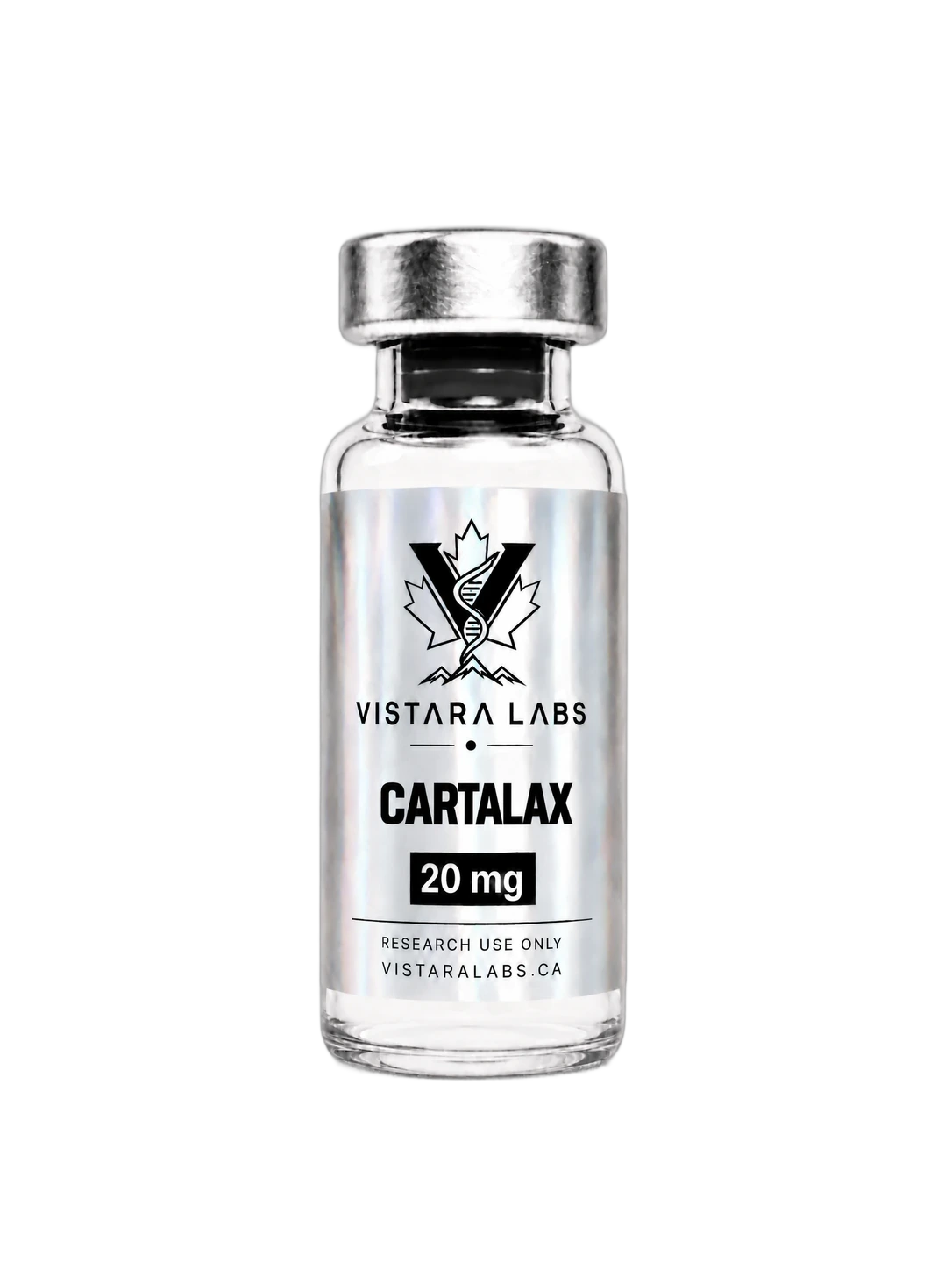
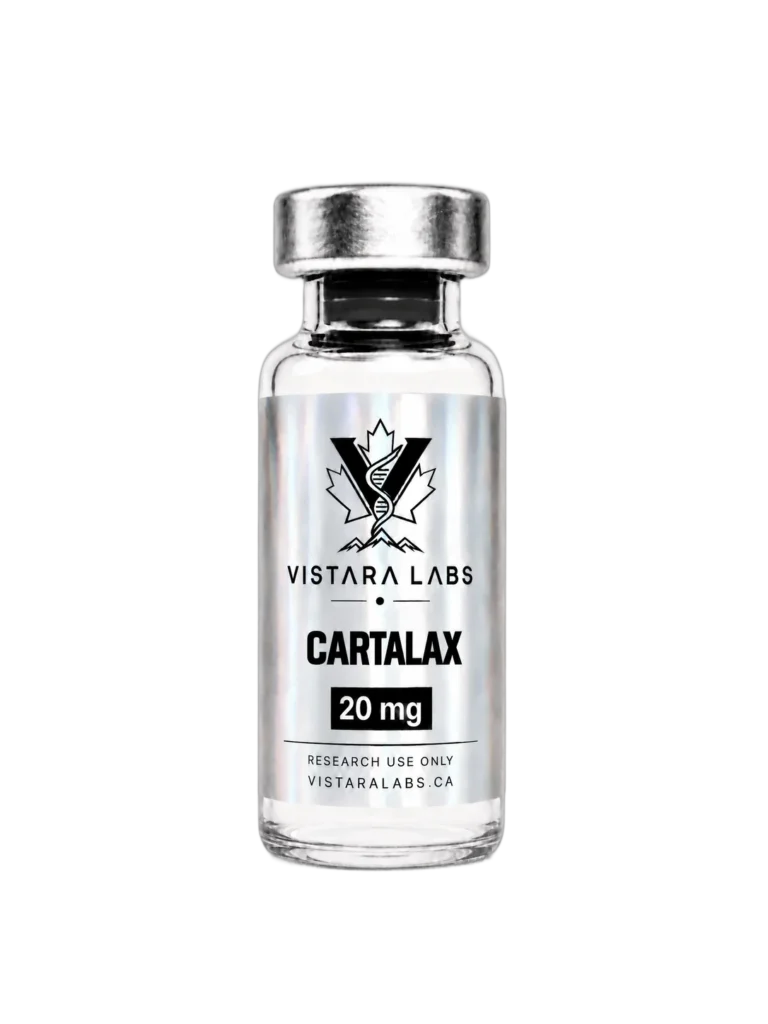
Cartalax is a synthetic tripeptide, Ala-Glu-Asp, designed from the short peptides found in cartilage-tissue extract. In molecular docking models from the Khavinson group it binds a short DNA sequence (acct), the proposed route to the genes above (Khavinson, 2016). It is supplied as a lyophilised powder. Our Cartalax reconstitution page covers preparing the vial with bacteriostatic water.
Vistara Labs stocks Cartalax research vials, shipped from within Canada to every province.
Frequently asked questions
What has Cartalax (AED) shown in cartilage cell research?
In aging human mesenchymal stem cells, AED at 200 ng/mL activated SOX9, aggrecan, type II collagen and COMP, the markers of cartilage formation. In primary rat chondrocytes it increased cell numbers by 1.4 to 2.1 times over five days, with the larger effect in cells from old animals, and it normalised the senescence markers p16, p21, p53, TNF-alpha, IL-1 alpha and sirtuin-1.
What human research exists on Cartalax?
The PubMed-indexed studies of AED are cell-culture and animal work. A 2023 review from the St Petersburg Institute of Bioregulation and Gerontology states that AED has been used orally in older patients with osteoarthritis, but the primary clinical report is not indexed and no patient numbers or outcomes are available to cite.
What is Cartalax?
Cartalax is the synthetic tripeptide Ala-Glu-Asp (AED, T-31), one of the short peptide bioregulators developed by the Khavinson group from cartilage-tissue peptides. It is studied for its effect on the genes chondrocytes and connective-tissue cells use for matrix production and renewal.
Sources: Myakisheva SN, Linkova NS, Diatlova AS, Polyakova VO, Ryzhak GA. The influence of peptides on the chondrogenic differentiation of human mesenchymal stem cells during replicative aging. Adv Gerontol. 2023;36(3):383-390. PMID 37782646. Myakisheva SN, Linkova NS, Polyakova VO, Ryzhak GA. Peptides of cartilage tissue: regulation of chondrocyte proliferation, geroprotection and prospects for use in osteoarthrosis. Vrach. 2023;34(10):46-49. DOI 10.29296/25877305-2023-10-09. Myakisheva SN, Linkova NS, Kozhevnikova EO, Polyakova VO, Ryzhak GA. Peptides prevent the forming of secretory phenotype of chondrocytes associated with the aging. Adv Gerontol. 2023;36(2):234-238. PMID 37356100. Myakisheva SN, Linkova NS, Kozhevnikova EO, Ryzhak GA. Chondrocytes secretory phenotype associated with aging: role in the pathogenesis of osteoarthritis and prospects for peptide bioregulation (review). Adv Gerontol. 2023;36(3):313-323. PMID 37782637. Ashapkin V, Khavinson V, Shilovsky G, Linkova N, Vanuyshin B. Gene expression in human mesenchymal stem cell aging cultures: modulation by short peptides. Mol Biol Rep. 2020;47(6):4323-4329. PMID 32399807. Fridman NV, Linkova NS, Kozhevnikova EO, Gutop EO, Khavinson VK. Comparison of the effects of KE and AED peptides on functional activity of human skin fibroblasts during their replicative aging. Bull Exp Biol Med. 2020;170(1):154-157. PMID 33231794. Lin’kova NS, Drobintseva AO, Orlova OA, et al. Peptide regulation of skin fibroblast functions during their aging in vitro. Bull Exp Biol Med. 2016;161(1):175-178. PMID 27259496. Povorozniuk VV, Khavinson VKh, Makogonchuk AV, Ryzhak GA, Kreslov EA, Gopkalova IV. Effect of peptide regulators on the structural and functional status of bone tissue in ageing rats. Adv Gerontol. 2007;20(2):134-137. PMID 18306703. Khavinson VK, Lin’kova NS, Tarnovskaya SI. Short peptides regulate gene expression. Bull Exp Biol Med. 2016;162(2):288-292. PMID 27909961.
All products supplied by Vistara Labs are intended for laboratory research use only. They are not drugs, are not approved for human or veterinary use, and are not intended to diagnose, treat, cure or prevent any condition. Nothing on this page constitutes medical advice or guidance for use in humans.