Ipamorelin research: what the human and lab studies show
Hormonal, Growth Hormone & Body Composition Research
Ipamorelin is a synthetic pentapeptide developed at Novo Nordisk in the 1990s as a selective growth hormone secretagogue, acting at the pituitary receptor later identified as the ghrelin receptor. Here is what the research found.
Findings
- In healthy men given a short intravenous infusion, every dose produced a single episode of growth hormone release, peaking at about 40 minutes, with a half-life of about two hours (Pharm Res, 1999).
- In a placebo-controlled phase 2 trial of 114 adults after bowel resection, up to seven days of twice-daily infusions were well tolerated, with adverse-event rates no higher than placebo (Int J Colorectal Dis, 2014).
- In pigs, ipamorelin released growth hormone as strongly as GHRP-6 but did not raise ACTH or cortisol, even at more than 200 times its ED50 (Eur J Endocrinol, 1998).
- In rats dosed for 15 days, longitudinal bone growth rose from 42 to 52 micrometres per day (P below 0.0001), with a dose-dependent gain in body weight (Growth Horm IGF Res, 1999).
- In rats given methylprednisolone, ipamorelin cut ten-day weight loss from 13.6 g to about 2 g and raised IGF-1 (Growth Horm IGF Res, 1999).
 View product →
Healthy volunteers: growth hormone release at every dose (Pharm Res, 1999)
Gobburu and colleagues gave ipamorelin by 15-minute intravenous infusion at five escalating rates, eight healthy men at each level. Drug levels rose in proportion to dose, with a terminal half-life of about two hours. Every dose produced a single episode of growth hormone release that peaked at about 40 minutes and then declined to baseline, and the concentration needed for half-maximal stimulation was 214 nmol/L.
Bowel surgery: a 114-patient phase 2 safety trial (Int J Colorectal Dis, 2014)
Ipamorelin reached a double-blind, placebo-controlled phase 2 trial in adults recovering from bowel resection. Beck and colleagues enrolled 117 patients, 114 of them analysed, and infused ipamorelin or placebo twice daily from the first day after surgery for up to seven days. It was well tolerated: 87.5% of the ipamorelin group had at least one treatment-emergent adverse event against 94.8% on placebo. Median time to the first tolerated solid meal was 25.3 hours on ipamorelin and 32.6 hours on placebo, a difference that did not reach statistical significance in this small proof-of-concept study. Two rat studies had shown ipamorelin shortening the time to the first bowel movement after laparotomy (J Pharmacol Exp Ther, 2009) and cutting the share of a test meal still in the stomach from 78% to 52%, close to the 44% in unoperated rats (J Exp Pharmacol, 2012).
Pigs and rats: growth hormone release without a cortisol rise (Eur J Endocrinol, 1998)
Raun and colleagues at Novo Nordisk described the pharmacology of ipamorelin. In rat pituitary cells it released growth hormone with potency similar to GHRP-6 (EC50 1.3 versus 2.2 nmol/L), and in conscious pigs the ED50 was 2.3 nmol/kg against 3.9 nmol/kg for GHRP-6. The difference was specificity. None of the secretagogues changed FSH, LH, prolactin or TSH, but GHRP-6 and GHRP-2 both raised ACTH and cortisol. Ipamorelin did not, even at doses more than 200 times its ED50 for growth hormone release, matching the selectivity of GHRH itself.
Bone growth and steroid-treated rats (Growth Horm IGF Res, 1999)
Two follow-up studies tested repeated dosing. Johansen and colleagues injected adult female rats three times daily for 15 days. Longitudinal bone growth rose from 42 micrometres per day on vehicle to 44, 50 and 52 micrometres per day across the three dose groups (P below 0.0001), with a dose-dependent gain in body weight. Malmlöf and colleagues then gave rats the glucocorticoid methylprednisolone, which did not blunt the acute growth hormone response to ipamorelin. Over ten days, steroid-treated rats lost 13.6 g; with ipamorelin added, the loss shrank to between 1.6 and 2.3 g, less than the 4.0 g lost by saline controls, and IGF-1 rose in parallel.
What ipamorelin is
Ipamorelin (NNC 26-0161) is the pentapeptide Aib-His-D-2-Nal-D-Phe-Lys-NH2, formula C38H49N9O5, molecular weight 711.9 g/mol, CAS 170851-70-4. Novo Nordisk derived it from GHRP-1 and later used it as the template for smaller analogues such as NNC 26-0235 (J Med Chem, 1998). It acts at the growth hormone secretagogue receptor, cloned in 1996 (Science); ghrelin, the receptor’s natural ligand, was identified a year after ipamorelin was described (Nature, 1999). It is supplied as a lyophilised powder; our ipamorelin reconstitution guide covers preparing it with bacteriostatic water, and our ipamorelin half-life page covers the human pharmacokinetics.
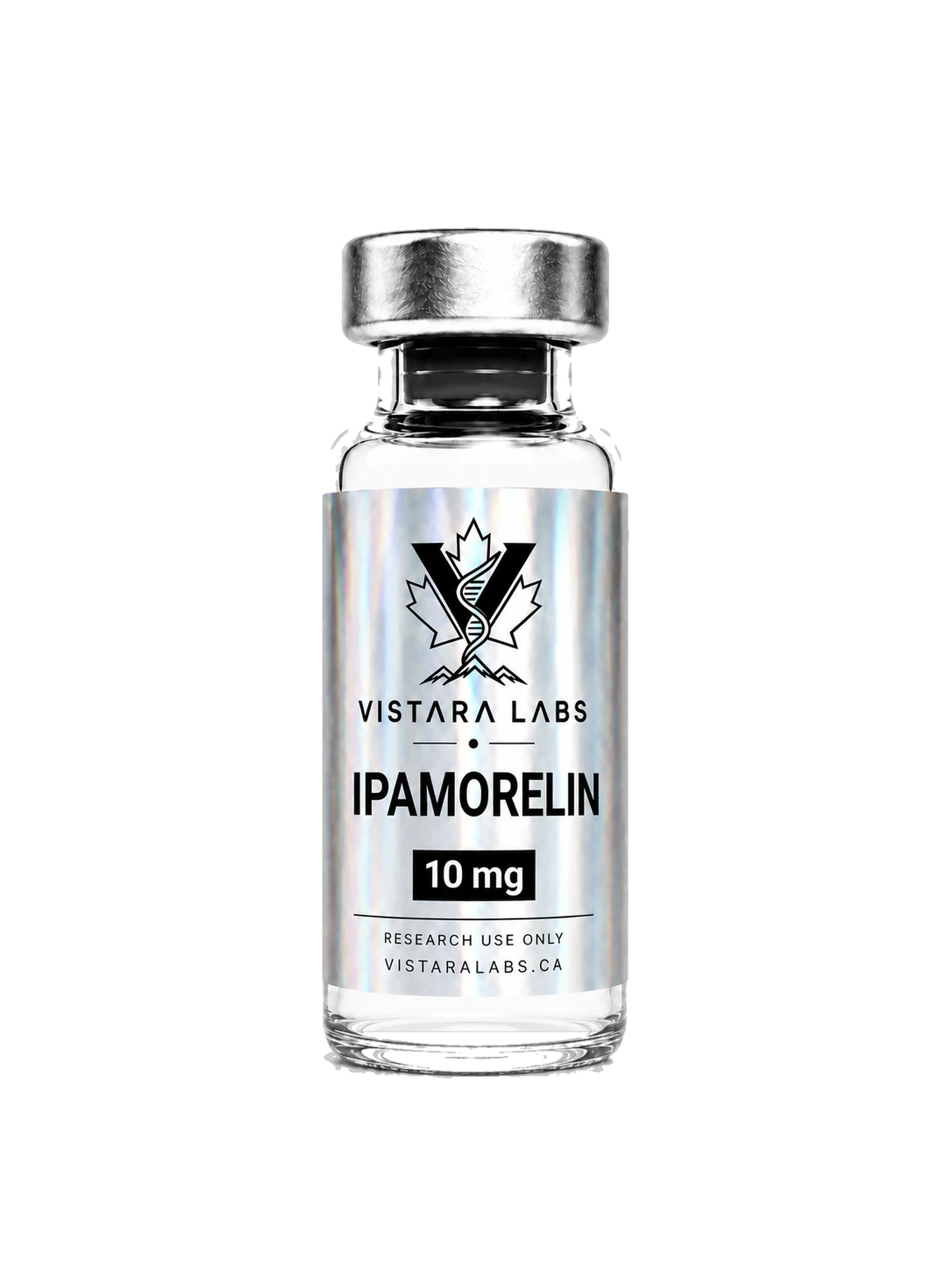
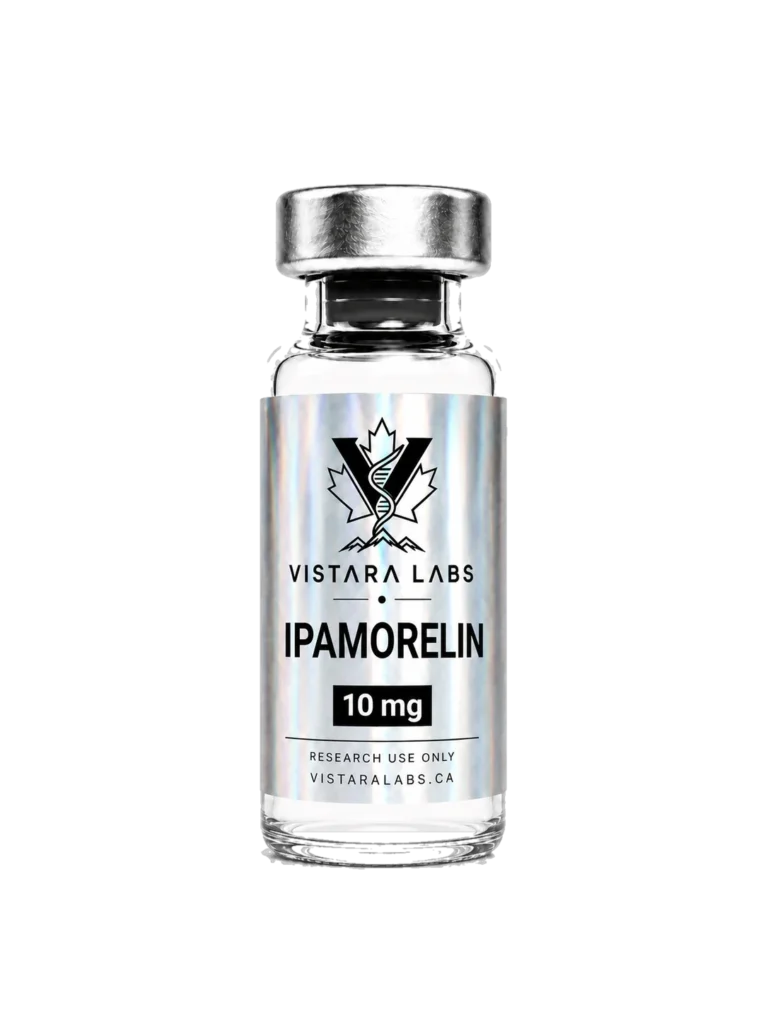
Vistara Labs stocks Ipamorelin research vials, shipped from within Canada to every province.
Frequently asked questions
What have the human studies of ipamorelin shown?
In healthy men given ipamorelin by short intravenous infusion, every dose produced a single episode of growth hormone release peaking at about 40 minutes, with a terminal half-life of about two hours. In a 114-patient placebo-controlled phase 2 trial after bowel resection, up to seven days of twice-daily infusions were well tolerated, with adverse-event rates no higher than placebo. Those two studies are the published human record.
What has ipamorelin done in animal studies?
In pigs it released growth hormone as strongly as GHRP-6 without raising ACTH or cortisol. In rats, 15 days of dosing raised longitudinal bone growth from 42 to 52 micrometres per day with a gain in body weight, it protected body weight and raised IGF-1 in rats given methylprednisolone, and in rat models of postoperative ileus it shortened the time to the first bowel movement and accelerated gastric emptying.
What is ipamorelin?
Ipamorelin is the synthetic pentapeptide Aib-His-D-2-Nal-D-Phe-Lys-NH2 (NNC 26-0161), developed at Novo Nordisk as a selective growth hormone secretagogue that acts at the growth hormone secretagogue receptor, the receptor later identified as the ghrelin receptor.
Sources: Gobburu JV, Agersø H, Jusko WJ, Ynddal L. Pharmacokinetic-pharmacodynamic modeling of ipamorelin, a growth hormone releasing peptide, in human volunteers. Pharm Res. 1999;16(9):1412-1416. PMID 10496658. Beck DE, Sweeney WB, McCarter MD; Ipamorelin 201 Study Group. Prospective, randomized, controlled, proof-of-concept study of the ghrelin mimetic ipamorelin for the management of postoperative ileus in bowel resection patients. Int J Colorectal Dis. 2014;29(12):1527-1534. PMID 25331030. Raun K, et al. Ipamorelin, the first selective growth hormone secretagogue. Eur J Endocrinol. 1998;139(5):552-561. PMID 9849822. Johansen PB, et al. Ipamorelin, a new growth-hormone-releasing peptide, induces longitudinal bone growth in rats. Growth Horm IGF Res. 1999;9(2):106-113. PMID 10373343. Malmlöf K, et al. Methylprednisolone does not inhibit the release of growth hormone after intravenous injection of a novel growth hormone secretagogue in rats. Growth Horm IGF Res. 1999;9(6):445-450. PMID 10629165. Venkova K, et al. Efficacy of ipamorelin, a novel ghrelin mimetic, in a rodent model of postoperative ileus. J Pharmacol Exp Ther. 2009;329(3):1110-1116. PMID 19289567. Greenwood-Van Meerveld B, et al. Efficacy of ipamorelin, a ghrelin mimetic, on gastric dysmotility in a rodent model of postoperative ileus. J Exp Pharmacol. 2012;4:149-155. PMID 27186127. Ankersen M, et al. A new series of highly potent growth hormone-releasing peptides derived from ipamorelin. J Med Chem. 1998;41(19):3699-3704. PMID 9733495. Howard AD, et al. A receptor in pituitary and hypothalamus that functions in growth hormone release. Science. 1996;273(5277):974-977. PMID 8688086. Kojima M, et al. Ghrelin is a growth-hormone-releasing acylated peptide from stomach. Nature. 1999;402(6762):656-660. PMID 10604470.
All products supplied by Vistara Labs are intended for laboratory research use only. They are not drugs, are not approved for human or veterinary use, and are not intended to diagnose, treat, cure or prevent any condition. Nothing on this page constitutes medical advice or guidance for use in humans.