Epitalon myths: what the research does not show
Cellular Energy & Mitochondrial Research
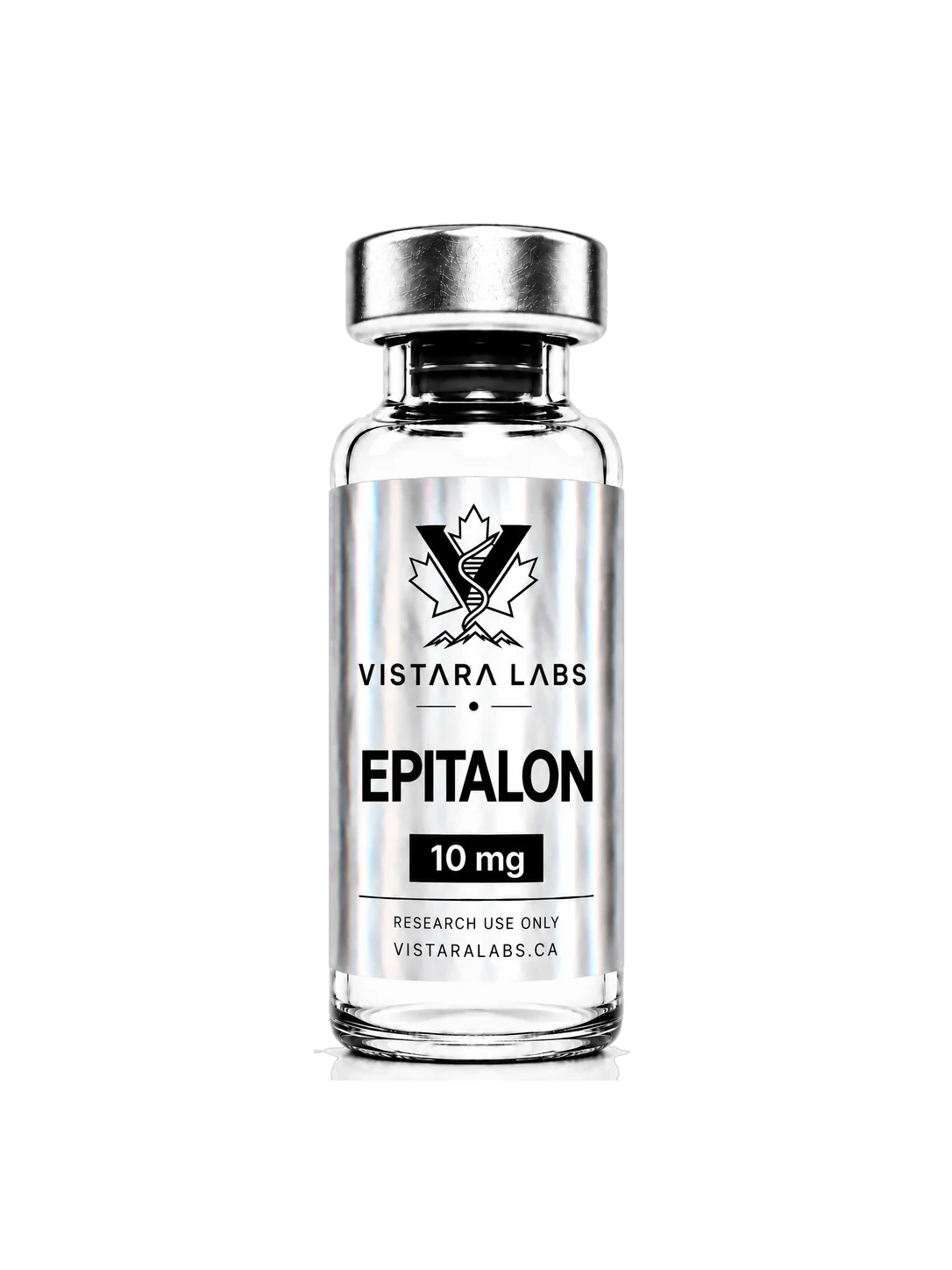
Epitalon is a synthetic four-amino-acid peptide (Ala-Glu-Asp-Gly) built from the composition of a pineal gland extract, and its evidence is strongest in cell culture, weaker in mice and thin in people. Each claim below is weighed against that pattern.
Findings
- In cultured human cells that lacked telomerase, epitalon switched on the enzyme and lengthened telomeres (Bull Exp Biol Med, 2003).
- Treated fibroblasts made 10 extra divisions past the point where control cells stopped (Bull Exp Biol Med, 2004).
- In 54 female mice per group given epitalon monthly for life, mean lifespan did not change, while maximum lifespan rose 12.3% (Biogerontology, 2003).
- The biggest gap: a 2026 narrative review found no adequately powered randomized trial and called epitalon biologically active but clinically unproven.
 View product →
Myth: epitalon lengthens your telomeres
Shown in cells, not in living people. The 2003 and 2004 results were in cell culture, from one research group. A 2025 study at an independent laboratory did replicate telomere lengthening in normal human cell lines, through higher hTERT expression and telomerase activity. That paper later carried a published correction. No study we found measured telomere length in people before and after epitalon.
Myth: epitalon extends lifespan
Partly, in mice, and not in the way the claim suggests. In the 2003 mouse study, average lifespan was unchanged. What rose was the tail of the curve: the last 10% of survivors lived 13.3% longer and maximum lifespan 12.3% longer. The same work found 17.1% fewer chromosome aberrations and six times less leukemia, with no change in overall tumour rate. A 2005 study in accelerated-ageing mice also reported longer maximum survival. No human lifespan data exist.
Myth: epitalon is proven to reverse ageing
No. The 2026 review set out what is missing: pharmacokinetic data, dose-ranging work and long-term safety are all described as inadequate, and human evidence is limited to small physiological or biomarker studies plus one older controlled study in an eye disease. Its authors list unresolved questions about cancer risk, immune response and product quality. Biologically active is not the same as proven.
Myth: the human longevity data are about epitalon
Usually not. Much of the human material cited online was gathered with epithalamin, a pineal extract. The 2026 review states that epithalamin is chemically distinct from the synthetic tetrapeptide and considers it separately, as historical context. Mixing the two makes the human evidence for epitalon look larger than it is.
Myth: epitalon fixes your sleep hormone
One primate result, not a human one. A 2001 study in senescent female macaques found epitalon raised evening melatonin and normalized the daily rhythm of cortisol. Reviews repeat that finding. It was a small study in monkeys, and we found no human study measuring melatonin after epitalon, so a sleep benefit in people remains untested.
Myth: telomerase activation is risk-free
That is the open question in this field. The 2025 study found telomere lengthening in cancer cell lines too, through a different route called alternative lengthening of telomeres. In mice, by contrast, a 2002 study reported smaller breast tumours in an accelerated-ageing strain. Findings point both ways, which is why the 2026 review lists cancer-related uncertainty as unresolved rather than settled.
What epitalon cannot promise
Epitalon has real laboratory activity and a consistent rodent story, both mostly from one group, and almost nothing in people.
- It cannot promise longer telomeres in a person; only cells have been measured.
- It cannot promise a longer life; average mouse lifespan did not move.
- It cannot promise younger skin, sleep or energy; those outcomes are untested.
- It cannot promise a known safety profile; long-term human safety data are inadequate.
Where the evidence stands
Epitalon is not an approved medicine in Canada for ageing, sleep or any other use. Its literature is largely Russian in origin, with a recent independent cell-line replication, and reviewers describe the human evidence as limited and unproven. Epitalon is supplied strictly as a laboratory research material.
Vistara Labs supplies epitalon as a laboratory research material. The page above is about the published research, not a claim about our product.
Frequently asked questions
Does epitalon really lengthen telomeres?
In human cell cultures, yes, including in a 2025 independent replication. No published study has measured telomere length in living people given epitalon.
Did epitalon make mice live longer?
Average lifespan did not change in a lifelong study of 54 mice per group. Maximum lifespan rose 12.3% and the longest-lived tenth gained 13.3%.
Is epitalon the same as epithalamin?
No. Epitalon is a synthetic four-amino-acid peptide based on the amino acid composition of epithalamin, a chemically distinct pineal extract. Human studies of one do not transfer to the other.
Sources: Khavinson VKh, Bondarev IE, Butyugov AA. Epithalon peptide induces telomerase activity and telomere elongation in human somatic cells. Bull Exp Biol Med. 2003. PMID 12937682. Khavinson VKh, Bondarev IE, Butyugov AA, et al. Peptide promotes overcoming of the division limit in human somatic cell. Bull Exp Biol Med. 2004. PMID 15455129. Anisimov VN, Khavinson VKh, Popovich IG, et al. Effect of Epitalon on biomarkers of aging, life span and spontaneous tumor incidence in female Swiss-derived SHR mice. Biogerontology. 2003. PMID 14501183. Jain A, Gallacher DM, Issa MA, et al. Epitalon and Epithalamin: A Narrative Review of Mechanistic, Preclinical, and Clinical Evidence. Int J Mol Sci. 2026. PMID 42884164. Al-Dulaimi S, Thomas R, Matta S, et al. Epitalon increases telomere length in human cell lines through telomerase upregulation or ALT activity. Biogerontology. 2025. PMID 40908429. Al-Dulaimi S, Thomas R, Matta S, et al. Correction: Epitalon increases telomere length in human cell lines through telomerase upregulation or ALT activity. Biogerontology. 2025. PMID 41240216. Anisimov VN, Popovich IG, Zabezhinskiĭ MA, et al. [Effect of epitalon and melatonin on life span and spontaneous carcinogenesis in senescence accelerated mice (SAM)]. Vopr Onkol. 2005. PMID 15909815. Khavinson V, Goncharova N, Lapin B. Synthetic tetrapeptide epitalon restores disturbed neuroendocrine regulation in senescent monkeys. Neuro Endocrinol Lett. 2001. PMID 11524632. Anisimov VN, Khavinsov VKh, Alimova IN, et al. Epithalon inhibits tumor growth and expression of HER-2/neu oncogene in breast tumors in transgenic mice characterized by accelerated aging. Bull Exp Biol Med. 2002. PMID 12428286. Araj SK, Brzezik J, Mądra-Gackowska K, et al. Overview of Epitalon-Highly Bioactive Pineal Tetrapeptide with Promising Properties. Int J Mol Sci. 2025. PMID 40141333.
All products supplied by Vistara Labs are intended for laboratory research use only. They are not drugs, are not approved for human or veterinary use, and are not intended to diagnose, treat, cure or prevent any condition. Nothing on this page constitutes medical advice or guidance for use in humans.