How Long Does AOD-9604 Last? Storage Before and After Mixing
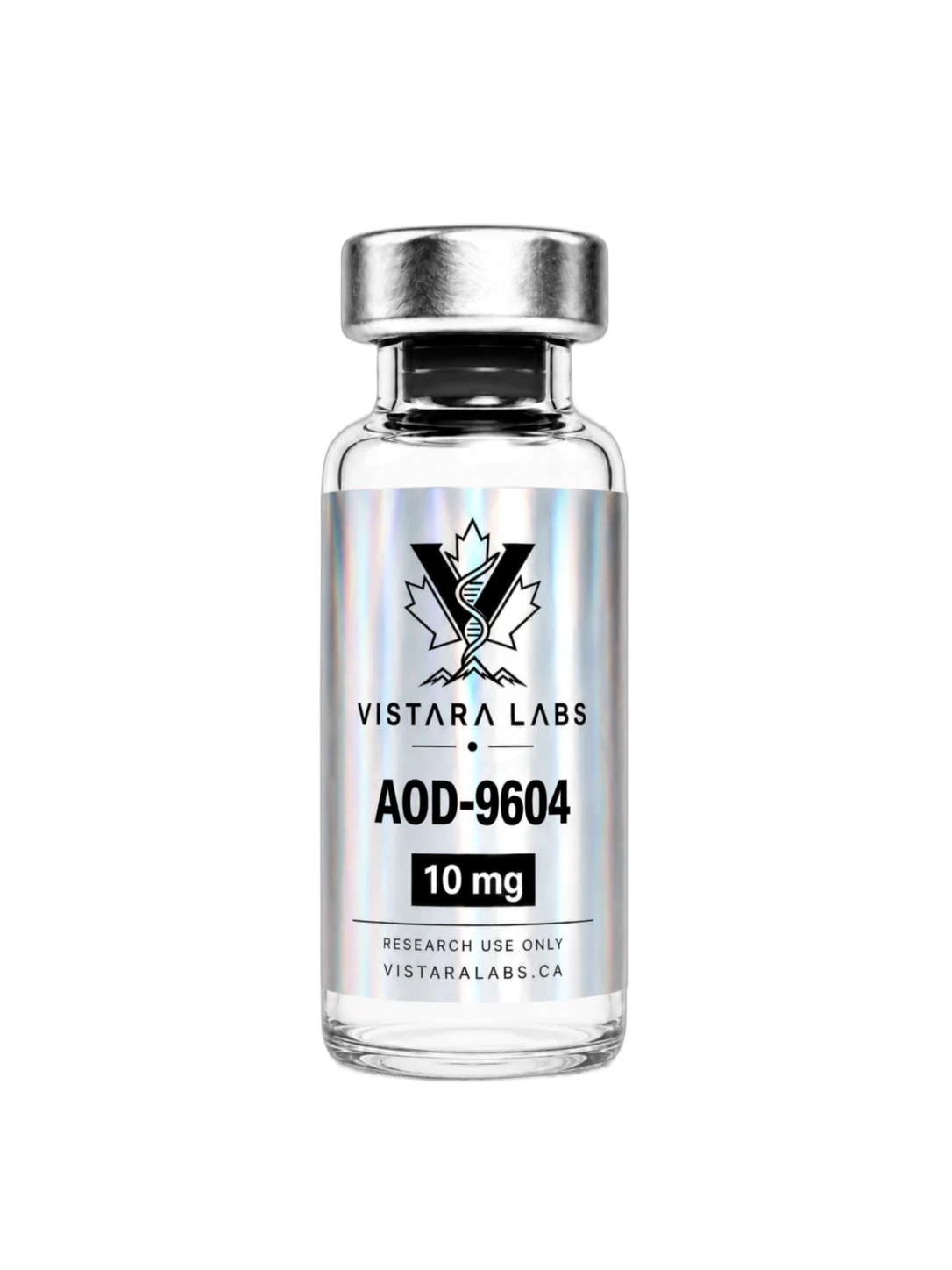
Lyophilised AOD-9604 keeps for years sealed, dry and frozen; once mixed with bacteriostatic water it lasts 8 to 12 weeks at 2 to 8 °C under Vistara Labs’ handling guidance, with quality slowly fading from around week 6 to 8. No published stability study covers AOD-9604 in solution, so that window is the general peptide guidance. Its 16 residues include two cysteines joined by a disulfide bond, which closes part of the chain into a ring, and a mixed vial is kept cold, dark and never frozen.
Findings
- AOD-9604 is the C-terminal 177 to 191 fragment of human growth hormone with an added tyrosine at the N-terminus, 16 residues in all (Cox et al., Drug Test Anal, 2015).
- One chemical supplier lists it as a cyclic (7→14) disulfide and rates the solid at at least 4 years at −20 °C.
- A second supplier’s documentation gives the powder 3 years at −20 °C and 2 years at 4 °C, and a solution 6 months at −80 °C and 1 month at −20 °C.
- In serum, the ring fragment CRSVEGSCG was significantly more stable than the parent peptide or its other breakdown products (Cox et al., 2015).
How long does AOD-9604 powder last?
Cayman Chemical supplies AOD-9604 as a solid stored at −20 °C and gives it a stability of at least 4 years. InvivoChem’s documentation for its AOD-9604 gives the powder 3 years at −20 °C and 2 years at 4 °C. Moisture is the main enemy of a freeze-dried cake: it lets the same reactions that happen in solution start in the solid. The AOD-9604 5 mg vial is kept capped and boxed, in the fridge for near-term work or the freezer for longer holds, and a cold vial is brought to room temperature before opening so that condensation does not form on the powder.
How long does AOD-9604 last after mixing?
At 2 to 8 °C, dark and accessed only through a swabbed stopper, mixed AOD-9604 lasts 8 to 12 weeks, with quality fading from around week 6 to 8. That is the general row in how long peptides last after mixing. The AOD-9604 reconstitution page has the calculator for the 5 mg vial.
What the structure says about stability
Growth hormone is a 191-residue protein. AOD-9604 takes its last fifteen residues, 177 to 191, and adds a tyrosine at the front, so it covers the same 16 positions as the fragment often sold as hGH 176 to 191. The sequence is YLRIVQCRSVEGSCGF. Its cysteines at positions 7 and 14 are joined in a disulfide bond, which Cayman’s formal name records as cyclic (7→14).
That bond shapes its storage profile. Free thiol groups and disulfide bonds can drive oxidation, a breakdown reaction called beta-elimination, and aggregation in proteins (Trivedi et al., Curr Protein Pept Sci, 2009). In AOD-9604 the two cysteines are already paired, so there is no free thiol left to oxidise, but the bond itself can still break down by the routes that review describes. The ring also seems to protect the middle of the chain: when the peptide was incubated in serum, the metabolite that stood out was CRSVEGSCG, the bridged loop, significantly more stable than the parent (Cox et al., 2015). That was enzyme work in serum, not a shelf-life test. AOD-9604 has no methionine, tryptophan or asparagine; its glutamine at position 6 can deamidate slowly. The practical result is the general window, with cold, dark storage and gentle swirling rather than shaking.
What the frozen-solution figures mean
The supplier’s 6 months at −80 °C and 1 month at −20 °C apply to a solution frozen once and kept sealed, a laboratory practice for single-use aliquots. They are not a reason to freeze a working vial that will be thawed and opened again.
How long does AOD-9604 last at room temperature?
There is no published figure for AOD-9604 in solution at room temperature, and neither supplier gives a room-temperature figure for the powder. A mixed vial is taken out of the fridge only for handling, because warmth speeds the reactions above.
Can AOD-9604 be frozen?
The powder can, and both suppliers’ longest figures are freezer figures at −20 °C. Single-use aliquots of solution can be frozen once. A working vial should not be frozen and thawed repeatedly, since freeze-thaw cycles aggregate peptides in solution.
How can you tell mixed AOD-9604 has degraded?
- Yellowing or any tint. Mixed AOD-9604 should be clear and colourless.
- Cloudiness that does not clear within 10 to 15 minutes of mixing, or that appears later. Haze that appears weeks on points to warm or bright storage.
- Particles or sediment.
- Gel or thickening that will not disperse.
Most chemical breakdown is invisible, which is why the time window applies even to a vial that still looks perfect.
Travelling with AOD-9604
Sealed powder vials are the form to travel with. A mixed vial travels upright in an insulated case with a cold pack that does not touch the glass, kept out of the light. AOD-9604 is supplied as a lyophilised vial only; there is no nasal spray.
AOD-9604 storage at a glance
| State | Where | How long |
|---|---|---|
| Powder, sealed | −20 °C, dry | 3 years to at least 4 years (supplier data sheets) |
| Powder, sealed | 4 °C, dry | 2 years (one supplier) |
| Mixed with bacteriostatic water | 2 to 8 °C, dark | 8 to 12 weeks, fading from week 6 to 8 (store guidance) |
| Solution aliquots, frozen once | −20 °C / −80 °C | 1 month / 6 months (one supplier) |
| Mixed, room temperature | Handling only | No published figure |
Certificates of analysis are on the lab reports page, and every order ships from within Canada by Canada Post Xpresspost.
Vistara Labs supplies AOD-9604 as a laboratory research material. The windows on this page describe how long the peptide stays in good condition.
Frequently asked questions
How long does AOD-9604 last in the fridge after mixing?
Under Vistara Labs’ handling guidance, 8 to 12 weeks at 2 to 8 °C in the dark, with quality fading from around week 6 to 8.
How long does AOD-9604 last at room temperature?
No published figure exists for AOD-9604 in solution at room temperature. A mixed vial is kept in the fridge and taken out only for handling.
Can you freeze AOD-9604?
Yes as powder: suppliers rate it at 3 years to at least 4 years at −20 °C. Solution can be frozen once as single-use aliquots, but a working vial should not go through repeated freeze-thaw cycles.
Does AOD-9604 go bad?
Yes. In solution its disulfide bond and glutamine change slowly, and faster when warm. Cloudiness, particles, a tint or gel mean it has degraded.
Does the disulfide bond make AOD-9604 more stable?
It closes positions 7 to 14 into a ring, and in one serum study that ring fragment outlasted the parent peptide. It does not extend the 8 to 12 week window for a mixed vial, so storage stays cold and dark.
Handling windows: Vistara Labs, October 2026. Sources: Cox HD, Smeal SJ, Hughes CM, Cox JE, Eichner D. Detection and in vitro metabolism of AOD9604. Drug Test Anal. 2015. PMID 25208511. Trivedi MV, Laurence JS, Siahaan TJ. The role of thiols and disulfides on protein stability. Curr Protein Pept Sci. 2009. PMID 19538140. Cayman Chemical. AOD-9604 (acetate), item 36790, product information: formal name, storage and stability. PDF. InvivoChem. AOD9604 acetate, V11415, batch documentation: storage conditions for powder and solution. PDF.
More on this: How Long Do Peptides Last After Mixing?
All products supplied by Vistara Labs are intended for laboratory research use only. They are not drugs, are not approved for human or veterinary use, and are not intended to diagnose, treat, cure or prevent any condition. Nothing on this page constitutes medical advice or guidance for use in humans.