How Long Does 5-Amino-1MQ Last? Storage Before and After Mixing
Sealed 5-Amino-1MQ powder keeps for long periods dry and cold, at 4 °C or −20 °C on supplier data sheets; once mixed with bacteriostatic water it lasts 8 to 12 weeks at 2 to 8 °C under Vistara Labs’ handling guidance, with quality slowly fading from around week 6 to 8. No published stability study covers 5-Amino-1MQ in solution, and no supplier sheet we checked puts a number of years on the powder, so the after-mixing window is the general guidance. 5-Amino-1MQ is a small quinolinium molecule, not a peptide, so the usual peptide failure modes do not apply; moisture, warmth and light are what matter, and a mixed vial is never frozen.
Findings
- 5-Amino-1MQ is a small molecule, not a peptide: the 5-amino-1-methylquinolinium cation, C10H11N2+, molecular weight 159.21 (PubChem).
- Chemical suppliers sell it as the iodide salt, C10H11IN2, molecular weight 286.11 (PubChem; MedChemExpress).
- One supplier’s data sheet stores the powder at 4 °C, sealed away from moisture, and gives solutions 1 year at −20 °C and 2 years at −80 °C.
- A second supplier lists it as a faint red to dark brown powder stored at −20 °C, at 98% or more by HPLC.
- N-methylated quinoliniums were identified as a promising scaffold for nicotinamide N-methyltransferase inhibitors (Neelakantan et al., J Med Chem, 2017).
How long does 5-Amino-1MQ powder last?
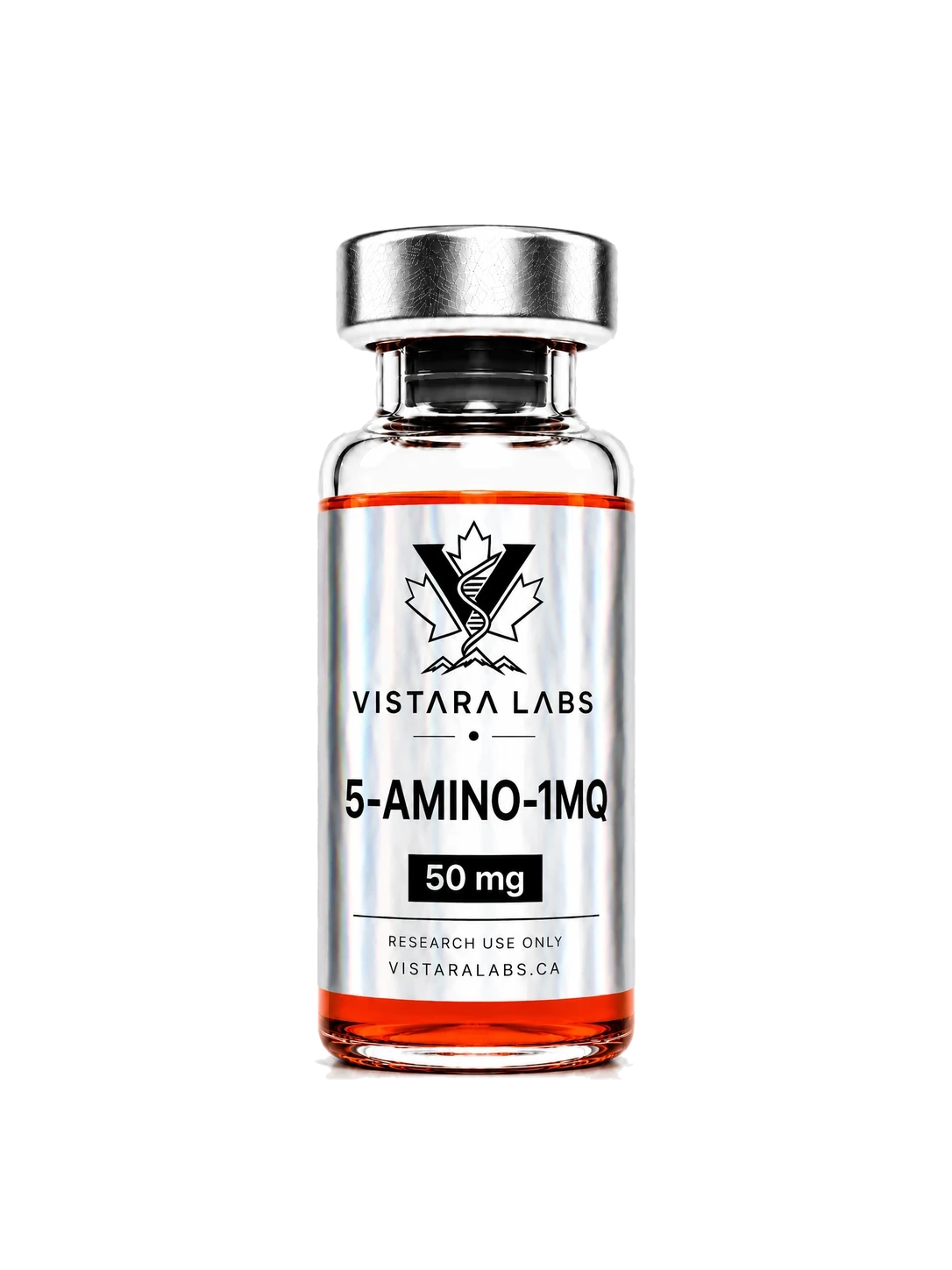
The two supplier sheets agree on dry, sealed, cold storage but not on the temperature. MedChemExpress stores its iodide powder at 4 °C, sealed and away from moisture; Sigma-Aldrich lists −20 °C. Neither sheet gives a number of years for the powder. For long holds the colder figure is the conservative one. Moisture is the main enemy of any dry powder, so the 5-Amino-1MQ 50 mg vial is kept capped, boxed, cold and dark, in the fridge for near-term work or the freezer for longer holds, and a cold vial is brought to room temperature before opening so that condensation does not form on the powder.
How long does 5-Amino-1MQ last after mixing?
At 2 to 8 °C, dark and accessed only through a swabbed stopper, mixed 5-Amino-1MQ lasts 8 to 12 weeks, with quality fading from around week 6 to 8. That is the general row in how long peptides last after mixing, applied here because no compound-specific figure exists. The 5-Amino-1MQ reconstitution page has the calculator for the 50 mg vial, and it notes that the vial should be labelled with the date and the concentration.
What the structure says about stability
5-Amino-1MQ is a single fused ring system, a quinoline, with an amino group on one ring and a methyl group on the ring nitrogen. That methyl makes it a quinolinium, which carries a permanent positive charge, so it is supplied as a salt; chemical suppliers sell the iodide. Its cation weighs about 159 Da, a small fraction of even a short peptide.
That changes the storage picture. Peptides and proteins change in solution mainly through oxidation of particular residues, deamidation, cleavage of the chain and aggregation (Manning et al., Pharm Res, 2010). 5-Amino-1MQ has no amino-acid chain, no peptide bonds and no residues to deamidate, and as a single small ion it has nothing to unfold or tangle into a gel. What remains are the general enemies of any dissolved research chemical: warmth, light and moisture. Both supplier sheets call for sealed storage away from moisture, and the product page asks for the vial to be kept cold, dry and away from light. It is also coloured: the supplier describes the powder as faint red to dark brown, and the reconstitution page describes a correctly mixed solution as clear and red. So, unlike most peptides, colour on its own is normal.
What the frozen-solution figures mean
The supplier’s 1 year at −20 °C and 2 years at −80 °C apply to stock solutions frozen once and kept sealed, a laboratory practice for single-use aliquots. They are not a reason to freeze a working vial that will be thawed and opened again.
How long does 5-Amino-1MQ last at room temperature?
There is no published figure for 5-Amino-1MQ in solution at room temperature. A mixed vial is taken out of the fridge only for handling. The reconstitution page notes that cloudiness appearing after storage can mean the solution has been kept too warm or exposed to light.
Can 5-Amino-1MQ be frozen?
The powder can, and one supplier lists −20 °C as its storage temperature. Single-use aliquots of solution can be frozen once, and the supplier’s solution figures are freezer figures. A working vial should not be frozen and thawed repeatedly, and the store guidance is that a mixed vial is never refrozen.
How can you tell mixed 5-Amino-1MQ has degraded?
- A change of colour. Mixed 5-Amino-1MQ should be clear and red. Darkening, or a shift away from the colour it had when first mixed, is a reason to discard it.
- Cloudiness that does not clear after standing, or that appears later.
- Particles or sediment that will not dissolve after standing.
Chemical change can be invisible, which is why the time window applies even to a vial that still looks perfect.
Travelling with 5-Amino-1MQ
Sealed powder vials are the form to travel with. A mixed vial travels upright in an insulated case with a cold pack that does not touch the glass, kept out of the light. 5-Amino-1MQ is supplied as a 50 mg vial only; there is no nasal spray.
5-Amino-1MQ storage at a glance
| State | Where | How long |
|---|---|---|
| Powder, sealed | −20 °C, dry | Long-term storage temperature on one supplier sheet; no number of years given |
| Powder, sealed | 2 to 8 °C, dry | 4 °C storage on a second supplier sheet; no number of years given |
| Mixed with bacteriostatic water | 2 to 8 °C, dark | 8 to 12 weeks, fading from week 6 to 8 (store guidance) |
| Solution aliquots, frozen once | −20 °C / −80 °C | 1 year / 2 years (supplier data sheet) |
| Mixed, room temperature | Handling only | No published figure |
Certificates of analysis are on the lab reports page, and every order ships from within Canada by Canada Post Xpresspost.
Vistara Labs supplies 5-Amino-1MQ as a laboratory research material. The windows on this page describe how long the compound stays in good condition.
Frequently asked questions
How long does 5-Amino-1MQ last in the fridge after mixing?
Under Vistara Labs’ handling guidance, 8 to 12 weeks at 2 to 8 °C in the dark, with quality fading from around week 6 to 8.
How long does 5-Amino-1MQ last at room temperature?
No published figure exists for 5-Amino-1MQ in solution at room temperature. A mixed vial is kept in the fridge and taken out only for handling.
Can you freeze 5-Amino-1MQ?
Yes as powder: one supplier stores it at −20 °C. Solution can be frozen once as single-use aliquots, which one supplier rates at 1 year at −20 °C, but a working vial should not go through repeated freeze-thaw cycles.
Does 5-Amino-1MQ go bad?
Yes, slowly, though not in the ways peptides do. Warmth, light and moisture are its main risks. Darkening, cloudiness or particles that will not dissolve mean it should be discarded.
Is 5-Amino-1MQ a peptide?
No. It is a small methylquinolinium molecule of about 159 Da with no amino-acid chain. It is still stored like a peptide, sealed, cold, dry and dark, because those conditions protect any dissolved research compound.
Handling windows: Vistara Labs, October 2026. Sources: Neelakantan H et al. Structure-Activity Relationship for Small Molecule Inhibitors of Nicotinamide N-Methyltransferase. J Med Chem. 2017. PMID 28548833. Manning MC et al. Stability of protein pharmaceuticals: an update. Pharm Res. 2010. PMID 20143256. National Center for Biotechnology Information. PubChem Compound Summary for CID 950107, 1-methylquinolin-1-ium-5-amine, and CID 66522933, its iodide. PubChem. MedChemExpress. NNMTi (5-amino-1-methylquinolinium iodide), HY-131042, product data sheet: formula, solubility and storage. PDF. Sigma-Aldrich. 5-Amino-1-methylquinolinium iodide, SML2832, product specification: form, colour, assay and storage temperature, as listed by its distributor Yorlab. Product listing.
More on this: How Long Do Peptides Last After Mixing?
All products supplied by Vistara Labs are intended for laboratory research use only. They are not drugs, are not approved for human or veterinary use, and are not intended to diagnose, treat, cure or prevent any condition. Nothing on this page constitutes medical advice or guidance for use in humans.