Oxytocin Nasal Spray vs Injection: How They Differ
An oxytocin nasal spray and an oxytocin injection deliver the same nine-amino-acid peptide; what differs is the route. Injected oxytocin goes straight into the blood, where its half-life is about 1 to 6 minutes, while nasal oxytocin reaches the blood poorly (0.7% bioavailability in one 2025 study) but has human and primate evidence of reaching the cerebrospinal fluid and specific brain regions. That is why obstetric medicine uses injection and brain and behaviour research mostly uses the nose. We supply both a ready-mixed oxytocin nasal spray and lyophilised oxytocin vials; here is what the research shows about each route.
Findings
- Injected oxytocin acts fast and clears fast. The approved injection is given by intravenous infusion or intramuscular injection, with a plasma half-life of about 1 to 6 minutes (US prescribing information).
- In 24 healthy adults measured by mass spectrometry, nasal oxytocin had a bioavailability of 0.7% against intravenous oxytocin, with large person-to-person variation (Shafer et al., Br J Anaesth, 2025).
- After intranasal oxytocin in humans, oxytocin in the cerebrospinal fluid rose significantly by 75 minutes, while plasma levels peaked at 15 minutes, and the two did not correlate (Striepens et al., Sci Rep, 2013).
- In 17 men, nasal and intravenous oxytocin both lowered amygdala blood flow in step with blood levels, but the nasal routes also changed blood flow in brain regions the intravenous route did not (Martins et al., Nat Commun, 2020).
- Labelled oxytocin given into the nose of rhesus macaques was found in the orbitofrontal cortex, striatum, brainstem and thalamus, along the paths of the olfactory and trigeminal nerves; given intravenously, it was not (Lee et al., Nat Commun, 2020).
What is oxytocin?
Oxytocin is a nonapeptide, a chain of nine amino acids, first found in extracts of the mammalian pituitary (US prescribing information). As a medicine it is an injection used before and after delivery, to start or strengthen labour contractions and in the period after birth. As a research compound it is studied for social cognition, bonding, stress and sexual function, almost always by the nasal route. The human research on that route is summarised in Oxytocin Nasal Spray: What the Human Research Shows.
How does injected oxytocin behave?
The approved injection is a sterile solution for intravenous infusion or intramuscular injection. Its plasma half-life is about 1 to 6 minutes, shorter in late pregnancy and during lactation, and after an intramuscular injection the uterus responds within 3 to 5 minutes and the response lasts 2 to 3 hours (US prescribing information). Given intravenously, oxytocin’s blood levels follow a predictable two-compartment model with low error (Shafer et al., Br J Anaesth, 2025).
The route matters for the brain because oxytocin is a peptide, and getting from blood into the brain means crossing the blood-brain barrier. In rhesus macaques given deuterium-labelled oxytocin, which can be told apart from the animal’s own, both intravenous and nasal administration put labelled oxytocin into the cerebrospinal fluid, and neither route triggered release of the animal’s own oxytocin; the nasal route did not reach higher fluid levels than the intravenous one (Lee et al., Mol Psychiatry, 2018).
How does nasal oxytocin behave?
A nasal spray deposits oxytocin on the lining of the nose. Some is absorbed into the blood and some can travel along the olfactory and trigeminal nerves, which run from the nose into the brain. The first human study to sample both fluids after intranasal oxytocin found plasma levels peaked at 15 minutes and fell after 75 minutes, while cerebrospinal fluid levels took up to 75 minutes to rise significantly, with no correlation between the two (Striepens et al., Sci Rep, 2013). That gap suggests the fluid rise was not just spillover from the blood.
In 2020, labelled oxytocin given into the nose of macaques was measured two hours later in brain regions along the olfactory and trigeminal nerve paths, including the striatum, where oxytocin affects motivated behaviour; the same labelled oxytocin given intravenously was not found there (Lee et al., Nat Commun, 2020). In implanted macaques, nasal oxytocin raised cerebrospinal fluid levels at the highest dose 15 to 30 minutes after administration without a measurable change in plasma (Freeman et al., Psychoneuroendocrinology, 2016).
The trade-off is the blood. In 2025, a mass-spectrometry study put nasal bioavailability at 0.7%, with large differences between people, which the authors suggested could partly explain inconsistent results across nasal oxytocin studies (Shafer et al., Br J Anaesth, 2025).
Does the route change what oxytocin does in the brain?
The clearest human answer comes from a double-blind, placebo-controlled, crossover study in 17 healthy men. Each received oxytocin by standard nasal spray, by nebuliser into the nose, and by slow intravenous infusion, and brain blood flow was imaged for two hours. The drop in amygdala blood flow was explained by oxytocin rising in the blood, whichever route was used. But the two nasal methods produced different regional patterns from each other and from the infusion, even though the nasal methods gave identical blood levels, which the authors took as robust evidence that the nasal route reaches specific brain regions directly (Martins et al., Nat Commun, 2020).
A later dose-response study from the same group found that intranasal oxytocin’s effects on amygdala blood flow were largest at the lower of three doses tested, a “less is more” pattern (Martins et al., Prog Neurobiol, 2022). More nasal oxytocin is not simply a stronger signal.
How do nasal spray and injection compare side by side?
| Question | Nasal spray | Injection |
|---|---|---|
| What is delivered? | Oxytocin, nine amino acids | Oxytocin, nine amino acids |
| Where it goes first | Nasal lining; olfactory and trigeminal nerve paths | Bloodstream (intravenous) or muscle (intramuscular) |
| Blood levels | Low and variable; 0.7% bioavailability in one study | Complete for intravenous; half-life about 1 to 6 minutes |
| Brain evidence | Fluid rise in humans; direct regional delivery in macaques | Reaches spinal fluid in macaques; brain effects follow blood levels |
| Main human research use | Social cognition, behaviour, brain imaging | Labour and delivery; pharmacokinetic studies |
| Forms we supply | Ready-mixed spray: 2 mg, 4 mg and 10 mg bottles | Lyophilised vials: 2 mg and 10 mg |
Which route fits which research question?
- Central effects, behaviour and brain imaging: the nasal route, which has evidence of direct nose-to-brain delivery and makes up most of the human behavioural literature.
- Systemic and peripheral effects, or precise blood levels: injection, whose blood levels follow a well-described model.
- Separating central from peripheral effects: both, as in the 2020 imaging study, which used intravenous oxytocin to show which brain changes simply follow blood levels.
How are the spray and the vials supplied?
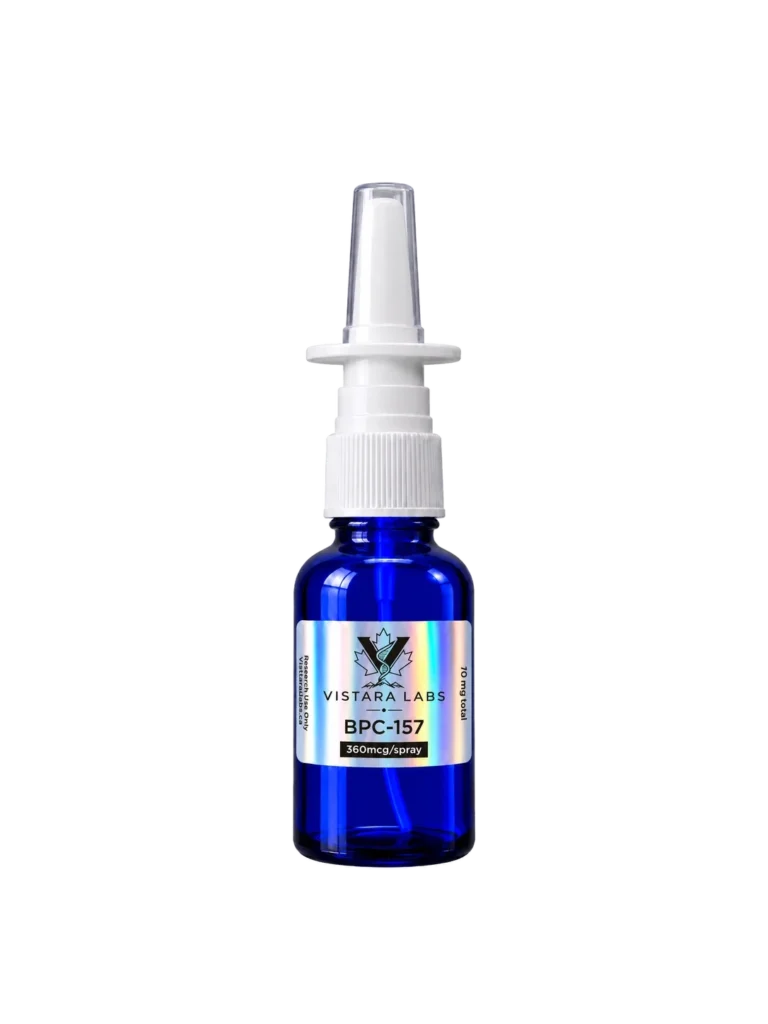
The Oxytocin Nasal Spray comes ready-mixed in a metered nasal pump that delivers 0.175 mL per press, in 2 mg, 4 mg and 10 mg bottles; the count per bottle is worked through in how many sprays in a peptide nasal spray, and storage in how to store a peptide nasal spray. The lyophilised vials (2 mg and 10 mg) are reconstituted with bacteriostatic water, covered in the oxytocin reconstitution guide and how long oxytocin lasts. The spray also appears in the Libido Spray Stack. Buying details for the spray are in Buy Oxytocin Nasal Spray in Canada, certificates of analysis are on the lab reports page, and every order ships from within Canada by Canada Post Xpresspost.
Oxytocin is supplied for laboratory research use only. The studies above were clinical and animal research using pharmaceutical or labelled preparations.
Frequently asked questions
Is oxytocin nasal spray as effective as an injection?
They do different jobs. Injection delivers oxytocin fully into the blood and is the approved route in labour. The nasal route delivers little to the blood (0.7% bioavailability in a 2025 study) but has evidence of reaching the cerebrospinal fluid and specific brain regions, which is why most human behaviour and brain research uses it.
Does nasal oxytocin reach the brain?
The evidence says some does. In humans, intranasal oxytocin raised cerebrospinal fluid levels within 75 minutes, and in macaques labelled nasal oxytocin was found in brain regions along the olfactory and trigeminal nerves, where intravenous oxytocin was not.
How long does oxytocin last in the body?
Its plasma half-life is about 1 to 6 minutes. After an intramuscular injection, the uterine response begins within 3 to 5 minutes and lasts 2 to 3 hours. After a nasal dose, plasma levels peaked at 15 minutes in one human study, while cerebrospinal fluid levels were still rising at 75 minutes.
What is the difference between the oxytocin spray and the oxytocin vial?
The spray is ready-mixed in a metered pump delivering 0.175 mL per press, for intranasal research. The vial is lyophilised powder that is reconstituted with bacteriostatic water, for research designs that need a solution.
Where can I buy oxytocin nasal spray in Canada?
Vistara Labs supplies a ready-mixed oxytocin nasal spray in 2 mg, 4 mg and 10 mg bottles and lyophilised oxytocin vials in 2 mg and 10 mg, with certificates of analysis on the lab reports page, shipped from within Canada by Canada Post Xpresspost.
Product details from vistaralabs.ca, October 2026. Sources: US prescribing information for oxytocin injection, USP (label revised 2026). Shafer SL et al. Plasma pharmacokinetics of intravenous and intranasal oxytocin in nonpregnant adults. Br J Anaesth. 2025. PMID 40121179. Striepens N et al. Elevated cerebrospinal fluid and blood concentrations of oxytocin following its intranasal administration in humans. Sci Rep. 2013. PMID 24310737. Lee MR et al. Oxytocin by intranasal and intravenous routes reaches the cerebrospinal fluid in rhesus macaques: determination using a novel oxytocin assay. Mol Psychiatry. 2018. PMID 28289281. Lee MR et al. Labeled oxytocin administered via the intranasal route reaches the brain in rhesus macaques. Nat Commun. 2020. PMID 32494001. Freeman SM et al. Plasma and CSF oxytocin levels after intranasal and intravenous oxytocin in awake macaques. Psychoneuroendocrinology. 2016. PMID 26826355. Martins DA et al. Effects of route of administration on oxytocin-induced changes in regional cerebral blood flow in humans. Nat Commun. 2020. PMID 32127545. Martins D et al. “Less is more”: a dose-response account of intranasal oxytocin pharmacodynamics in the human brain. Prog Neurobiol. 2022. PMID 35122880.
More on this: Oxytocin Nasal Spray: What the Human Research Shows, Buy Oxytocin Nasal Spray in Canada and Semax and Selank: Intranasal vs Subcutaneous Research Routes.
All products supplied by Vistara Labs are intended for laboratory research use only. They are not drugs, are not approved for human or veterinary use, and are not intended to diagnose, treat, cure or prevent any condition. Nothing on this page constitutes medical advice or guidance for use in humans.