Snap-8 research: what the skin studies show
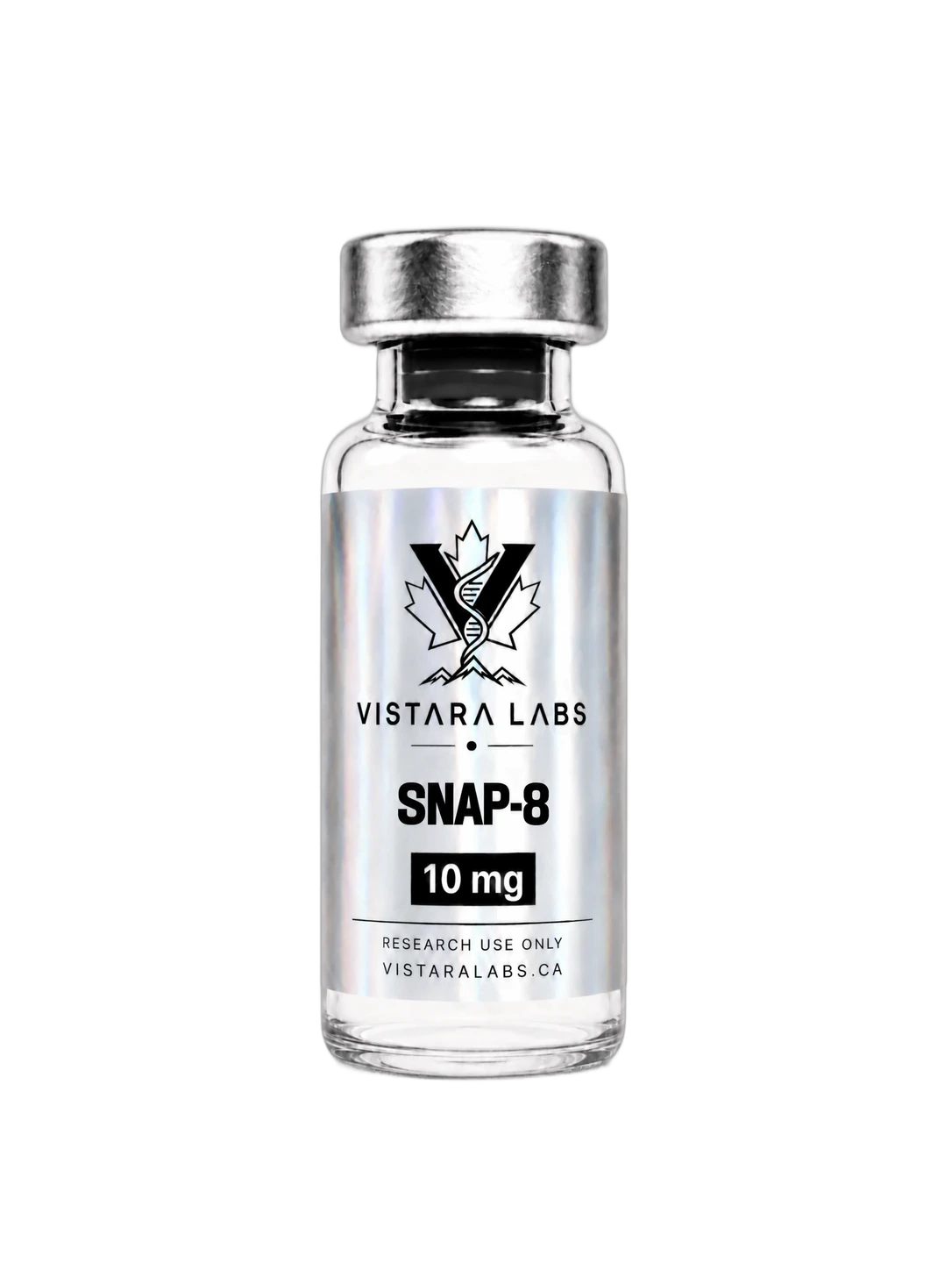
Snap-8 (acetyl octapeptide-3, also listed as acetyl octapeptide-1) is an eight-amino-acid cosmetic research peptide, the longer relative of argireline, studied for how it interferes with the SNARE complex that drives expression lines. Here is what the research found.
Findings
- In the manufacturer’s volunteer panel, Snap-8 produced a mean 35% reduction in wrinkle depth, with a maximum of 62%, as summarised in a 2020 peer-reviewed review. This is Snap-8 data, but it is industry data, not an independent trial.
- For the parent peptide argireline, a randomised, placebo-controlled trial of 60 subjects reported total anti-wrinkle efficacy of 48.9% versus 0% for placebo after four weeks on peri-orbital lines.
- In the first argireline volunteer study, a 10% emulsion reduced wrinkle depth by up to 30% in 30 days, measured by skin topography.
- In the laboratory, Snap-8 at 1.5 mM inhibited neurotransmitter release by 43%, and combining it with a second SNARE-targeting peptide raised inhibition from 38% to 47%.
- A 24-volunteer randomised study of argireline over 60 days confirmed its anti-wrinkle activity and recorded a significant fall in transepidermal water loss.
 View product →
Expression lines: Snap-8’s own volunteer panel (Front Chem, 2020)
No independent clinical trial of Snap-8 on its own has been published in PubMed. What exists is the developer’s dossier, summarised in the 2020 peer-reviewed review by Errante and colleagues in Frontiers in Chemistry. They describe Snap-8 as a mimic of the SNAP-25 protein that acts as a competitive inhibitor of SNARE complex formation, the machinery a nerve ending uses to release the signal that contracts a facial muscle. In the laboratory assay, 1.5 mM Snap-8 cut neurotransmitter release by 43%. The manufacturer’s volunteer panel reported a mean wrinkle-depth reduction of 35% and a maximum of 62%. The review also records a pairing experiment: Snap-8 alone inhibited release by 38%, the peptide Leuphasyl alone by 7%, and the two together at 0.75 mM each by 47%, read by the authors as additive.
Peri-orbital wrinkles: argireline randomised trial (Am J Clin Dermatol, 2013)
Snap-8 is argireline with two extra residues on the same SNAP-25 template, so the parent molecule’s human trials are the closest controlled evidence. Wang and colleagues randomised 60 Chinese subjects 3:1 to argireline or placebo, applied twice daily to peri-orbital wrinkles for four weeks. Subjective grading gave a total anti-wrinkle efficacy of 48.9% in the argireline group against 0% for placebo. Silicone replicas of the skin, analysed by a wrinkle-measurement apparatus, showed roughness parameters falling significantly in the argireline group (p < 0.01) with no measurable change in the placebo group. The authors concluded argireline had a significant anti-wrinkle effect.
Wrinkle depth: the first argireline volunteer study (Int J Cosmet Sci, 2002)
Blanes-Mira and colleagues introduced the hexapeptide in 2002. In the laboratory it inhibited neurotransmitter release with a potency similar to botulinum neurotoxin A but much lower efficacy, which the authors attributed to interference with SNARE complex formation or stability. In healthy women volunteers, an oil-in-water emulsion containing 10% of the peptide reduced wrinkle depth by up to 30% after 30 days, measured by skin topography.
Skin texture and water loss: argireline controlled study (J Cosmet Dermatol, 2017)
Raikou and colleagues ran a prospective randomised study in 24 healthy volunteers over 60 days, in four groups (acetyl hexapeptide-3, which is argireline, alone; tripeptide-10 citrulline alone; both; or neither). Skin microtopography and transepidermal water loss were measured at days 20, 40 and 60. The authors confirmed the anti-wrinkle activity of argireline and recorded a significant decrease in transepidermal water loss with it. A 2025 review in the International Journal of Molecular Sciences agrees the in vivo studies indicate anti-wrinkle action, adding that delivery through the skin barrier remains the main open formulation question.
What Snap-8 is
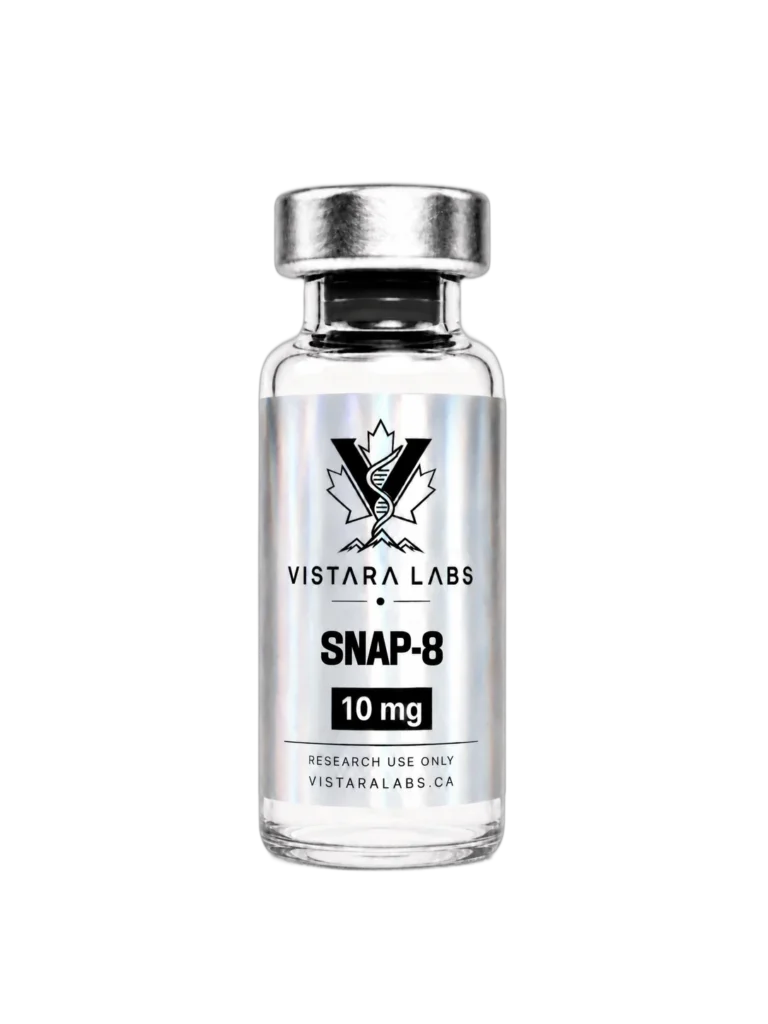
Snap-8 is a synthetic octapeptide built from the N-terminal sequence of SNAP-25, one of the three proteins that form the SNARE complex. Argireline covers six residues of that sequence; Snap-8 extends it to eight, which is the basis for the manufacturer’s claim of stronger SNARE competition. It is studied as a cosmetic research peptide for expression lines, not as a medicine. It is supplied as a lyophilised powder; the Snap-8 reconstitution page covers laboratory handling with bacteriostatic water.
Vistara Labs stocks Snap-8 research vials, shipped from within Canada to every province.
Frequently asked questions
What has human research shown for Snap-8?
The only human data on Snap-8 itself comes from the manufacturer’s volunteer panel, which reported a mean 35% reduction in wrinkle depth and a maximum of 62%, as summarised in a 2020 peer-reviewed review. No independent clinical trial of Snap-8 alone has been published.
How does Snap-8 differ from argireline in the research?
Both are built on the N-terminal sequence of SNAP-25 and both are studied as SNARE complex inhibitors. Argireline is six amino acids and has randomised, placebo-controlled human trials behind it; Snap-8 adds two residues and, in the manufacturer’s laboratory assay, inhibited neurotransmitter release by 43% at 1.5 mM.
What is Snap-8?
Snap-8 (acetyl octapeptide-3) is a synthetic eight-amino-acid cosmetic research peptide that mimics part of the SNAP-25 protein and is studied for competitive inhibition of SNARE complex formation in the skin.
Sources: Errante F, et al. Cosmeceutical peptides in the framework of sustainable wellness economy. Front Chem. 2020;8:572923. PMID 33195061. Wang Y, et al. The anti-wrinkle efficacy of argireline, a synthetic hexapeptide, in Chinese subjects: a randomized, placebo-controlled study. Am J Clin Dermatol. 2013;14(2):147-153. PMID 23417317. Blanes-Mira C, et al. A synthetic hexapeptide (Argireline) with antiwrinkle activity. Int J Cosmet Sci. 2002;24(5):303-310. PMID 18498523. Raikou V, et al. The efficacy study of the combination of tripeptide-10-citrulline and acetyl hexapeptide-3: a prospective, randomized controlled study. J Cosmet Dermatol. 2017;16(2):271-278. PMID 28150423. Zdrada-Nowak J, et al. Acetyl hexapeptide-8 in cosmeceuticals: a review of skin permeability and efficacy. Int J Mol Sci. 2025;26(12):5722. PMID 40565185.
All products supplied by Vistara Labs are intended for laboratory research use only. They are not drugs, are not approved for human or veterinary use, and are not intended to diagnose, treat, cure or prevent any condition. Nothing on this page constitutes medical advice or guidance for use in humans.