What Is Reta Peptide? Reta, GLP-3 and Retatrutide Explained
Weight Loss & Metabolism Research
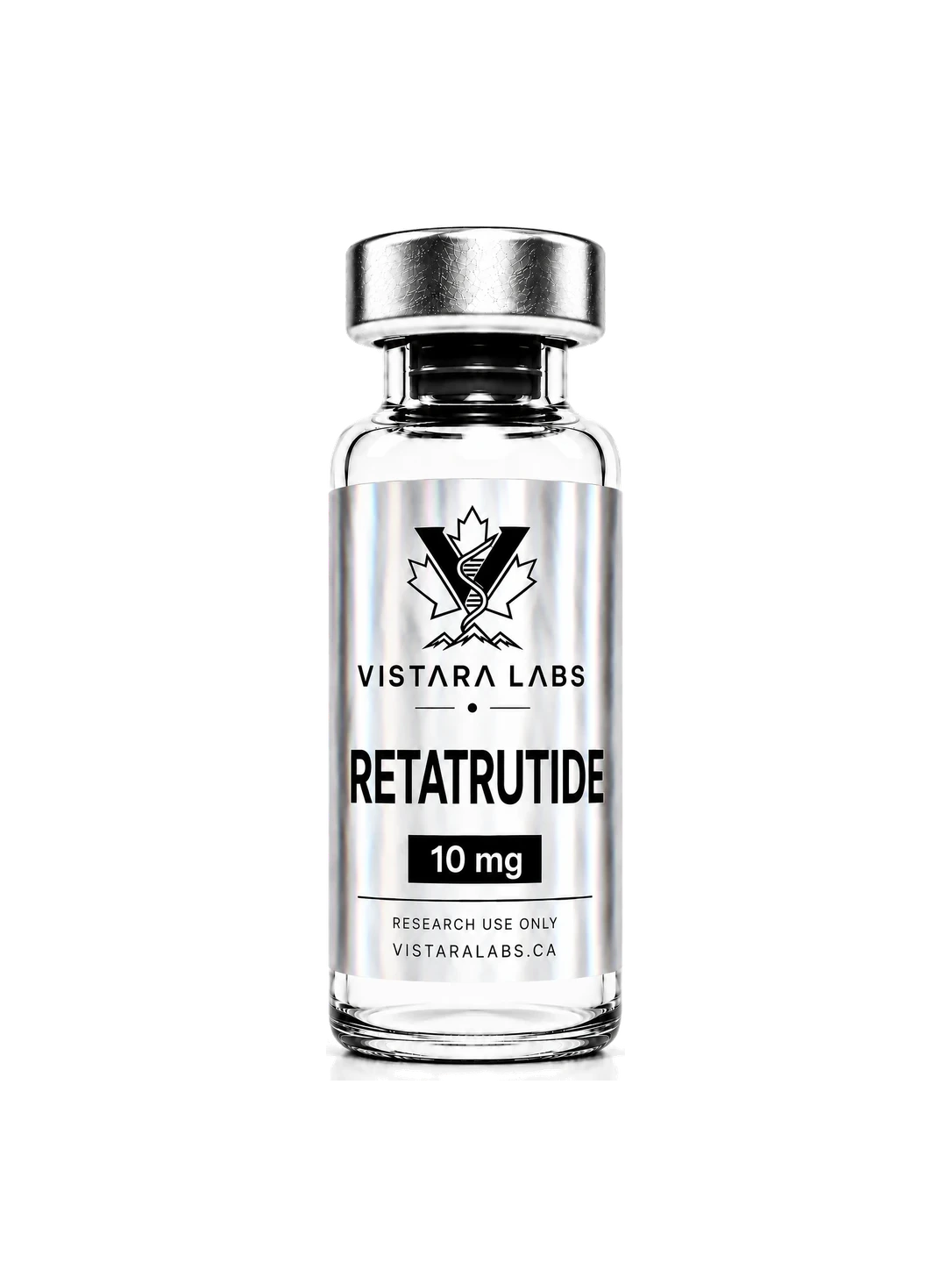
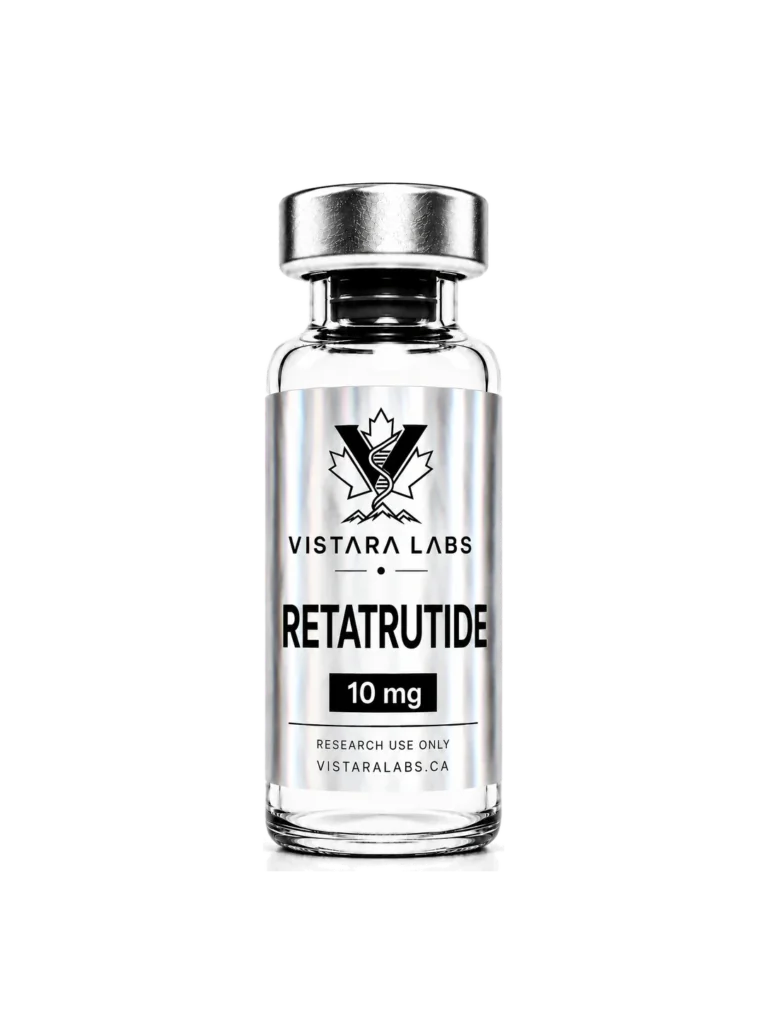
Retatrutide, known across research forums as reta peptide, reta or GLP-3, is a single synthetic peptide that activates three hormone receptors at once: GIP, GLP-1 and glucagon. In a 48-week phase 2 obesity trial published in the New England Journal of Medicine in 2023, the highest-dose group lost a mean 24.2% of body weight, and a phase 3 trial published in 2026 recorded a mean loss of 25.0% over 80 weeks. Vistara Labs supplies reta (GLP-3) as a lyophilised research vial. This guide explains the nicknames, the triple-receptor mechanism and what the published trials recorded.
Findings
- Reta is one peptide with agonist activity at the GIP, GLP-1 and glucagon receptors; in obese mice, glucagon-driven energy expenditure added to the appetite effects of GIP and GLP-1 (Coskun, Cell Metabolism, 2022).
- In the 2023 phase 2 obesity trial of 338 adults, body weight fell 24.2% at 48 weeks in the top-dose group versus 2.1% with placebo, and 83% of that group lost 15% or more (Jastreboff, NEJM, 2023).
- In a liver substudy of 98 participants, 86% of the top-dose group reached normal liver fat within 24 weeks, against 0% on placebo (Sanyal, Nature Medicine, 2024).
- A phase 3 trial of 2,339 adults recorded mean weight change of minus 25.0% at 80 weeks versus minus 3.9% with placebo, plus less knee pain and fewer sleep apnoea events (Jastreboff, NEJM, 2026).
 View product →
Why is retatrutide called reta, GLP-3 or RT?
The names are community shorthand, not official terms. Reta is simply the first syllable of the generic name, and retta is a common misspelling of it in search and on forums. RT is the two-letter code that appears in forum threads and order lists.
GLP-3 needs more explanation, because there is no hormone called GLP-3. The body makes GLP-1 and GLP-2, both cut from the proglucagon precursor. “GLP-3” is an informal label that places reta as the next step after single-receptor GLP-1 compounds and dual-receptor compounds: it is the third receptor (glucagon) that the nickname is pointing at. Our guide to GLP-1, GLP-2 and “GLP-3” sets out the full family.
How does reta work?
Reta is a single peptide chain engineered to activate three receptors that normally respond to three different gut and pancreatic hormones. In laboratory assays it showed balanced glucagon and GLP-1 receptor activity with stronger GIP receptor activity (Coskun, Cell Metabolism, 2022).
- GLP-1 receptor. The target of the first incretin drugs. Activation increases glucose-dependent insulin release and reduces food intake.
- GIP receptor. The second incretin receptor, also involved in glucose-dependent insulin secretion.
- Glucagon receptor. The addition that sets reta apart. In obese mice, glucagon receptor activity increased energy expenditure, and that added to the reduced calorie intake driven by the two incretin receptors (Coskun, 2022).
The same 2022 paper reported a first-in-human single-dose study in which the drop in body weight persisted up to day 43, and a pharmacokinetic profile that supported once-weekly administration in later trials. A 12-week phase 1b study in adults with type 2 diabetes followed (Urva, Lancet, 2022).
Single, dual and triple agonists
Reta is usually discussed alongside two earlier compounds. Semaglutide (sold as Ozempic and Wegovy) acts on one receptor; tirzepatide acts on two; reta adds a third.
| Compound | Receptors activated | Class |
|---|---|---|
| Semaglutide | GLP-1 | Single agonist |
| Tirzepatide | GIP and GLP-1 | Dual agonist |
| Retatrutide (reta) | GIP, GLP-1 and glucagon | Triple agonist |
Side-by-side detail is in Retatrutide vs Semaglutide and Retatrutide vs Tirzepatide.
What have the reta trials shown?
Phase 2 obesity trial (NEJM, 2023)
This double-blind, placebo-controlled trial enrolled 338 adults with a BMI of 30 or higher, or 27 or higher with at least one weight-related condition; 51.8% were men. Participants received once-weekly reta or placebo for 48 weeks. At 24 weeks, mean weight change was minus 17.5% in the top-dose group versus minus 1.6% with placebo. By 48 weeks it reached minus 24.2% versus minus 2.1%. In the top-dose group, 100% of participants lost at least 5% of body weight, 93% at least 10% and 83% at least 15% (Jastreboff, NEJM, 2023).
Phase 2 type 2 diabetes trial (Lancet, 2023)
Run across 42 centres in the USA, this trial randomised 281 adults with type 2 diabetes to reta, placebo or an established GLP-1 receptor agonist. At 24 weeks, HbA1c fell by 2.02 percentage points in the top-dose group versus 0.01 with placebo, a larger reduction than the active comparator. Body weight fell 16.94% at 36 weeks in that group, versus 3.00% with placebo, and there were no reports of severe hypoglycaemia (Rosenstock, Lancet, 2023).
Liver fat substudy (Nature Medicine, 2024)
Participants from the obesity trial with at least 10% liver fat formed a 98-person substudy. At 24 weeks, liver fat fell by a mean 82.4% in the top-dose group and 81.4% in the next group down, against a 0.3% rise with placebo, and 86% of the top-dose group reached normal liver fat (below 5%) (Sanyal, Nature Medicine, 2024). We cover it in detail in the reta fatty-liver trial.
Phase 3 trials (2026)
Three phase 3 reports were published in 2026:
- Obesity without diabetes (NEJM, 2026). 2,339 adults were randomised to one of three reta dose levels or placebo for 80 weeks. Mean weight change was minus 17.6%, minus 23.7% and minus 25.0% versus minus 3.9% with placebo. In 574 participants with knee osteoarthritis, pain scores fell further than with placebo, and in 243 with obstructive sleep apnoea the apnoea-hypopnoea index dropped by up to 34.3 events per hour versus 9.9 with placebo (Jastreboff, NEJM, 2026).
- Obesity with type 2 diabetes (Lancet, 2026). 1,152 adults across 92 centres in eight countries; at 80 weeks, weight fell 18.8% in the top-dose group versus 5.1% with placebo, with improved glycaemic control (Bellido, Lancet, 2026).
- Type 2 diabetes, reta alone (Lancet, 2026). 537 adults managed by diet and exercise; at 40 weeks, HbA1c fell up to 1.94 percentage points and weight up to 15.3%, versus 2.6% with placebo, with no severe hypoglycaemia (Bajaj, Lancet, 2026).
Across these trials the most common adverse events were gastrointestinal and mostly mild to moderate; our page on reta side effects lists them. A trial-by-trial breakdown is in retatrutide weight-loss trials.
| Trial | Population | Length | Main result, top dose |
|---|---|---|---|
| Phase 2, NEJM 2023 | 338 adults with obesity | 48 weeks | Weight minus 24.2% vs 2.1% placebo |
| Phase 2, Lancet 2023 | 281 adults, type 2 diabetes | 36 weeks | Weight minus 16.94% vs 3.00% placebo |
| Phase 2a, Nat Med 2024 | 98 adults, fatty liver | 24 weeks | Liver fat minus 82.4% |
| Phase 3, NEJM 2026 | 2,339 adults with obesity | 80 weeks | Weight minus 25.0% vs 3.9% placebo |
| Phase 3, Lancet 2026 | 1,152 adults, obesity and diabetes | 80 weeks | Weight minus 18.8% vs 5.1% placebo |
Is reta an approved drug?
No. Retatrutide remains an investigational compound: as of autumn 2026 it has no approved drug product in Canada or the United States (Drugs.com, 2026). Everything above comes from clinical research using pharmaceutical preparations under medical supervision. Outside those trials, reta is sold in Canada as a research chemical for laboratory use, which is the basis on which Vistara Labs supplies it. The legal position is explained in Is Reta Legal in Canada?
Reta for research in Canada
Vistara Labs supplies reta (GLP-3) as a lyophilised powder in 10 mg, 20 mg and 30 mg vials, shipped from within Canada by Canada Post Xpresspost. Lyophilised vials are reconstituted with bacteriostatic water; the volumes and concentration arithmetic are in the reta reconstitution calculator, and storage before and after mixing is covered in How Long Does Retatrutide Last? Products are third-party tested, with certificates on the lab reports page. For ordering, see where to buy reta in Canada.
Reta is supplied for laboratory research use only. The trials above were clinical research using pharmaceutical preparations under medical supervision.
Frequently asked questions
What is reta peptide?
Reta peptide is the research-community name for retatrutide, a single synthetic peptide that activates the GIP, GLP-1 and glucagon receptors. It is also called reta, retta, GLP-3 and RT.
Why is retatrutide called GLP-3?
GLP-3 is a nickname, not a real hormone. The body makes GLP-1 and GLP-2; “GLP-3” marks reta as the step after single GLP-1 and dual GIP/GLP-1 compounds, because it adds a third receptor, glucagon.
What has retatrutide research shown?
In a 2023 phase 2 trial of 338 adults with obesity, the top-dose group lost a mean 24.2% of body weight at 48 weeks versus 2.1% with placebo. A 2026 phase 3 trial of 2,339 adults recorded a mean loss of 25.0% at 80 weeks versus 3.9%, with improvements in knee pain and sleep apnoea.
How is reta different from semaglutide and tirzepatide?
Semaglutide activates the GLP-1 receptor alone and tirzepatide activates GIP and GLP-1. Reta activates both of those plus the glucagon receptor, which in animal research added an increase in energy expenditure.
Where can I buy reta in Canada?
Vistara Labs supplies reta (GLP-3) as lyophilised 10 mg, 20 mg and 30 mg research vials, shipped from within Canada by Canada Post Xpresspost, with certificates on the lab reports page.
Product details from vistaralabs.ca, October 2026. Sources: Coskun T et al. Cell Metab. 2022. PMID 35985340. Urva S et al. Lancet. 2022. PMID 36354040. Jastreboff AM et al. Triple-hormone-receptor agonist retatrutide for obesity: a phase 2 trial. N Engl J Med. 2023. PMID 37366315. Rosenstock J et al. Lancet. 2023. PMID 37385280. Sanyal AJ et al. Triple hormone receptor agonist retatrutide for metabolic dysfunction-associated steatotic liver disease: a randomized phase 2a trial. Nat Med. 2024. PMID 38858523. Jastreboff AM et al. Retatrutide, a triple hormone receptor agonist, for treatment of obesity. N Engl J Med. 2026. PMID 42814954. Bellido V et al. Lancet. 2026. PMID 42810372. Bajaj HS et al. Lancet. 2026. PMID 42250575. Drugs.com. Retatrutide approval status. drugs.com.
More on this: Where to Buy Reta in Canada and GLP-1, GLP-2 and GLP-3 explained.
All products supplied by Vistara Labs are intended for laboratory research use only. They are not drugs, are not approved for human or veterinary use, and are not intended to diagnose, treat, cure or prevent any condition. Nothing on this page constitutes medical advice or guidance for use in humans.
References
Retatrutide has been evaluated in randomised, placebo-controlled human trials through phase 3.
- Triple-Hormone-Receptor Agonist Retatrutide for Obesity - A Phase 2 TrialRandomised, double-blind, placebo-controlled phase 2 obesity trial, 48 weeks.
- Retatrutide, a GIP, GLP-1 and glucagon receptor agonist, for people with type 2 diabetes: a randomised, double-blind, placebo and active-controlled, parallel-group, phase 2 trial conducted in the USARandomised, double-blind, placebo- and active-controlled phase 2 trial; 281 participants with type 2 diabetes.
- Triple hormone receptor agonist retatrutide for metabolic dysfunction-associated steatotic liver disease: a randomized phase 2a trialRandomised phase 2a substudy; 98 participants with metabolic dysfunction-associated steatotic liver disease.
- Efficacy and safety of retatrutide, a GIP, GLP-1, and glucagon receptor agonist, in people with type 2 diabetes and inadequate glycaemic control with diet and exercise: a double-blind, randomised, phase 3 trialDouble-blind randomised phase 3 trial in type 2 diabetes.
Links open the study record on PubMed so the source can be checked directly. Listing a study is not a claim that its findings apply to any other use, product or route of administration. Research use only.