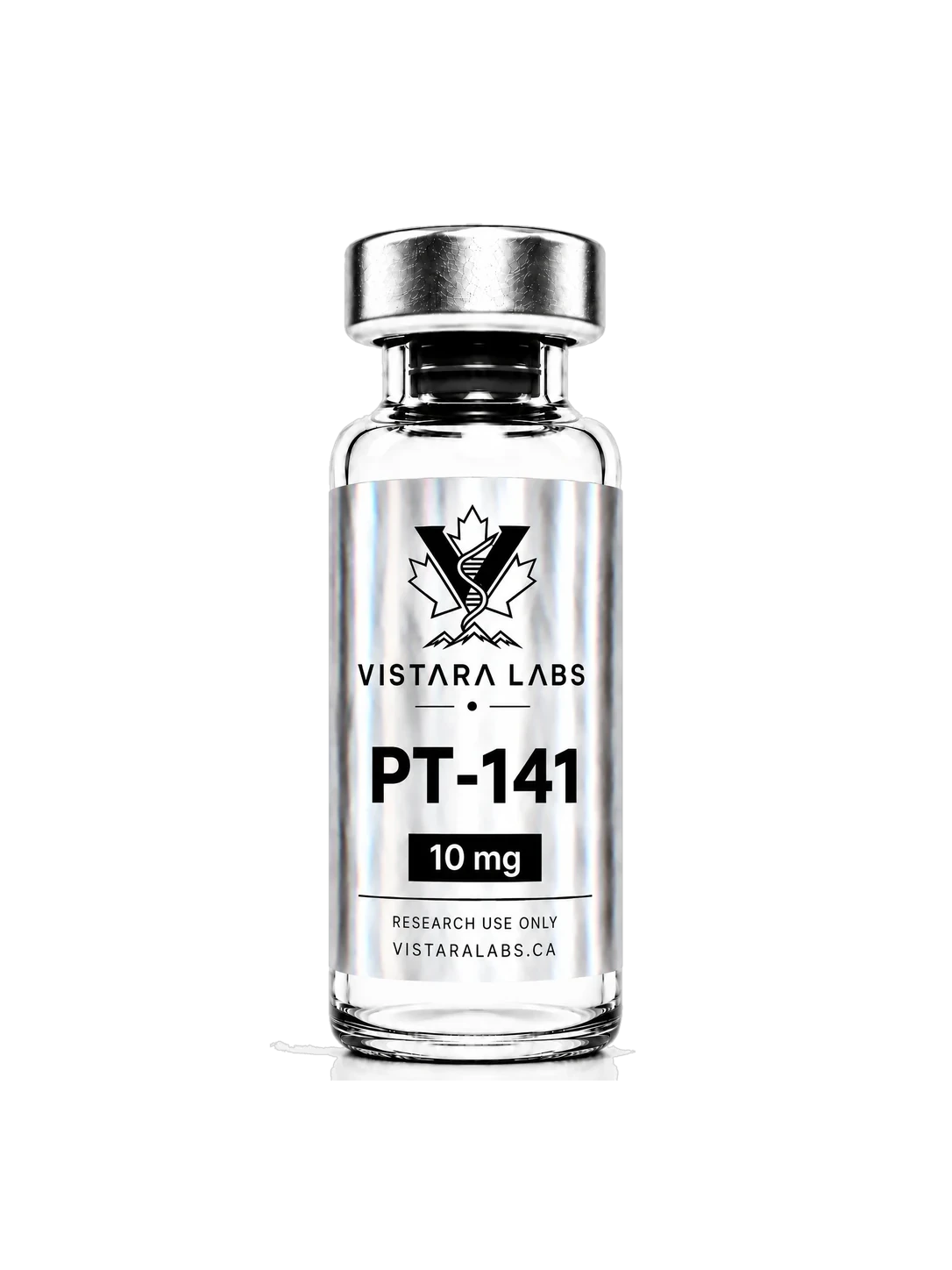
What Is PT-141? Bremelanotide Explained
Sexual Health & Intimacy Research
PT-141, generic name bremelanotide, is a synthetic seven-amino-acid ring peptide that activates melanocortin receptors in the brain, chiefly MC4R and MC3R. It acts on the central pathways of sexual desire rather than on blood flow, and two identical phase 3 trials in 1,267 premenopausal women found significant gains in desire and reductions in related distress (Kingsberg, Obstetrics & Gynecology, 2019). The US FDA approved it in 2019 under the brand name Vyleesi. Vistara Labs supplies PT-141 as a 10 mg lyophilised vial and as a ready-mixed PT-141 Nasal Spray. This guide covers where PT-141 came from, how it works and what the research recorded in women and men.
Findings
- PT-141 is a synthetic analogue of alpha-melanocyte-stimulating hormone and an agonist at the MC3R and MC4R receptors, which sit mainly in the central nervous system (Molinoff, Ann N Y Acad Sci, 2003).
- It is almost identical to melanotan II: the same ring of amino acids, ending in a carboxylic acid instead of an amide (PubChem).
- In an animal model it selectively increased sexual solicitation in females without changing other sexual behaviours or general activity (Pfaus, PNAS, 2004).
- In two phase 3 trials of 1,267 women with hypoactive sexual desire disorder, it produced statistically significant increases in desire and reductions in distress versus placebo, leading to US approval as Vyleesi in 2019 (Kingsberg, 2019; Dhillon and Keam, Drugs, 2019).
 View product →
Where did PT-141 come from?
PT-141 comes from the same research line as melanotan II, an earlier synthetic melanocortin peptide, and the two molecules are near-identical. Our article on the clinical history of melanotan II tells that story in full.
The chemical link is close. PubChem lists both as the same cyclic structure built on Nle, Asp, His, D-Phe, Arg, Trp and Lys. The one difference is the tail: melanotan II ends in a carboxamide (molecular weight 1024.2), and bremelanotide ends in a carboxylic acid (1025.2). Small as that change is, PT-141 became the compound developed for sexual function, while melanotan II remained associated with tanning research. See PT-141 vs Melanotan II for the full comparison.
How does PT-141 work?
The melanocortin system is a family of receptors, MC1R to MC5R, that respond to hormones such as alpha-MSH. PT-141 mimics alpha-MSH and activates MC3R and MC4R, both expressed mainly in the brain (Molinoff, 2003). A 2019 regulatory review describes its high affinity for MC4R, the subtype thought to matter most for sexual function (Dhillon and Keam, Drugs, 2019).
Animal work traced where the effect starts. In animal studies, PT-141 activated neurons in the hypothalamus, and neurons in that same region were shown to connect to erectile tissue (Molinoff, 2003). In female animals, bremelanotide increased solicitation behaviours when given under the skin or infused directly into the medial preoptic area, a brain region central to appetitive sexual behaviour, and the authors proposed that it works by activating dopamine terminals there (Pfaus, J Sex Med, 2007).
That central route is what separates PT-141 from erectile drugs such as sildenafil and tadalafil, which act on blood vessels in the genital tissue. The difference is set out in PT-141 vs Viagra and PT-141 vs Tadalafil.
What has PT-141 research shown in women?
The first animal evidence
A 2004 study in PNAS reported that PT-141 selectively stimulated solicitational behaviour in female animals, the standard animal measure of sexual interest, without affecting lordosis, pacing or general motor activity, and without changing the perception of sexual reward. The authors noted that a selective effect on appetitive sexual behaviour in female animals had not been reported before (Pfaus, PNAS, 2004).
Phase 2b
A large dose-finding phase 2b study in premenopausal women with hypoactive sexual desire disorder (HSDD), or HSDD mixed with arousal disorder, set the benchmarks for later trials. At the dose later carried into phase 3, responder rates were statistically significant versus placebo on all seven endpoints analysed (Althof, J Sex Med, 2019).
The phase 3 trials
Two identical randomised, double-blind, placebo-controlled phase 3 trials ran from 2015 to 2016, mostly at US sites, with 24 weeks of treatment. Of 1,267 women randomised, mean age 39, the PT-141 groups recorded statistically significant increases in the desire domain of the Female Sexual Function Index and significant reductions in distress about low desire, in each trial and in the combined data (all P values 0.005 or lower). Nausea, flushing and headache were more common than with placebo, and most events were mild or moderate (Kingsberg, Obstet Gynecol, 2019).
Approval as Vyleesi
On the strength of those trials, bremelanotide was approved in the United States in 2019 as Vyleesi, for premenopausal women with acquired, generalised hypoactive sexual desire disorder. It was the first regulatory approval for the compound (Dhillon and Keam, Drugs, 2019). Approval applies to that pharmaceutical product only; research-grade PT-141 is a separate material supplied for laboratory use.
What has PT-141 research shown in men?
The earliest human work was in men, and much of it used a nasal spray. A 2003 review reported that PT-141 produced penile erections in animal studies, and a rapid, dose-dependent increase in erectile activity in healthy men and men with erectile dysfunction (Molinoff, 2003).
- Intranasal study, 2004. In double-blind, placebo-controlled testing in healthy men and in men with mild-to-moderate erectile dysfunction, intranasal PT-141 produced a statistically significant erectile response, with the first erection beginning about 30 minutes after administration. Peak blood levels came at about 30 minutes and the half-life was roughly two hours; no maximum tolerated dose was found (Diamond, Int J Impot Res, 2004).
- Combination study, 2005. In a randomised crossover study of 19 men with erectile dysfunction, low-dose intranasal PT-141 given with low-dose sildenafil produced a significantly greater erectile response than sildenafil alone, with no new or increased adverse events (Diamond, Urology, 2005).
Our PT-141 studies page collects the wider clinical record.
How PT-141 compares with other compounds
| Compound | Main target | Where it acts |
|---|---|---|
| PT-141 (bremelanotide) | MC4R and MC3R | Brain |
| Melanotan II | Melanocortin receptors, including MC1R | Brain and skin |
| Sildenafil, tadalafil | PDE5 enzyme | Blood vessels |
| Oxytocin | Oxytocin receptor | Brain and body |
| Kisspeptin | KISS1R | Hypothalamus, reproductive hormones |
Head-to-head pages cover PT-141 vs Oxytocin and PT-141 vs Kisspeptin.
PT-141 for research in Canada
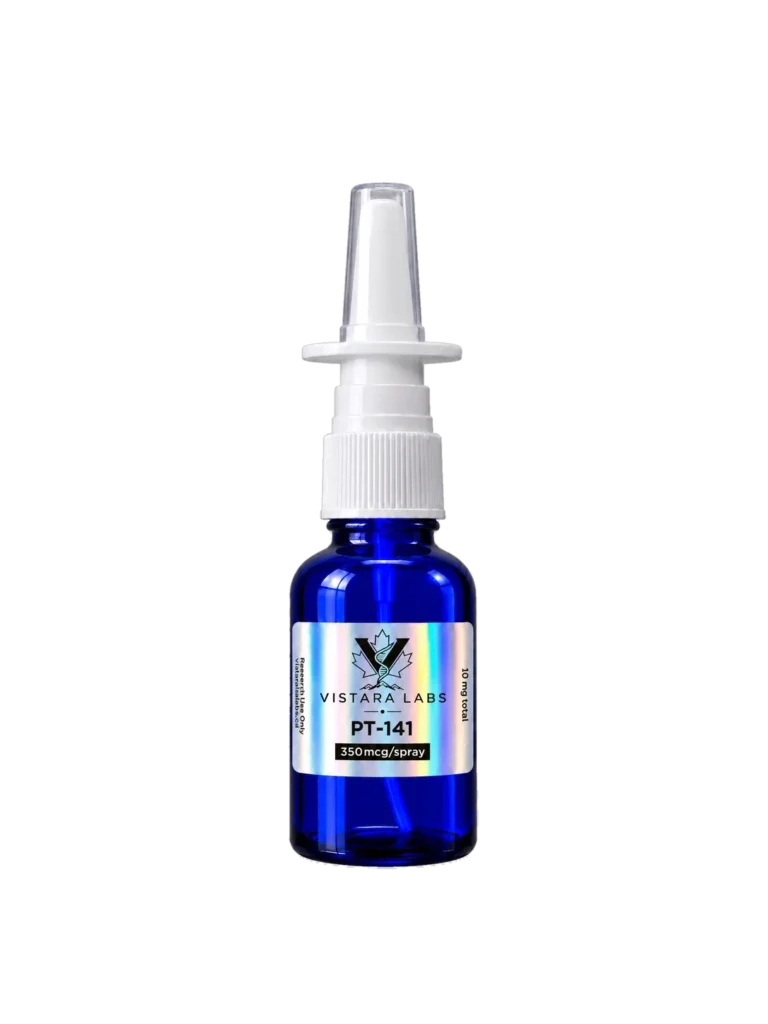
Vistara Labs supplies PT-141 as a 10 mg lyophilised vial and as a ready-mixed metered nasal spray delivering 0.175 mL per press, both shipped from within Canada by Canada Post Xpresspost. The vial is reconstituted with bacteriostatic water; volumes and concentrations are in How Much Bacteriostatic Water for a PT-141 10 mg Vial?, and storage in How Long Does PT-141 Last? Products are third-party tested, with certificates on the lab reports page.
PT-141 is supplied for laboratory research use only. The human studies above were clinical research using pharmaceutical preparations under medical supervision.
Frequently asked questions
What is PT-141?
PT-141 is a synthetic cyclic peptide, generic name bremelanotide, that activates the MC4R and MC3R melanocortin receptors in the brain. It was developed from melanotan II and studied for sexual desire and arousal.
Is PT-141 the same as bremelanotide?
Yes. PT-141 is the development code and bremelanotide the generic name. The approved pharmaceutical product, for premenopausal women with hypoactive sexual desire disorder, is sold in the United States as Vyleesi.
What has PT-141 research shown in women?
Two identical phase 3 trials in 1,267 premenopausal women with hypoactive sexual desire disorder found statistically significant increases in sexual desire and reductions in related distress compared with placebo over 24 weeks.
What has PT-141 research shown in men?
Studies in healthy men and men with erectile dysfunction recorded a significant, dose-dependent erectile response, beginning about 30 minutes after intranasal administration. Combined with low-dose sildenafil, it produced a greater response than sildenafil alone.
How is PT-141 different from melanotan II?
The two share the same ring structure, but PT-141 ends in a carboxylic acid where melanotan II ends in an amide. PT-141 was developed for sexual function, while melanotan II is associated mainly with tanning research.
Where can I buy PT-141 in Canada?
Vistara Labs supplies PT-141 as a 10 mg lyophilised vial and a ready-mixed nasal spray, shipped from within Canada by Canada Post Xpresspost, with certificates on the lab reports page.
Product details from vistaralabs.ca, October 2026. Sources: Molinoff PB et al. PT-141: a melanocortin agonist for the treatment of sexual dysfunction. Ann N Y Acad Sci. 2003. PMID 12851303. Pfaus JG et al. Selective facilitation of sexual solicitation in the female rat by a melanocortin receptor agonist. Proc Natl Acad Sci U S A. 2004. PMID 15226502. Pfaus J, Giuliano F, Gelez H. Bremelanotide: an overview of preclinical CNS effects on female sexual function. J Sex Med. 2007. PMID 17958619. Althof S et al. Responder analyses from a phase 2b dose-ranging study of bremelanotide. J Sex Med. 2019. PMID 31277966. Kingsberg SA et al. Bremelanotide for the treatment of hypoactive sexual desire disorder: two randomized phase 3 trials. Obstet Gynecol. 2019. PMID 31599840. Dhillon S, Keam SJ. Bremelanotide: first approval. Drugs. 2019. PMID 31429064. Diamond LE et al. Int J Impot Res. 2004. PMID 14963471. Diamond LE et al. Urology. 2005. PMID 15833522. PubChem. Bremelanotide, CID 9941379; Melanotan II, CID 92432.
More on this: Buy PT-141 (Bremelanotide) in Canada and Buy PT-141 Nasal Spray in Canada.
All products supplied by Vistara Labs are intended for laboratory research use only. They are not drugs, are not approved for human or veterinary use, and are not intended to diagnose, treat, cure or prevent any condition. Nothing on this page constitutes medical advice or guidance for use in humans.