What Is NAD+? The Coenzyme Behind Cellular Energy
Cellular Energy & Mitochondrial Research
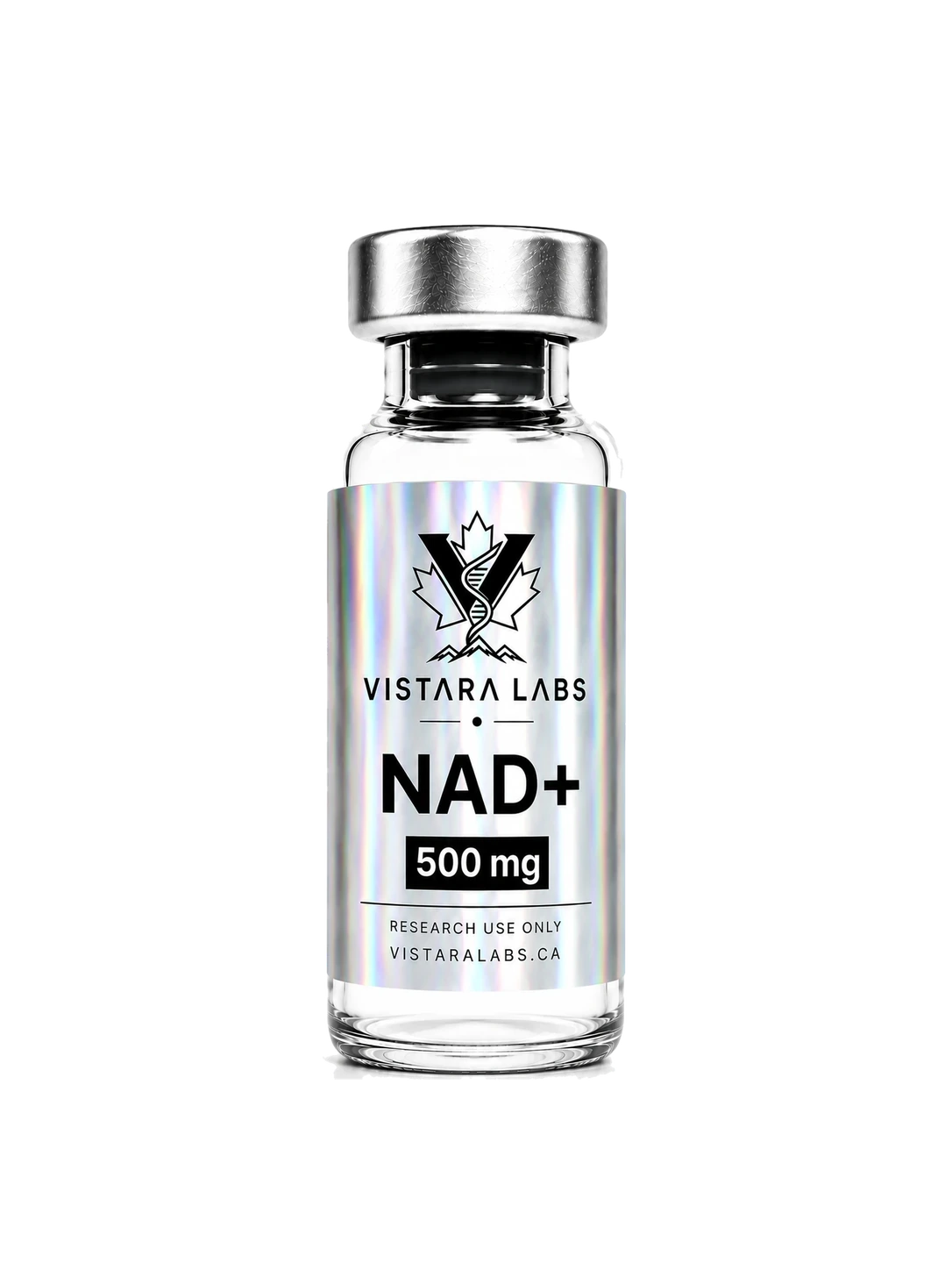
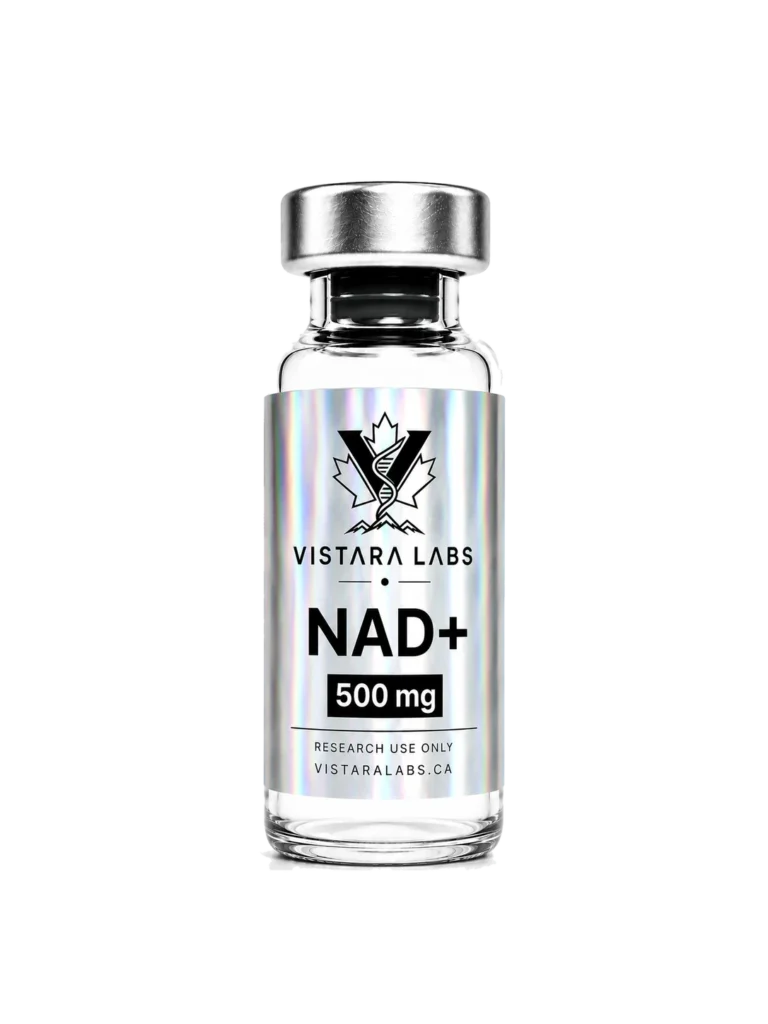
NAD+ (nicotinamide adenine dinucleotide) is a coenzyme found in every living cell: a small molecule made of two nucleotides joined together that carries electrons in energy metabolism and fuels the sirtuin, PARP and CD38 enzymes that handle DNA repair and cell signalling. It is not a peptide, and human tissue studies show its levels fall with age, which is why it has become one of the most studied molecules in ageing research. Vistara Labs supplies it as a NAD+ 500 mg lyophilised vial and a ready-mixed NAD+ Nasal Spray.
Findings
- NAD+ is a redox coenzyme central to energy metabolism and an essential cofactor for sirtuins, CD38 and PARPs (Covarrubias et al., 2021).
- In human skin samples from 49 people, NAD+ levels fell with age while DNA damage and PARP activity rose (2012).
- In healthy adults aged 20-87, plasma NAD+ declined significantly with age (2019).
- A 6-hour intravenous infusion raised plasma NAD+ by 398% in healthy men, with no adverse events during the infusion (2019).
- Its precursor nicotinamide riboside raised NAD+ in blood immune cells by about 60% in adults aged 55-79 (2018).
 View product →
What is NAD+?
NAD+ stands for nicotinamide adenine dinucleotide. A nucleotide is a building block of the kind found in DNA and RNA; NAD+ is two of them, one carrying nicotinamide (a form of vitamin B3) and one carrying adenine, linked through their phosphate groups. The “+” marks the oxidised form, the one ready to accept electrons. When it picks up electrons it becomes NADH, and the cell constantly cycles between the two.
Where it came from
NAD+ was first detected in 1906, when Arthur Harden and William John Young found that yeast juice needed a small, heat-stable “coferment” to ferment sugar (Harden and Young, Proc R Soc Lond B, 1906). Over the following decades that factor was identified as NAD+, and it is now recognised as one of the most important small molecules in biology.
Why it is not a peptide
Peptides are chains of amino acids. NAD+ contains none: it is built from sugars, phosphates and two nitrogen-containing bases. It is sold alongside research peptides because researchers often study it with them, especially mitochondrial peptides such as MOTS-c and SS-31. Our page NAD+ Is Not a Peptide. Here Is What It Is. covers the chemistry in more depth.
How NAD+ works
NAD+ has two jobs, and they explain why researchers care about its levels.
Job one: carrying electrons
Every time a cell burns glucose or fat, electrons are stripped from the fuel. NAD+ collects them as NADH and delivers them to the mitochondria, the cell’s power plants, where they drive production of ATP, the cell’s energy currency. This makes NAD+ a redox coenzyme central to energy metabolism (Covarrubias et al., Nat Rev Mol Cell Biol, 2021).
Job two: fuel for repair and signalling enzymes
NAD+ is also consumed, not just recycled. Three enzyme families break it apart to do their work (Covarrubias et al., 2021):
- Sirtuins are regulators that switch genes and proteins on and off in response to the cell’s energy state, and they are closely linked to ageing research.
- PARPs (poly-ADP-ribose polymerases) are the first responders to DNA damage, and they use NAD+ to flag and repair broken strands.
- CD38 is an enzyme on immune and other cells that breaks down NAD+ as part of calcium signalling.
Because these enzymes use NAD+ up, the cell must keep making it from vitamin B3 precursors such as nicotinamide, nicotinamide riboside (NR) and nicotinamide mononucleotide (NMN).
What the research has shown
NAD+ declines with age in human tissue
Australian researchers measured NAD+ and related markers in skin samples from 49 people aged 15 to 77, plus newborns. NAD+ fell with age in both sexes, most strongly in males (correlation r = -0.706). DNA damage and PARP activity rose with age, and higher PARP activity went with lower NAD+, which the authors proposed as one route by which oxidative damage drains NAD+ (Massudi et al., PLoS One, 2012). A 2019 study of healthy people aged 20 to 87 found the same pattern in blood: plasma NAD+ declined significantly with age, along with NADP+ (Clement et al., Rejuvenation Res, 2019). The 2021 review in Nature Reviews Molecular Cell Biology describes a gradual decline in tissue and cellular NAD+ with age in multiple organisms, humans included, and links it to age-related disease (Covarrubias et al., 2021).
Direct NAD+ in people
The first study to measure what happens when NAD+ itself enters the human bloodstream was a 2019 pilot in 11 healthy men aged 30 to 55. Eight received NAD+ by intravenous infusion over 6 hours and three received saline. By the end of the infusion, plasma NAD+ was up 398% from baseline and remained elevated two hours later. Its breakdown products nicotinamide, ADP-ribose and methylnicotinamide also rose, showing that the body takes up NAD+ and processes it actively. No adverse events were observed during the infusion (Grant et al., Front Aging Neurosci, 2019).
Raising NAD+ through its precursors
Much of the human research uses precursors. In a randomised, double-blind, placebo-controlled crossover trial at the University of Colorado, 24 healthy adults aged 55 to 79 completed two 6-week periods. Nicotinamide riboside was well tolerated and raised NAD+ in peripheral blood mononuclear cells (a type of white blood cell) by about 60% compared with placebo, and the authors called for trials on blood pressure and arterial stiffness (Martens et al., Nat Commun, 2018).
The detailed trial record, including later studies, is on NAD+ Benefits: What the Restoration Research Shows.
NAD+ at a glance
| Question | Answer |
|---|---|
| Type | Dinucleotide coenzyme, not a peptide |
| First described | 1906, in yeast |
| Main roles | Energy metabolism; fuel for sirtuins, PARPs, CD38 |
| With age | Declines in human skin and plasma |
| Direct human data | IV pilot, 398% plasma rise (2019) |
How NAD+ compares with related compounds
NAD+ supplies the cell’s energy chemistry, while glutathione is its main antioxidant (NAD+ vs Glutathione). MOTS-c is a mitochondrial signalling peptide (NAD+ vs MOTS-c), and 5-Amino-1MQ is studied for blocking NNMT, an enzyme that uses up nicotinamide (NAD+ vs 5-Amino-1MQ). Other ageing compounds are on What Is Epitalon? and What Is SS-31?.
Forms we stock
NAD+ comes as a 500 mg lyophilised vial (freeze-dried powder for laboratory reconstitution) and as a ready-mixed metered NAD+ Nasal Spray, which also appears in the Cognitive Clarity Spray Stack with Semax and Selank. Concentration arithmetic is in How Much Bacteriostatic Water for a NAD+ 500 mg Vial?, storage in How Long Does NAD+ Last?, and the spray format in NAD+ Nasal Spray in Canada. Certificates of analysis are on the lab reports page, and orders ship from within Canada by Canada Post Xpresspost (see Buy NAD+ in Canada).
NAD+ is supplied by Vistara Labs for laboratory research use only. The human studies above are described as published research findings.
Frequently asked questions
What is NAD+?
NAD+ is nicotinamide adenine dinucleotide, a coenzyme in every living cell. It carries electrons in energy metabolism and is the fuel for sirtuins, PARPs and CD38, enzymes involved in DNA repair, gene regulation and cell signalling.
Is NAD+ a peptide?
No. Peptides are chains of amino acids, and NAD+ contains none. It is a dinucleotide, two nucleotides joined through their phosphate groups, one carrying nicotinamide (a form of vitamin B3) and one carrying adenine.
What has NAD+ research shown?
Human studies show NAD+ falls with age in skin (2012) and plasma (2019). A 2019 pilot found that a 6-hour intravenous infusion raised plasma NAD+ by 398% with no adverse events, and a 2018 trial found its precursor nicotinamide riboside raised NAD+ in blood immune cells by about 60%.
What is the difference between NAD+ and NADH?
They are two forms of the same molecule. NAD+ is the oxidised form, ready to accept electrons; NADH is the reduced form after it has picked them up. Cells cycle constantly between the two during energy metabolism.
Why does NAD+ decline with age?
Research points to rising demand: a 2012 human skin study found that DNA damage and PARP activity increased with age, and higher PARP activity went with lower NAD+. Reviews also link the decline to the NAD+-consuming enzyme CD38.
Product details from vistaralabs.ca, October 2026. Sources: Harden A, Young WJ. The alcoholic ferment of yeast-juice. Part II. The coferment of yeast-juice. Proc R Soc Lond B. 1906. doi:10.1098/rspb.1906.0070. Massudi H et al. Age-associated changes in oxidative stress and NAD+ metabolism in human tissue. PLoS One. 2012. PMID 22848760. Martens CR et al. Chronic nicotinamide riboside supplementation is well-tolerated and elevates NAD+ in healthy middle-aged and older adults. Nat Commun. 2018. PMID 29599478. Clement J et al. The plasma NAD+ metabolome is dysregulated in “normal” aging. Rejuvenation Res. 2019. PMID 30124109. Grant R et al. A pilot study investigating changes in the human plasma and urine NAD+ metabolome during a 6 hour intravenous infusion of NAD+. Front Aging Neurosci. 2019. PMC6751327. Covarrubias AJ et al. NAD+ metabolism and its roles in cellular processes during ageing. Nat Rev Mol Cell Biol. 2021. PMID 33353981.
More on this: Cellular Energy & Mitochondrial Research.
All products supplied by Vistara Labs are intended for laboratory research use only. They are not drugs, are not approved for human or veterinary use, and are not intended to diagnose, treat, cure or prevent any condition. Nothing on this page constitutes medical advice or guidance for use in humans.
References
Human NAD+ work is largely pharmacology and tolerability rather than clinical outcomes. A 2026 systematic review reports no eligible clinical-outcome trial of intravenous or intramuscular NAD+ itself for anti-ageing or wellness.
- NAD⁺ supplementation for anti-aging and wellness: A PRISMA-guided systematic review of preclinical and clinical evidencePRISMA systematic review; 113 intervention studies including 33 human studies. Reports no eligible clinical-outcome trial of intravenous or intramuscular NAD+ itself for anti-ageing or wellness.
- A Pilot Study Investigating Changes in the Human Plasma and Urine NAD+ Metabolome During a 6 Hour Intravenous Infusion of NADHuman pilot pharmacology study; plasma and urine NAD+ metabolome during a 6-hour intravenous infusion. Not an efficacy trial.
- Intravenous infusion of nicotinamide adenine dinucleotide (NAD(+)) versus nicotinamide riboside (NR): a retrospective tolerability pilot study in a real-world settingRetrospective tolerability pilot comparing four days of intravenous NAD+ with intravenous nicotinamide riboside in a real-world setting.
- Oral LNAD+ rapidly elevates whole blood intracellular NAD and metabolic flux without elevating plasma NAD: evidence from a randomized controlled trialRandomised controlled trial of a specific modified ORAL NAD+ formulation; clinical outcomes exploratory and formulation-specific.
Links open the study record on PubMed so the source can be checked directly. Listing a study is not a claim that its findings apply to any other use, product or route of administration. Research use only.