BPC-157 Side Effects: What the Research Reports
Across the published research, BPC-157 side effects have been notably absent: formal toxicology in four animal species found no serious toxicity, and the three human pilot studies reported no adverse effects. That covers knee injections, bladder injections and intravenous infusion. This guide sets out what each study measured and recorded, the questions researchers still list, and how BPC-157 fits a laboratory research setting.
Findings
- A preclinical safety programme in four animal species found BPC-157 well tolerated, with no genetic or embryo-fetal toxicity (Xu et al., 2020).
- In a 2025 intravenous pilot, infusions produced no measurable effects on heart, liver, kidney, thyroid or blood glucose markers, and no side effects were reported (Lee and Burgess).
- In 12 women with interstitial cystitis, no adverse events were reported, and 10 of 12 reported complete resolution of symptoms (Lee et al., 2024).
- BPC-157 has a half-life under 30 minutes and breaks down into small peptide fragments and single amino acids (He et al., 2022).
 View product →
What is BPC-157?
BPC-157 (Body Protection Compound 157) is a synthetic fifteen-amino-acid peptide derived from a protein found in human gastric juice. Its research literature centres on soft-tissue repair, gut lining and blood-vessel signalling, covered in BPC-157 Research and the Knee-Pain Data. A 2025 systematic review screened 544 articles and included 36 studies, of which 35 were preclinical; it reported that preclinical safety studies showed no adverse effects across several organ systems (Vasireddi et al., HSS J, 2025).
What did animal toxicology studies find?
The most complete safety dataset comes from a 2020 preclinical evaluation run to support a clinical programme, testing BPC-157 in four animal species (Xu et al., Regul Toxicol Pharmacol, 2020):
- Single-dose toxicity: no test-related effects attributable to BPC-157.
- Repeated-dose toxicity: well tolerated, with no abnormal changes against the solvent control group, apart from a decrease in creatinine at the highest level tested; it recovered on its own within two weeks of stopping, and the authors linked it to BPC-157’s pharmacological activity.
- Local tolerance: irritation was mild.
- Genetic and embryo-fetal toxicity: none found.
The authors concluded that BPC-157 was well tolerated and caused no serious toxicity in any of the four species.
How the body handles BPC-157
A follow-up pharmacokinetic study in two animal species found an elimination half-life of under 30 minutes with linear behaviour across all doses tested. Using radio-labelled BPC-157, the researchers showed it was rapidly broken down into small peptide fragments and then single amino acids that entered normal amino acid metabolism, with excretion through urine and bile (He et al., Front Pharmacol, 2022). That rapid conversion into ordinary amino acids is consistent with the clean toxicology results.
What did the human studies report?
Three small human studies have been published, all from clinics in Florida. A 2025 narrative review summarised them simply: no adverse effects were reported (McGuire et al., Curr Rev Musculoskelet Med, 2025).
Knee pain, 2021
A retrospective chart review followed up 16 patients who had received intra-articular BPC-157, alone or with thymosin beta-4. Of the 12 who received BPC-157 alone, 11 (91.6%) reported significant improvement in knee pain; overall, 14 of 16 (87.5%) reported relief (Lee and Padgett, Altern Ther Health Med, 2021). The full breakdown is in our knee-pain study analysis.
Interstitial cystitis, 2024
Twelve women aged 39 to 76 with moderate to severe interstitial cystitis, none of whom had responded to pentosan polysulfate, received BPC-157 injections around the inflamed area of the bladder during a single cystoscopy. Ten of 12 reported complete resolution of symptoms, the other two rated their success at 80%, nobody dropped out, and no adverse events were reported (Lee et al., Altern Ther Health Med, 2024). More detail is in BPC-157 and bladder pain.
Intravenous safety, 2025
The first study designed specifically around safety was an IRB-approved pilot in two adults, a 58-year-old man and a 68-year-old woman. Fasting blood work and vital signs were recorded before and after an infusion on each of two consecutive days, with a higher amount on day two, and participants were asked about side effects at every visit. The infusions produced no measurable effects on the tested markers of the heart, liver, kidneys, thyroid or blood glucose, and no side effects were reported (Lee and Burgess, Altern Ther Health Med, 2025).
What questions do researchers still raise?
The main open question is scale: a 2026 systematic review counted three human studies with 30 participants in total, and larger controlled trials are the next step researchers point to (Poolton et al., Acta Orthop Belg, 2026). A second point is angiogenesis. BPC-157 promotes new blood-vessel growth through VEGFR2 signalling (Hsieh et al., J Mol Med, 2017), which is central to its repair research, and reviewers mention the theoretical relevance of vessel growth to tumours alongside work showing BPC-157 inhibiting uncontrolled cell proliferation (McGuire et al., 2025). Reviewers also flag that material from unregulated sources varies in quality (Vasireddi et al., 2025), which is why verified purity matters for research use.
How does BPC-157 compare with TB-500?
BPC-157 is often studied alongside TB-500, a peptide related to thymosin beta-4; the two differ in origin, mechanism and evidence base. See BPC-157 vs TB-500: How They Differ.
How is BPC-157 supplied for research?
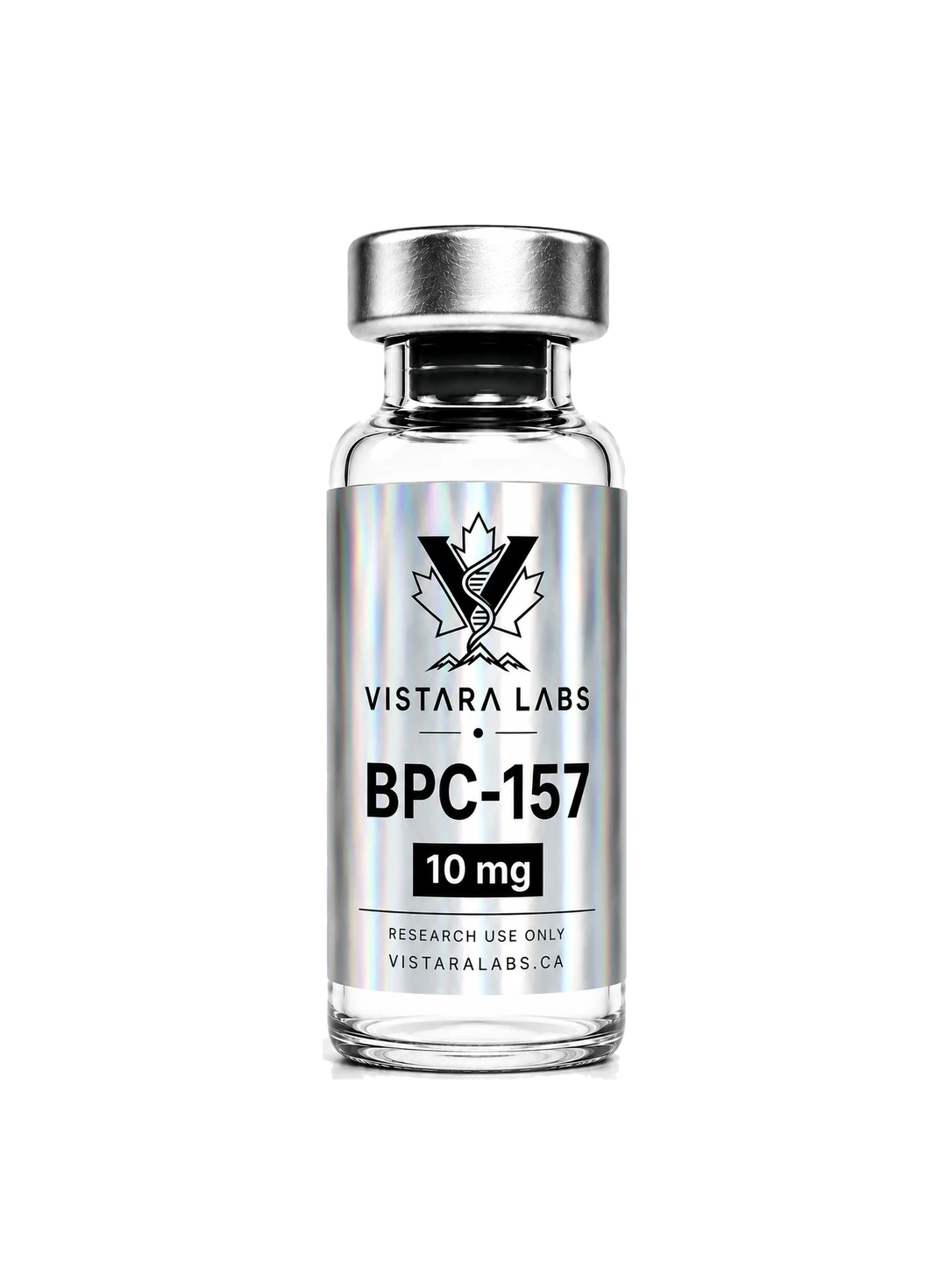
Vistara Labs supplies BPC-157 as a 10 mg lyophilised vial and as a ready-mixed BPC-157 Nasal Spray delivering 0.175 mL per press. Vials are reconstituted with bacteriostatic water (see the BPC-157 reconstitution guide), and storage is covered in How Long Does BPC-157 Last? Every product is third-party tested, with certificates on the lab reports page, and ships from within Canada by Canada Post Xpresspost.
BPC-157 is supplied for laboratory research use only. The human studies above were clinical research carried out under medical supervision.
Frequently asked questions
What side effects has BPC-157 research reported?
The three published human pilot studies, covering knee injections, bladder injections and intravenous infusion, reported no adverse effects. In animal toxicology across four species, BPC-157 was well tolerated, with mild local irritation and no serious toxicity.
What did the BPC-157 intravenous safety study show?
In a 2025 IRB-approved pilot in two adults, intravenous BPC-157 on two consecutive days produced no measurable effects on markers of heart, liver, kidney and thyroid function or blood glucose, and no side effects were reported.
What did animal toxicology studies of BPC-157 find?
A 2020 preclinical programme found no test-related effects after single doses, good tolerability with repeated dosing, mild local irritation and no genetic or embryo-fetal toxicity.
How long does BPC-157 stay in the body?
In animal studies its elimination half-life was under 30 minutes. It was broken down into small peptide fragments and single amino acids and excreted through urine and bile.
Where can I buy BPC-157 in Canada?
Vistara Labs supplies BPC-157 as a 10 mg lyophilised vial and a ready-mixed nasal spray, third-party tested and shipped from within Canada by Canada Post Xpresspost.
Product details from vistaralabs.ca, October 2026. Sources: Xu C et al. Preclinical safety evaluation of body protective compound-157, a potential drug for treating various wounds. Regul Toxicol Pharmacol. 2020. PMID 32334036. He L et al. Pharmacokinetics, distribution, metabolism, and excretion of body-protective compound 157 in rats and dogs. Front Pharmacol. 2022. PMID 36588717. Lee E, Padgett B. Intra-articular injection of BPC 157 for multiple types of knee pain. Altern Ther Health Med. 2021. PMID 34324435. Lee E, Walker C, Ayadi B. Effect of BPC-157 on symptoms in patients with interstitial cystitis: a pilot study. Altern Ther Health Med. 2024. PMID 39325560. Lee E, Burgess K. Safety of intravenous infusion of BPC157 in humans: a pilot study. Altern Ther Health Med. 2025. PMID 40131143. McGuire FP et al. Regeneration or risk? A narrative review of BPC-157 for musculoskeletal healing. Curr Rev Musculoskelet Med. 2025. PMID 40789979. Vasireddi N et al. Emerging use of BPC-157 in orthopaedic sports medicine: a systematic review. HSS J. 2025. PMID 40756949. Poolton JT, Minett J, Kazmi A. Human evidence for BPC-157 in orthopaedic and regenerative medicine: a systematic review of efficacy and safety. Acta Orthop Belg. 2026. PMID 42885452. Hsieh MJ et al. Therapeutic potential of pro-angiogenic BPC157 is associated with VEGFR2 activation and up-regulation. J Mol Med. 2017. PMID 27847966.
More on this: Buy BPC-157 in Canada.
All products supplied by Vistara Labs are intended for laboratory research use only. They are not drugs, are not approved for human or veterinary use, and are not intended to diagnose, treat, cure or prevent any condition. Nothing on this page constitutes medical advice or guidance for use in humans.
References
Most published BPC-157 work is preclinical. A 2025 systematic review screened 544 records and included 36 studies — 35 preclinical and one clinical. The human reports below are small and uncontrolled, and all three appear in the same journal.
- Emerging Use of BPC-157 in Orthopaedic Sports Medicine: A Systematic ReviewSystematic review; 544 records screened, 36 studies included — 35 preclinical and 1 clinical.
- Intra-Articular Injection of BPC 157 for Multiple Types of Knee PainRetrospective chart review, 17 patients (16 followed up by telephone); no control group, no blinding, no validated outcome instrument.
- Effect of BPC-157 on Symptoms in Patients with Interstitial Cystitis: A Pilot StudyUncontrolled pilot, 12 women with interstitial cystitis; no placebo group or blinding.
- Safety of Intravenous Infusion of BPC157 in Humans: A Pilot StudySafety pilot, 2 adults given intravenous BPC-157; preliminary tolerability observations only.
Links open the study record on PubMed so the source can be checked directly. Listing a study is not a claim that its findings apply to any other use, product or route of administration. Research use only.